- Category
- War in Ukraine
Russia Adapts to Shelter Its Jets, But Ukraine’s Deep-Strike Drones May Already Be Ahead
 Prefer U24 Media on Google
- Authors

-72b63a4e0c8c475ad81fe3eed3f63729.jpeg "Photo of Cyril Barabaltchouk")
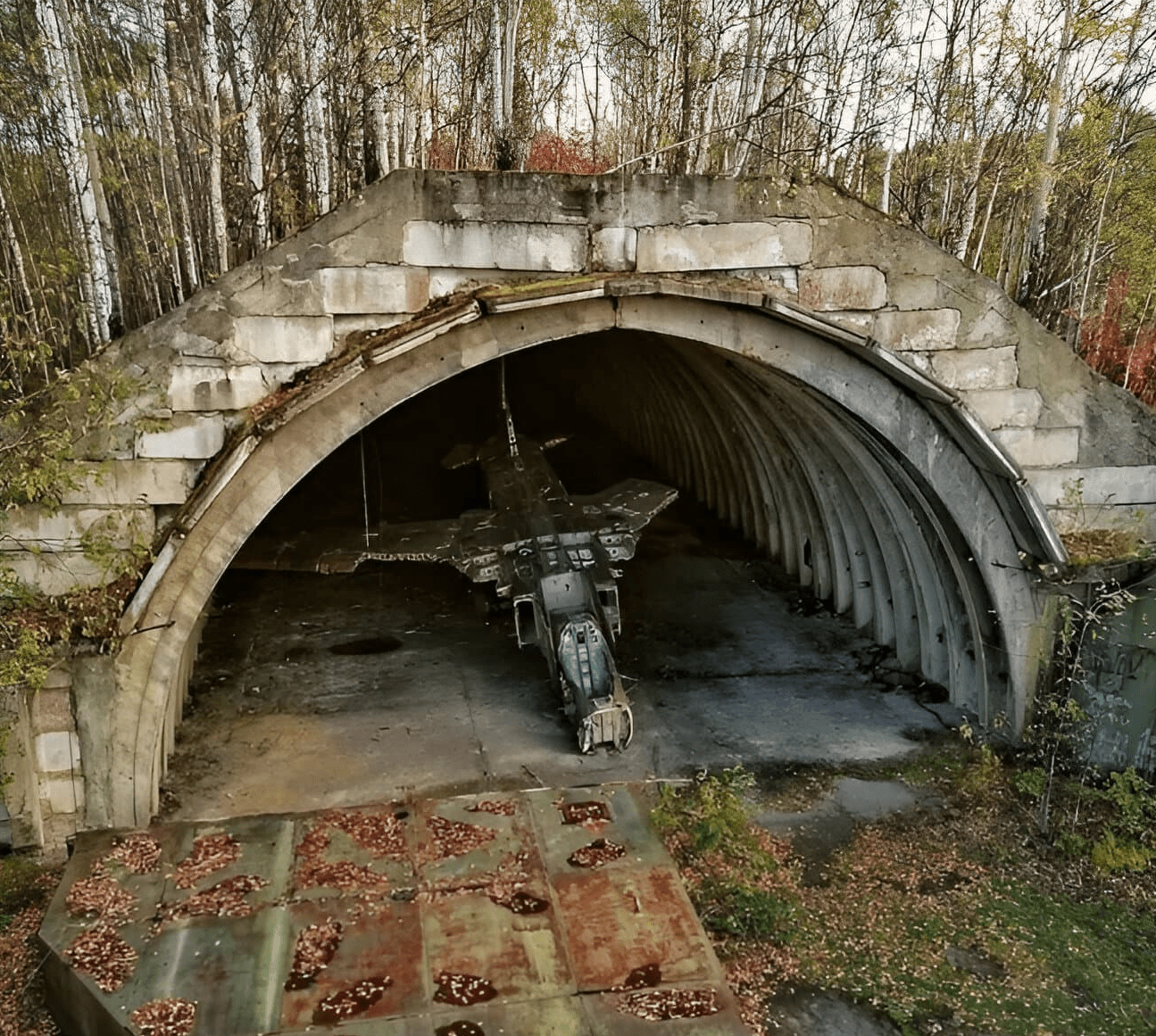
Reinforced concrete aircraft shelters constructed by Russia across 14 airbases to safeguard its tactical aviation are failing to protect planes from Ukrainian drone strikes, Defense Express reported on June 4.
Moscow began a large-scale construction campaign at front-line airfields in 2024 under orders from then-newly appointed Defense Minister Andrei Belousov. The initiative aimed to shield Russian tactical aircraft from Ukrainian long-range drones and cluster-munition variants of ATACMS ballistic missiles.
We bring you stories from the ground. Your support keeps our team in the field.
By the summer of 2025, extensive construction was documented at 14 separate airbases situated around Ukraine and within the temporarily occupied Crimea. These capital works were deemed necessary because Russia’s modernized Su-27, Su-30, Su-34, and Su-35 fighters are too large to fit inside standard Soviet-era 2A13 (AU-13) arched shelters, Defense Express wrote.
However, Defense Express saw that Russian military bloggers have recently begun complaining that Ukrainian drones are successfully penetrating and striking targets inside these reinforced concrete structures. Russian forces remain uncertain whether these penetrations represent a systematic operational upgrade or isolated incidents.
According to Defense Express, the breakthrough may stem from a pragmatic advancement in Ukrainian drone design. In late May 2026, the co-founder and chief designer of Ukrainian mil-tech firm Fire Point, Denys Shtilerman, announced that their middle-strike platforms—such as the FP-2 drone—had been upgraded to carry a much heavier 200-kilogram warhead.
Standard Soviet-era 2A13 shelters feature concrete walls 60 centimeters thick, while the newer 2A19 variants are 50 centimeters thick with a 5-millimeter internal steel lining. These structures were originally engineered to withstand nearby high-explosive bomb blasts, shrapnel, and cluster submunitions rather than direct, precision penetrations.
-0dc38916235b2c5f4485ce75aa99572b.jpg)
Defense Express notes that, while the exact composition of the new FP-2 warhead remains undisclosed, analysts note that concrete barriers can be breached using tandem-charge warheads like the BROACH system found on Storm Shadow cruise missiles, where an initial shaped charge creates an opening for the main explosive to enter. Alternatively, a high-explosive blast on the exterior can cause severe spalling on the inner concrete surface, turning concrete fragments into high-speed shrapnel that shreds the aircraft inside without fully collapsing the roof.
The report notes a precedent for this vulnerability. In late April 2026, the Special Operations Forces of Ukraine executed a successful strike against concrete shelters housing Russian Iskander operational-tactical missile systems near Ovrashki in occupied Crimea. The construction of those missile shelters is virtually identical to Russia’s newly built aircraft hangars.
If these precise drone strikes continue methodically, Defense Express notes, they will not only inflict direct aircraft losses and disrupt front-line airfield operations, but completely invalidate Russia’s multi-year, multi-million dollar fortification efforts.
This fortification effort extends into other strategic frontiers. A recent report highlighted new hangar construction at the Chkalovsk naval aviation base in Russia’s Kaliningrad region, near the NATO border.
While designed to shield Su-30SM and Su-24M aircraft from drone strikes and hide them from satellite reconnaissance, analysts noted that these specific Baltic structures rely on thin, profiled metal sheets that offer only limited fragmentation protection compared to the heavy concrete shelters built closer to Ukraine.
Discuss this article: