- Category
- Latest news
Russia’s Next-Gen Oreshnik IRBM Relies on Cold War Tech, CNN Investigation Finds
 Prefer U24 Media on Google
- Authors


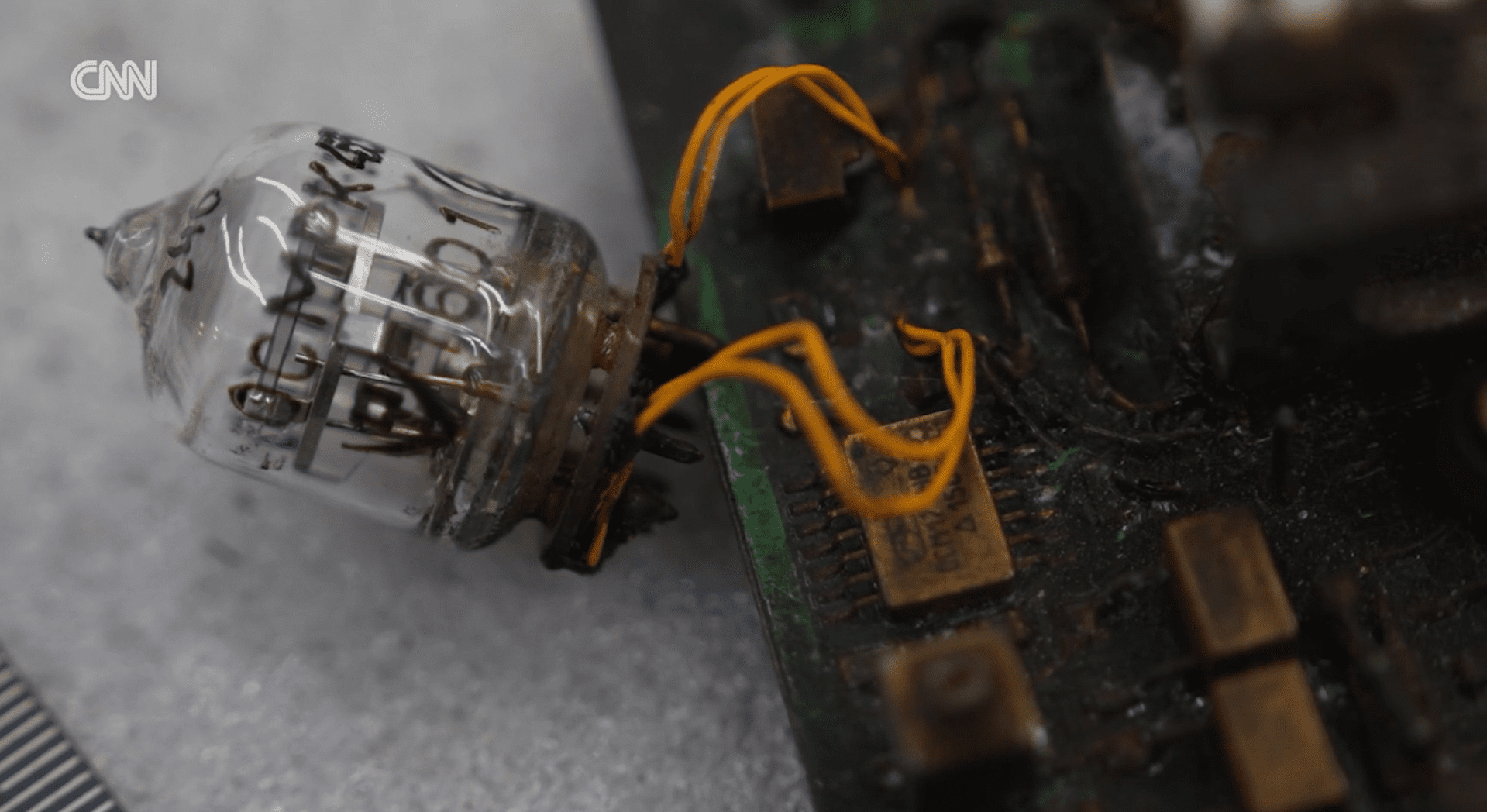
Russian ballistic missile components retrieved from a 2024 strike in Dnipro show that the weapon, known as “Oreshnik” (or “Kedr”), relies on outdated technology, including Soviet-era vacuum tubes and mechanical gyroscopes.
This is according to a video investigation published by CNN on January 11, 2026, based on an analysis conducted by Ukraine’s Kyiv Scientific Research Institute of Forensic Examinations.
In the CNN report, Ukrainian weapons specialists walk journalists through the missile debris, describing its internal architecture. “Yuri Gagarin flew with the same type of gyroscope,” one expert remarked, referring to the navigation system found inside the missile wreckage.


According to the analysts, while Russia has promoted the weapon as a breakthrough, the design and components suggest legacy technology repurposed from older programs.
The missile uses an inertial navigation system guided by an analog gyroscope. Control boards recovered from the debris show the presence of glass-encased electron tubes—likely krytrons or high-frequency resonators—suggesting the missile architecture is not fully digital.
Some components bore manufacturing markings from 2018, indicating they may have been intended for earlier projects.
Last night, russia launched an Oreshnik ballistic missile on Lviv Oblast.
— UNITED24 (@U24_gov_ua) January 9, 2026
Targeted at civilians living in a region far behind the frontline, this IRBM reached the speed of approximately 13,000 km/h.#russiaisaterroriststate pic.twitter.com/Z7BrT5XiaM
In addition, CNN footage includes the deployment mechanism for the missile’s payload. The device is designed to release six submunitions, each fragmenting further into smaller kinetic projectiles.
However, analysts noted that a strike near Lviv on January 9, 2026, demonstrated functional failures: only four submunition clusters and two isolated elements reached the ground, with wide dispersal suggesting poor accuracy or partial disintegration during reentry.
-fe851b90d8a0ba797c376cd41cd6a9ac.png)
Ukrainian intelligence believes the warhead relies purely on kinetic energy and mass, not explosives. According to CNN, the missile may exceed Mach 11 (roughly 3,740 m/s) during its terminal phase, stressing both guidance and structural integrity.
While Russia continues to promote Oreshnik as a next-generation weapon, the findings released by CNN and Ukrainian forensic experts suggest the system incorporates legacy hardware and suffers from performance limitations in real-world deployments.
Earlier on January 9, Russia launched its Oreshnik intermediate-range ballistic missile at a state-owned facility in Lviv, just miles from the Polish border, causing only minor structural damage, Reuters reported. The missile carried inert submunitions and was part of a broader overnight attack involving drones and other missiles.
Discuss this article:
-9bd5e1532102621f8fb1c4ba871a3171.png)


-80134f2dc17b4a887d01513a1c7bc929.png "Illustration of Russian military infrastructure targeted by Ukrainian strikes in temporarily occupied eastern Ukraine. (Source: General Staff of the Armed Forces of Ukraine)")