- Category
- Latest news
Under the Banner of Missionary Work, Russia Is Deepening Its Church Influence Across Africa
 Prefer U24 Media on Google
- Authors



The Russian Orthodox Church has significantly expanded its footprint across Africa, growing its presence from 4 to 34 countries in under three years, according to Ukraine’s Center for Countering Disinformation on February 18.
Western media note that after the Synod’s decision on December 29, 2021, to create a Patriarchal Exarchate of Africa, the Church has since registered approximately 350 parishes and communities and enlisted more than 270 clergy members.
We bring you stories from the ground. Your support keeps our team in the field.
The Center reported that this expansion of the Church’s “mission” coincides with the Kremlin’s intensified engagement with African states. A dedicated unit has reportedly been established within Putin’s administration to oversee Africa-related policy, indicating that the Russian Orthodox Church’s “soft power” activities are being synchronized with Russia’s broader state objectives.
According to the Center, religious institutions are being used to disseminate anti-Western messaging and cultivate environments favorable to the Kremlin. At the same time, as the Church broadens its reach, Russia is reportedly increasing efforts to recruit African nationals for employment at defense enterprises and for participation in the war against Ukraine.
“Under the slogans of ‘missionary activity,’ Moscow is building a network of influence in Africa. This is not about spirituality, but about the Kremlin’s geopolitical strategies and the use of the continent’s human resources in the interests of war,” the Center stated.
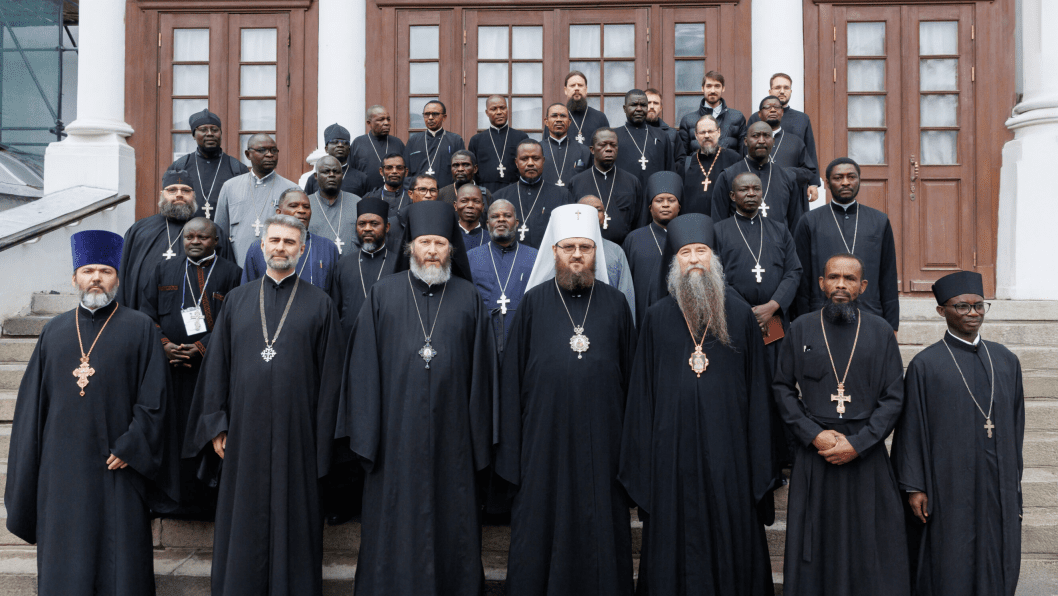
In addition to expanding its physical and institutional presence abroad, Russia’s pro-Kremlin religious establishment has also moved to shape the digital sphere.
According to The Moscow Times, representatives of the World Russian People’s Council — a body closely affiliated with the Russian Orthodox Church — have proposed the development of an “Orthodox” artificial intelligence system grounded in what they describe as traditional spiritual values. They argue that dependence on Western-developed AI technologies carries ideological risks for Russia.
Deputy chairman Mikhail Ivanov said that Western AI models, trained on “alien values,” could distort interpretations and introduce ideas deemed undesirable into Russia’s information space. In his view, Russia requires its own technological platform guided by defined moral and spiritual principles.
-a302cefa87498a21834054eb79eb3245.png)
“This is not about replacing a pastor or automating faith. It should be a safe guide to verified sources of knowledge,” Ivanov said, adding that such a system should strictly adhere to the canons of the Russian Orthodox Church, according to The Moscow Times.
Earlier, an Orthodox religious network operating in Sweden come under scrutiny after allegations surfaced that it backed Russia’s military campaign and maintained connections to Russian military intelligence.
Locally dubbed “Z-nuns” due to their public use of the pro-invasion “Z” symbol, the women sold religious items in Swedish parishes while presenting their activities as charitable fundraising. Swedish authorities suspect that funds generated from these sales may have been directed toward supporting Russian military units involved in the war against Ukraine.
Discuss this article:

-c439b7bd9030ecf9d5a4287dc361ba31.jpg "Photo of Katherina Popilnichenko")