- Category
- War in Ukraine
Experimental Dome Against Russian Fiber-Optic FPV Drones Starts Trials in Kharkiv
 Prefer U24 Media on Google
- Authors

-72b63a4e0c8c475ad81fe3eed3f63729.jpeg "Photo of Cyril Barabaltchouk")
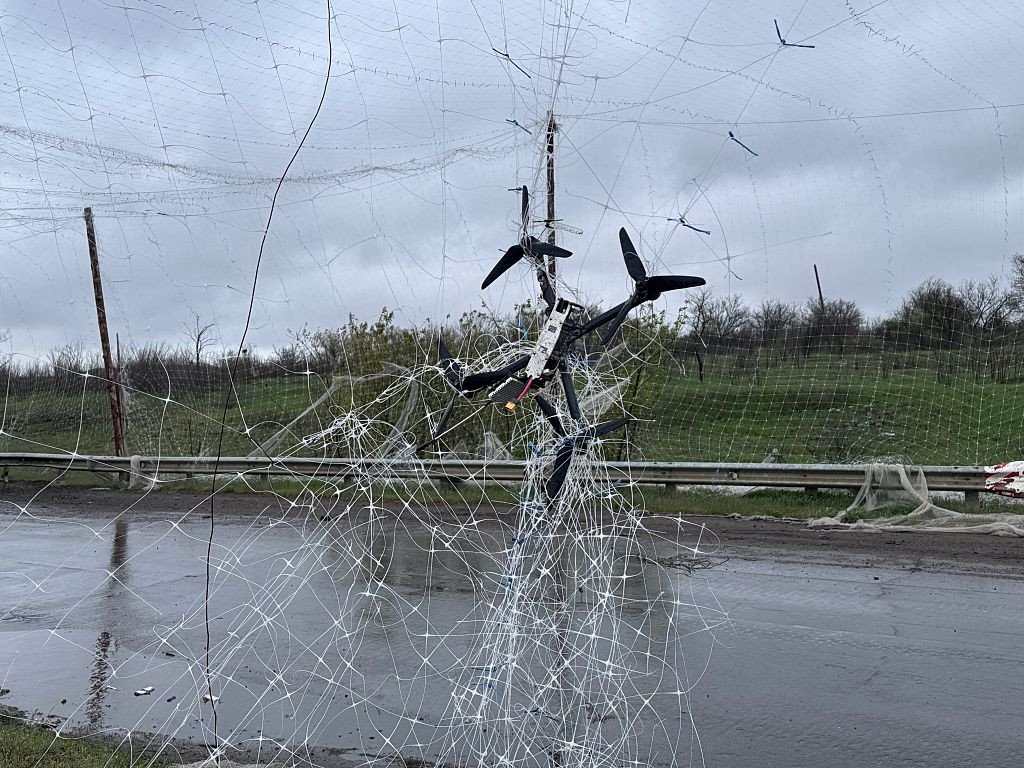
The Kharkiv Regional Military Administration has launched an experimental air defense initiative in partnership with the 2nd National Guard Corps “Khartia” to actively counter Russian FPV drones, according to Head of the Regional Military Administration Oleh Syniehubov on Radio Khartia on July 30.
The initiative specifically targets fiber-optic guided drone variants.
We bring you stories from the ground. Your support keeps our team in the field.
The pilot program is currently being tested within a classified sector of the region before being scaled to create a protective “dome” around the entire city of Kharkiv if successful. Syniehubov emphasized that Russian forces launch vast numbers of drones toward the city daily, making active countermeasures essential to prevent severe civilian casualties and infrastructure destruction.
“Military forces are also experimenting, searching for active countermeasure tools. For a week now, we have been working with the 2nd Corps of the NGU 'Khartia' on an experimental project that will be implemented in a certain area—we won’t specify where—for active countermeasures,” Syniehubov stated in an interview with Radio Khartia.
He added: “If it proves successful—and I believe it will be successful—we will implement it across the entire territory, creating such a protective dome around Kharkiv against fiber-optic FPV drones.”

The initial testing stage is being financed entirely from the regional budget, though local authorities plan to seek international and state assistance once the system demonstrates its operational viability. “The work is very complex. The tools are complex, the financing is complex. We will fund it entirely from the regional budget because it is experimental,” the regional chief explained to Radio Khartia, noting that successful implementation will lead to fundraising through United24 and other donor platforms.
“For us, this is a priority; it is our responsibility—protecting the city and our civilian population,” he added.
Rather than developing an entirely new concept, the initiative adapts proven frontline anti-drone technologies to fit the urban defense requirements of Kharkiv, where only a fraction of incoming Russian drones currently manage to breach local defenses. “We would have around one hundred fiber-optic FPVs hitting the city of Kharkiv daily, and we understand what the consequences could be,” Syniehubov detailed during the Radio Khartia broadcast.
He clarified that “when we say 'experiment, ' it is not something invented from scratch. This is already working at the front, but adapted to the current situation and needs. It will definitely be effective.”
-d6d131aae3c063f048a1518f94335e6e.jpg)
The active defense dome forms the outer perimeter of a comprehensive three-tiered defense strategy designed to protect Kharkiv’s civilian infrastructure and main transport routes. The second layer incorporates passive physical barriers, including anti-drone netting stretched across the entirety of the Kharkiv Ring Road and the Kharkiv Highway up to Academik Proskura Street. The third and final layer relies on mobile fire groups equipped with shotguns and automated weapon turrets to physically destroy any loitering munitions that bypass the first two barriers.
“Physical destruction, where people will stand with shotguns or automated turrets, is already the third and final line, which must shoot down whatever the first two echelons failed to handle,” Syniehubov noted, adding that local air defenses have also neutralized over 2,000 long-range Shahed and Italmas drones since the start of 2026, including more than 100 loitering munitions and jet-powered Shaheds destroyed this week alone, according to Radio Khartia.
Ukrainian defense technology company Contra Drone had recently unveiled a layered counter-drone architecture combining more than 20 defensive technologies, including an automated mini air defense platform designed to track and destroy FPV drones without direct operator input.
Discuss this article:
-9a7b3a98ed5c506e0b77a6663f5727c5.png)


-c439b7bd9030ecf9d5a4287dc361ba31.jpg "Photo of Katherina Popilnichenko")



-29a1a43aba23f9bb779a1ac8b98d2121.jpeg "Photo of Illia Kabachynskyi")