- Category
- War in Ukraine
How AI and Crowdsourcing Help Document Russian War Crimes in Ukraine
Ukraine is navigating the most documented war in history. Every day, Ukrainians generate terabytes of data, capturing critical evidence of Russian crimes across the country. To process this massive volume of information, find missing people, and catalog war crimes for future court proceedings, Ukrainian teams are deploying AI-driven analysis programs. We spoke with the Ukraine War Archive, an organization preserving the digital memory of Ukraine’s defense.
 Prefer U24 Media on Google
- Authors

-24deccd511006ba79cfc4d798c6c2ef5.jpeg "Photo of Louis Beaudemont")
Without memory, there is no culture. Without memory, there would be no civilization, no society, no future.
Elie Wiesel
Holocaust survivor and writer
Since Russia’s full-scale invasion of Ukraine in 2022, daily life for both soldiers and civilians has been shaped by a relentless stream of shocking news: an uninterrupted flow of images and text that must be collected, verified, analyzed, categorized, interpreted, and, often, used as evidence of war crimes.
🚨 BREAKING: Russian drone operator hunts down civilian market vendor in Ukraine’s Kherson.
— UNITED24 Media (@United24media) August 4, 2026
Police video captured the moment a Russian drone hunted down a 52-year-old civilian market vendor, leaving him severely wounded with blast trauma and shrapnel injuries. A war crime filmed… pic.twitter.com/T49nvR6RZO
These records include video of a Russian attack drone killing a fruit vendor in Kherson—part of what Russians themselves call "human safari" targeting civilians— intercepted audio of a Russian soldier’s wife encouraging him to rape Ukrainian women, as well as footage of Ukrainian children in Russian-occupied territories being militarized and indoctrinated by occupying forces.
Our enemy publishes a vast amount of photos and videos [...] parading them like trophies.
Eleonora Beley
Research Director at Ukraine War Archive
How to process millions of files
To process tens of millions of files—a task handled by only a few hundred people across NGOs, government bodies, the military, and prosecutors' offices—the organization Ukraine War Archive (UWA) developed a system powered by artificial intelligence and crowdsourcing, using partners’ and open source content.
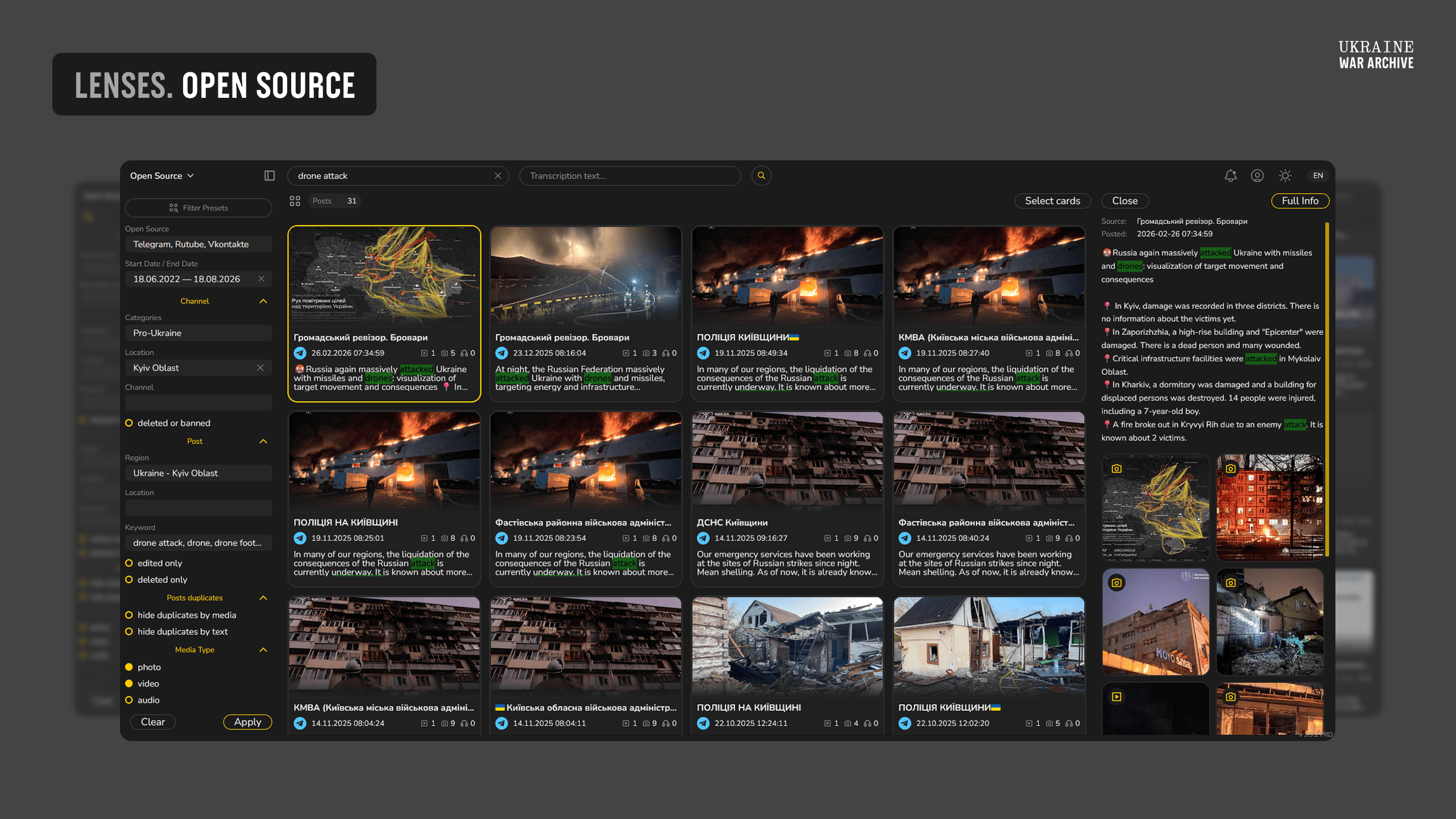
Individuals or organizations can submit material to the UWA. This can include videos and photos taken on a phone during the Russian occupation of Ukrainian territory, or footage of a drone hitting a residential building.
The instant a file is ingested, UWA calculates its hash value—a unique cryptographic fingerprint. Because a hash calculation is a mathematical constant, future claims by Russian state media that a video was edited, altered, or fabricated after collection can be immediately and scientifically disproven by rerunning the calculation; if even a single pixel has been changed, the hash string will fail to match.
Once the files are archived, outside organizations can request access to them for criminal investigations, searches for missing relatives, or the production of news reports and documentaries.
At the core of the UWA research and archiving system, the “Linza” tool performs continuous scraping and monitoring of over 8,000 social media channels—a number that is constantly growing at the request of partner organizations. To guarantee the evidentiary value of the data, the system applies the Berkeley protocol: every post is automatically archived with its source, a unique timestamped digital fingerprint, and a backup copy.
The system then uses artificial intelligence tools to search the archive for specific information: facial matches, occurrences of written names, or repeated appearances of specific vehicle types in photos. For analysts, the time savings are substantial. Instead of manually reviewing hundreds of chat threads to study, for example, Russian propaganda or disinformation around mobilization, they simply enter a keyword or tag. The centralized interface filters the posts and directly highlights the search terms.
We are doing everything we can to make it easy to find information.
Eleonora Beley
Research Director at Ukraine War Archive
“These are photos, videos, texts, and testimonies,” explains Eleonora Beley, Research Director at Ukraine War Archive. “We are storing terabytes of information. Our goal is to preserve them permanently so that 50 or 100 years from now, future generations can draw verified information about what is happening to us today.”
She spoke in a small cinema hall in central Kyiv during a documentary film and human rights festival—an event where images from around the world are examined through the lens of a country at war. Ukraine War Archive was founded in 2022 to provide professionals, NGOs, historians, and prosecutors worldwide with access to a structured database.
Securing digital evidence under international standards
Collecting open-source evidence at this scale requires more than downloading videos from social media. For digital material to be admissible in court, investigators must prove where it came from, when it was collected, and that it has never been altered.
That is why Ukraine War Archive follows the Berkeley Protocol .
The protocol was developed based on lessons learned from past conflicts, such as in Syria, where investigators faced the rapid deletion of videos and photos from social media platforms before they could be legally preserved. By setting guidelines for long-term storage and investigator anonymity through secure digital identities, the Berkeley Protocol allowed NGOs to serve as crucial legal aides, providing actionable data for prosecutors.
-639eacbfbce594c9306781d41539ee90.png)
Under the Berkeley Protocol:
Investigators preserve the target URL, the HTML source code (containing metadata invisible to the naked eye), and a timestamped, full-page screenshot;
Every file collected receives a hash value (a unique cryptographic digital fingerprint) upon entry that proves it has not been altered;
Only material directly relevant and necessary to an investigation is collected, reducing the overloading of storage systems and unnecessary invasions of privacy.
“We preserve the chain of custody so that this information can serve as admissible evidence for law enforcement agencies,” says Beley. “We sign an agreement, ingest your material into the archive, and generate a table where every item—even a 10-second clip—is hashed.”
The threat of Russian digital disinformation and cognitive warfare
Following major attacks, Russian state media and pro-Kremlin channels routinely claim that video evidence is "staged" or digitally manipulated. During the 2022 Bucha massacre, Russian officials falsely claimed that footage showing dead civilians was fabricated after Russian troops withdrew. Similarly, after the strike on the Ohmatdyt Children’s Hospital in Kyiv, Russian state outlets falsely alleged that the damage was caused by a Ukrainian air defense missile rather than a Russian Kh-101 cruise missile.
We know how Russia knows how to rewrite history.
Wife of a MIA soldier
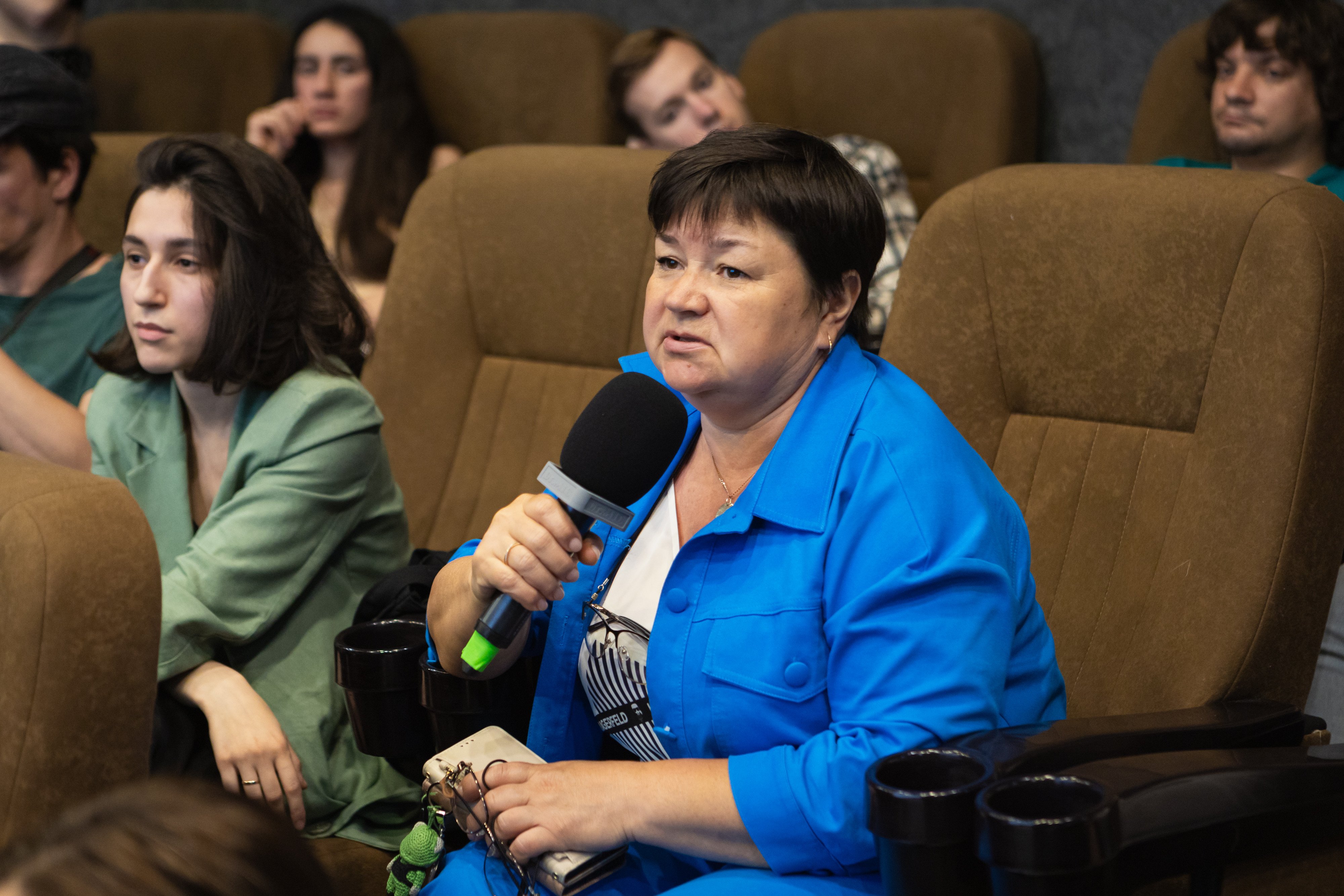
Searching for the missing in the world's most documented war
While digital archiving serves criminal justice, it also addresses the immediate pain of families searching for missing loved ones. In Ukraine, a disappearance affects entire communities.
With over 90,000 officially registered missing persons, “we are actually talking about more than half a million people impacted by this tragedy,” says Beley. To put this into perspective, she notes that this figure equals the pre-war population of a medium Ukrainian city, or “125 fully packed interregional trains.”
Today, Russian forces exploit this trauma by spreading photos and videos of prisoners of war as trophies. To counter this, the UWA, alongside “Linza,” developed the “Missing People” tool, which continuously monitors Russian social media platforms using algorithmic tracking. “Mainly Telegram, VKontakte, YouTube, RuTube, as well as certain TikTok channels,” Beley explains.
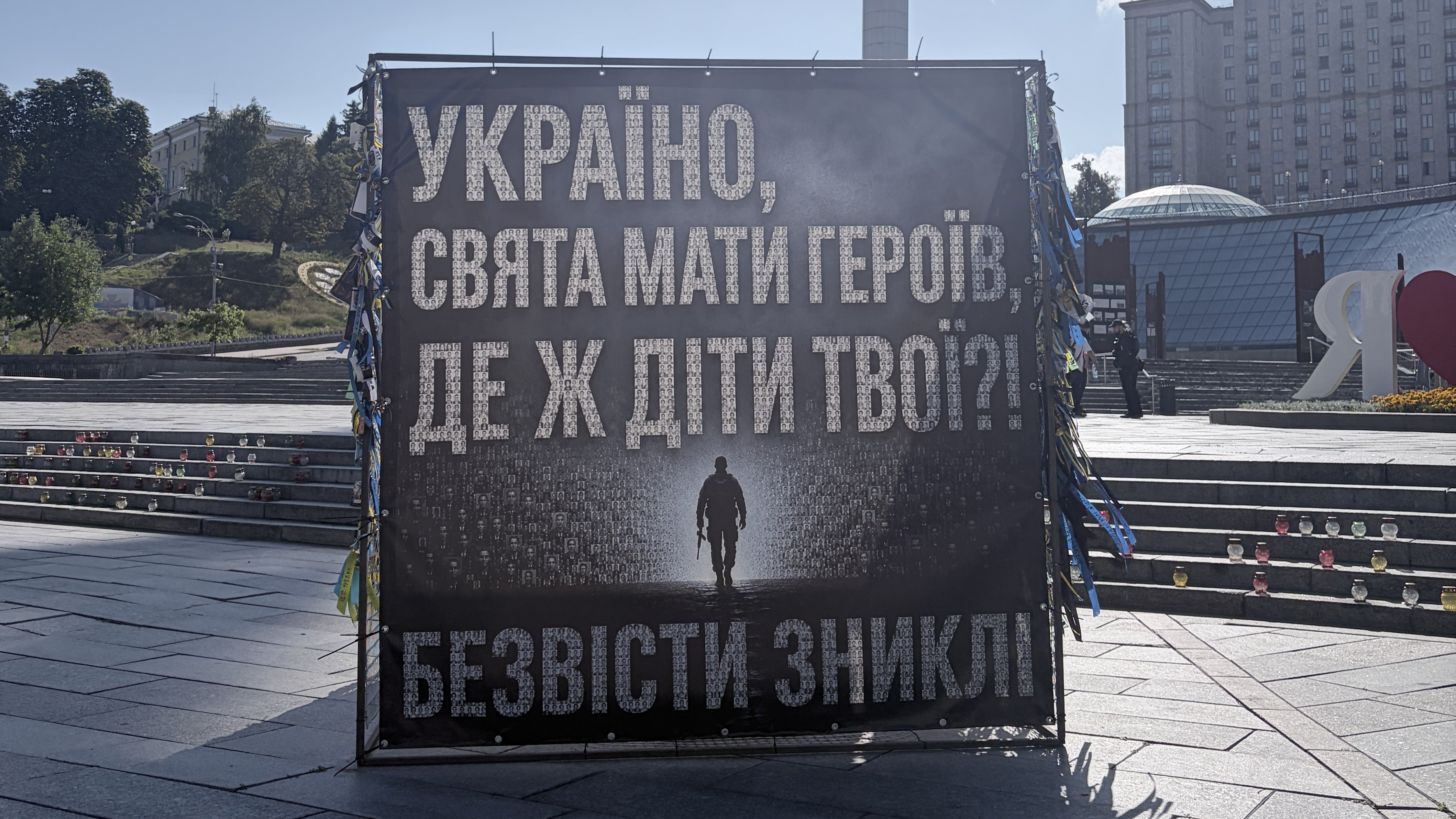
This system helps fill gaps left by fragmented state registers. Faced with institutional delays, relatives exhaust themselves searching through dubious Russian channels. Experience shows that “relatives are often the best investigators,” says Beley. “It’s the family... Sometimes it feels like these people could dig up the devil himself from under the ground.”
Missing People centralizes and cross-references data to identify matches while protecting families from financial extortion schemes by Russian scammers. However, technology only handles sorting; human experts remain essential to verifying results.
“We live in what is called the most documented war in history,” says Beley. “Our conflict evolves at the same speed as technology. By having access to both this data and technology, we can meet today’s challenges.”
The war, paradoxically, accelerates the democratization of Ukrainian institutions through technology and, as French philosopher Jacques Derrida pointed out, “There is no political power without control of the archive, if not of memory. Effective democratization can always be measured by this essential criterion: the participation in and the access to the archive, its constitution, and its interpretation.”
Discuss this article: