- Category
- War in Ukraine
Moscow Running Low on Fuel: Ukraine Launches One of the Largest Drone Attacks on the Russian Capital
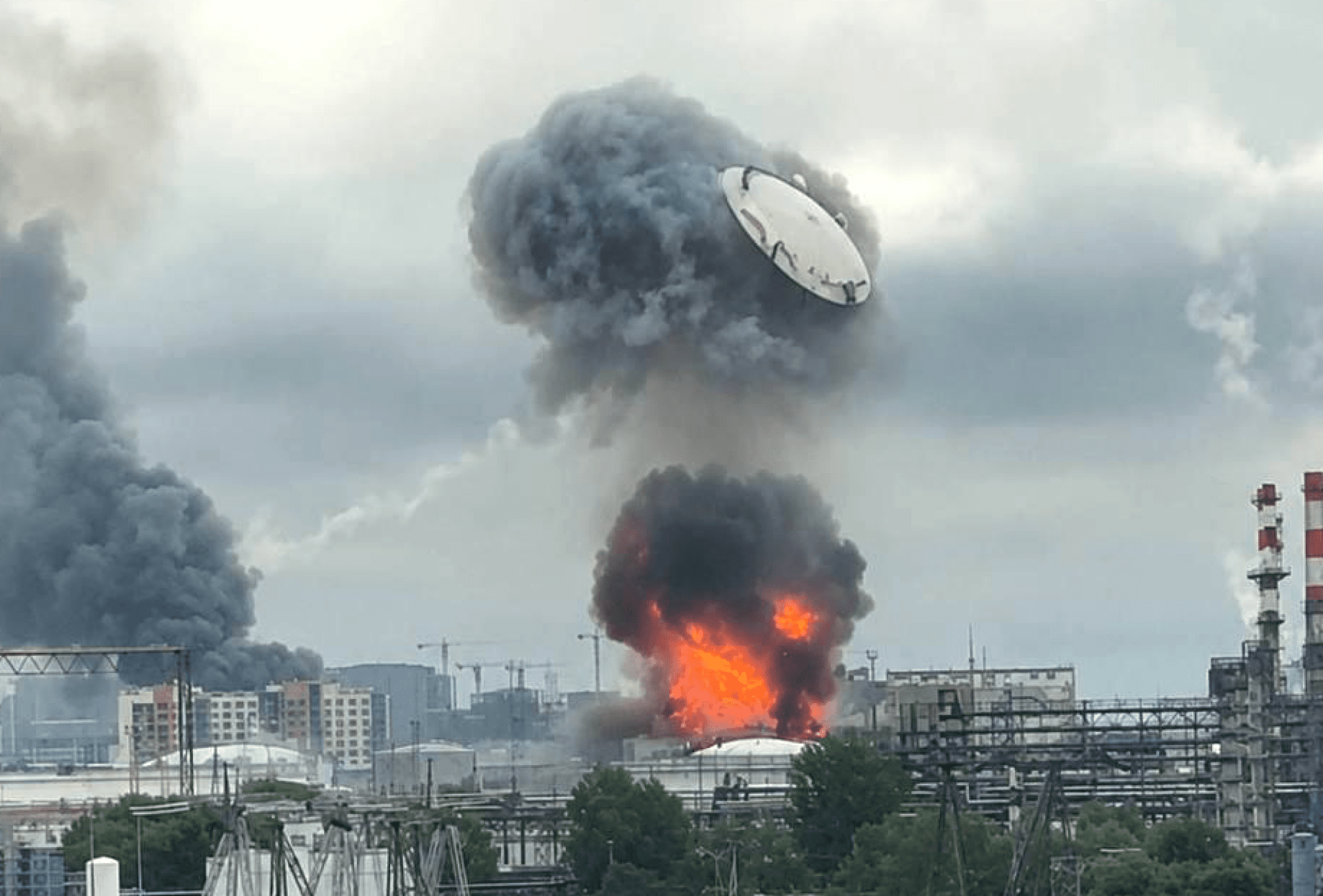
Moscow may run short of fuel very soon. A second large-scale strike on an oil refinery in Russia’s capital has led to its full shutdown. Russian air defense couldn't cope with the Ukrainian attack because it was simply too large to handle.
 Prefer U24 Media on Google
- Authors

-29a1a43aba23f9bb779a1ac8b98d2121.jpeg "Photo of Illia Kabachynskyi")
The morning of May 18 brought a flood of photos and videos showing the 10-ton lid of an oil storage tank blown up into the air. Ukrainians have already turned the footage into a thousand memes; in Russia, those who aren't afraid to joke say, “Why should Moscow be dragged into Russia's war with Ukraine?” But the Kremlin isn't finding any of this funny.
The reason? Ukraine’s mass drone strike, which was possibly the largest by number of aerial assets used to date. Russia's Ministry of Defense reported that its air defenses shot down 992 Ukrainian fixed-wing drones over 24 hours, along with four long-range cruise missiles and ten guided bombs. Since the Russian ministry only reports downed drones, the actual number launched was likely even higher.
This strike not only broke Ukraine's own previous record for drones used in a single day, it also exceeded the largest number of drones Russia has ever launched in a 24-hour period. To put it plainly: Ukraine appears to have launched more drones in a single day than Russia has. A year ago, that would have been unthinkable. Today, Moscow is seeing and feeling that new reality.
Russian air defense, meanwhile, couldn't keep up. Numerous videos show Russian surface-to-air missiles detonating near the drones without bringing them down, while the drones continued on their way. Some missiles missed their targets entirely and came down on residential buildings instead. Ukraine, for its part, hit what it was aiming for: the refinery in Moscow is now burning across the entire site.
Scaling up strike power
The attack on Moscow is direct proof that Ukraine has significantly expanded its capacity to produce deep-strike drones and has learned to mount combined, mass attacks capable of breaking through Russian defenses. Notably, the Russian Ministry of Defense reports are now also listing downed Ukrainian cruise missiles, which is further evidence that Ukraine has built its own missiles and is using them effectively against the enemy. Where Ukraine once lagged hopelessly behind Russia, it can now respond in kind. President Volodymyr Zelensky put it directly:
Tonight's long-range "sanctions" once again reached the Moscow region, with the Moscow refinery struck for the second time in a week; targets in the Rostov region and in Ukraine's temporarily occupied territories were also hit. He called it a fully justified response to Russian strikes on Ukrainian cities and communities, and another important result of Ukrainian forces' work against facilities that sustain Russia's war machine.
Ukraine is ramping up both deep-strike and mid-range strikes alike, continuing its campaign to dismantle Russia's logistics and economic capacity. That's possible thanks to steady, large-volume contracting of drones and missiles, which is exactly why sustained partner support on this front matters so much: Ukraine needs drones in large numbers, on an ongoing basis.
Moscow without gasoline
The strike on the Moscow refinery has one specific aim: cutting into Russia's ability to profit from oil. Refinery strikes reduce exports, and the resulting domestic shortages are already rattling the market. Ukraine's precision strikes on Russia's oil sector have already pushed 15 regions into a fuel crisis, and this is no longer just about Crimea. Moscow itself already has certain restrictions on gasoline sales in place. Further precision strikes on refineries will only deepen the shortage, forcing fuel to be shipped in from other regions and stretching out supply chains.
That's also pushing up prices: for the first time in a long while, gasoline prices are climbing. That's an unusual situation for Russia, where the government specifically pays suppliers to keep prices artificially low, and even that subsidy isn't enough to hold the line anymore. The country, once nicknamed a "gas station," is now facing one of the largest fuel crises in its history across a significant share of its territory.
The upshot: Russia, which might otherwise have cashed in on high oil prices, has largely missed that opportunity, just as its budget deficit has already topped 6 trillion rubles and could reach 10 trillion by year's end. Where that money comes from is anyone's guess.
Ukraine, for its part, states a simple goal: to stop the war.
Discuss this article:
-4a56a6b482ec132402c16ef6fcabf9a2.png)

-c439b7bd9030ecf9d5a4287dc361ba31.jpg "Photo of Katherina Popilnichenko")