- Category
- War in Ukraine
Putin’s 2027 Budget Sends Russia’s Domestic Market Into a Panic
Russia is heading into 2027 with a 5.5 trillion ruble ($65 billion) hole in its budget. But no one believes it will stop there: the 2026 deficit is expected to reach at least twice its originally planned level. Tax hikes will cover only part of the gap, while Moscow’s last hope—domestic borrowing—is already showing signs of strain.
 Prefer U24 Media on Google
- Authors

-29a1a43aba23f9bb779a1ac8b98d2121.jpeg "Photo of Illia Kabachynskyi")
In late September, the Russian government unveiled its draft budget for 2027: record spending, record revenues, and the highest level of war spending yet. While most of these figures were broadly expected, one number caught many by surprise—the record projected budget deficit. Even at the planning stage, it stands at 5.5 trillion rubles ($65 billion).
As recently as mid-September, Vladimir Putin said Russia expected its federal budget deficit to come in at around 2% of GDP in 2027, counting in part on higher oil and gas revenues. But Russia’s recent record gives the market reason to question whether even the new deficit target for 2027 will hold.
The figure itself is comparable to what is already happening in Russia’s 2026 budget: as of the end of August, the deficit stood at the same level—5.5 trillion rubles. It will be even larger by the end of the year.
Russia’s Budget for 2026–2027
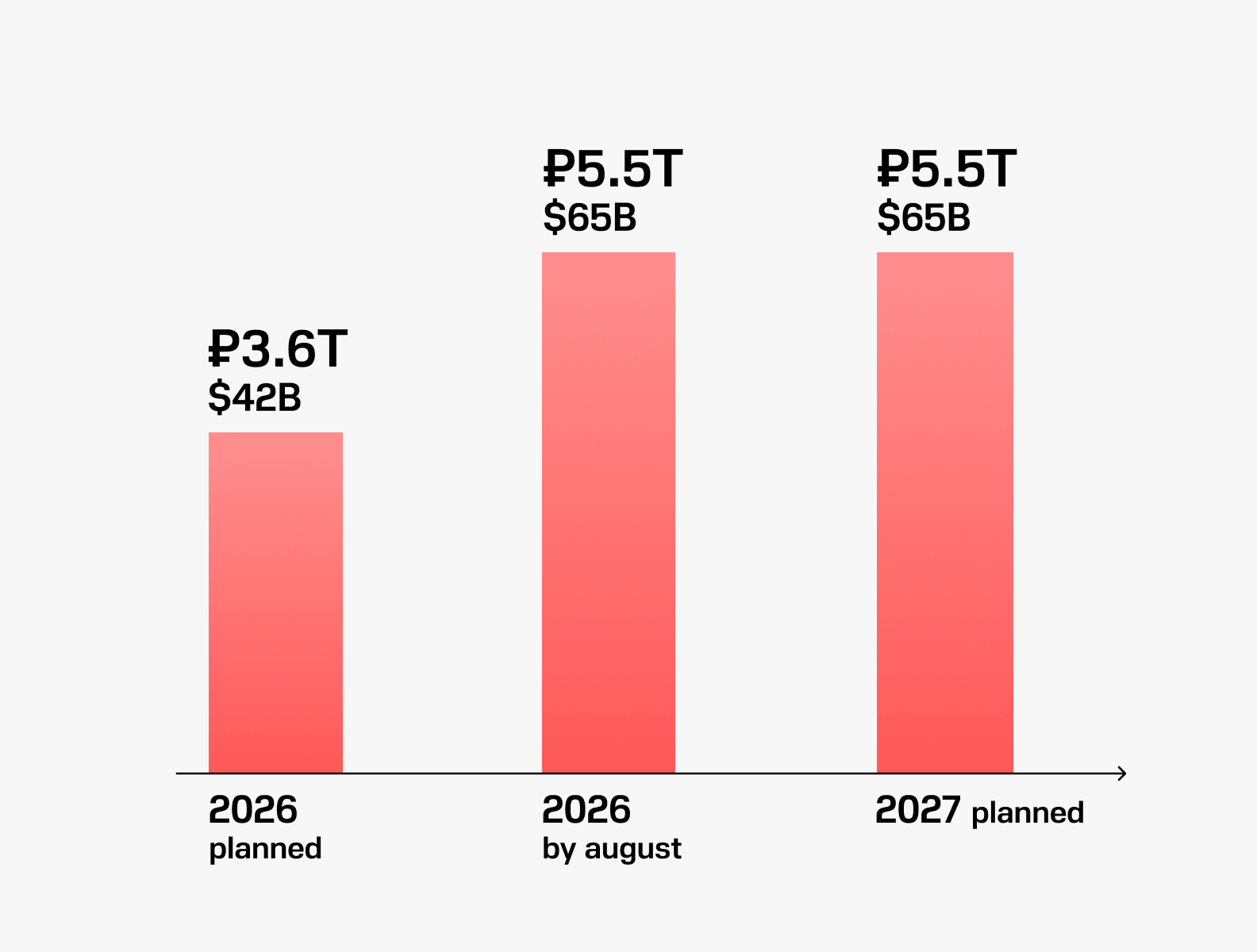
In effect, the Russian government is saying: we expect the situation next year to look similar.
The problem is that Russia’s own recent record gives little reason to assume the 2027 deficit will stay within the projected limit. The 2026 budget envisioned a maximum deficit of 3.6 trillion rubles ($42 billion), and the actual figure is set to exceed that by almost a factor of two.
If this is the government’s scenario, what should be expected of the deficit by the end of next year?
Russia’s domestic borrowing crisis
On September 30, 2026, Russia’s Finance Ministry failed to sell its own bonds. The auction was declared unsuccessful because investors submitted no bids at prices acceptable to the government.
Federal loan bonds, or OFZs, have been Russia’s primary tool for plugging holes in the budget in recent years. The Finance Ministry regularly puts them up for auction, while banks and investors buy them. Over the summer, however, the mechanism had already begun to falter:
On June 24, the auction was canceled.
On July 1, only 10.3 billion rubles ($120 million) worth of bonds were sold out of a planned 110 billion rubles ($1.3 billion).
On July 8, the auction was canceled.
On July 15, no bids were received at an acceptable price.
After that, the Finance Ministry suspended placements altogether to avoid selling debt at any price.
For 2027, the Finance Ministry wants to place 7.72 trillion rubles ($90billion) worth of bonds, compared with the 5.39 trillion rubles (63 billion) envisioned for the same year in last year’s budget. Russia plans to borrow nearly one and a half times as much as it projected just a year ago—and at a time when demand for its debt is already weak.
Yields on short-term OFZs have risen to 14.5%, while yields on long-term bonds have reached 15.5%, their highest level of the year. During trading on September 30, long-term issues were yielding 16.2%–16.8% annually. That is a record level, making this extremely expensive money for the government.
Russia plans to borrow much more in 2027
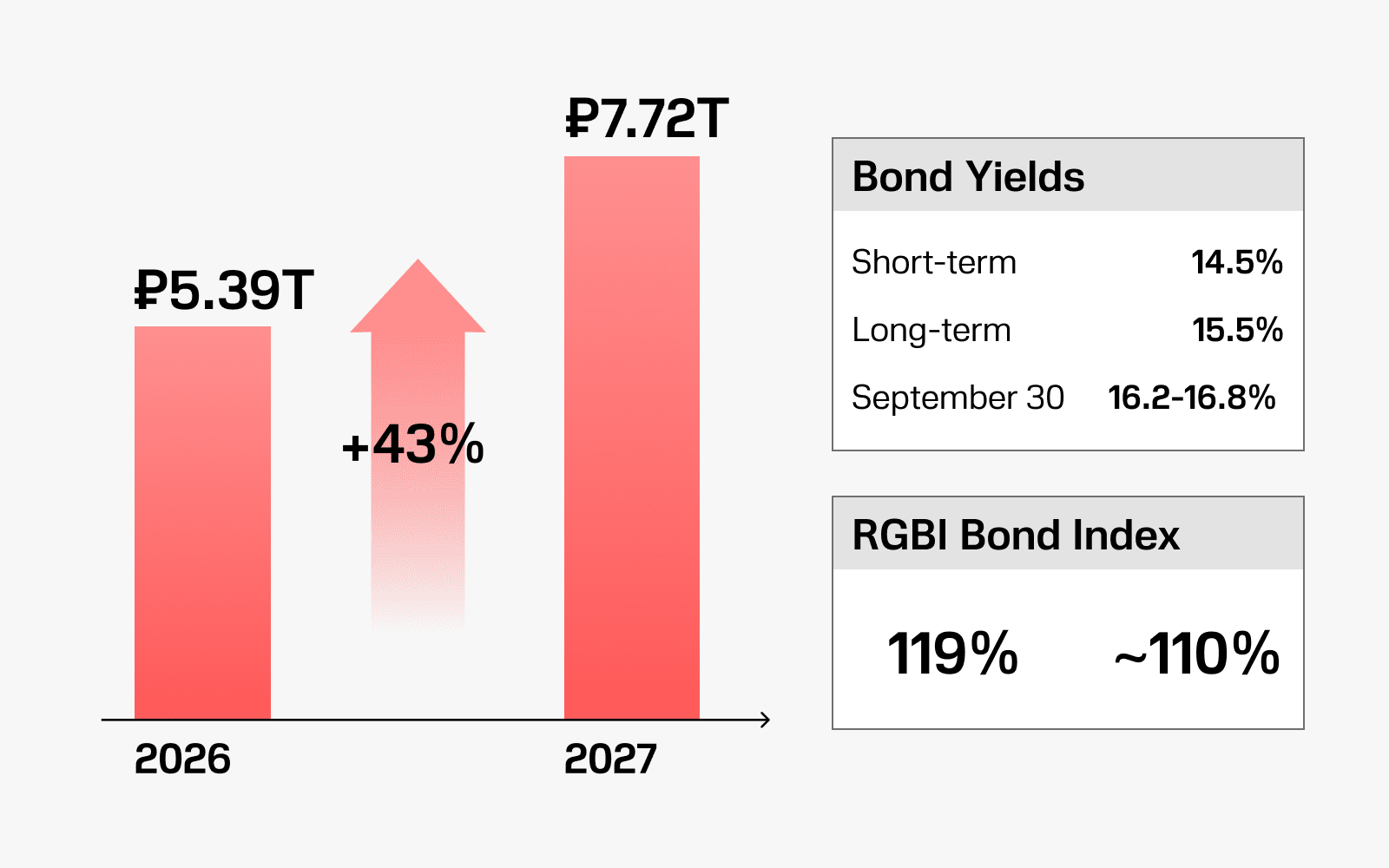
At the same time, the RGBI government bond price index fell from around 119 to roughly 110 points, its lowest level this year.
The new budget plans added to that pressure: as details emerged of the government’s sharply increased borrowing plans for 2027, the index dropped by around one point on September 28, with Russian analysts directly linking the decline to the additional 2.3 trillion rubles ($27 billion) Moscow plans to borrow.
Bond prices and yields move in opposite directions, so the decline in the index means that those who already hold government securities are taking losses, while new buyers are demanding increasingly greater compensation for the risk.
Russia’s war spending is making its debt problem worse
As things stand, the Russian government is bringing more and more debt to market just as investors are becoming increasingly reluctant to absorb it, particularly under current conditions: the Kremlin is spending an increasing share of its budget on the war, significantly exceeding planned expenditures.
For example, 12.1 trillion rubles ($141.5billion) had been budgeted for 2026, but actual spending could turn out to be 5 trillion rubles ($58.5 billion) higher. Moscow is channeling money into a sector that does not help the economy grow. Potential investors, meanwhile, are demanding increasingly high returns to hold Russian government debt.
Russia’s National Defense Budget
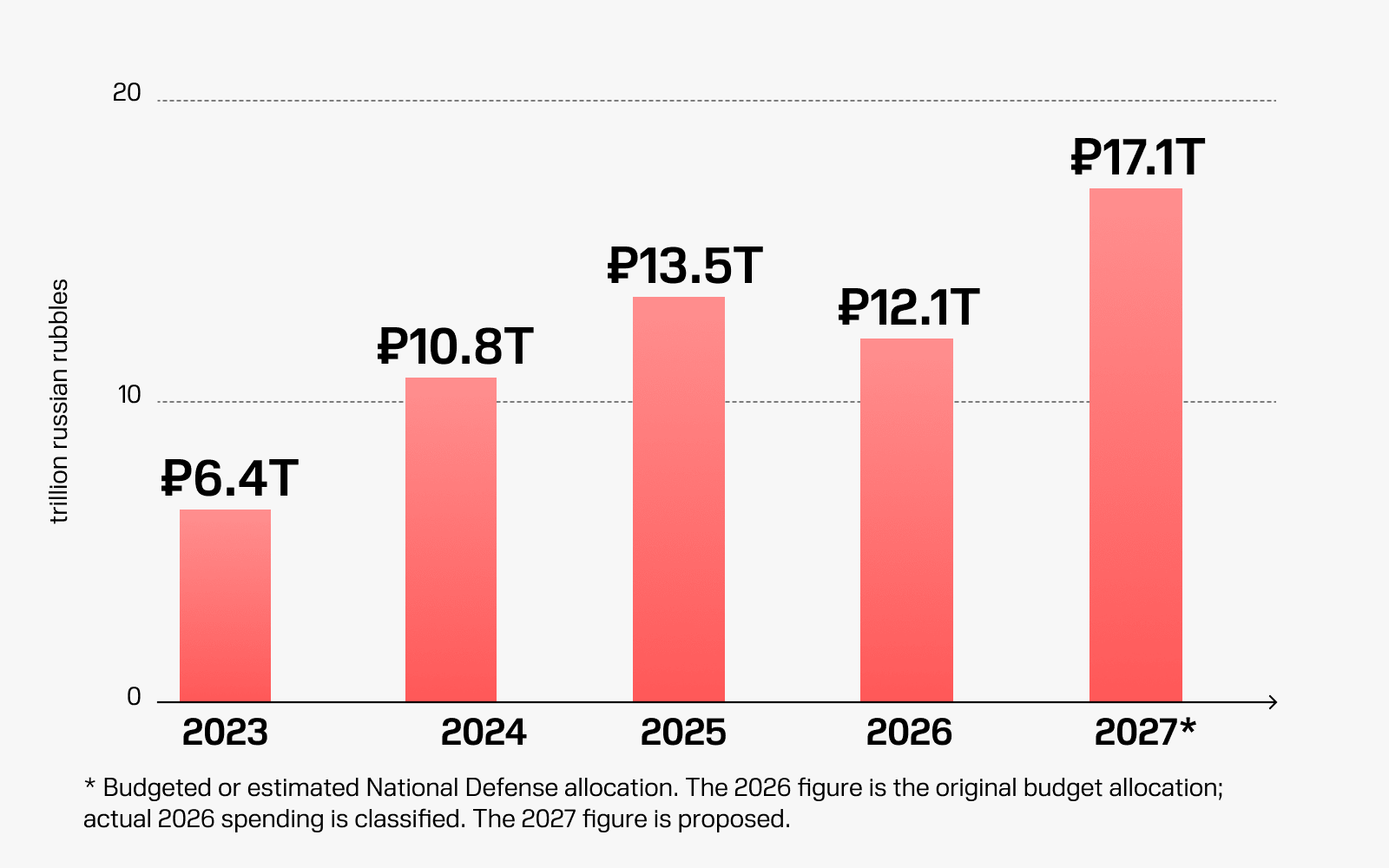
And the draft 2027 budget does not envision savings on the single largest area of expenditure—the war. Together with funding for security and law enforcement agencies, militarized spending accounts for more than 43% of all federal expenditures.
This creates a vicious cycle: money flows into a sector that burns through it. More money is needed, and interest rates rise. Debt becomes more expensive, and servicing it requires even more funds. Ultimately, this means that in 2027, the Russian government will spend more on servicing its debt than on any other area except the war, more than on social spending, education, healthcare, and so on.
The war is already costing Russia too much. That is why even greater pressure is needed to deprive the Kremlin of opportunities to generate revenue and, as a result, prevent it from financing combat operations in Ukraine and hybrid warfare in Europe.
Discuss this article: