- Category
- War in Ukraine
Russia Has No More Money to Throw at Its War in Ukraine. Its 2027 Budget Shows Why

Russia’s war machine spends more than $200 billion annually on its war against Ukraine. And this appears to be the maximum Moscow and the broader Russian economy can currently afford, as long as sanctions remain in place and prevent Russia from earning more.
 Prefer U24 Media on Google
- Authors


The Russian government has presented its draft budget for 2027. The budget itself is a record high, with expenditures reaching 48.8 trillion rubles (almost $600 billion). War-related spending is also at an all-time high:
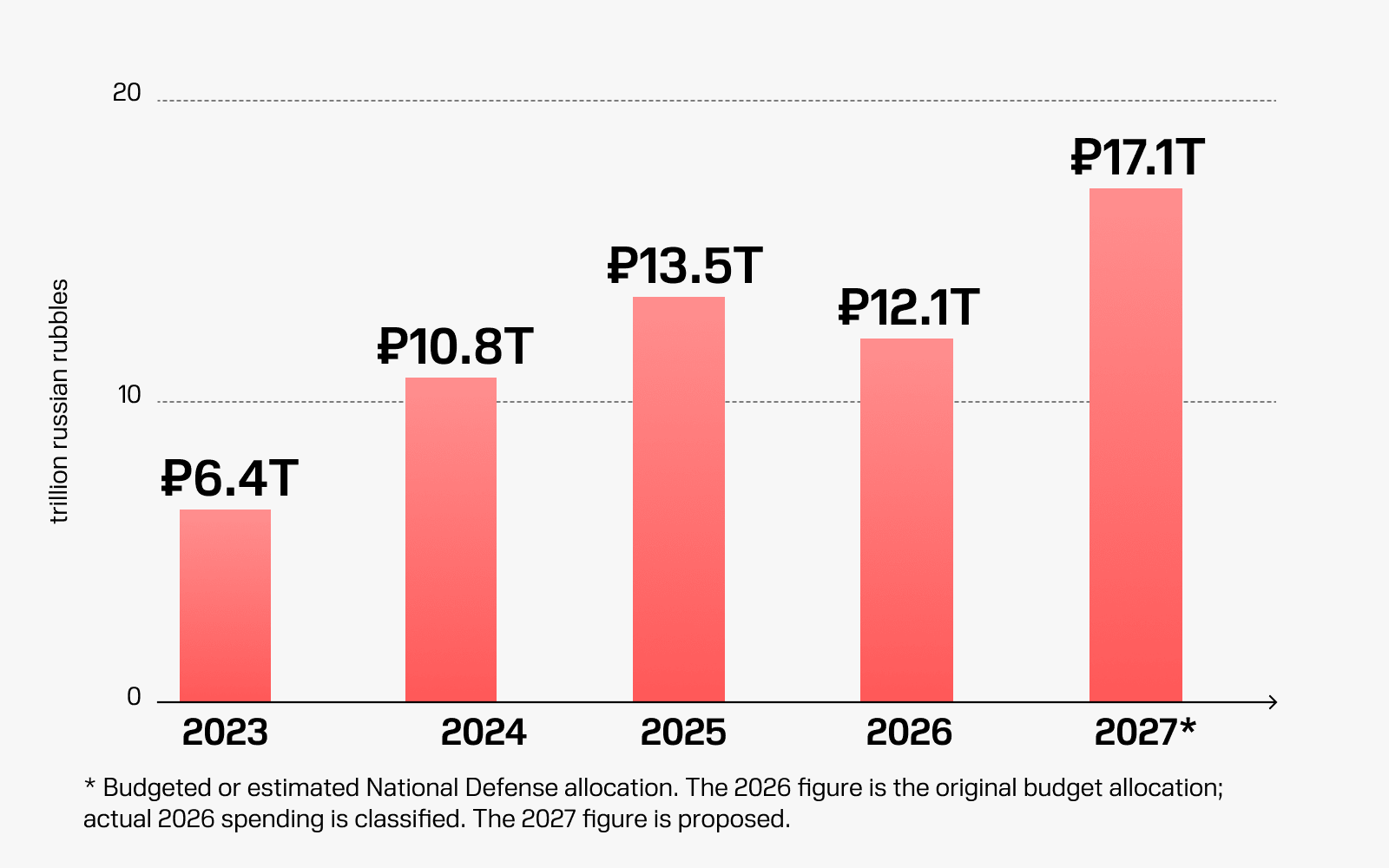
National Defense: 17.1 trillion rubles (almost $210 billion)
National Security: 4.3 trillion rubles ($52.7 billion)
Russia is allocating 21.4 trillion rubles ($262.5 billion) to the war/defense, or over 43% of all government spending. Officially, war expenditures are increasing by more than 40% year over year, clearly indicating Vladimir Putin’s intention to continue the war. However, this appears to have pushed Russia to its financial limits, leaving little room to spend more.
Russia’s ability to borrow more money is also coming under pressure. Several government bond auctions failed in 2026 as investors demanded increasingly higher yields, pushing borrowing costs to record levels. Yet Moscow plans to borrow 7.72 trillion rubles ($94 billion) in 2027, nearly 50% more than previously projected, even as demand for its debt weakens.
How much is Russia spending on its war in Ukraine?
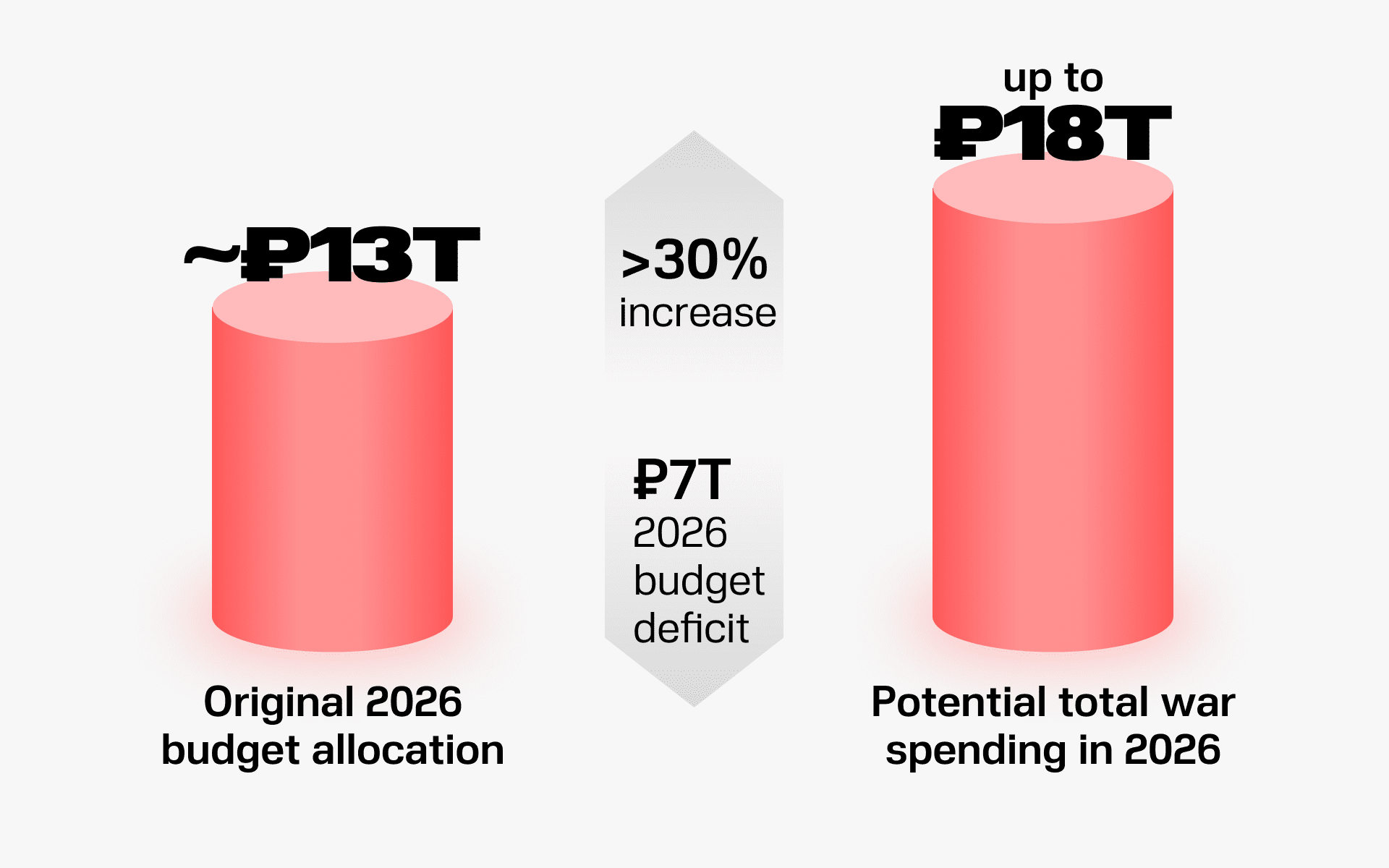
In 2026, Russia’s official budget allocated slightly less than 13 trillion rubles (almost $160 billion) to the war against Ukraine. It was a substantial amount, but it proved insufficient.
The Russian government does not disclose all the details, citing national security and secrecy restrictions. However, it is known that in the spring of 2026, an additional 2 trillion rubles ($24.5 billion) had to be allocated to the war. At the time, reports emerged that Russia was suffering catastrophic losses on the battlefield and needed the money both to compensate the families of fallen soldiers and to recruit new troops.
Later in the year, the American news outlet Bloomberg reported that the Kremlin would allocate an additional 4–5 trillion rubles ($49–61 billion) to the war by the end of 2026. As a result, total war expenditures could reach 18 trillion rubles ($221 billion)—more than 30% above the amount originally planned.
This also coincides with Russia’s record budget deficit, which had exceeded 5 trillion rubles ($61 billion) as of October 2026 and could reach 7 trillion rubles ($86 billion) by the end of the year—more than twice the originally projected figure.
The draft budget for 2027 provides a clear indication of Russia’s financial constraints: the government is allocating 17.1 trillion rubles to national defense, roughly in line with what Moscow is expected to spend on the war in 2026. In other words, Russia knows exactly how much it can afford to spend on the war, and it simply does not have any more money available.
In reality, the apparent increase in war spending exists largely on paper. Because these expenditures are classified, we cannot see the actual costs incurred in 2026 or fully understand how the funds are being distributed.
Why is Russia struggling to fund its war in Ukraine?
Russia is doing everything it can to keep its economy afloat, but this has become increasingly difficult. At the same time, divisions among the country’s elites continue to deepen.
The Bank of Russia operates according to its own priorities, while the Ministry of Finance follows a different approach. Then there are Putin, the business elite, and other stakeholders influencing developments in the Russian economy.
Each is responsible for a particular area or seeks to secure its own interests. As a result, situations arise in which businesses demand lower interest rates, while the Bank of Russia is forced to explain why such cuts are not possible.
In the draft budget for 2027, the government has attempted to account for the maximum possible increase in military spending while also identifying where the money will come from. Tax increases will affect a dozen sectors of the economy.
The budget is designed to avoid emergency efforts to find additional funding for unexpected expenditures. Instead, the government is trying to plan everything in advance while keeping the economy in a reasonably stable condition.
Can Russia finance its growing budget deficit in 2027?
However, it remains difficult to understand what the Russian government is counting on.
In 2026, the budget deficit will exceed 5 trillion rubles. For 2027, the government is already projecting a deficit of at least the same size.
Where will Moscow find the minimum of 10 trillion rubles needed to cover the shortfall created by record war expenditures?
Even record oil prices are not enough to help the Kremlin.
Russia has been forced to import gasoline because of Ukrainian strikes on its oil refineries. Domestic fuel prices are significantly lower than international prices, and a mechanism known as the “damper” requires the government to pay oil companies hundreds of billions of rubles each month to prevent them from raising prices for consumers.
On top of that, Russian oil continues to trade at a discount on global markets.
High oil prices driven by developments in the Middle East are helping Putin generate additional revenue, but they are still not enough to rescue the Russian economy.
As a result, additional sanctions and measures to cut off Russia’s ability to generate more revenue could become decisive factors in preventing the Kremlin from continuing the war.
Strikes on Russian oil refineries are already having this effect. Even Putin has acknowledged that they have reduced Russia’s GDP by 1%, without accounting for the many other economic losses the country is suffering as a result of the war.
Meanwhile, Russia continues to lose troops at a record pace. Total military casualties have already exceeded 1.5 million, and by the end of 2026, the Russian army will have lost more than 400,000 service members this year alone, most of them killed.
Yet Russian forces are making virtually no advances and have achieved no major victories. In the first six months of 2026 alone, Russia spent more than 10 trillion rubles ($122.7 billion) on the war, nearly matching the amount originally budgeted for the entire year. And still, it has little to show for it.
World War I demonstrated that a war can be lost economically rather than on the battlefield. Russia’s economy is reaching the limits of its capacity, which are insufficient to secure victory. This is a signal to Ukraine and its partners in Europe and the United States that they need to act more decisively and proactively: economic pressure is delivering results and helping Ukraine sustain its defense.
Depriving Russia of the revenue it expects to receive would undermine the Kremlin’s economic capacity to continue active offensive operations. This, in turn, would force Moscow to the negotiating table. The priority now is to increase pressure, not ease it.
Discuss this article: