- Category
- War in Ukraine
Ukraine Opened Russia’s Notorious Oreshnik Missile. Here’s What’s Inside
 Prefer U24 Media on Google
- Authors


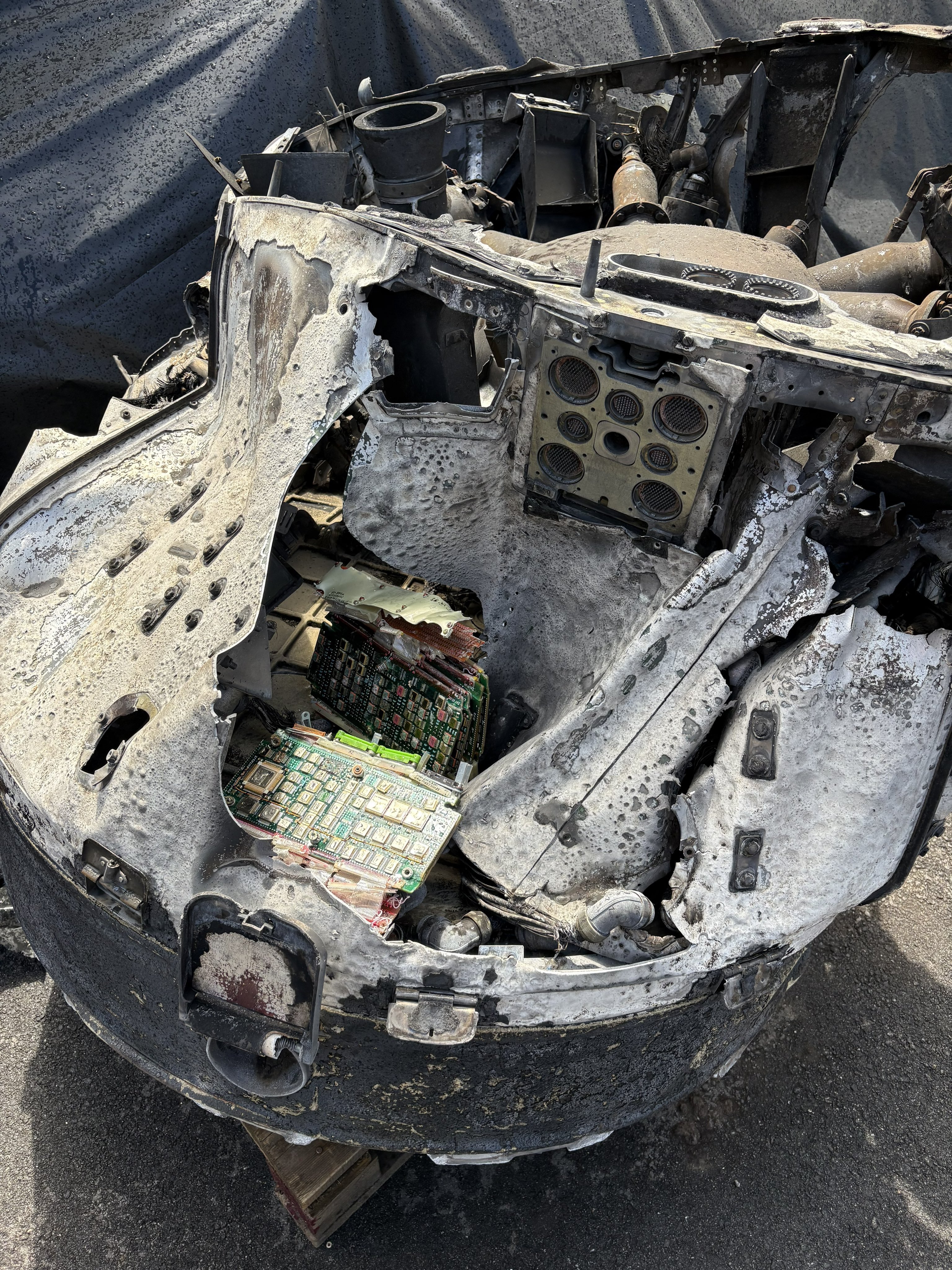
Ukrainian investigators have published new findings from the wreckage of a Russian ballistic missile that struck an industrial zone near Bila Tserkva in the Kyiv region overnight on May 23–24, revealing inert warhead simulators instead of explosive payloads and exposing new details about the missile’s internal design, according to Defence Blog on May 28.
According to Defence Blog, Russia launched the RS-26 Rubezh missile, promoted by Moscow under the name Oreshnik, from the Kapustin Yar test range in the Astrakhan region.
We bring you stories from the ground. Your support keeps our team in the field.
Ukrainian Air Force spokesperson Colonel Yurii Ihnat confirmed the launch, which marked the third known combat use of the system after previous strikes on Dnipro in November 2024 and the Lviv region in January 2026.
The missile hit an industrial area of Bila Tserkva, a city of about 200,000 people located roughly 80 kilometers south of Kyiv. The impact zone also partially covered a garage cooperative near the targeted facility. No casualties were reported.

What the missile carried may be more important than where it landed. According to Ukrainian analysis, the Oreshnik was fitted with inert simulators—metal and concrete blocks with no explosive content. Ukraine’s military has identified the same configuration in all three known combat uses of the system.
The Oreshnik is designed as a nuclear-capable delivery system with multiple independently targetable reentry vehicles. In practice, that means warhead elements separate from the missile body high in the atmosphere and descend toward separate aim points, Defence Blog wrote.
Using dummy payloads allows Russia to demonstrate range, trajectory, and terminal behavior without causing the level of destruction that could cross a major political threshold.
🇷🇺🇺🇦 BREAKING: Russia has launched an Oreshnik intermediate range ballistic missile strike targeting Bila Tserkva, Ukraine, marking another major escalation in the war and renewed use of Moscow’s hypersonic capable IRBM arsenal. pic.twitter.com/sRfm8dg9vw
— Defence Index (@Defence_Index) May 24, 2026
At the Bila Tserkva impact site, investigators found craters about three meters wide and two meters deep. Those dimensions are consistent with heavy inert blocks rather than explosive warheads.
Analysts comparing the craters with earlier Oreshnik strike sites in Dnipro and the Lviv region found no major difference, weakening Moscow’s claims about the system’s supposed unique penetration capability, according to Defence Blog.
The debris gave Ukrainian specialists their clearest look yet at the missile’s internal architecture. Among the recovered parts was a warhead deployment unit responsible for separating the reentry vehicles from the post-boost stage.
-fe851b90d8a0ba797c376cd41cd6a9ac.png)
The findings indicate that the missile carries six main warhead elements, each of which separates into six smaller submunitions during terminal descent. That configuration produces the distinctive 36-point impact pattern seen in footage from all three known Oreshnik strikes.
Investigators also recovered a wiring unit linking the individual warhead elements. Electronic components found in the guidance section included parts with 2018 manufacturing dates, matching earlier analysis of debris recovered after the Lviv region strike.
Vladyslav Vlasiuk, Ukraine’s Commissioner for Sanctions Policy, said the electronic components recovered from the Bila Tserkva wreckage came primarily from Russian and Belarusian manufacturers. According to him, five components were produced in Belarus and 57 in Russia.
🇷🇺💥🇺🇦
— 𝔗𝔥𝔢 𝕯𝔢𝔞𝔡 𝕯𝔦𝔰𝔱𝔯𝔦𝔠𝔱△ 🇬🇪🇺🇦🇺🇲🇬🇷 (@TheDeadDistrict) May 24, 2026
Last night, at around 2 a.m., Russia reportedly used the “Oreshnik” IRBM for the third time against Ukraine — allegedly targeting the city of Bila Tserkva. The exact impact location remains unknown.
*️⃣ The video appears to show 6 payload sections carrying 6 submunitions… pic.twitter.com/20apWOMRBU
The strike also involved more than one Oreshnik missile. OSINT analyst Kim Høvik was among the first to suggest that two missiles may have been launched overnight on May 23–24.
He analyzed footage from two locations and noted that one camera in Donetsk was recording northward at around 00:59, showing MIRV-like reentry characteristics consistent with an Oreshnik strike near the area outside Avdiivka in the temporarily occupied Donetsk region.
That would place it roughly 17 minutes before the confirmed Bila Tserkva impact at 01:16. It was later confirmed by Ukrainian President Volodymyr Zelenskyy, who wrote about it in a letter addressed to Donald Trump and the US Congress.
Russia used 2x Oreshnik IRBMs last night.
— kim høvik (@kimhvik2) May 24, 2026
This one seen from Donetsk - not looking towards Kyiv region. https://t.co/XMm1GrGuRJ pic.twitter.com/h2eXmJ689M
The fate of the possible second Oreshnik remains unclear. It is not publicly confirmed whether it was a failed strike, a deliberate test, or a successful strike against a target in temporarily occupied territory.
According to Defence Blog, the choice of Bila Tserkva as the target also matters. After earlier strikes on Dnipro and the Lviv region, the May 24 launch moved the missile’s demonstrated aim point closer to the Kyiv region. Each use has shown the system’s reach into a different part of Ukraine, while the use of inert warheads allows Russia to collect performance data without producing mass casualties.
Earlier, Ihnat revealed that Ukraine uses satellite monitoring and other intelligence tools to track Russian missile launches from the Kapustin Yar test range, where heat signatures can provide the first sign of a potential attack.
Discuss this article:
-4a56a6b482ec132402c16ef6fcabf9a2.png)


-72b63a4e0c8c475ad81fe3eed3f63729.jpeg "Photo of Cyril Barabaltchouk")