- Category
- War in Ukraine
Ukraine Sends Satellite Intelligence Straight to Soldiers’ Phones, Bypassing HQ
 Prefer U24 Media on Google
- Authors


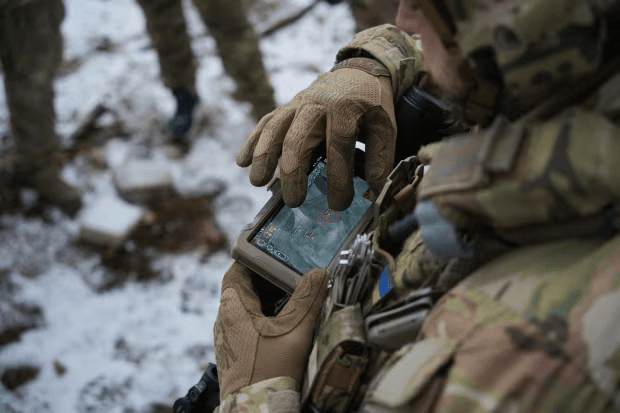
Ukrainian troops are testing a system that delivers high-resolution commercial satellite imagery directly to smartphones, tablets, and laptops on the battlefield, reducing the time needed to identify and strike Russian targets by nearly 90%.
We bring you stories from the ground. Your support keeps our team in the field.
According to The Wall Street Journal on June 5, the technology allows frontline units to receive satellite images approximately 15 minutes after they are captured, bypassing traditional intelligence distribution channels that previously required multiple layers of review and approval.
The system is being developed through cooperation between Colorado-based Vantor, US communications company Persistent Systems, Dutch defense technology firm Bravo1Alpha, and Ukrainian defense manufacturer Bureviy. Large-scale testing has reportedly been underway in Ukraine for the past six months.
🇺🇦 AFU erhalten kommerzielle Satellitenbilder 🛰️ von Vantor direkt auf Smartphones / Tabletts der Soldaten. Die Übermittlung erfolgt innerhalb von 15 Min. und unterstützt Wirk-Entscheidungen gegen 🇷🇺 Ziele in Echtzeit. — WSJ
— @BrennpunktUA 🇩🇪🇺🇦 (@BrennpunktUA) June 5, 2026
Das neue System hat die Zeit von der Zielerfassung… pic.twitter.com/8Nzyi7sVmY
According to The Wall Street Journal, one Ukrainian unit operating in southeastern Ukraine recently used the technology to identify a Russian command post concealed beneath dense tree cover.
Electronic signals detected in the area suggested military activity, but conventional reconnaissance drones were unable to confirm the target due to seasonal foliage.
Satellite imagery delivered directly to soldiers' mobile devices revealed the outlines of armored vehicles hidden under the trees. After several days of observation, the position was struck by Ukrainian drones.

The newspaper also described another operation in which Ukrainian forces compared newly acquired satellite imagery with archival images taken before Russia’s full-scale invasion.
Analysts identified infrastructure changes and fresh vehicle tracks near a former agricultural facility. Further investigation indicated the site was being used as a Russian ammunition depot, which was later targeted by Ukrainian strike drones.
According to The Wall Street Journal, the new approach significantly shortens the military’s “sensor-to-shooter” cycle—the time between detecting a target and engaging it. Previously, satellite intelligence often passed through centralized review processes in Kyiv before reaching frontline units, a process that could take hours or even days.
Vantor’s current satellite constellation consists of 10 satellites and covers approximately 7 million square kilometers of the Earth’s surface each day. The company says its systems can revisit locations 12 to 15 times daily and provide coordinates with an accuracy of roughly five meters, sufficient for many drone strike missions.

The technology is also reducing reliance on reconnaissance drones, which are frequently jammed or intercepted by Russian electronic warfare systems. According to The Wall Street Journal, direct access to satellite imagery enables Ukrainian units to verify targets without exposing additional assets to risk.
Ukraine’s experience is already attracting attention from Western militaries. According to The Wall Street Journal, US Special Operations Command has begun integrating software that distributes commercial satellite imagery directly to soldiers' mobile devices, while the US Army is developing systems intended to provide faster access to intelligence data across operational units.
Earlier, ICEYE founder Rafał Modrzewski said Ukraine’s Defense Forces use the company’s radar satellites to monitor Russian troop movements in near real time, with the ability to capture up to 20–24 images of the same target daily. Modrzewski said ICEYE continued supplying satellite data to Ukraine even during temporary restrictions on other Western satellite services.
Discuss this article:
-9a7b3a98ed5c506e0b77a6663f5727c5.png)


-c439b7bd9030ecf9d5a4287dc361ba31.jpg "Photo of Katherina Popilnichenko")


-29a1a43aba23f9bb779a1ac8b98d2121.jpeg "Photo of Illia Kabachynskyi")