- Category
- War in Ukraine
What’s Inside Russia’s Top Secret Khabarovsk Submarine
 Prefer U24 Media on Google
- Authors


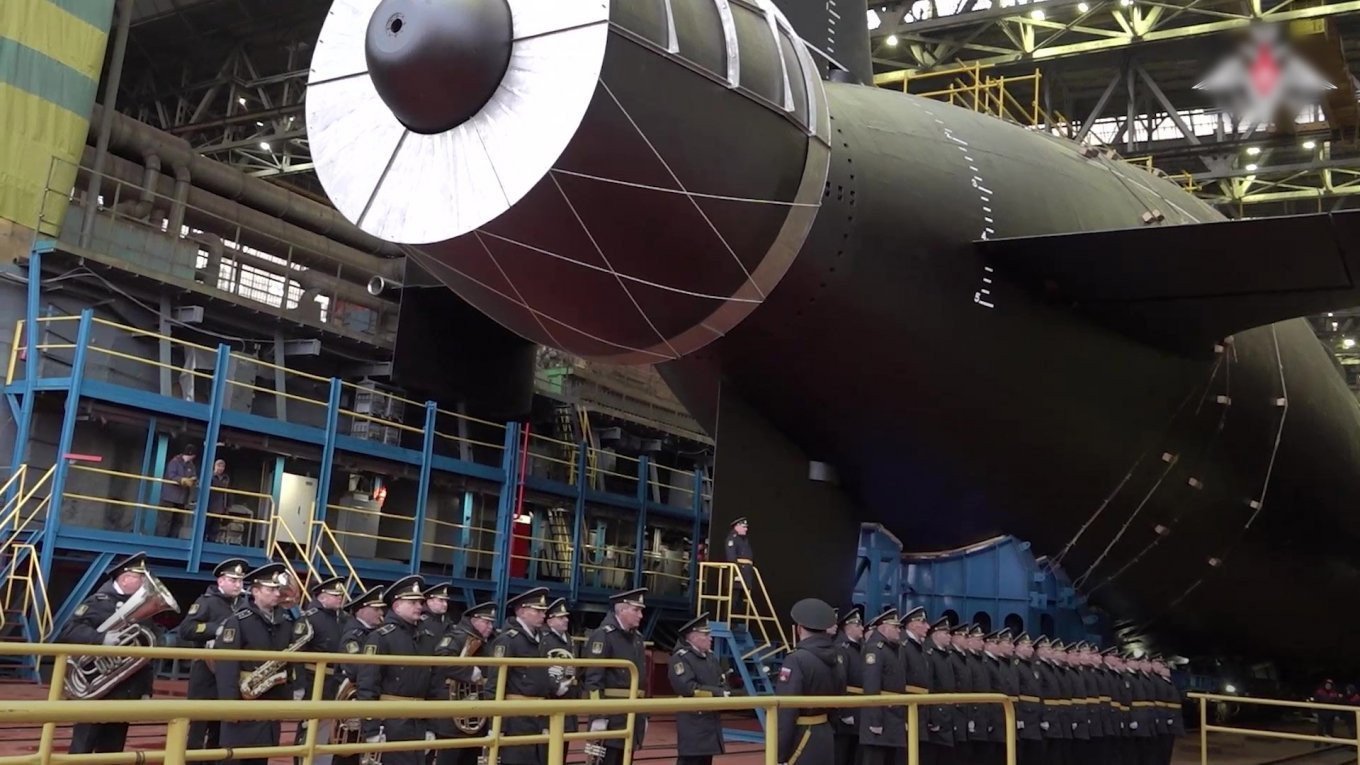
Russia’s newest ultra-secret submarine, the Project 09851 Khabarovsk, appears to be a hybrid design built from two of Moscow’s largest existing submarine platforms and optimized almost entirely around carrying the nuclear-powered Poseidon strategic weapon, naval analyst H. I. Sutton reported for Naval News on May 6.
According to Sutton’s analysis, the submarine combines structural elements from the Borei-class ballistic missile submarine and the Belgorod, the first Russian submarine modified to carry Poseidon nuclear underwater drones.
We bring you stories from the ground. Your support keeps our team in the field.
In practice, H. I. Sutton described the vessel as essentially the “stern of a Borei” merged with the “bow of a Belgorod.”
Although both parent platforms rank among the largest submarines in the world, Khabarovsk is believed to be somewhat shorter because it lacks the central sections found on each design. On Borei-class submarines, that space houses Bulava intercontinental ballistic missile launch tubes, while Belgorod uses it for docking deep-diving submersibles.
Even without those sections, Khabarovsk remains a massive vessel. Satellite imagery and open-source analysis from late 2025 estimate the submarine at roughly 135 meters long and 13.5 meters wide, H. I. Sutton notes.
The nuclear submarine "Khabarovsk" was launched in Severodvinsk, the Ministry of Defense reported.
— Beefeater (@Beefeater_Fella) November 1, 2025
This carrier of underwater weapons and robotic means will successfully accomplish tasks to terrorise the world and expand Russia's interests in the World Ocean, the department… pic.twitter.com/Rcp0c4Ll1Q
The submarine’s forward section reportedly mirrors Belgorod’s configuration, including launch systems for Poseidon torpedoes alongside conventional heavyweight torpedoes. Sutton estimates the submarine may carry up to six Poseidon weapons stored inside two flooded side hangars positioned along the bow.
Those launch compartments are believed to be loaded through massive forward hatches resembling oversized torpedo tubes. Between them sits a smaller compartment for standard torpedoes, though analysts believe the submarine’s conventional combat capability is secondary to its primary mission as a Poseidon carrier.
Naval News noted that the overall internal arrangement resembles Soviet Cold War-era cruise missile submarines and may include a dual-hull or “double-bubble” internal structure to maximize available space around the oversized Poseidon launch systems.
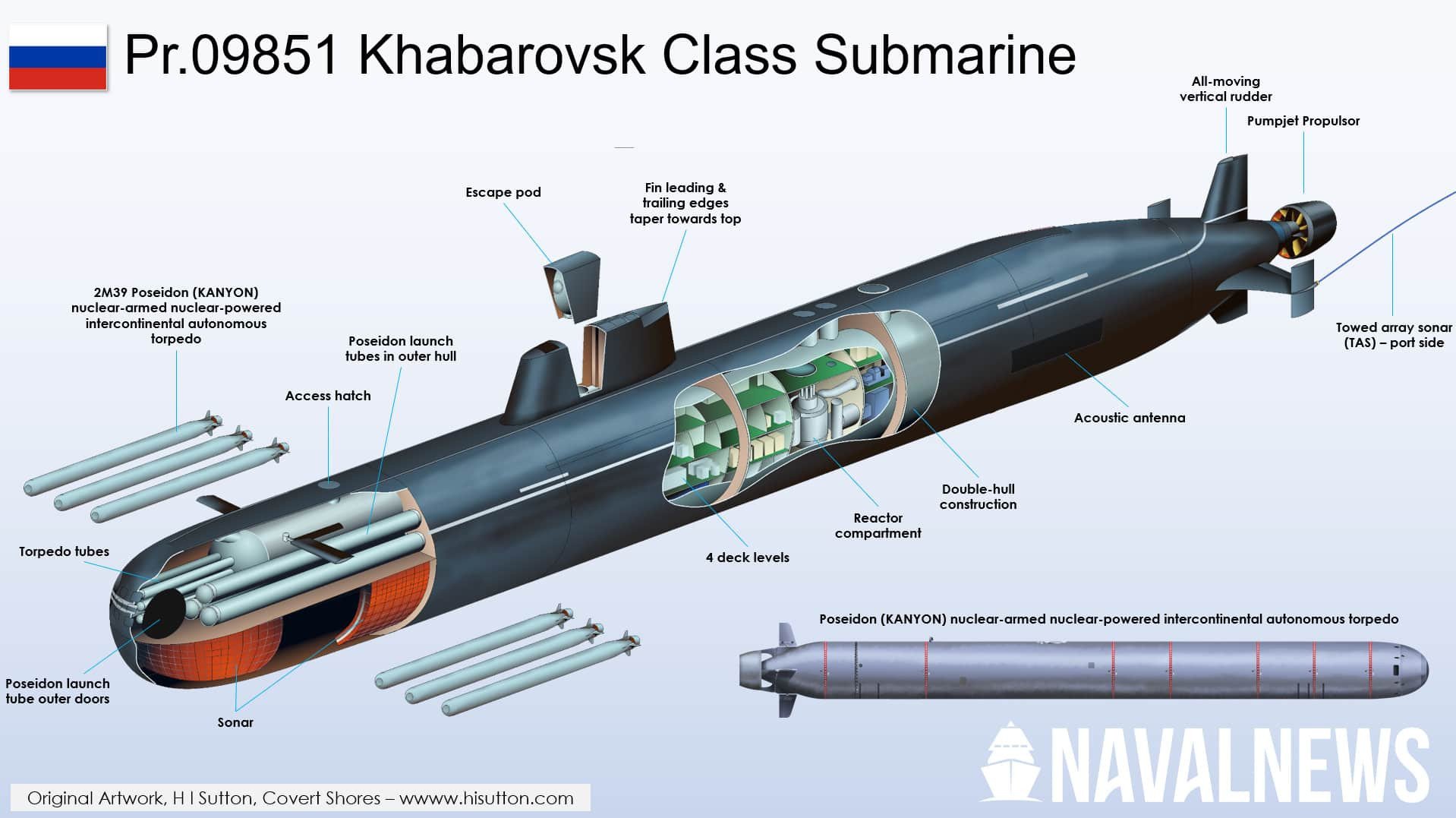
Unlike traditional attack submarines, Khabarovsk appears purpose-built almost exclusively around Russia’s controversial Poseidon weapon program.
Russia unveiled Poseidon publicly in 2018 when the Russian leader presented a series of so-called “invincible” strategic weapons designed to bypass Western missile defenses. Poseidon is described as a nuclear-powered, nuclear-armed autonomous underwater vehicle capable of striking targets at intercontinental range.
Although often referred to as an underwater drone, analysts generally describe Poseidon as a giant nuclear torpedo. Russian officials claim the system can attack coastal cities, naval bases, and even carrier strike groups using either conventional or nuclear payloads.
In late October 2025, Russia claimed to have successfully tested Poseidon’s onboard nuclear propulsion system for the first time. According to Moscow, the prototype operated underwater using its own compact nuclear power plant after launch from a submarine platform.
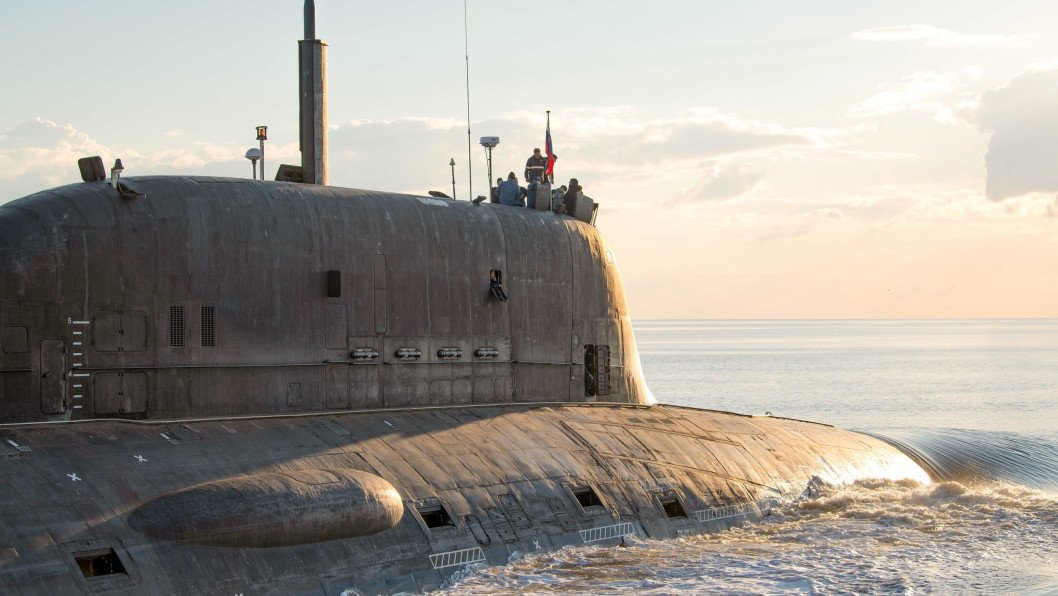
The aft section of Khabarovsk reportedly borrows heavily from the upgraded Borei-A design and is likely powered by an OK-650V nuclear reactor, a system known for relatively low acoustic signatures compared with earlier Russian submarines.
Analysts also noted that the submarine’s emergency escape capsule is positioned inside the sail rather than farther aft, a configuration more typical for Russian submarines despite the sail itself appearing relatively compact for a vessel of this size.
Sutton concluded that Khabarovsk represents an “all-in bet” on the Poseidon program, with most of the submarine’s design sacrifices made to prioritize deployment of the strategic weapon.
While NATO navies continue monitoring the project closely, Naval News noted that Poseidon has not yet fundamentally changed the balance of naval deterrence despite Russia’s efforts to present it as a revolutionary system.
Earlier, Russian leader Vladimir Putin claimed that Moscow successfully tested a nuclear-powered unmanned underwater vehicle known as “Poseidon”, and claimed the system outstrips Russia’s new Sarmat ICBM in power and performance.
Discuss this article:







-bd4f3bab1c9a2691bdd3f19a41246909.jpg "Recruits are inducted into Ukraine’s 144th Special Operations Center on June 29, 2025, in Ukraine.")