- Category
- World
Poland and UK Label Russia as Biggest Threat in Historic New Defense Deal
 Prefer U24 Media on Google
- Authors

-72b63a4e0c8c475ad81fe3eed3f63729.jpeg "Photo of Cyril Barabaltchouk")
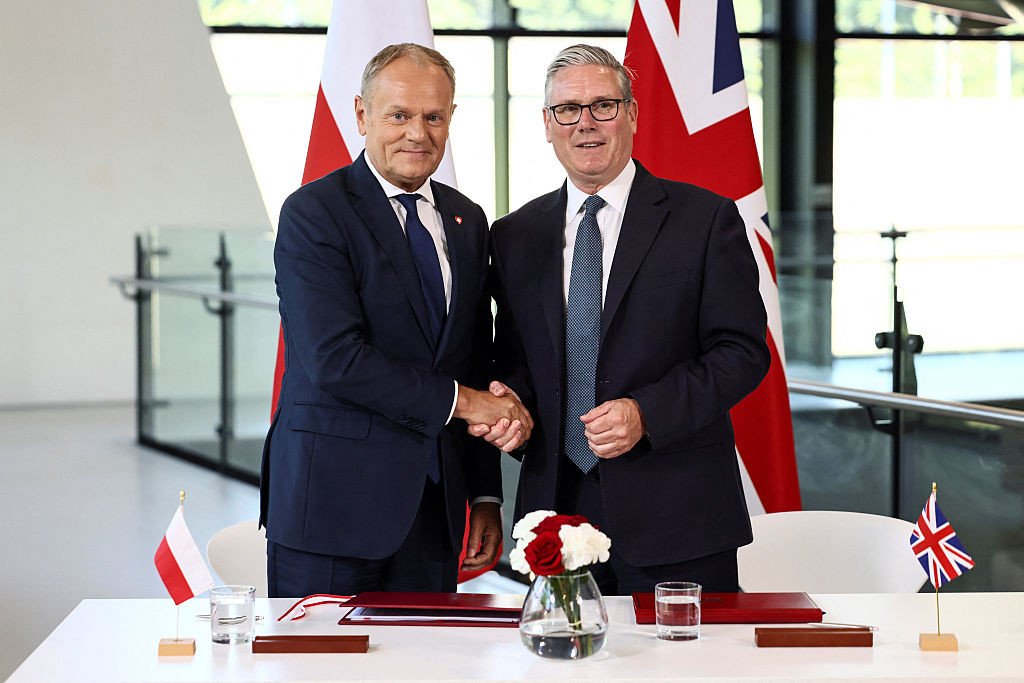
Polish Prime Minister Donald Tusk and British Prime Minister Keir Starmer will sign a historic Security and Defence Partnership Treaty in London, significantly strengthening European bilateral alliances against the Russian threat, Money.pl reported on May 27.
The treaty is part of a strategic action by Warsaw to secure ironclad bilateral defense commitments across Europe. Poland recently finalized a similar partnership with France and plans to initiate another with Germany this coming June.
We bring you stories from the ground. Your support keeps our team in the field.
Before departing for London, Tusk emphasized that the new treaty is designed to elevate Polish-British relations to their absolute highest diplomatic and military level, specifically tailoring cooperation toward containment and active deterrence.
According to Money.pl, Tusk made it clear that while Poland remains entirely committed to the transatlantic alliance, the reality of a potential conflict requires immediate mechanisms that bypass the bureaucratic lag of waiting for unanimous decisions from all 32 NATO members.
“History teaches us that Poland must build credible alliances that will deter possible aggressors and from which practical actions will arise—this is the nature of the treaty between Poland and the United Kingdom,” Tusk stated.
The text of the bilateral treaty explicitly names Russia as the biggest threat to European stability—an inclusion Tusk described as a “significant breakthrough” for framing future military and defense integration between London and Warsaw, Money.pl wrote.
Addressing questions regarding why Poland is pursuing bilateral defense pacts alongside existing NATO Article 5 guarantees, Tusk explained that rapid unilateral or trilateral action could prove critical in the opening hours of a regional crisis. In the event of an attack, Poland can now count on a near-instant military response from London and Paris before a formal alliance-wide consensus is reached.
Furthermore, Tusk noted that Europe must adapt to a changing geopolitical landscape, explicitly acknowledging that the United States is poised to draw down its military footprint on the continent regardless of current transatlantic ties.
“The United States will reduce its presence in Europe anyway,” Tusk warned, as reported by Money.pl. “This is not a surprise, but we also talk about it in cordial relations with our most important ally.”
Warsaw’s strategy hinges on maximizing its own domestic defense spending to guarantee that international allies take its security seriously. By reinforcing its massive domestic military modernization with a lattice of highly reactive bilateral treaties, Poland aims to position itself as a self-sufficient anchor on NATO’s eastern flank.
These bilateral defense agreements follow warnings from Warsaw regarding structural vulnerabilities within NATO. Donald Tusk had recently cautioned that a Russian provocation or attack against an alliance member could occur within “months, rather than years.”
Tusk openly questioned whether the broader alliance—and the United States—remained logistically and politically prepared to execute an immediate response, pointing to a slow allied reaction when roughly 20 Russian drones breached Polish airspace. Emphasizing that Article 5 paper guarantees require a “practical context,” Warsaw’s newly signed pacts with London and Paris are designed to bypass potential consensus delays on the eastern flank.
Discuss this article:
-9a7b3a98ed5c506e0b77a6663f5727c5.png)


-c439b7bd9030ecf9d5a4287dc361ba31.jpg "Photo of Katherina Popilnichenko")