- Category
- Anti-Fake
The Ugly Truth Behind the "Traditional Values" Russia Sells
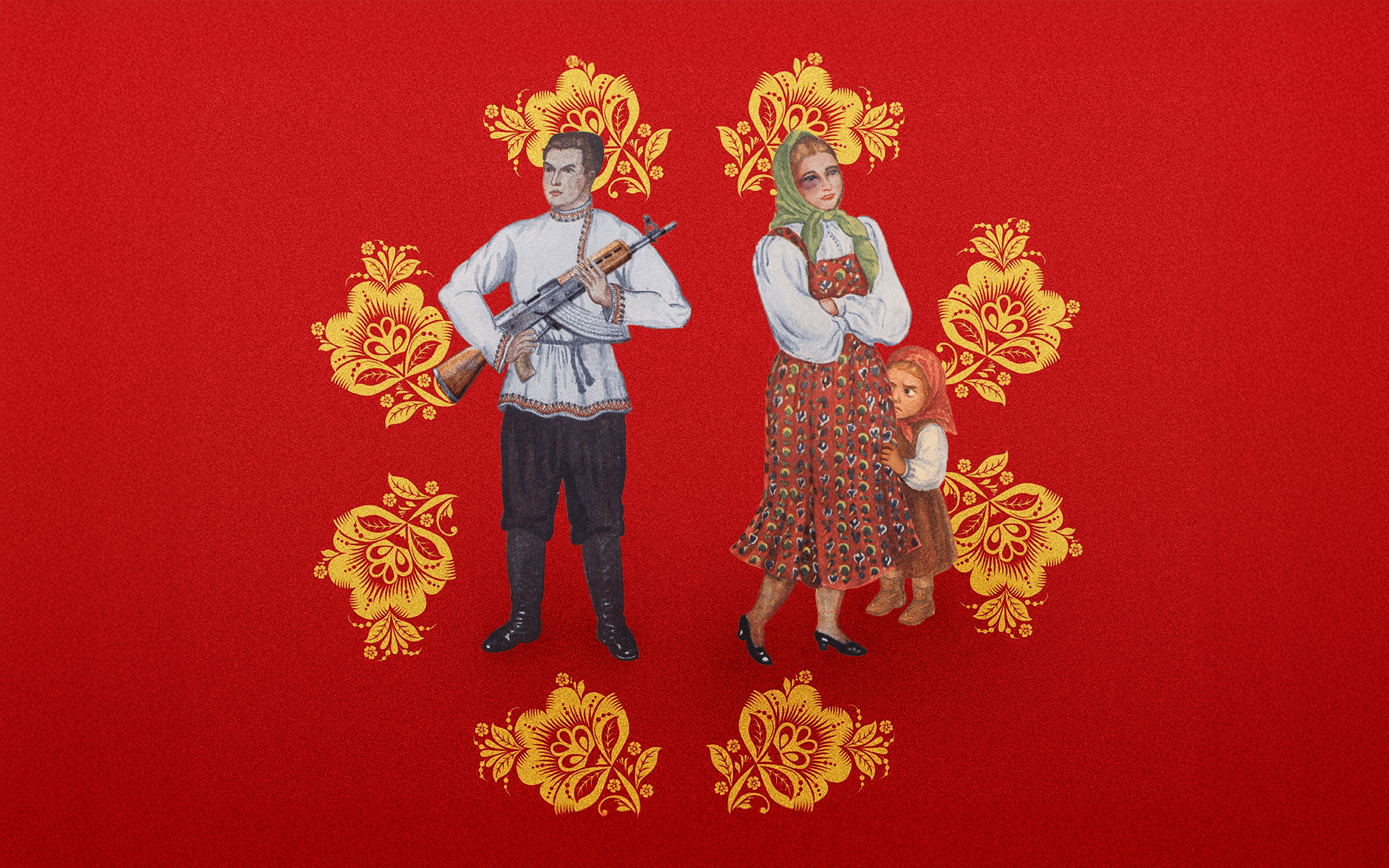
Russia claims to defend “traditional values” like faith, family, and patriotism. Yet it kidnaps children, jails priests, and sends soldiers back to war on crutches.
 Prefer U24 Media on Google
- Authors

-46f6afa2f66d31ff3df8ea1a8f5524ec.jpg "Photo of Jess Daly")
“We will never give up our love for the country, faith, traditional values, ancestral customs, and respect for all peoples and cultures,” Russia’s leader, Vladimir Putin, declared on Victory Day in Moscow’s Red Square, May 9, 2025. “As for the West, it seems to be determined to cancel these millennia-old values.”
A moral “threat”
Russia has long cast itself as a haven for conservatives, guarding “traditional values” that the West has supposedly lost.
But what does the Kremlin brand as “traditional values”? While Putin denounces Western modernity as a moral threat, Russia itself contradicts its supposed ideals: children are abducted from occupied territories of Ukraine, domestic violence is normalized, religious minorities are persecuted, and soldiers’ lives are deemed expendable.
Putin has long sought to institutionalize this rhetoric, even signing a 2022 decree enshrining “traditional Russian spiritual and moral values” as state doctrine—part of a broader narrative casting its war in Ukraine and confrontation with the West as a civilizational struggle.
In August 2024, Putin signed yet another decree offering “humanitarian support” to foreigners who embrace these values and want to move to Russia. Some Western bloggers have jumped on board—promoting their new “traditional” lives online in exchange for hefty payments.
She left the U.S. to prove how great life in Russia is, but things didn’t go as planned. pic.twitter.com/tEk7YkG3MW
— UNITED24 Media (@United24media) July 13, 2025
American blogger Alexandra Jost (“Sasha meets Russia”), for example, repeats this propaganda, trying to depict Russia as “the land of tradition, family, and faith,” claiming that Moscow rejects the “gender agenda” and offers women real choice. Yet the reality is stark: according to reports, a Russian official recently told soldiers’ wives not to speak out if abused by their returning husbands, insisting it was merely a “family matter.”
Behind the ornate rhetoric of family, morality, and spirituality lies a system that uses “tradition” as camouflage for repression and endless war.
Family values
Russia’s claimed traditional family values entail a strong family, protection of life, and support for children.
But the European Court of Human Rights has ruled otherwise—finding Russia guilty of systematically abducting, deporting, and indoctrinating Ukrainian children. At least 19,546 are still missing. Only 1,560 have been brought back.
A Russian woman from Surgut has admitted to repeatedly beating a Ukrainian girl she 'adopted'.
— UNITED24 Media (@United24media) July 31, 2024
"I have been beating her throughout the war and will continue to do so," she says in a video obtained by Ukrainian public human rights organization ZMINA. pic.twitter.com/wKra1TlbvJ
Russia has forcibly taken children from orphanages, killed their parents, split families during filtration processes, created unbearable living conditions in occupied areas, and brazenly kidnapped children from their homes and schools, Bring Back Kids UA reported.
Russian occupation authorities in Ukraine have created an online “catalog” of 294 Ukrainian children listed for adoption, and sorted by physical traits such as eye and hair color. Each child is introduced with photos, age, gender, and character traits, with some labeled as “obedient” or “calm.”
The way they describe our children is indistinguishable from a slave catalog. This is child trafficking in the 21st century, and the world must act to stop it immediately.
Mykola Kuleba
CEO of the Save Ukraine organization
At home, Moscow stages its own theatre. After “partial mobilization” to send Russian men to the war against Ukraine, the “Council of Mothers and Wives” appeared, demanding answers about their relatives' conditions.
Putin staged a meeting with select members in 2022, posing as a defender of families. But when the council’s organizer, Olga Tsukanova, kept pushing for the truth, the police detained her.
By July 2023, the group was labelled as a “foreign agent”—a title that carries heavy bureaucratic burdens, social stigma, and countless legal restrictions, with a possibility of criminal prosecution. “Attentive, respectful attitude towards a woman, a mother is an essential part of our (Russian) traditions,” Putin said on March 8, 2025, in an International Women’s Day address.
Convicted of killing his wife, a Russian soldier now wants back on the front in Ukraine.
— UNITED24 Media (@United24media) July 26, 2025
🧵1/4⬇️ pic.twitter.com/CsQmIUHegw
In reality, Russia’s idea of family values also extends to domestic violence. In 2017, the Russian State Duma—with Putin’s endorsement—decriminalized it. Legally, family members are allowed to batter a victim, such as a wife or child, as long as it wasn’t enough to hospitalise them.
And poverty? Official stats in 2023 celebrated a “historic victory”: less than 10% of Russians living below the poverty line. But an investigation by Insider revealed the truth—the government simply rewrote how poverty is measured. A statistical trick. On paper, Russia looks richer. In reality, its families are growing poorer. Russia changed its poverty‐calculation methodology in 2021.
Before that, the poverty line was directly tied to the cost of food and essential goods; now it is based on relative income—specifically, the median per capita income in each region, adjusted by “regional coefficients.” These coefficients mean that poorer regions set a lower threshold for what counts as “poor.”
As a result, fewer people qualify officially—even though real incomes, inflation, and the cost of living have worsened. Insider calculated that using older methods of calculation, there would be at least an additional 2.3 million poor in Russia.
Religious freedom
Russia claims to defend “family values”—respect for heritage, religion, and diversity. In practice, priests are jailed for anti-war sermons, and minority faiths are outlawed.
The Kremlin has turned the Russian Orthodox Church (ROC) into a propaganda machine. Its leader, Patriarch Kirill (Vladimir Gundyaev, a former KGB officer), brands the war against Ukraine as a “holy war.” He accuses Kyiv and the West of “Satanism,” while ROC networks run espionage operations across Europe. Currently, 61.8% of the population follows the church, making it a useful tool for bolstering regime support, the Australian Institute for International Affairs reported.
Inside Russia, opposing the war is treated as heresy. Pacifism is declared incompatible with Orthodoxy, “clearly discredit the activities of the highest church authorities,” and cause “harm to church unity.” Priests who refuse to glorify aggression face fines, exile from the clergy, or imprisonment. Since 2011, clergy cannot even resign freely—only on medical grounds.
The ROC has seized over 1,600 parishes and 23 monasteries in occupied Ukrainian territories, pressuring clergy to collaborate and suppressing independent Ukrainian churches.
Some in Russia resisted at the start of the full-scale invasion, but most now face persecution. In Germany, a Russian priest launched “PEACE TO ALL”, a project to support clerics punished for anti-war views after nearly 300 priests signed a March 2022 appeal to Russian authorities for peace and a ceasefire.
“Putin claims: ‘They will die, and we will go to heaven as martyrs.’ I must disappoint anyone who believes this lie. Only peacemakers enter heaven. Ukraine never attacked Russia.”
A former priest of the Russian Orthodox Church
Hieromonk Ioann Kurmoyarov received three years in prison for “spreading fakes” about the army. Beyond the ROC, Russia enforces severe religious repression. Catholics, Protestants, Jehovah’s Witnesses, Ukrainian Christians, and Crimean Tatar Muslims are deemed as threats to its control.
Since February 2022, at least 67 clergy of different faiths have been killed, many in occupied territories. Within Russia, more than 350 Muslims have been prosecuted for alleged ties to Hizb ut-Tahrir , despite no proof of violence. Sentences reach up to 15 years.
Moral integrity
Russia claims to stand for truth, honesty, and justice. In reality, it is one of the world’s most corrupt major economies, where a small elite thrives while ordinary citizens suffer.
Since early 2025, more than 100 senior regional officials—including vice-governors, deputies, and regional ministers—have been investigated for bribery, fraud, and abuse of office, enriching themselves while ordinary Russians bear the cost of war.
Deputy Defense Minister Timur Ivanov, was living a life of luxury: lavish parties, foreign trips, elite real estate—and was even listed by Forbes as one of the wealthiest figures in Russia’s security apparatus. He profited from construction contracts in temporarily occupied Mariupol through embezzlement and pilfering state funds.
Dmitrii Ovsiannikov, former governor of the occupied city of Sevastopol, used sanction evasion to secure a life in the UK despite being sanctioned since 2017. Ovsiannikov received large sums of money from his wife, lived in his brother’s home in London, drove a luxury car, and sent his children to private school—until his arrest in April 2025 for deliberately violating UK sanctions.
Policitian Dmitrii Ovsiannikov is the first to be convicted under Russia sanctions. Here's Ovsiannikov getting nicked https://t.co/58rLsmNM3p pic.twitter.com/KSQt0uSJ3M
— CourtNewsUK (@CourtNewsUK) April 10, 2025
Transparency International (TI) ranks Russia 154th out of 180 countries for corruption. In 2023 alone, more than a quarter of Russians using public services admitted to paying bribes. Since launching its full-scale invasion of Ukraine, the Kremlin has stripped away checks and balances, deepening authoritarianism and enabling corruption at every level.
State-controlled energy giants fuel this system. At home, they shield the elite from accountability. Abroad, Russia uses energy as a geopolitical weapon—cutting off gas, hiking prices, and destabilizing neighbours like Moldova to spread authoritarian influence.
Patriotism
“Patriotism consists of love for family, small homeland, and country,” Putin claims. In practice, his “patriotism” means sending soldiers as cannon fodder, feeding a mafia-like funeral industry that thrives on mass death.
Since 2022, more than 120,000 Russian troops have been killed, with total losses—including wounded, captured, and missing—estimated at nearly 1 million personnel. Yet, Putin calls this sacrifice patriotic.
The Kremlin now routinely sends wounded soldiers back into combat, sent to fight against Ukraine on crutches. What began as desperation is now policy—a systemic strategy to sustain offensive operations despite catastrophic losses.
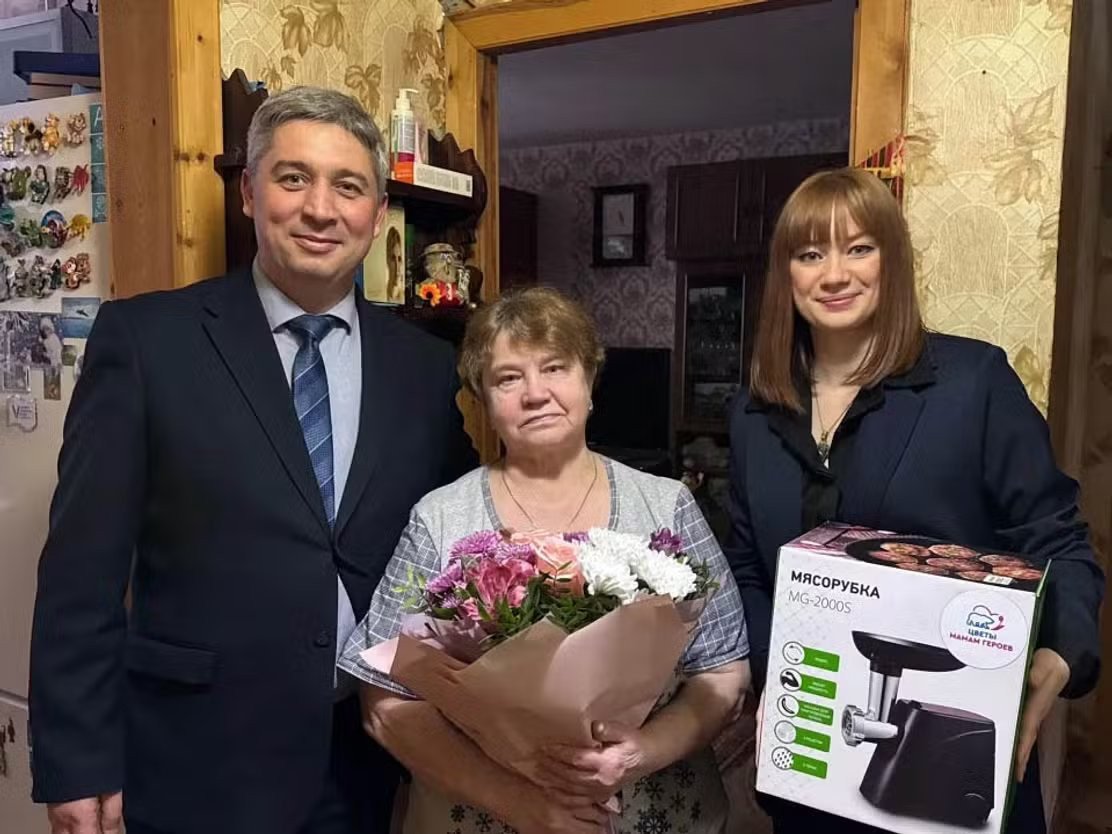
Families, meanwhile, are rewarded with grotesque “gifts” in exchange for their sons’ and husbands' lives. As part of a campaign called “Flowers for the Mothers of Heroes,” parents were handed meat grinders and bouquets. “Meat grinder” is a term used to describe Moscow’s troops thrown onto the frontline and killed in extremely high volumes.
Towels, potatoes, even a multi-cooker wrapped in paper reading “life” have been given to grieving families.
Putin’s idea of patriotism also extends to indoctrination. Ukrainian children abducted from occupied territories are forced into camps and military schools, stripped of their language, culture, and identity. They are raised to serve Russia’s war machine—trained, conditioned, and eventually deployed against their own country
In classrooms, Ukrainian curricula are erased and replaced with Russian textbooks. Weekly indoctrination sessions, “Conversations About the Important,” glorify war and militarism, preparing children to fight under the name of “Russian patriotism”.
This pipeline is reinforced by Yunarmiya—the “Young Army” launched by Russia’s Defense Ministry in 2016. Marketed as a youth movement, it is, in fact, a militarized training system. Children as young as eight swear loyalty to Russia, promise to “defend its interests,” and begin combat training in firearms, tactics, drones, and more.
Since 2024, every Russian school—including those in occupied Ukraine—must establish youth army or cadet classes starting in the fifth grade. Nearly 30 million children are already undergoing or have completed militarized training.
Putin once said that he believes liberalism has “outlived its purpose” and “become obsolete.” Donald Tusk, Poland’s Prime Minister, responded, “Whoever claims that liberal democracy is obsolete also claims that freedoms are obsolete, that the rule of law is obsolete, and that human rights are obsolete.”
Discuss this article:
-c439b7bd9030ecf9d5a4287dc361ba31.jpg "Photo of Katherina Popilnichenko")

-206008aed5f329e86c52788e3e423f23.jpg "Photo of Oleksandr Moiseienko")
-72b63a4e0c8c475ad81fe3eed3f63729.jpeg "Photo of Cyril Barabaltchouk")