- Category
- Culture
At Art Basel Paris, Nikita Kadan Brings Ukraine’s War to the Heart of the Art Market
 Prefer U24 Media on Google
- Authors

-554f0711f15a880af68b2550a739eee4.jpg "Photo of Lucile Brizard")
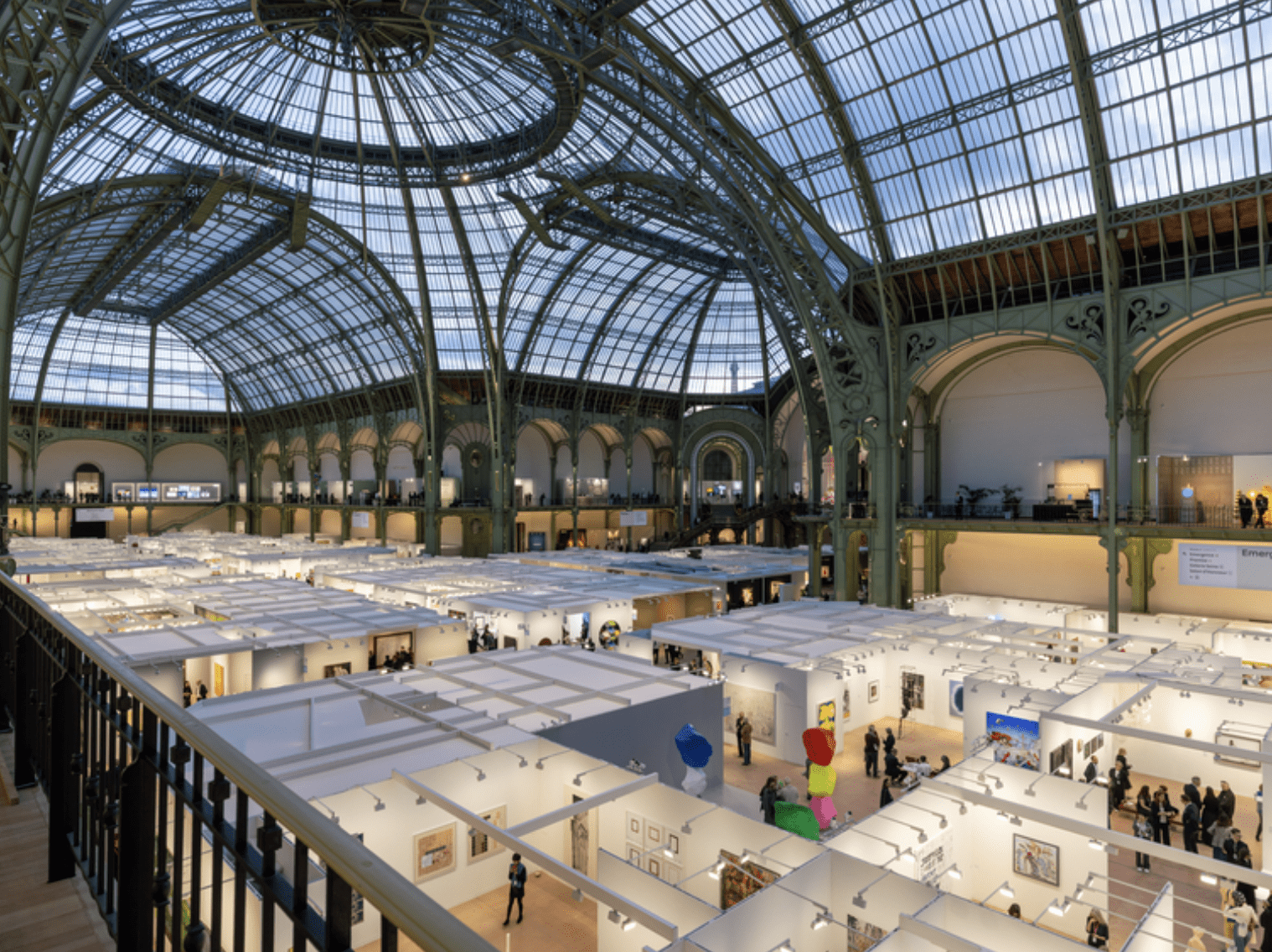
As Paris positioned itself as a capital of contemporary art, one booth at Art Basel offered something different: reflection over spectacle. Ukrainian artist Mykyta Kadan stood out with a solo project presented by Voloshyn Gallery (Kyiv) and Galerie Poggi (Paris). Rooted in the experience of war, his drawings, sculptures, and installations explored how Ukraine’s recent history shapes its deeply grounded art scene.
Art Basel Paris opened its doors to the public on October 24. The newly restored Grand Palais hummed with its usual mix of anticipation and performance. Collectors, curators, and dealers moved through the aisles of what has newly become one of the world capitals of contemporary art. Amid the frenzy, one booth stood apart: a collaboration between Voloshyn Gallery (Kyiv) and Galerie Poggi (Paris), presenting a solo project by Ukrainian artist Mykyta Kadan.
The exhibition, rooted in the ongoing war against Ukraine, examines how a nation imagines itself through ruin. His drawings, sculptures, and installations question the ways modernism, violence, and faith intersect.
Born in Kyiv in 1982, Kadan belongs to a generation shaped by the post-Soviet transition and war. A co-founder of the Revolutionary Experimental Space collective and the curatorial group Hudrada, he has long blurred the boundaries between art, activism, and research.
Nikita Kadan at Art Basel Paris: a booth that refuses spectacle
For Voloshyn Gallery and Galerie Poggi, Kadan’s inclusion marks a milestone. It places Ukrainian contemporary art squarely within Europe’s premier art-market stage, not as a gesture of solidarity but as part of a shared discourse on violence, modernity, and image-making.
The centerpiece—a monumental charcoal work titled Shchekavytsia Mountain—takes its name from a Kyiv hill linked to one of the city’s legendary founders, Shchek of the Polyanian tribe. In 2022, as nuclear threats circulated on Russian state television, Ukrainians online began joking about hosting an “orgy on Shchekavytsia” in the event of an attack. The meme became a collective coping mechanism.
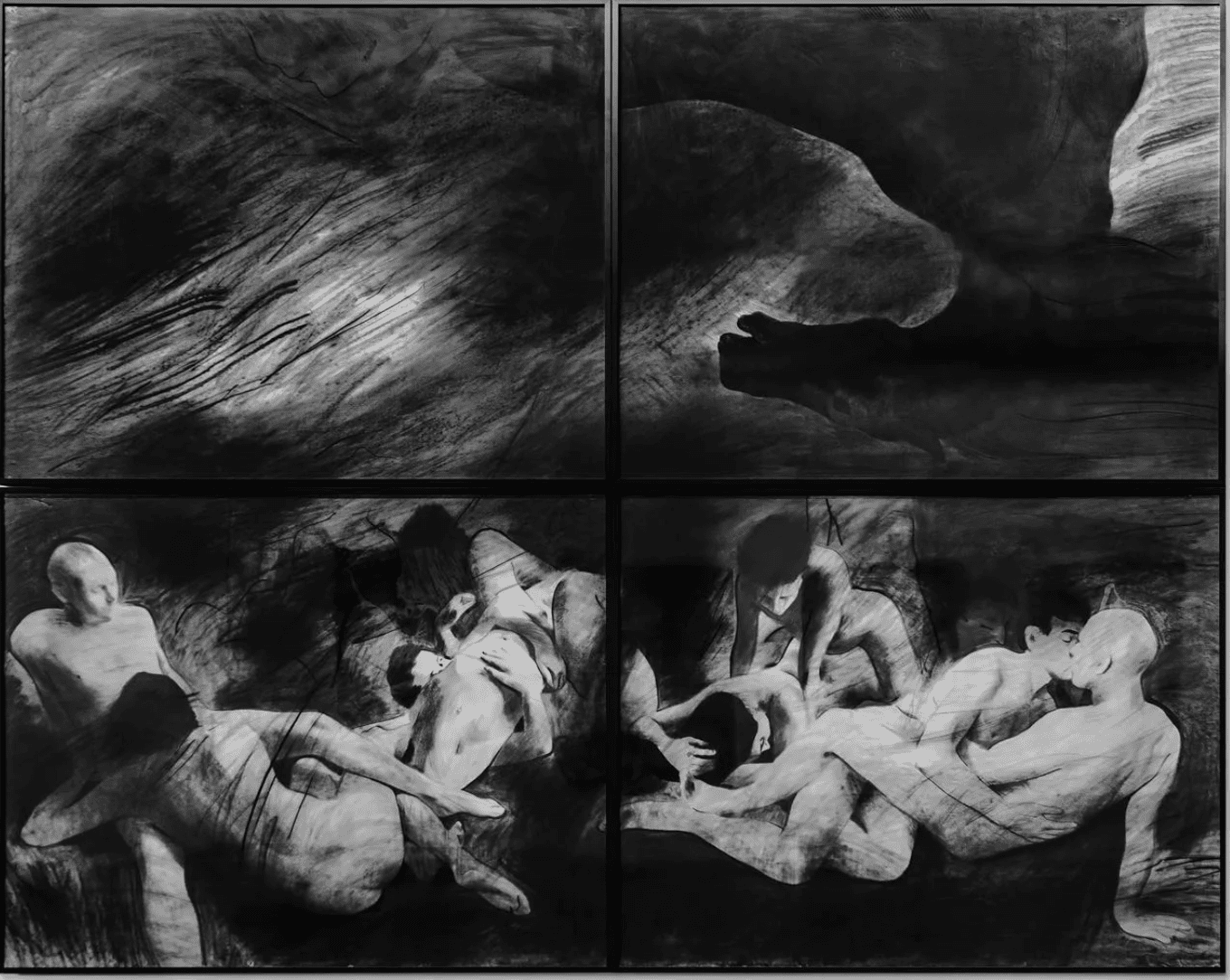
Kadan translates that moment of dark humor into a large-scale allegory. The drawing depicts a realized version of the imagined scene, both mythic and romantic. It functions as a national painting that refuses heroism, gesturing instead toward readiness.
The installation expands outward through several new works that trace a decade of war. 2015-2025, a pair of flag-like sculptures, which merge fragments of a shot-up GAZ truck found near Siverskodonetsk with a shrapnel-pierced kettle recovered from Ukraine’s east. Together, they form a material chronicle of conflict.
The artist’s ongoing Universal Ruin series extends this dialogue globally: charcoal drawings of wrecked buildings in Borodianka (a town in Kyiv region that suffered heavy destruction during Russia’s invasion in 2022) layered with black-and-white photographs of modernist icons like Giacometti’s Female Head and Brâncuși’s Table of Silence.
A smaller piece, Kharkiv Region Sculpture, made from a torn road sign mounted on marble, abandons collective symbols altogether. It represents no flag, no nation, only a wounded surface and an unnamed origin. Across Kadan’s works, craters recur—in ground, in metal, in memory. They suggest that the landscape itself has become a memory, scarred and expressive.
Contemporary Ukrainian art finds a stage in one of Europe’s art capital
The timing is telling. Art Basel Paris has weathered crises in each of its previous years: a nationwide strike in 2022, the aftermath of the Hamas attacks in 2023, and leaks at the Grand Palais in 2024. None of it has dulled the fair’s allure. Paris, now firmly positioned between London’s market mindset and Basel’s elitism, thrives on this tension between commerce and thought.
The city’s art week coincides with a cascade of major openings: Gerhard Richter at Fondation Louis Vuitton, the new Fondation Cartier site, and Offscreen Paris, where fellow Ukrainian duo Yarema Malashchuk and Roman Khimei present their video work You Shouldn’t Have to See This.
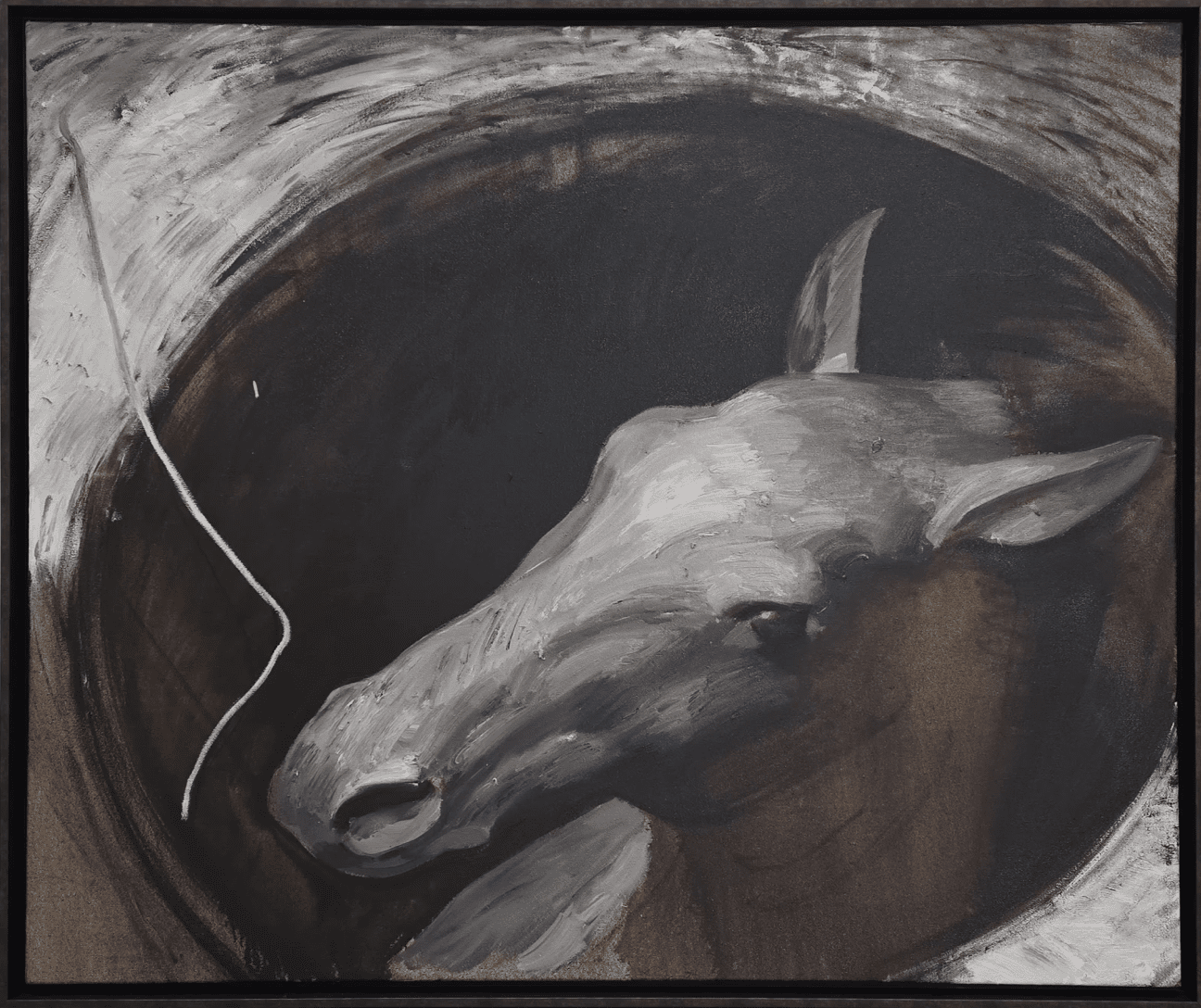
Within this crowded landscape, Kadan’s presence feels both timely and corrective. His art refuses abstraction for abstraction’s sake; it insists on the visible consequences of politics. For many visitors, his booth provides a moment of suspension—a reminder that not all images are exchangeable commodities.
The drawings’ ash tones and salvaged materials create a visual silence that resists the noise of record-breaking sales, like the $11.5 million Julie Mehretu sold by White Cube or Pace’s $10 million Modigliani earlier in the week.
In interviews, Kadan has described art-making as “a daily act of non-defeat.” His recent pieces, including those shown in Paris, merge local trauma with universal imagery—proof that contemporary Ukrainian art can no longer be confined to geography.
By October 26, as Art Basel Paris closes, most headlines will likely focus on sales figures and celebrity collectors. Kadan’s exhibition lingers as an alternative.
Discuss this article:
-4a56a6b482ec132402c16ef6fcabf9a2.png)


-e00d178a31a987cd514e15ad3a8c2131.jpeg "Max Klymenko wearing the Etnodim, featuring embroidery inspired by traditional Ukrainian crafts. (Source: Ian Treherne)")
-e88c01988249cd60b6f04f79d29156b7.jpeg "Damage to “Cosmogony,” the largest painting in Ukraine, following a Russian drone attack on Lutsk on October 13, 2026. (Source: @sashyyna/Instagram)")
-480d70a36b9b34492b0b32ca04af4489.jpg "People attend the funeral ceremony of the famous Ukrainian writer Victoria Amelina at the Garrison Church, in Lviv, Ukraine, on July 5, 2023. (Source: Getty Images)")