- Category
- Interview
Russia’s Shadow Fleet Is a Growing Threat in the Baltic Sea. Can Europe Stop It?
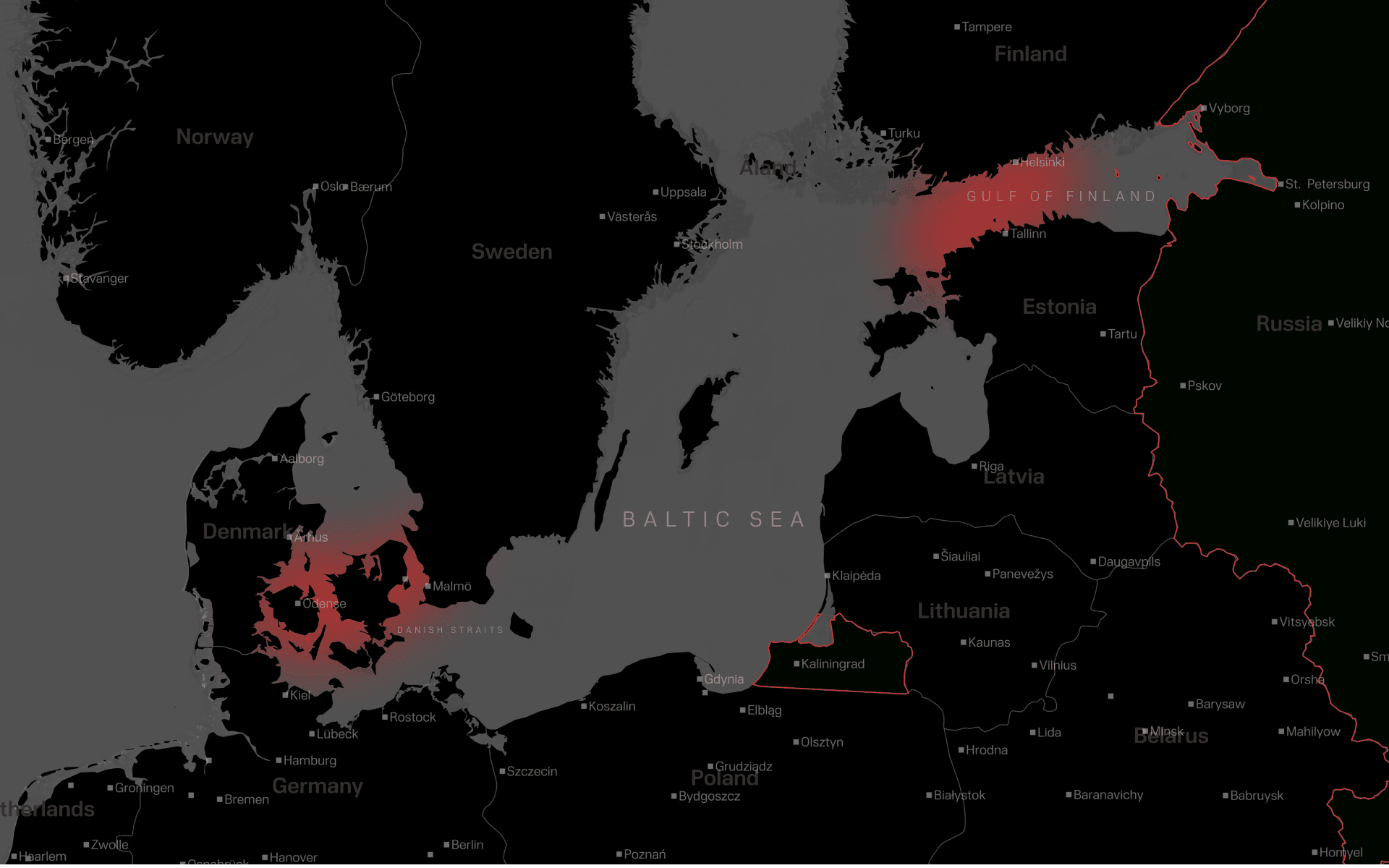
As Russia exports record levels of crude oil through its so-called “Shadow Fleet,” consisting of poorly insured, improperly maintained, ships and operating in violation of international maritime law. As a result, security concerns in the Baltic Sea are rising. Could the fleet be restricted—or even blocked—from operating there?
 Prefer U24 Media on Google
- Authors

-605be766de04ba3d21b67fb76a76786a.jpg "Joseph Place")
Russia was supposed to lose its ability to export oil after Western sanctions targeted its energy sector. Instead, it built a workaround: a sprawling network of aging tankers known as the “Shadow Fleet,” moving crude across the world while hiding ownership, insurance, and sometimes even the ship’s identity.
The percentage of Russian oil that was transported by the shadow tanker fleet is high. It varies between 60% (Brookings’ estimate) to 80% (S&P’s estimate). The fleet has potentially over 1200 vessels, either controlled by Russia, allies like Iran or China, or independent states, but often bearing false registrations, flags, and improper insurance. Official shipping via the Russian state shipping company Sovcomflot in 2025, becoming no longer profitable, at the same time.
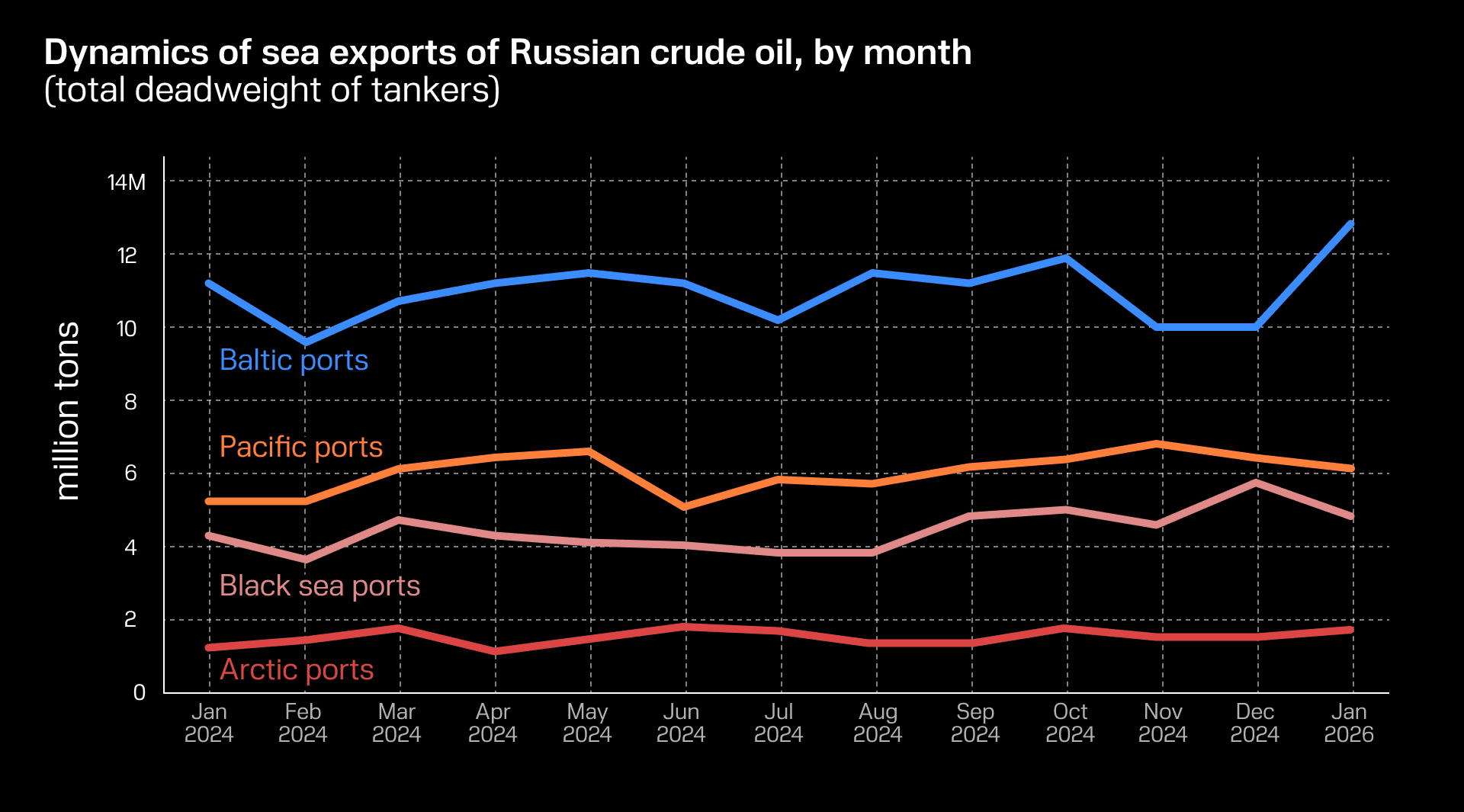
Nowhere is this system more visible than in the Baltic Sea. By early 2026, nearly half of the crude leaving Russia’s Baltic ports was transported by sanctioned vessels, pushing exports through the region to record levels. Fires and sudden damage to undersea infrastructure indicate that the Shadow Fleet is also becoming a security threat in one of Europe’s most strategically sensitive seas.
So what can actually be done about it? Could Baltic nations restrict or even block this traffic?
The blockade in the Baltic Sea
We spoke to two experts: Meelis Oidsalu, former Estonian Defense Minister and security expert, and Julian Pawlak, Senior Associate at the German Institute for International and Security Affairs.
They discussed the rise of Russia’s “Shadow Fleet” in the Baltic Sea, the challenges in tackling it, the legal challenges it poses, and the threats it poses to European security. They also assessed whether a blockade would be feasible and what other options Europe may have to address the problem.
What are the major concerns about Russia’s Shadow Fleet?
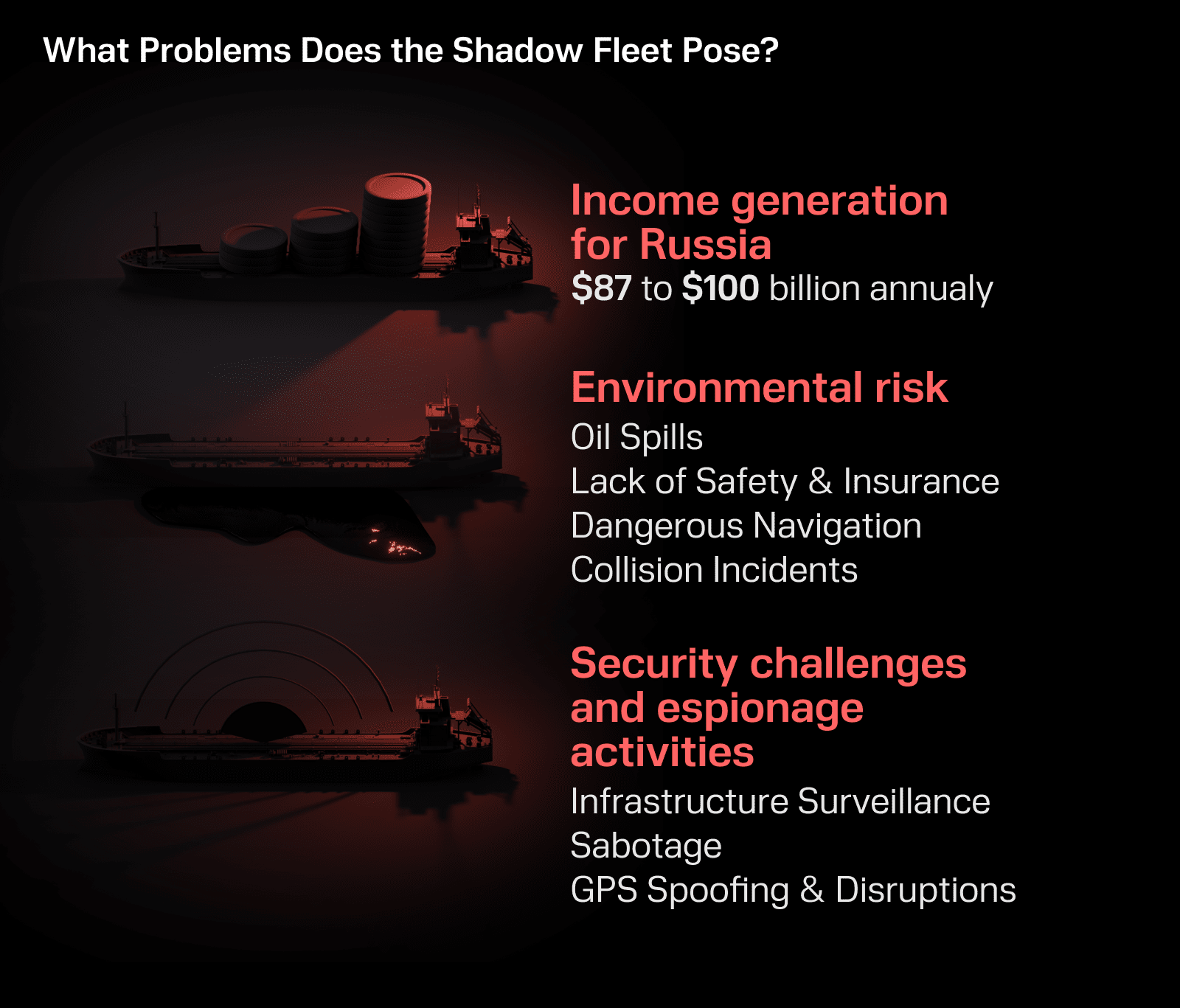
“Shadow Fleet is a main instrument to continuously generate income via exporting and selling crude oil, oil products, and other goods,” says Pawlak. “Russia is able to circumvent sanctions and continue its war efforts against Ukraine.” Then, there is a matter of the tankers themselves. Pawlak explained:
The vessels used are often old, of bad maintenance, not sufficiently insured, and part of opaque ownership structures…They represent floating environmental risks: an accident with an oil tanker in the small Baltic Sea would have immense environmental consequences.
Julian Pawlak
Senior Associate at the German Institute for International and Security Affairs
Russia deliberately buys older ships, at a lower cost, and their average age is 40 years old.
Thirdly, the direct threat. “These vessels can be used to conduct espionage and sabotage under the guise of freedom of navigation,” Pawlak says.
How have the European governments responded so far?
“When Germany made a rare move on January 10 and blocked the entrance of the ‘zombie tanker’ Tavian to the Baltic Sea, that was actually initiated by Greenpeace,” says Oidsalu. “Baltic Sea governments do not pull their weight when it comes to environmental protection in the Baltic. That applies sadly to sanctions evasion and seabed infrastructure protection.”
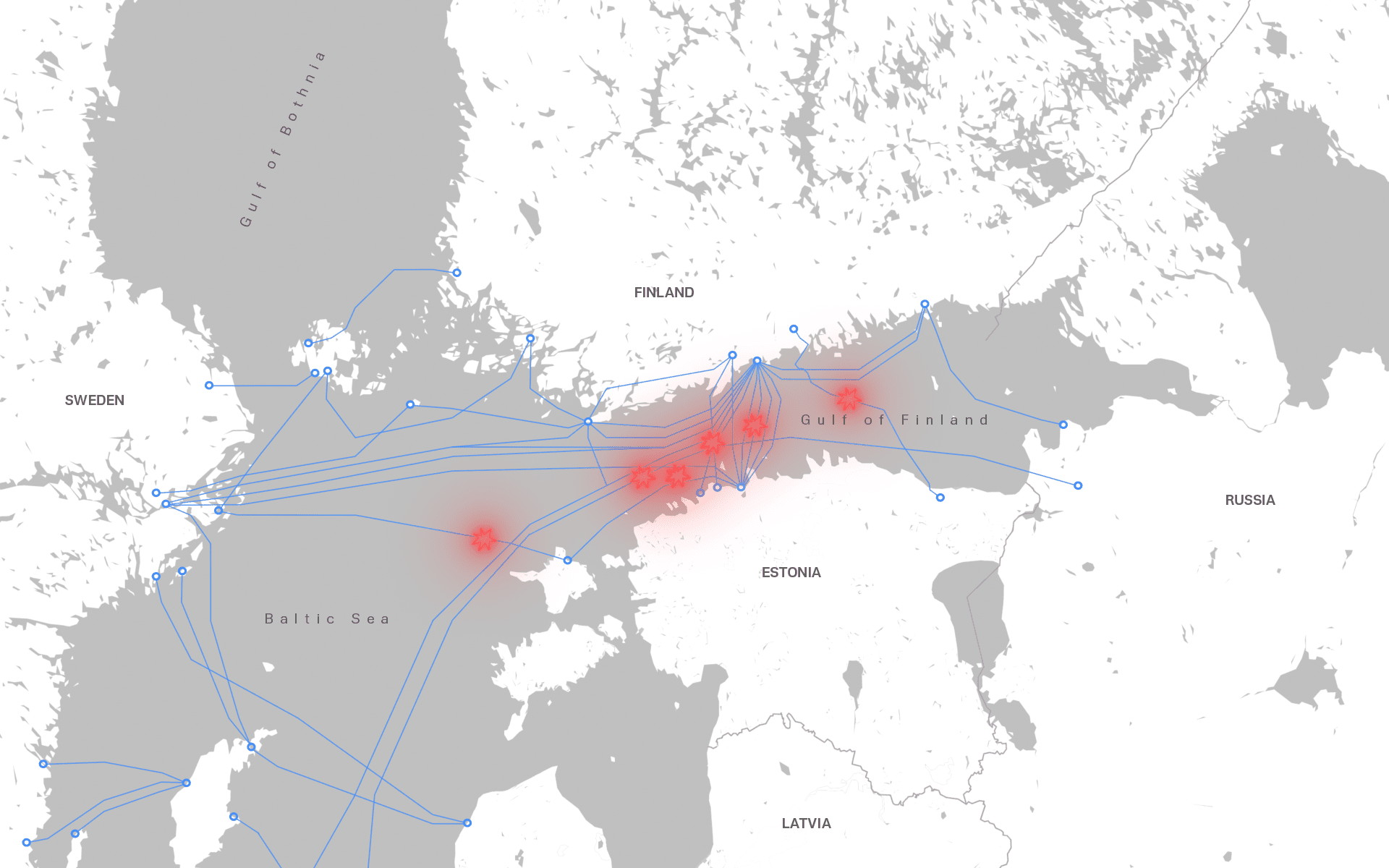
The consequences, he notes, can be costly. Estonia alone has suffered at least €200 million ($232 million) in damage from incidents involving power cables, data lines, and gas pipelines. “But for some reason,” he says, “the cables keep breaking.”
European governments have acknowledged the problem, as 14 countries issued a joint warning letter on January 27, calling for tighter control over Russia’s shadow fleet.
“But, the governmental sources told us there was no actual plan for escalation,” says Oidsalu. “Shadow Fleet vessels are rarely intercepted, even in cases where there is a clear legal basis.”
How severe is the security threat of the Shadow Fleet?
Security concerns in the region continued to grow over the years, says Oidsalu. Finnish military intelligence reported that the region’s security situation severely deteriorated in 2025, including drone-related airspace violations, which have affected air transport infrastructure in the region, such as Denmark, Norway, and Germany, where drones were used to disrupt air traffic and security risks. This is in addition to warnings from Finnish intelligence about further attacks on undersea cables.
“Discussions often talk about sanction evasion, but the use of such vessels for acts of sabotage and beyond is real,” says Pawlak. “Taking the perspective from a security and defense lens is crucial to identify the given threat potential.”
Since the Nord Stream pipeline sabotage, “There have been another 16 undersea—power or data—cables and one gas pipeline damaged in about 10 separate incidents,” Oidsalu says. Figures do differ; however, there is a significant number of incidents suspected of being sabotage.
“This is no crisis,” he says. “It is a slow-cooking undersea war we have here in the Baltic Sea.”
Can these incidents be linked to Russia?
“Finnish military intelligence was the first one to publicly acknowledge that Russia is behind the cable sabotage operations in the Baltic Sea,” says Oidsalu. But, “Western intelligence agencies have not been willing or able to attribute drone flights to Russia or its shadow fleet vessels,” says Oidsalu. “Though OSINT and other investigative reporting have produced plausible, evidence-based hypotheses. Whether the lack of official attribution reflects policy considerations or limitations in intelligence capability is uncertain.”
Some governments have been more cautious about attributing responsibility, Oidsalu says, because hybrid warfare relies on plausible deniability and concealing who ordered an attack.
However, “No such incidents have occurred before 2022,” he adds. “And now they come in volume.”
What’s the key distinction between legal and illegal shipping in the region?
“Sanctions are not necessarily globally binding, hence such trade or buying oil is not per se illegal,” explained Pawlak. “It only is, for instance, for companies in the EU, the UK, or the US, if sanctions are being imposed by themselves.”
“In practice, ‘legal vs illegal’ [shipping] is less about whether a ship carries Russian cargo and more about the legal regime of passage,” says Oidsalu. “Secondly, compliance, identity, and insurance status. There has been a sharp rise in identity and document fraud, such as forged or ‘zombie’ IMO numbers or totally made-up, invented IMO numbers.”
But determining whether a vessel is acting illegally is often more complicated than it appears, says Oidsalu.
“There is also the flag-switching problem,” he adds. “Vessels that sail under the flag of only one state and vessels that sail under the flags of two or more states, using them according to convenience, may be treated as a ship without nationality, according to UNCLOS Article 92 . One could say that the Baltic Sea governments should be obliged to intercept such a ship, but this is not done.”
There is also the matter of insurance.
“Last year, 56% sanctioned tankers moved outside generally acceptable insurance coverage, which is a major red flag for the enforceability of liability if a disaster occurs,” Oidsalu says. Others bear the costs of accidents such as fires and oil spills, as happened in Malaysia when a Russian tanker collided with another ship and spilled oil.
Russia is exporting record levels of oil through the Baltic. Why has it increased recently?
“In short, sanctions tightened, but Russia’s workaround capacity scaled up faster than enforcement,” says Oidsalu. “The Baltic route is structurally crucial: up to 60% of Russia’s seaborne crude exports are transported through the Baltic Sea and the Danish Straits. Crude exports from Baltic ports were up 4.5% year on year in November 2025; oil products exports were up 17.7% month on month in November, though down year on year.”
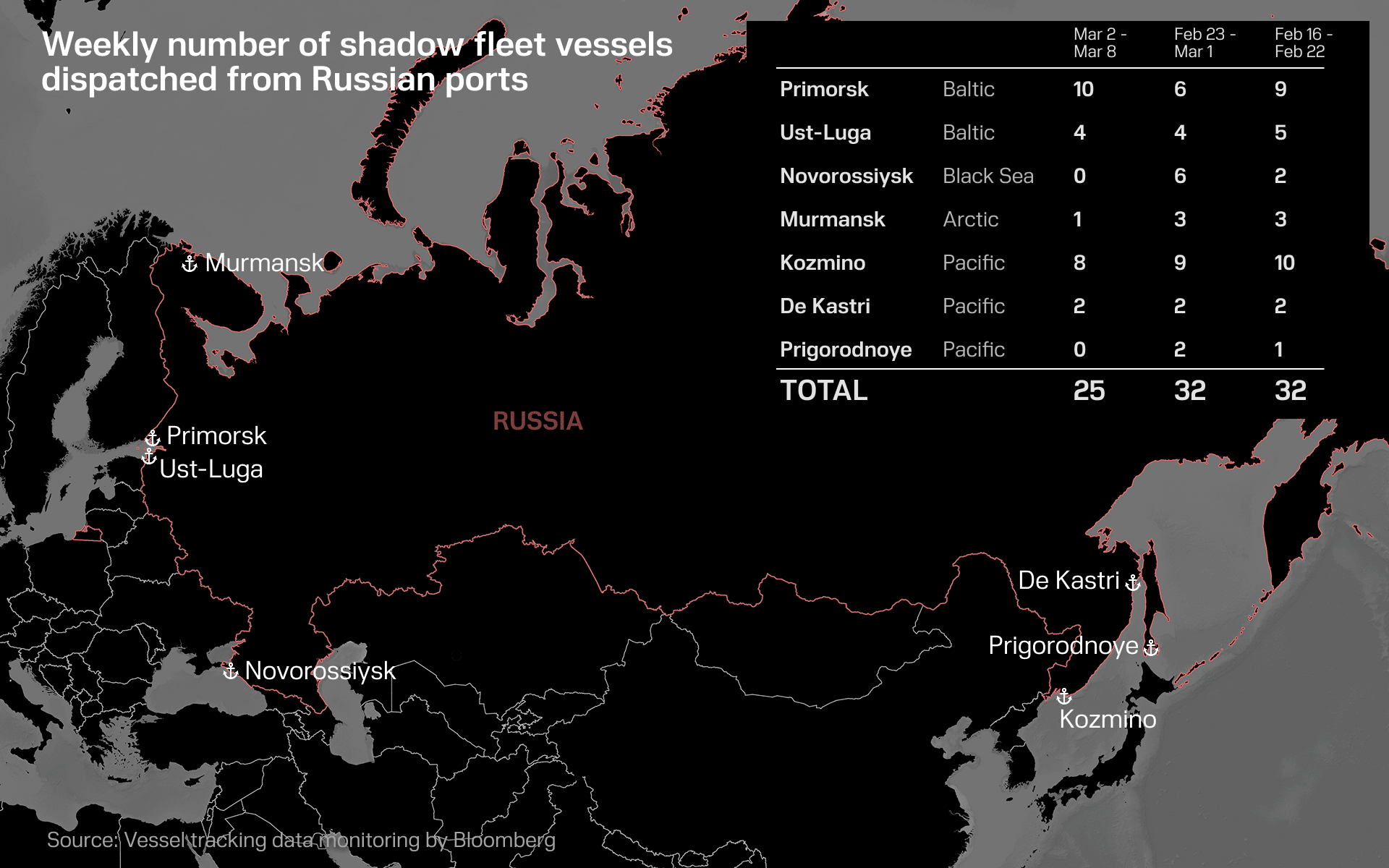
It is not just sanctions, however, it is geography and access, explained Pawlak:
“Before Russia’s full-scale invasion, the Black Sea had been the main maritime export route for crude oil and oil products from the Russian Federation. The Ukrainian potential to threaten local sea lines of communication and deny Russian shipping access to large parts of the Black Sea forced the Russians to seek other routes. For some time now, the Baltic Sea has represented the main Russian line of maritime oil exports.”
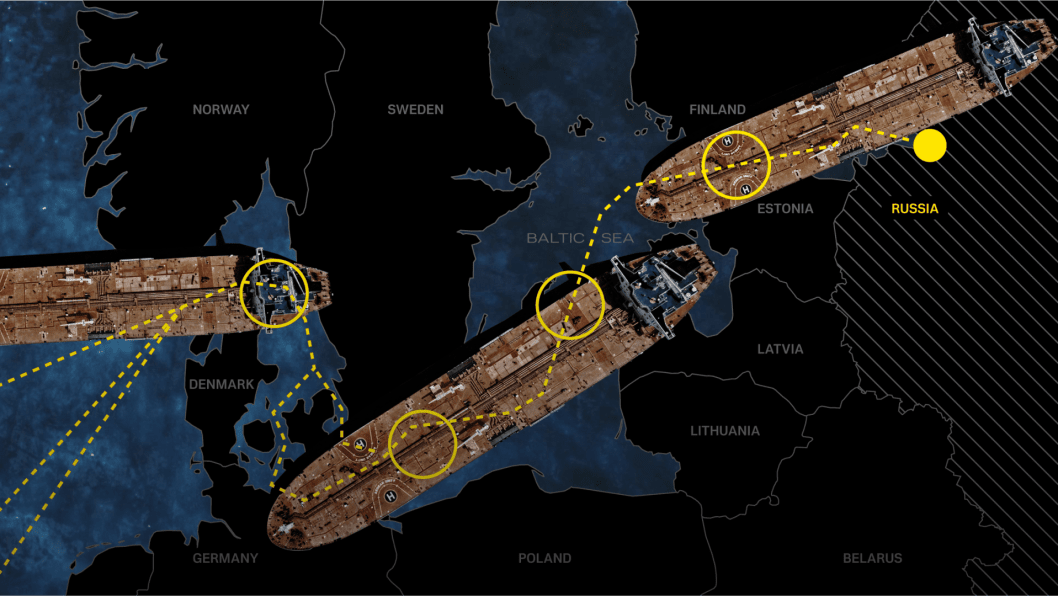
Why have NATO and European nations been unable to curb the shadow fleet and illegal maritime activity?
The first obstacle is legal, says Pawlak. International maritime law strongly protects freedom of navigation.
“Freedom of Navigation and the Right of Innocent Passage are two of the most important principles of the United Nations Convention on the Law of the Sea,” Pawlak says. Under these rules, ships generally have the right to pass through international waters and even territorial seas, making it legally complicated to stop them.
Authorities typically need specific grounds to intervene—such as ships sailing without a flag, using fraudulent documentation, or posing a military threat. “In the end, it is about political will and decisiveness to use existing legal frameworks,” he says.
Oidsalu's first answer is short: lack of coordination and a low number of interceptions.
“Some Baltic Sea nations have distributed draft documents on how to coordinate a more effective response at sea,” he says. “But the draft language has repeatedly been softened to accommodate divergent threat perceptions and risk tolerance.”
🇸🇪🇩🇰🇫🇮🇩🇪🇵🇱🇪🇪🇱🇹🇱🇻Signing a Joint declaration with all the Baltic Sea countries to increase and deepen cooperation around Baltic Sea security. We will all work together towards several common goals. Among them: (1/5) pic.twitter.com/NCpt1jo1JI
— Pål Jonson (@PlJonson) June 5, 2025
At the same time, Russia has been adapting its tactics. “Instructing captains not to comply with coastal state demands, avoiding territorial seas where enforcement powers are stronger, and sometimes deploying armed guards on vessels,” says Oidsalu.
These measures, he says, have successfully deterred Baltic Sea states from escalating interceptions. “Coastal states worry about Russia’s response to systematic seizures,” says Oidsalu. “Denmark’s reluctance is reinforced by fears of reciprocal measures affecting national commercial interests tied to the logistics giant Maersk.”
There are also practical constraints. “Law enforcement at sea is risky,” he says. “Ships can refuse documents or reject boarding, forcing a choice—back down or escalate. In some cases, meaningful interdiction requires military force and willingness to confront Russian military presence.”
While there have been interceptions—by Belgian special forces, as well as by French and UK naval forces—Oidsalu says they remain insufficient to have a real impact.
“There are very rare ‘showcase interceptions’ that produce nice videos, but these seldom interceptors have no other effect than to force the Russian side to conduct a counter-operation, as they did in May last year in Estonia after they intervened with a shadow fleet vessel. In Estonia’s case, Russia declared a maritime ‘danger area’ which also encompassed sea areas in the Estonian territorial sea. After that, they intercepted a vessel leaving Estonian port.”
⚡ Sweden has detained the cargo vessel Caffa in the Baltic Sea over suspected transport of grain taken from temporarily Russian-occupied Ukrainian territories. pic.twitter.com/xhsEe2Jchc
— UNITED24 Media (@United24media) March 8, 2026
If countries created a blockade in the Gulf of Finland or the Danish Straits, how would it work in practice?
This is where the two experts differed.
Pawlak was skeptical of this idea, and said that, “For physical examples of blockades and their potential in the Baltic Sea, one has just to look at both World Wars in the first half of the 20th century. The Danish Straits and the Gulf of Finland are both important areas where blockades were possible. Mines were a main way to go—still, thousands are to be found on the grounds of the North and Baltic Sea. Naval and air forces, as well as coastal defense assets, could be used for sea denial in the Baltic Sea.”
This would be an essentially challenging endeavor, he says, especially for countries not at war, and would pose problems for other shipping, the environment, and human life, as the historical example shows.
Oidsalu had a different perspective. He says that it would be a multilayered maritime control regime, using a range of approaches from channeling and inspecting to denying passage to boats that lack proper documentation, safety practices, and insurance.
There would also be some selective interdiction. “Boarding or inspection of specific high-risk or clearly non-compliant vessels that have a forged IMO, that are stateless, manifestly unsafe, sanctioned with clear evidence, etc,” says Oidsalu. “Preventing passage for targeted categories regardless of destination or flag—this is the most escalatory and legally contentious model, as till now this has been reserved for vessels posing an imminent threat.”
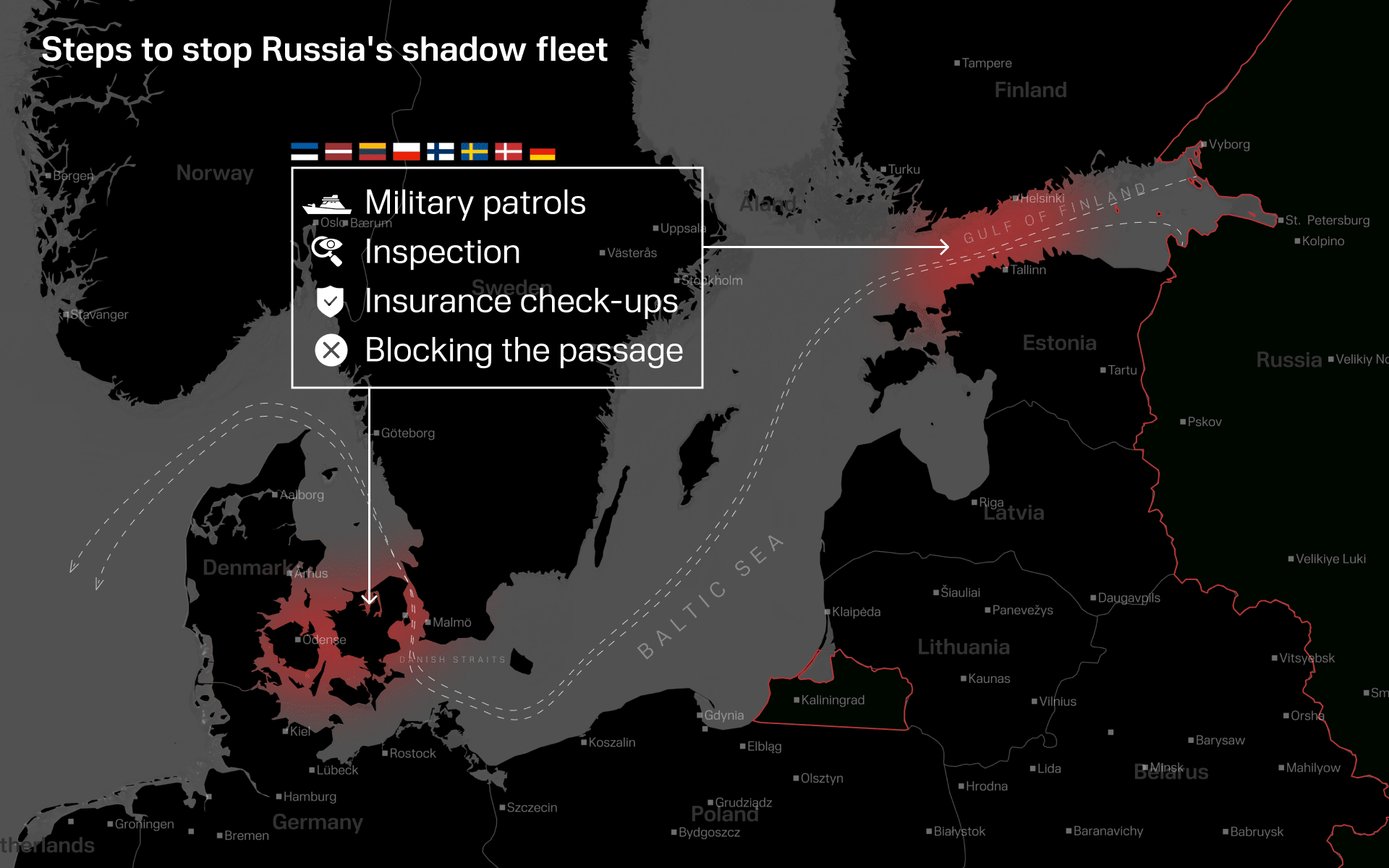
Both experts agree it would be difficult, although for slightly different reasons.
“So far, officials I have spoken to have not grasped closing the Danish Straits as feasible, and even modest proposals may stall due to escalation and capacity constraints,” Oidsalu continued. “In practice, states can take on a selective, risk-based model.”
There have been no signs of real escalatory measures against the Russian shadow fleet vessels that, every week, pass through the Baltic Sea and would be legal to intercept. They sail freely, sometimes in groups of several ships.
Meelis Oidsalu
Former Estonian Defense Minister
Who would have the authority to enact or enforce it?
“Authority would fragment by zone and mechanism,” says Oidsalu. Coastal states would enforce rules within their territorial waters and through ports and anchorages using tools such as port-state control and environmental or safety enforcement.
“The EU can set the sanctions framework and target the enabling ecosystem,” he adds. NATO’s role, however, would be more limited. The alliance could provide surveillance, deterrence, and protection of infrastructure.
“But NATO officials describe its mandate as constrained. It recently had no plan to intercept any ships as part of the Baltic Sentry,” Oidsalu says, adding that there has been no indication the alliance plans to take a more proactive role.
What could Russia’s response be if a blockade were imposed?
“A blockade would represent a forceful act and could be considered an act of war,” says Pawlak.
“Even without any substantive coordinated activity by the Baltic Sea countries, Russia has already shown its response playbook,” says Oidsalu. “Its navy has occasionally escorted the shadow fleet, it has taken on more coercive behavior at sea—there have been reported aggressive manoeuvres, radar and weapon signalling, jamming.”
Oidsalu also pointed to Russia’s use of the aforementioned “danger areas,” “Russians also violated Estonian airspace with their fighter jet in response to one interception last year,” Oidsalu says, “Some fear that the hybrid attacks on the airports in Northeastern Europe would be repeated. More cables would be cut." Such sabotage can cost hundreds of millions of euros and affect the populations of the Baltic region, he adds.
What else can be done to mitigate illegal shadow-fleet shipping?
“To mitigate shipping threats, existing frameworks and potentials should be used at first,” says Pawlak. These measures include tackling vessels sailing under false or missing flags, enforcing sanctions regimes more consistently, and using environmental protection laws to stop ships that pose clear environmental threats.
Oidsalu shared the view that measures are already in place to mitigate the shadow fleet; however, they are not being upheld at the necessary level.
“There are also more indirect ways,” he says. “The European Union has been expanding sanctions lists, targeting the servicing ecosystem, and restricting enabling services, dealing with countries like India in order to get them to change their stance.”
These measures, he argues, allow enforcement to scale without physically blocking shipping routes.
“But today, we cannot say that the Baltic Sea states are doing the minimum to ensure that vessels entering the Baltic Sea follow the maritime law or respect the sanctions imposed on the aggressor.”
Many intelligence agencies have different threat perceptions, he says, and some show disinterest. “In Finland, for example, the internal security service and military intelligence are publicly debating whether Russia is behind the cable-cutting incidents. Estonian foreign intelligence did not even mention the term ‘Shadow Fleet’ in their latest public threat report.”
It is not about intelligence failure; it is about the willingness of the Baltic Sea countries' governments to set up a coordinated ship interception framework and launch a collective maritime operation to raise the cost of this business to the aggressor.
Meelis Oidsalu
Former Estonian Defense Minister
Discuss this article:
-9a7b3a98ed5c506e0b77a6663f5727c5.png)

-f3430f0449615e9897dff835086ac204.jpg "Ukraine Broke With a Soviet-Era Military System and Rebuilt It Around the Soldier")
-e126c16a85d580738cf2d57e760b80a3.jpeg "Photo of Vladyslav Greziev")



-930ed56b9d4c7f0232c62eddea7edc08.jpg "Ukraine’s Mindset Has Changed Faster Than Most of Europe—What 35 Years of Data Show")
-d6c21a19c8fd931d512b5818298453c4.jpeg "Maryna Starodubska")