- Category
- Latest news
The Guinness World Record Drone Ukraine Doesn’t Have Yet—but May Soon Need
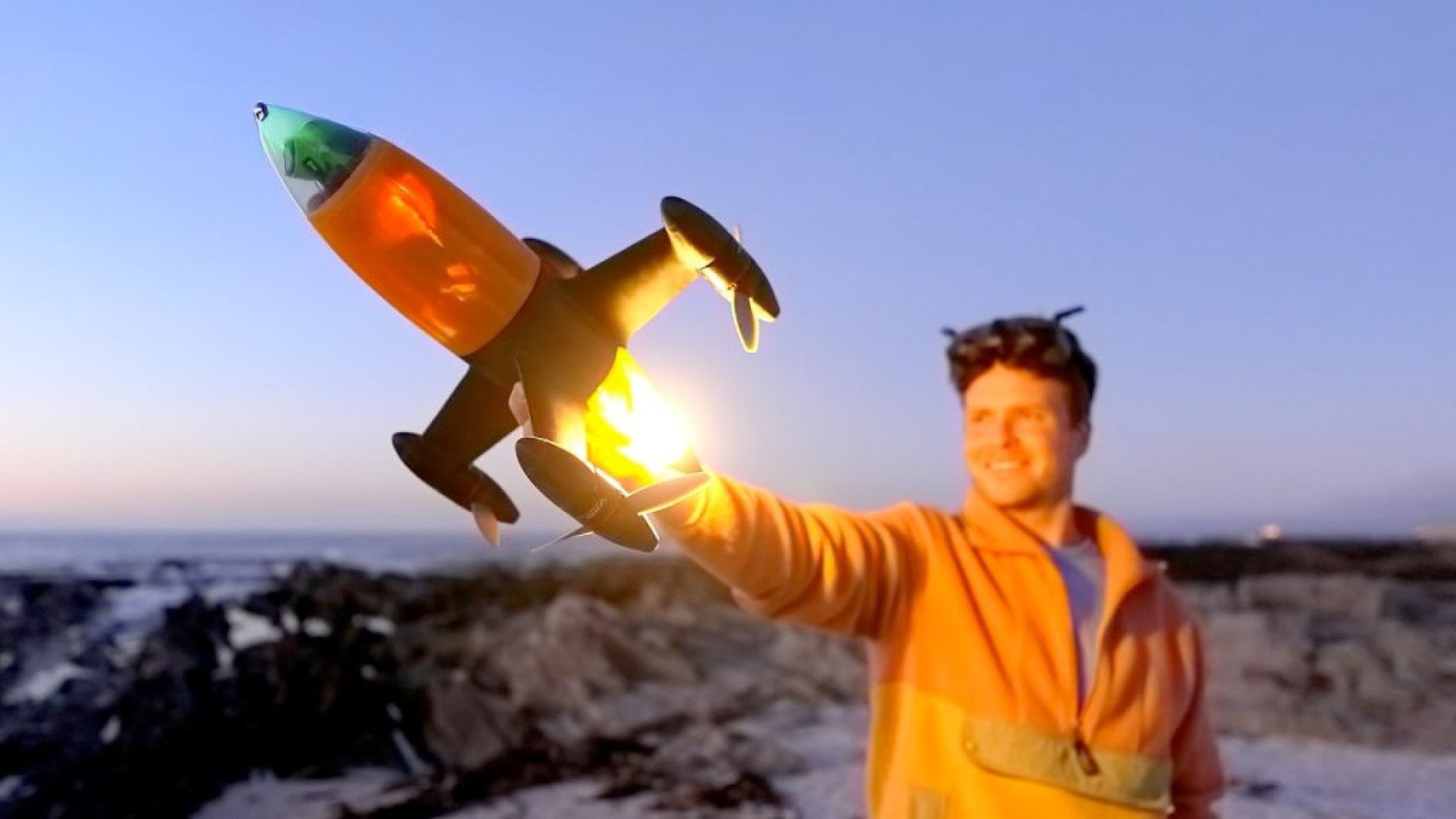
As Russia experiments with jet-powered Shahed attack drones designed to outrun conventional interceptors, a civilian quadcopter has just demonstrated the kind of raw speed Ukraine may soon need.
 Prefer U24 Media on Google
- Authors




A father-and-son engineering team from South Africa has set a new world record, pushing a battery-powered quadcopter to 657.59 km/h, a velocity that approaches the performance envelope required to intercept next-generation airborne threats, according to the Guinness World Records on January 15.
World record speed with battlefield implications
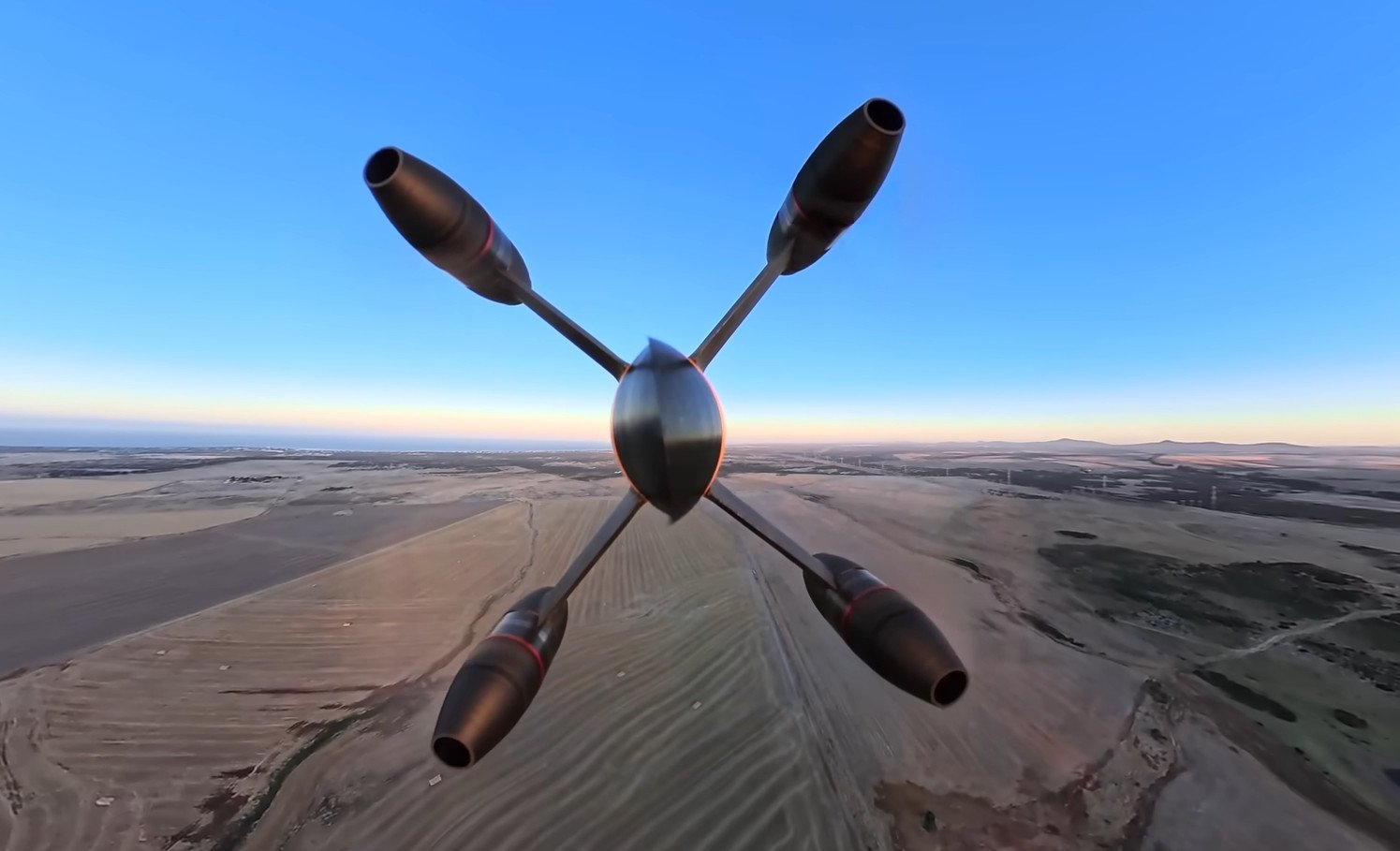
Luke and Mike Bell, a father-son duo from South Africa, have reclaimed the title for the fastest quadcopter ever built. Their latest creation, the Peregreen V4, was officially clocked at 657.59 km/h, making it the fastest battery-powered radio-controlled quadcopter on record.
Just a month earlier, the title had been held by Australian engineer Benjamin Biggs, whose drone reached 626 km/h.
Before that, the Bells themselves had set—and repeatedly broken—the benchmark, accelerating from 480 km/h in mid-2024 to 585 km/h in late 2025.
Why speed now matters in Ukraine’s air war
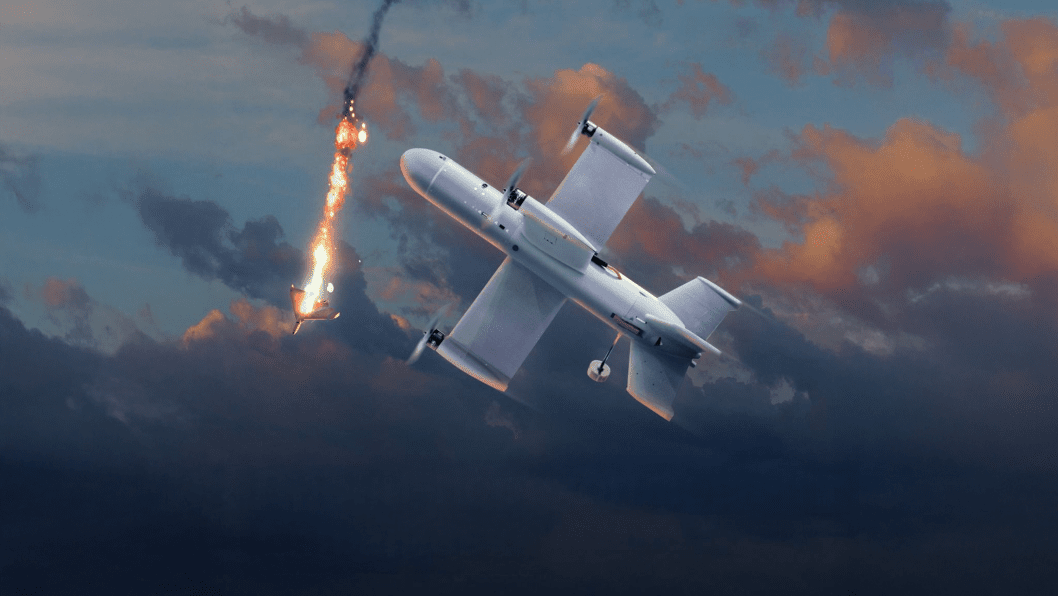
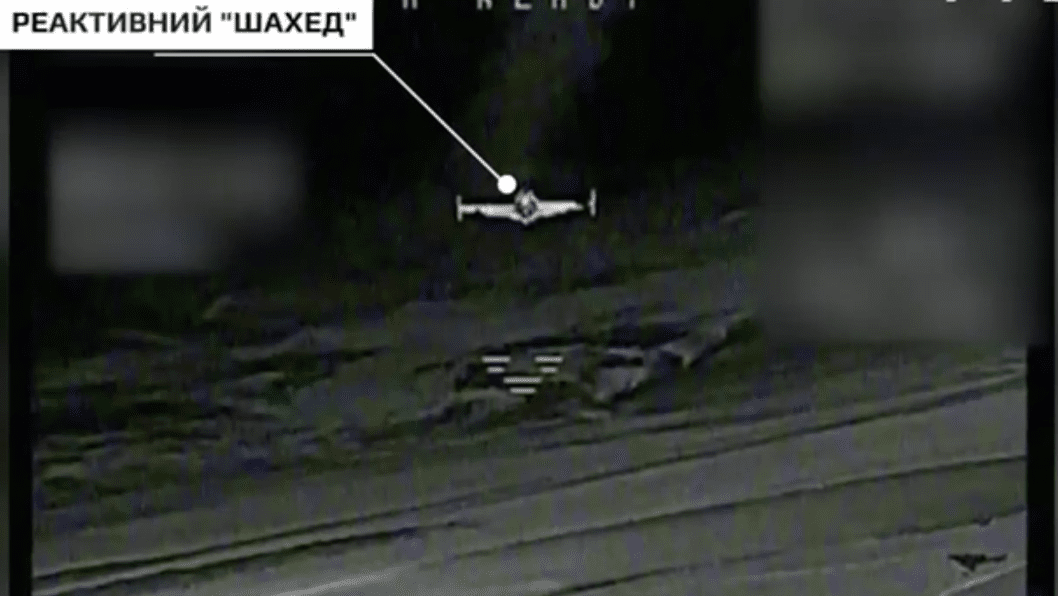
Ukrainian air defenses are increasingly confronting Shahed-type drones modified with turbojet propulsion, dramatically increasing their speed compared to the original propeller-driven variants.
These jet-powered Shaheds are harder to intercept with traditional FPV drones, which often lack the speed and climb rate to close the distance.
While Peregreen V4 is a civilian experimental platform—not a weapon—it demonstrates that quad-rotor designs are no longer inherently slow. In theory, interceptor drones operating at similar speeds could engage fast-moving aerial targets that currently challenge Ukraine’s layered air defense.
Two years of relentless engineering
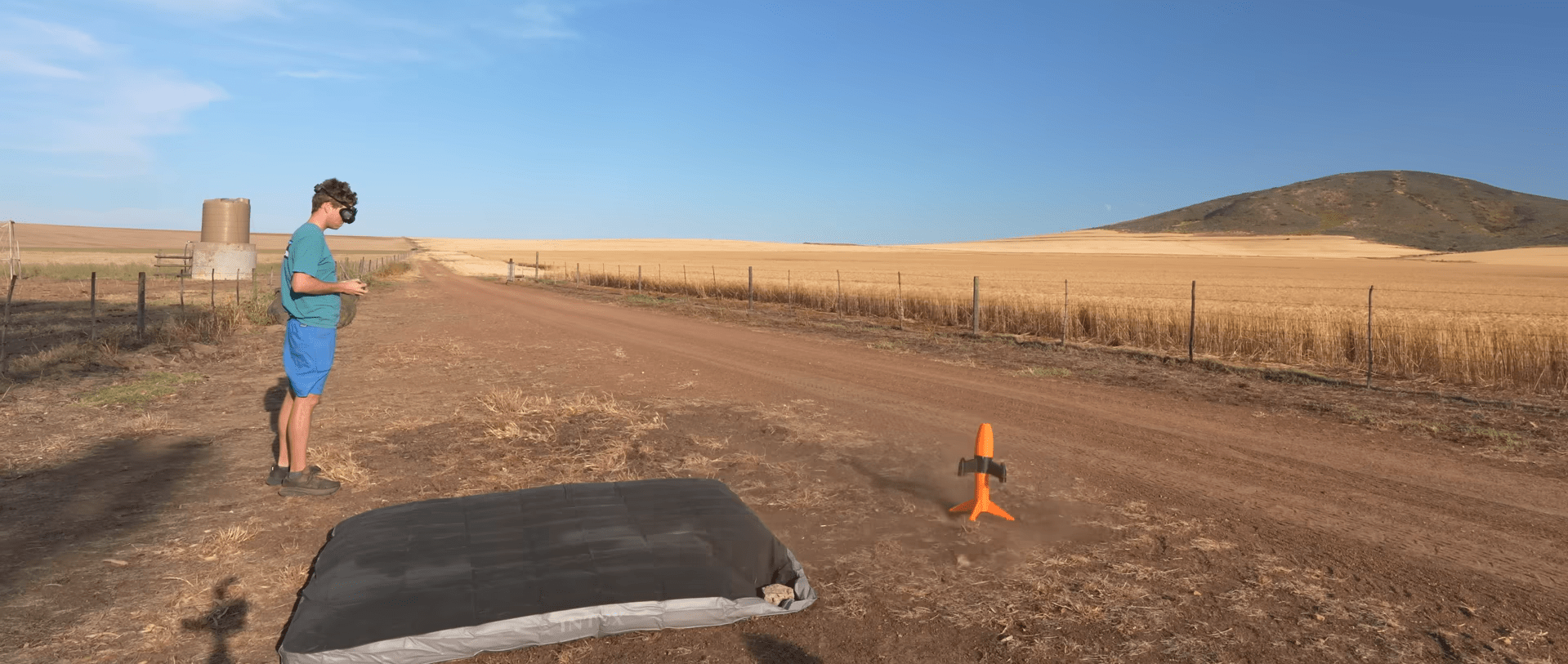
Peregreen V4 is the product of more than two years of continuous refinement. Luke Bell, a professional aerial videographer based in Cape Town, handled most of the hands-on development, while his father Mike focused on engineering solutions.
The name reflects the philosophy: this is the fourth ground-up iteration, not a modified off-the-shelf racing drone.
3D printing as a speed multiplier
One of the key enablers behind the record was extensive use of high-speed 3D printing. Rapid prototyping allowed the team to test, discard, and re-engineer components at a pace impossible with traditional manufacturing.
The drone was printed on a Bambu Lab H2D dual-nozzle printer, allowing multiple materials to be used in a single part. This proved critical for structural sections such as the tail and camera mount.
Thanks to the printer’s large build volume, the fuselage was produced as a single, seamless piece, eliminating joints that add weight, turbulence, and structural weakness—an important aerodynamic advantage at extreme speeds.
Motors, power, and aerodynamics
The Bells significantly upgraded the drone’s internal hardware for the V4 iteration. Power comes from T-Motor 3120 brushless motors, selected for stability at extreme rotational speeds. A 900 kV winding, up from 800 kV in the previous version, allowed higher RPM and top-end velocity.
Energy is supplied by lithium-polymer batteries optimized for short bursts of maximum power—ideal for record runs measured in seconds rather than endurance.
Aerodynamics received equal attention. Using the AirShaper simulation platform, the team refined the airframe’s contours to reduce drag. Propeller size was cut to six inches, a deliberate compromise that sacrificed thrust efficiency in favor of outright speed.
Capturing a drone that’s almost too fast to see
Documenting the record proved to be a challenge in itself. At nearly 660 km/h, Peregreen V4 is both tiny and fleeting, making it difficult to track visually.
The solution was elegant: the team used the onboard camera from their previous record holder, Peregreen 3, to film the run.
As per standard Guinness methodology, the drone flew in opposite directions to cancel out wind effects. The averaged result—657.59 km/h—was certified as the highest ground speed ever recorded by a battery-powered quadcopter.

From hobby record to strategic signal
Peregreen V4 was built to chase a record, not to fight a war. Yet its achievement sends a clear signal: quadcopters are no longer confined to low-speed roles.
As Ukraine adapts to faster, more sophisticated aerial threats—including jet-powered Shaheds—the gap between experimental civilian drones and future interceptor platforms is narrowing fast.
Earlier, Ukrainian defense-tech company General Chereshnya unveiled its upgraded AIR Pro interceptor drone, designed to shoot down Russian reconnaissance and strike unmanned aircraft.
Discuss this article:



-c439b7bd9030ecf9d5a4287dc361ba31.jpg "Photo of Katherina Popilnichenko")