- Category
- Latest news
Ukraine Sends First Female-Led Expedition to Antarctica
 Prefer U24 Media on Google
- Authors

-c439b7bd9030ecf9d5a4287dc361ba31.jpg "Photo of Katherina Popilnichenko")
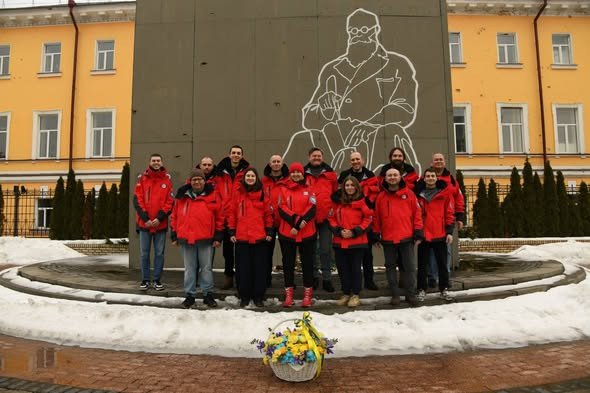
The 31st Ukrainian Antarctic Expedition has set off for the Vernadsky Research Base, marking a historic milestone as meteorologist Anzhelika Hanchuk becomes the first woman to lead the mission, according to a Facebook post by the National Antarctic Scientific Center of Ukraine on February 25.
We bring you stories from the ground. Your support keeps our team in the field.
The team is scheduled to spend one year at the station, taking over duties from the 30th expedition. Their work will focus on three scientific fields: geophysics, meteorology, and biology. In addition to these research goals, the crew is responsible for maintaining the continuous operation of the Vernadsky Research Base throughout their stay.
Evgen Dykyj, director of the National Antarctic Scientific Center, highlighted the significance of Ukraine’s ongoing presence in the region.
"It has been 30 years since Britain handed over its Antarctic station to us, and we have been writing our own chronicle of polar science.”
But in reality, our work there is about a much broader dimension. Geographically, because Antarctica is a region where we “measure the pulse" of the entire planet, and chronologically, because we are continuing the longest series of Antarctic observations, which are much older than 30 years.
It is very important that even under the conditions of Russia’s full-scale invasion of Ukraine, we maintain the continuity of uninterrupted research and develop new areas," Dykyj said.
The rotation of polar teams remains a consistent process despite the challenges facing the country. In early April 2025, the 29th expedition returned home after a year of service, while the 30th expedition, led by Oleksandr Poluden, began its mission in March 2025.
The selection process for this current 31st expedition began in July, culminating in the appointment of Hanchuk as the first female leader for a year-long rotation.
Hanchuk is an experienced polar researcher who previously served in the 27th Ukrainian Antarctic Expedition between 2022 and 2023. During her previous deployment, she conducted specialized research in meteorology, oceanography, glaciology, and aerology.

Her leadership marks a new chapter for the station, which Ukraine originally acquired from the United Kingdom on February 6, 1996. The facility, formerly known as Faraday, was transferred for the symbolic price of one pound sterling and renamed in honor of Volodymyr Vernadsky.
Earlier, the Vernadsky Research Base served exclusively as a hub for Ukraine’s polar science, where teams of researchers focused on the quiet study of the continent's biology, geophysics, and meteorology.
Before the Russia’s full-scale invasion, the station's daily life was defined by the rhythm of continuous data collection and the presence of thousands of penguins on the small island.
However, this changed when 31 polar scientists transitioned from their roles from their work at Ukraine’s Antarctic station to the Armed Forces of Ukraine, eventually becoming known as the "Military Penguins" for their service in the defense of their country.
Discuss this article:




-80134f2dc17b4a887d01513a1c7bc929.png "Illustration of Russian military infrastructure targeted by Ukrainian strikes in temporarily occupied eastern Ukraine. (Source: General Staff of the Armed Forces of Ukraine)")