- Category
- War in Ukraine
“Crimean Wake-Up”: Russian Officers War-Game Ukraine Landing in Annexed Crimea
 Prefer U24 Media on Google
- Authors

-111f0e5095e02c02446ffed57bfb0ab1.jpeg "Photo of Roman Kohanets")
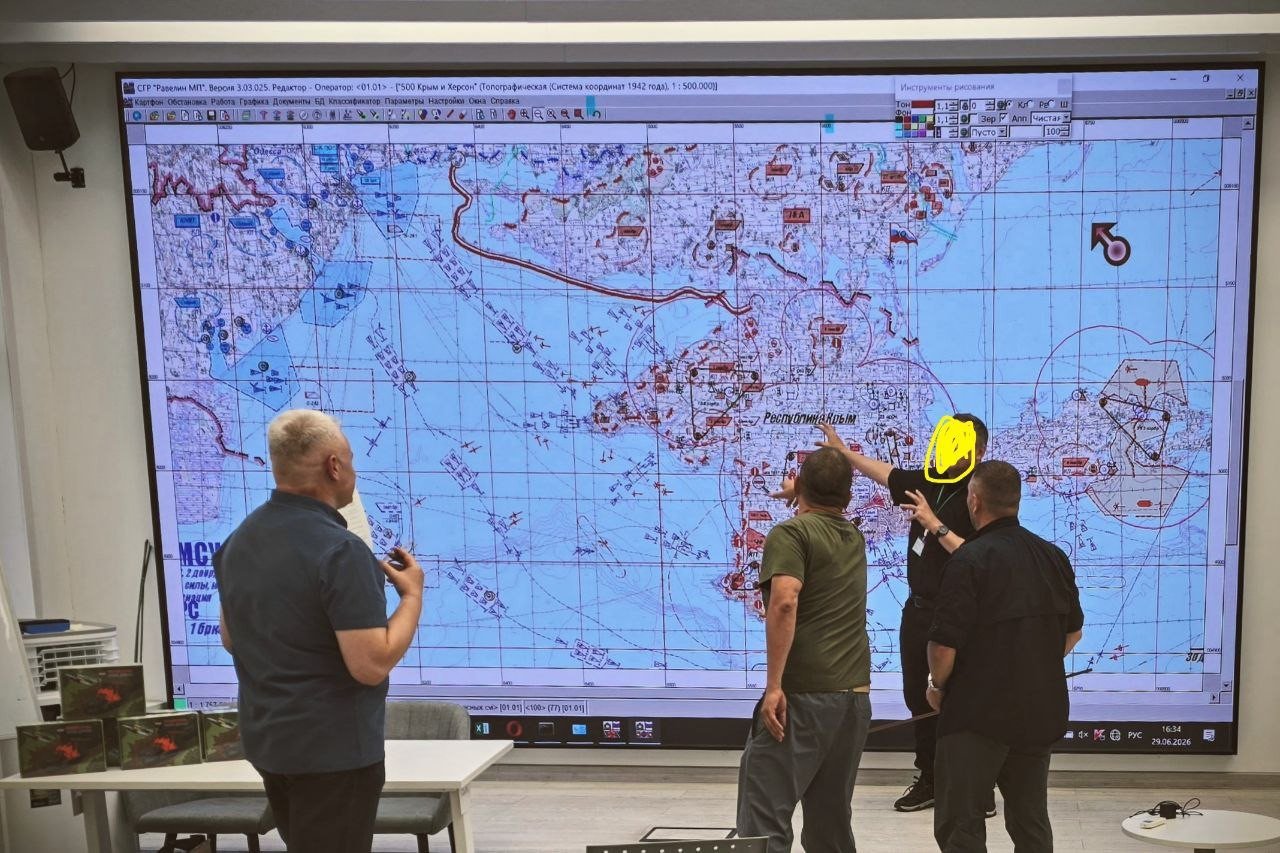
A Russian military commentator has disclosed his participation in a war game rehearsing how Russia would repel a Ukrainian amphibious landing on temporarily occupied Crimea, the outlet The Moscow Times reported on July 2.
The commentator, reserve colonel Viktor Murakhovsky, described the command-staff exercise on his Telegram channel and identified it as “Crimean Wake-Up.” He reported that the staff was drawn from reserve and retired officers of Russia's armed forces.
We bring you stories from the ground. Your support keeps our team in the field.
In the post, Murakhovsky wrote that the "Blue" side "acted unconventionally, making broad use of the newest means of detection and destruction," while the "Red" side "was forced to operate defensively." He assessed that the exercise ran smoothly and at a high level.
The map showed blue arrows tracing routes from Odesa and the northwestern Black Sea toward the peninsula. Red defensive positions ringed Sevastopol, northern and eastern Crimea, and the Kerch Strait.
Assigning opposing "Blue" and "Red" forces is standard practice in attack-and-defense war games, where one team plays the attacker and the other the defender. In this scenario, Blue represented the advancing Ukrainian force and Red the Russian forces.
-3a6c792c79e08862dff85f98a0fdc34e.jpg)
Judging by the map, The Insider added, the scenario modeled not a classic World War II landing but a modern operation built around drones, long-range precision weapons, and fast attack boats.
That Russian planners would rehearse a Crimean landing at all marks a shift in how the peninsula's security is now viewed. For months, Ukraine's "logistic lockdown" has steadily throttled the road, rail, and ferry links that sustain Russia's garrison there, pairing bridge strikes with attacks on fuel depots, radar, and air defenses.
June brought the campaign's heaviest tempo yet, with more than a dozen long-range strikes on Russian military and industrial targets. The cumulative effect has turned Crimea from a secure rear base into a contested salient—one whose defenders now treat a seaborne assault as a scenario worth war-gaming rather than dismissing.
Discuss this article:

-2386d89295678553e91e27f1a0d592e3.png "Ukraine Just Wrapped Up a Four-Season Military Operation: 277 km² Cleared, 8,000 Russian Troops Eliminated")
-29a1a43aba23f9bb779a1ac8b98d2121.jpeg "Photo of Illia Kabachynskyi")

-c439b7bd9030ecf9d5a4287dc361ba31.jpg "Photo of Katherina Popilnichenko")