- Category
- War in Ukraine
Russia’s Soldiers Are Increasingly Dying Instead of Being Wounded. Ukraine’s Drones Help Explain Why
For Russian soldiers sent to the front in Ukraine, becoming a casualty increasingly means death. Ukrainian commanders say as many as 70% of Russian troops lost on the battlefield are now killed rather than wounded.
 Prefer U24 Media on Google
- Authors

-29a1a43aba23f9bb779a1ac8b98d2121.jpeg "Photo of Illia Kabachynskyi")
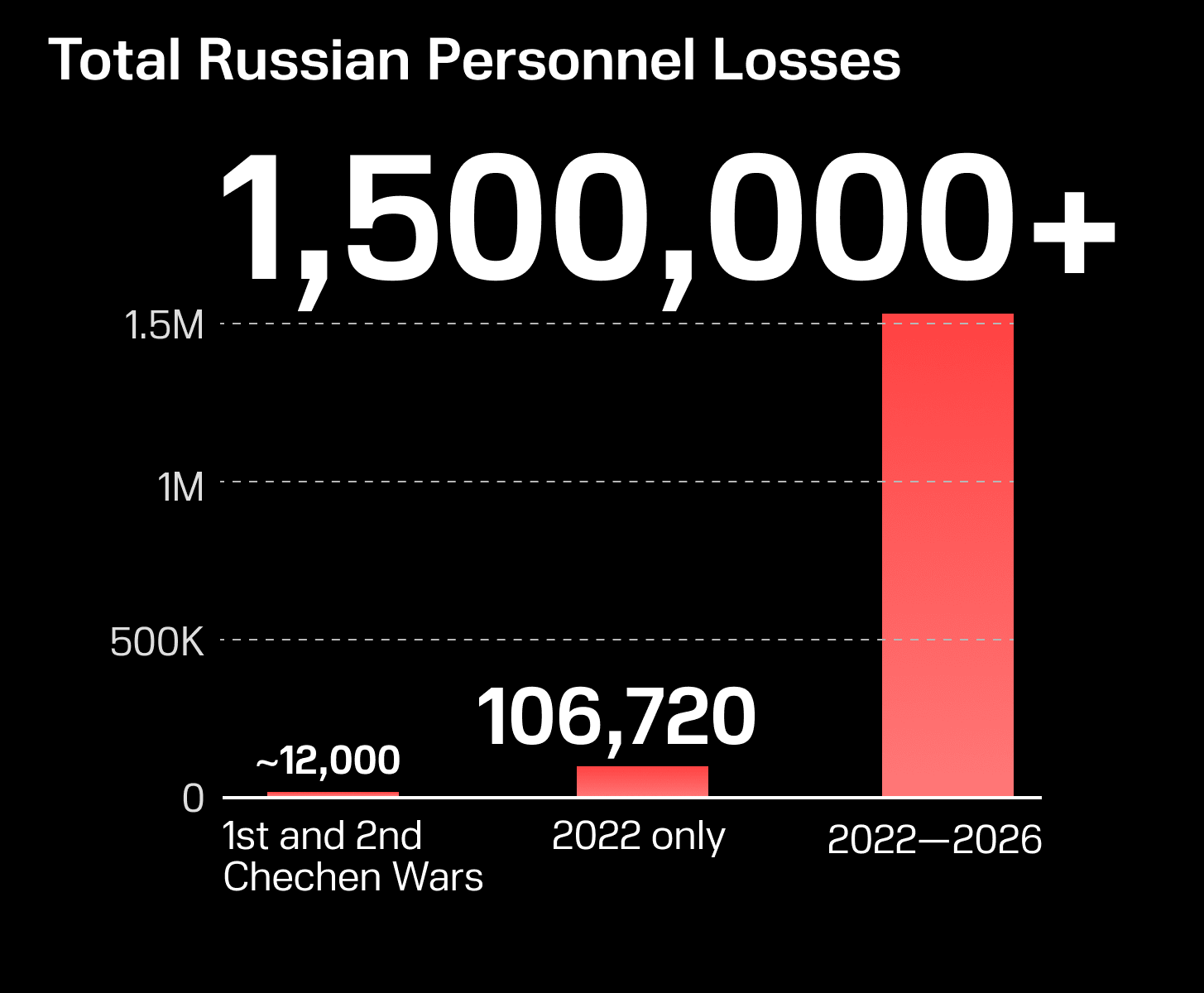
Russia’s total combat casualties since the start of its full-scale war in Ukraine surpassed 1.5 million killed and wounded on September 9, 2026.
These are Russia’s heaviest losses in a single war since World War II, according to estimates by the General Staff of the Armed Forces of Ukraine. The figure already exceeds the combined losses of the Soviet and Russian armies in all wars and armed conflicts of the second half of the 20th and early 21st centuries. There has also been another important shift: Russian soldiers on the battlefield today are far more likely to be killed than wounded.
The Russian military is currently losing around 40,000 troops every month—more than it lost during the entire 10-year Soviet-Afghan War. Losses on this scale have not been seen in warfare since World War II, as the Kremlin sends enormous numbers of its troops to war and suffers staggering losses.
Something similar happened under Stalin: he believed victory could be achieved through numbers rather than strategy and was prepared to throw vast amounts of manpower into battle simply to overwhelm the enemy. Moscow is pursuing a similar approach today and is preparing to mobilize an additional 600,000 troops for the war against Ukraine in 2026–2027. The decision could be announced after Russia’s State Duma elections in late September.
-b0aaa0ed29a891f480c1e0b019675335.jpg)
For several years, the Russian military’s heavy losses have been accompanied by another shift: increasingly, those losses are not wounded troops but irreversible losses—deaths. One reason is the massive proliferation of drones across the front and the steadily increasing effectiveness of their use.
Russia’s killed-to-wounded ratio is rising
There are no official statistics on exactly how many Russian troops are being killed. Ukrainian President Volodymyr Zelenskyy has mentioned only once, citing intelligence data, that the ratio of Russian troops killed to wounded had approached nearly 2:1—62% killed versus 38% wounded.
According to UNITED24 Media sources among senior commanders, the imbalance toward fatalities is even greater: as many as 70% of Russian troops who become casualties on the front today are killed.
Ukrainian intelligence data point to the same trend. Russia suffered around 240,000 personnel losses between January and July 2026, at least 140,000 of which were classified as irreversible losses, according to an August briefing by Ukraine’s military and foreign intelligence agencies.
By September 15 is became known that Russia has lost 301,030 military personnel killed or wounded since the beginning of 2026.
British military intelligence estimates suggest that at least half a million Russian soldiers have been killed in the full-scale war, with the vast majority of the losses incurred since January 2023, in return for Russia gaining 2% of Ukrainian territory.
How drones are driving Russian battlefield losses
There are several specific reasons for this. One is the Russian command’s strategy of sending poorly trained troops into assaults, one or two at a time, without the necessary weapons or equipment. Their task is simple: reach a designated point and try not to get killed along the way. The losses resulting from this strategy are, unsurprisingly, enormous—particularly because of the second factor.
That factor is drones. The front line is saturated with FPV drones, with the Ukrainian military deploying hundreds of thousands of them every month. Russian troops conducting assaults are a priority target. But this is not limited to the front line; drones are also used against targets farther behind it. Middle Strike operations, for example, destroy command posts, logistics infrastructure, military equipment, and areas where Russian troops are concentrated.
-3e0ce9cc15df48bb33986204cd936bb2.jpg)
Unlike artillery shells, FPV drones offer greater precision and therefore have a higher likelihood of inflicting fatal injuries. In other words, an FPV drone is more likely to kill a Russian soldier than merely wound him. Given the density of drones along the front, even if one misses, another can finish the job.
The statistics directly reflect this. Drones inflicted at least 156,735 casualties among Russian troops—killed and wounded combined—between December 2025 and April 2026 alone, reports Ukraine’s Unmanned Systems Forces. In March 2026, 35,351 Russian personnel casualties were recorded, 90% of them caused by drones.
New recruits joining the Russian military should understand that there will only be more drones on the battlefield. Sending over half a million additional people to assault Ukrainian positions will leave them facing the same statistics: most likely, drones will kill them either while they are traveling toward the front or as they attempt to storm Ukrainian positions. For them, this war will lead in only one direction.
Discuss this article:

-c439b7bd9030ecf9d5a4287dc361ba31.jpg "Photo of Katherina Popilnichenko")