- Category
- War in Ukraine
“We Know the War From the Battlefield, Not Offices”: What Goals Face Ukraine’s New Defense Minister
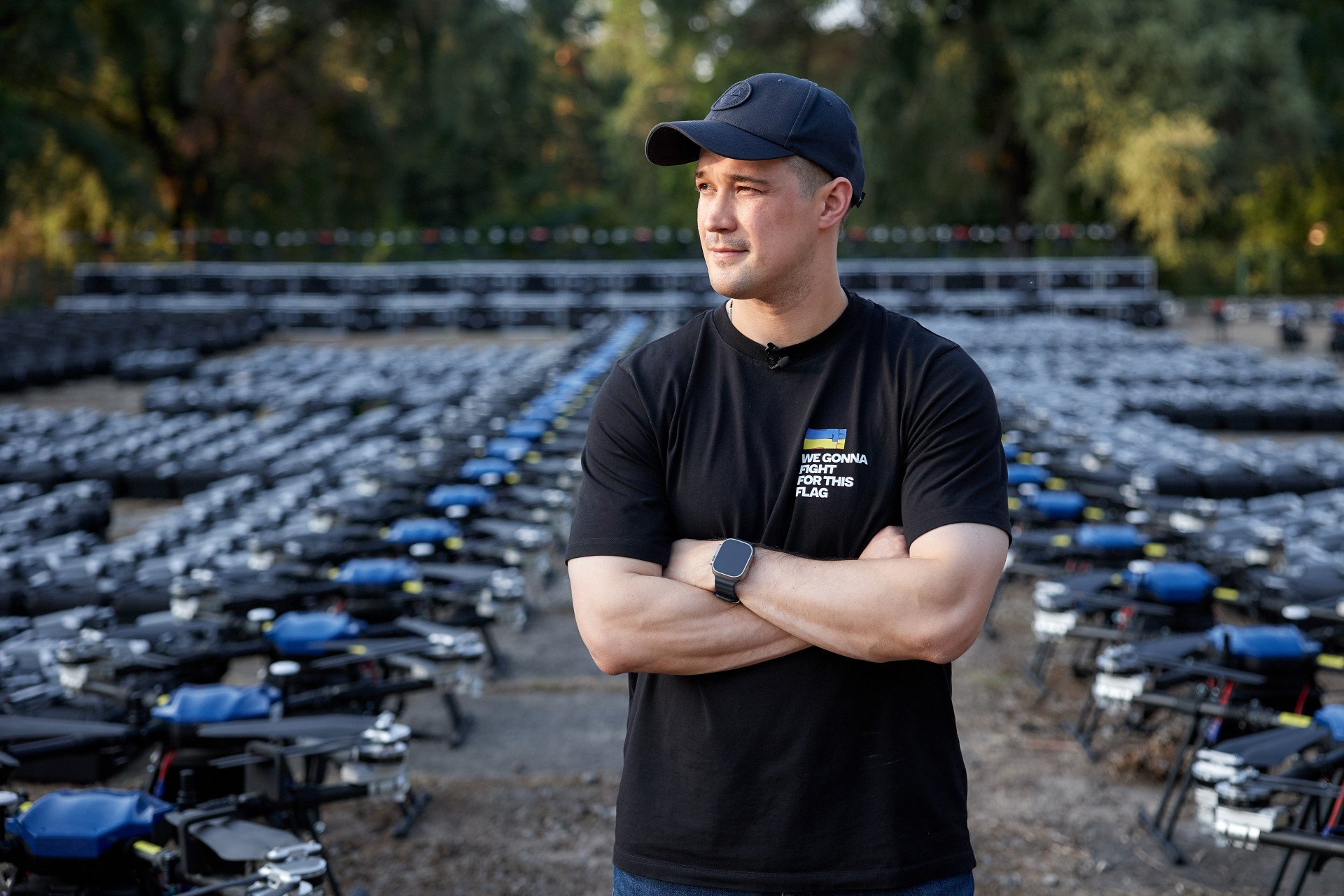
Ukraine’s new Minister of Defense, Mykhailo Fedorov, met with Ukrainian and international media in a closed session, where he spoke about his objectives in the new post and how he intends to change the way the war is fought. His experience at the Digital Transformation Ministry has, unsurprisingly, proven useful.
 Prefer U24 Media on Google
- Authors

-29a1a43aba23f9bb779a1ac8b98d2121.jpeg "Photo of Illia Kabachynskyi")
Before Fedorov, who assumed the post of Minister of Defense of Ukraine in mid-January, stands a clear task from the president: “Build a system capable of stopping the enemy in the air, halting advances on the ground, and intensifying asymmetric and cyber strikes against the enemy and its economy,” says Fedorov. “Make the cost of war for Russia one it cannot sustain, thereby forcing peace through strength.”
We bring you stories from the ground. Your support keeps our team in the field.
Fedorov has long been involved in the war effort. Ukraine’s Digital Transformation Ministry, which he previously led, has taken on many responsibilities since 2022: building the Defense Tech direction, developing drone capabilities, information warfare, and dozens of other critical areas.
Now, as he himself notes, two key goals stand before him:
Rebuilding management—it is necessary to change the paradigm that the Defense Ministry is only about procurement and supply. It is a matter of civilian oversight and coordination. The right objectives must be set. A system without clear tasks begins to fail, Fedorov says. Therefore, management is the first task. Management must be built around those who are capable of achieving defined goals. If people do not demonstrate measurable results, they can’t remain in the system.
Eliminating 50,000 Russians per month. In December 2025, there were 35,000 irreversible losses. “If we reach 50,000, we will see what happens to the enemy,” says Fedovov. “They view people as a resource, and shortages are already evident.”
To make the first goal a reality, Fedorov’s team has already reviewed the entire staffing structure of the Ministry of Defense, and new appointments are being prepared. One of them is already known: Pavlo Yelizarov has been appointed deputy commander of the Air Force; previously, he created the highly effective unit Lasar’s Group. As Fedorov notes, the Ministry of Digital Transformation succeeded in building a system that provides clear data, helping to understand where money is spent and where savings are possible. The same approach will be replicated at the Ministry of Defense.
Experience from the Ministry of Digital Transformation will also help address the second goal. A number of initiatives were launched there:
Bonus system (ePoints)—a system that provides high-quality battlefield data. It shows how much enemy manpower and equipment each unit destroys, at what depth, and which weapons are most effective in combat conditions.
A proprietary combat unit that directly participates in fighting, allowing knowledge of the war to be taken from the battlefield rather than from offices.
The launch of Brave1, which today is the largest angel investor in Ukrainian defense tech.
The Brave1 Marketplace.
The Army of Drones and its derivative programs.
As an example, Fedorov cites interceptor drones:
“As early as February last year, we began working on interceptor drones. We even created a real-time R&D format: in the Chernihiv direction, we allowed all companies developing interceptors and paid them $20,000 for each downed Shahed. They began to scale, and the money “followed” each destroyed Shahed. At the time, no one believed in it. But already this month, 40,000 interceptors will be delivered to the military.”
Previously, the Ministry of Digital Transformation team also managed to open markets for drones, missiles, electronic warfare systems, and ammunition; increase margins for companies; change policies; and adopt the necessary regulations to максимально accelerate the development of defense innovations. Fedorov is convinced that the involvement of private companies is critically important.
The focus will not be limited to what has already been created. Fedorov announced the launch of a revolutionary project, Mission Control: each crew will enter into the system the UAV type, destination, launch location, and other parameters. This will make it possible to better understand the effectiveness of drone usage. Through Mission Control, the team wants to close the entire drone lifecycle: procurement, delivery, and then battlefield use. While ePoints show task completion reports, it is important to have a complete picture—including results and accumulated experience. The Mission Control functionality has been in development for two years.
This is one of Fedorov’s tasks—to calculate everything systematically. In his view, knowing everything about everything helps accelerate managerial decision-making. “We need to see the full picture,” he says.
One of the main challenges is creating a domestic equivalent to the Mavic drone: it is important to find a replacement for Mavics and other Chinese drones. Already this January, a solution is being tested that uses the same camera and has a longer flight range. The R&D direction is critical, as is the formation of new units. This refers to the creation of drone-assault units that operate under a different doctrine for drone use.
“Recently, Code 9.2 carried out a unique operation in Kupiansk,” Fedorov said, without providing details. “This tactic works, so the future belongs to drone-assault units. You will hear more about them.”
At the same time, there is a priority target regarding the Russian forces: to eliminate Russian drone operators from the battlefield. Units specifically tasked with hunting drone operators are being formed. They already exist, and the experience gained is being scaled.
Finally, among what can be discussed publicly is work with partners. Fedorov promises to strengthen cooperation at all levels while also offering Ukraine’s own value.
“We will build a system on which they can train their software products using our data,” says Fedorov. “Today, frontline data has extraordinary value. That is why we will build a data polygon to train their AI models.”
What is the bottom line? To hope for partners’ assistance, but to rely on Ukraine’s own strength.
“If we stop the enemy in the air and on the ground and deliver a devastating blow to its economy, we have every chance to end this war,” says Fedorov.
Discuss this article:


-bff688a0f71d93b1cc877675781b9b93.png "Footage released by Ukraine’s Phoenix unmanned systems unit shows a Russian vehicle with an armed soldier in the rear being targeted on the Toretsk direction. (Source: Phoenix unmanned systems unit)")
-72b63a4e0c8c475ad81fe3eed3f63729.jpeg "Photo of Cyril Barabaltchouk")