- Category
- World
Japanese, Chinese, and European Companies Still Feed Russia’s Weapons Industry
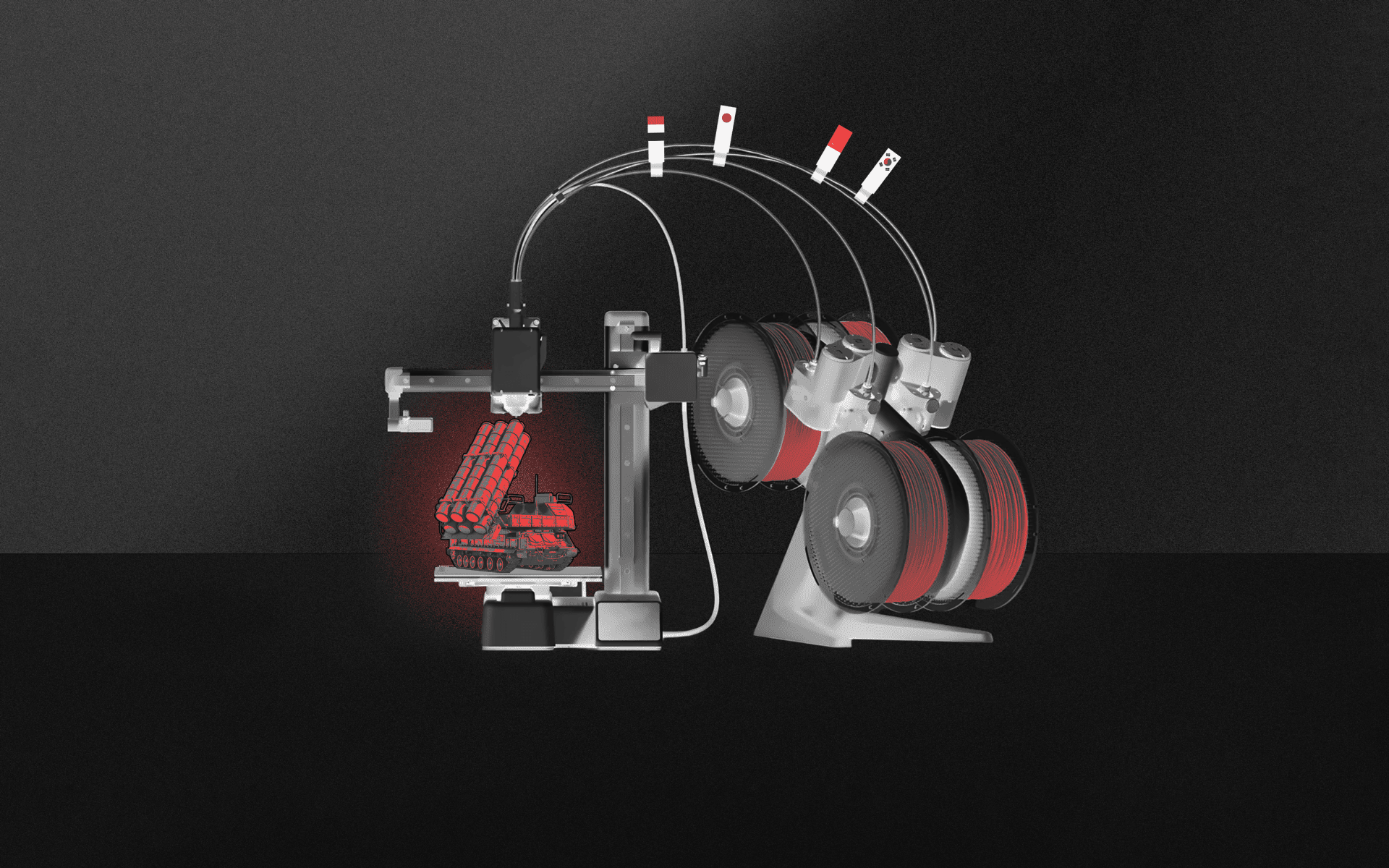
Russia’s vast territory and abundant natural resources have not spared it from relying on foreign materials, with domestic substitutes falling short. Internal documents reveal supply chains stretching from France to Japan that continue to feed a key weapons enterprise, often without suppliers fully knowing where their products end up.
 Prefer U24 Media on Google
- Authors

-46f6afa2f66d31ff3df8ea1a8f5524ec.jpg "Photo of Jess Daly")
Russia’s war machine is powered by a vast network of defense enterprises, and the Perm Powder Plant sits at the core of Russia’s military-industrial complex, producing components for more than 200 weapon systems. By its own description, Perm Powder Plant ensures Russia’s state defense capability.
But this industrial powerhouse is not self-sufficient. Internal Russian defense documents obtained by UNITED24 Media reveal that Perm Powder Plant remains heavily dependent on foreign supply chains. It is the country’s largest producer of solid rocket fuel and a monopoly supplier of key propellant types. From anti-tank systems like “Kornet” and “Metis”, to “Grad”, “Smerch”, and “Tornado” rocket systems, to “Iskander”, “Topol-M”, and “Yars” ballistic missiles—its output feeds directly into some of Russia’s most destructive weapons.
Its reach extends further, into S-300 and S-400 air defense systems, “Buk” and “Tor,” advanced air-to-air missiles, and naval systems, including “Kalibr”.
Materials and chemicals sourced from companies across France, Belgium, China, Japan, and South Korea are finding their way into Russia’s supply chains, filling critical gaps in domestic production and sustaining its war in Ukraine. The same records reveal plans to expand procurement and scale up production, despite sanctions.
What do we know about the Perm Powder Plant?
Founded in 1934, Perm Powder Plant became a core supplier of Soviet ballistic powders and later expanded into fuels, earning top military honors. Today, it remains a critical artery of Russia’s military capability.
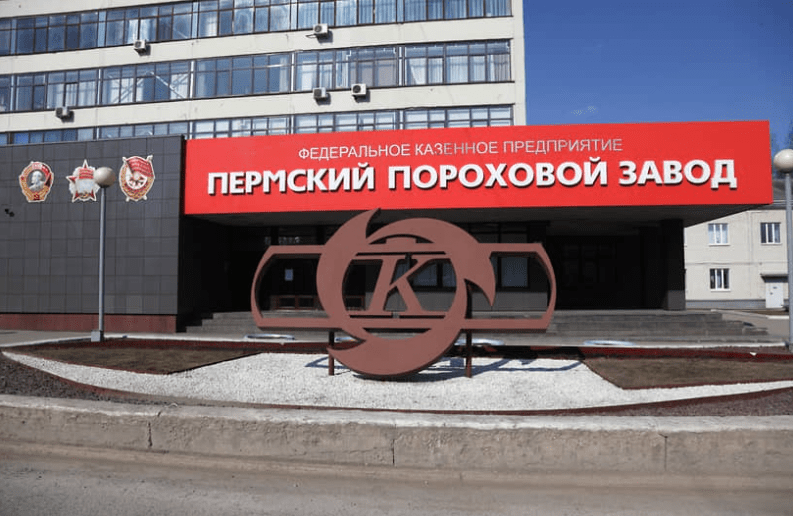
Between 2023 and 2025, Perm Powder Plant launched a major industrial expansion, upgrading equipment, building new facilities, scaling processing capacity, and driving demand. Procurement of foreign chemicals rose alongside this growth, with the plant moving to stockpile key inputs. At the same time, its workforce surged from 5,200 to 9,900 employees by the end of 2024.
All foreign material deliveries are tightly controlled—governed by Russian civil law and state defense procurement rules, with contracts requiring approval from the 591st Military Representative Office. This particular office oversees and controls defence production, from state defence order contracts to monitoring production.
The plant is so strategically important that it is heavily defended by layers of air defense systems, including the Groza-04 electronic warfare system, the Poliana anti-drone system, the Enot radar, and the Igla MANPADS.
At Perm Powder Plant, foreign-sourced chemicals are processed, transformed into propellants and components, and fed into Russia’s weapons production chain. The documents don’t just describe foreign dependency, they detail it, down to the chemicals, suppliers, and volumes involved. While sanctions are causing issues, these crucial materials continue to feed its war machine.
Foreign materials sustaining Russia’s war machine
Cellulose acetate
Rhodia Acetow, owned by Cerdia—originally part of a French chemical group—manufactures cellulose acetate, a critical binder in armoring and propellant systems, such as the Kalibr cruise missile, which is supplied to Russia via A2 Group LLC.
Cerdia is one of the world’s leading manufacturers of cellulose acetate for cigarette filters, headquartered in Basel, Switzerland, with production sites in Germany, Brazil, and the US. The company’s website still references its presence in Russia.
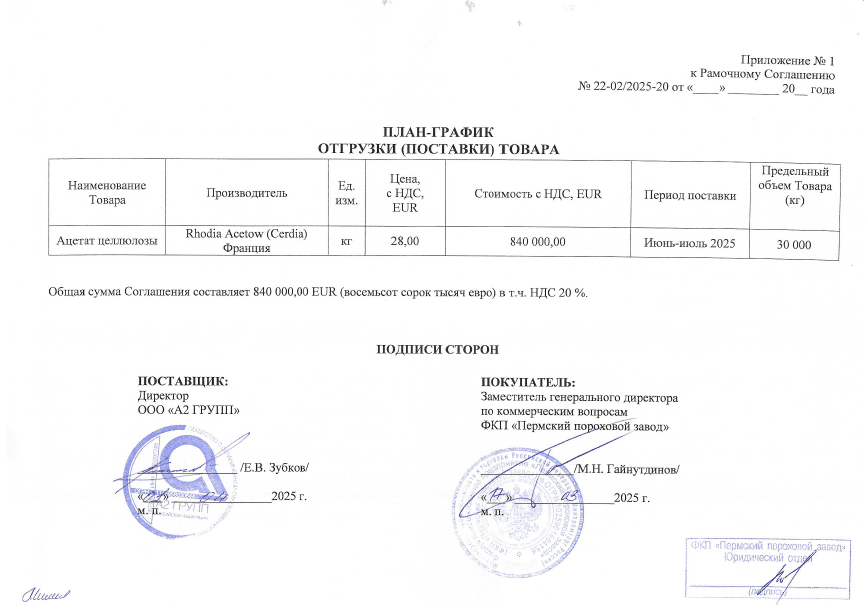
Russia’s Sverdlov Plant, a prospective domestic producer, can only deliver limited volumes and still fails to meet technical standards, even as demand continues to rise. Analysis certificates show 10,360 kg was required in 2023. By February 2025, Perm Powder Plant signed a framework agreement with A2 Group for 30,000 kg worth €840,000 ($988,500), with over 10 tonnes delivered by July 2025.
Attempts to stretch supply—including using expired stock and testing German-made alternatives—have fallen short, leaving Rhodia Acetow as the critical source.
Cellulose triacetate
Cellulose triacetate is a critical input in missile propulsion, acting as a burn-rate modifier and stabilizer in solid rocket fuel. The material is used directly in missile production, as a ballistic propellant component in systems including the Buk surface-to-air missile.
Russia relies on a single approved source, Daicel Corporation from Japan, and is supplied via intermediaries such as Technointorg. Chinese restrictions, US and EU sanctions now constrain access to this material, but do not completely eliminate it. Daicel sent a delegation to investigate where the materials were being used, but were purposefully was misled.
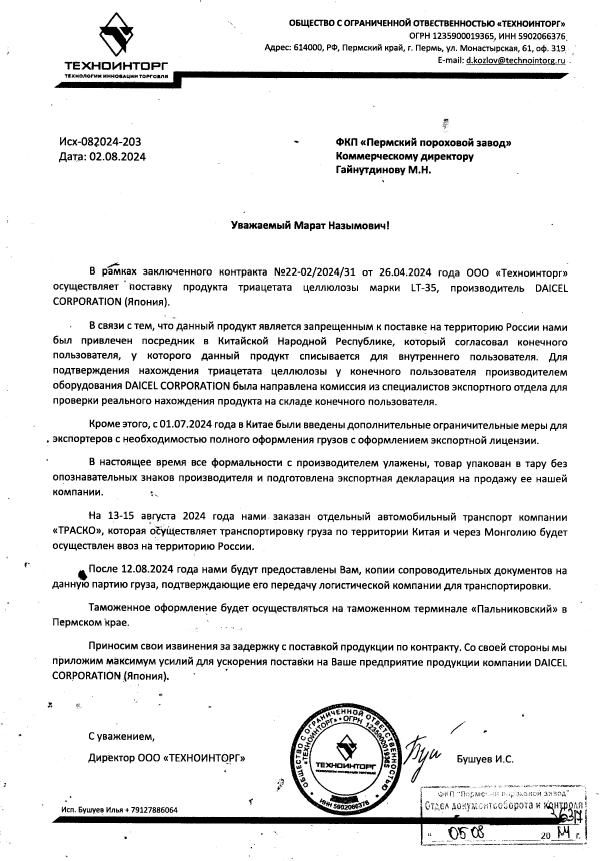
To keep the supply flowing, Technointorg turned to sanction-circumvention schemes. Documents show the intermediary routing the Japanese material through a Chinese front company—Amitychem Corporation—with shipments entering Russia via Mongolia.
Despite restrictions, demand has surged from 600 kg in 2023 to 1.5 tonnes by 2025. Internal documents show efforts to secure reserves, with procurement records describing Japanese supply as “acutely scarce” and warning of ongoing disruption, even as long-term plans point to continued expansion.
Requests were made to TASMA in Kazan, Tatarstan, and escalated to the region's Deputy Prime Minister to revive production, underscoring urgent demand for cellulose triacetate. Even so, reliance on Daicel continues.
A domestic substitute is under development at the Sverdlov Plant, though current samples fall short of required standards.
Centralite II
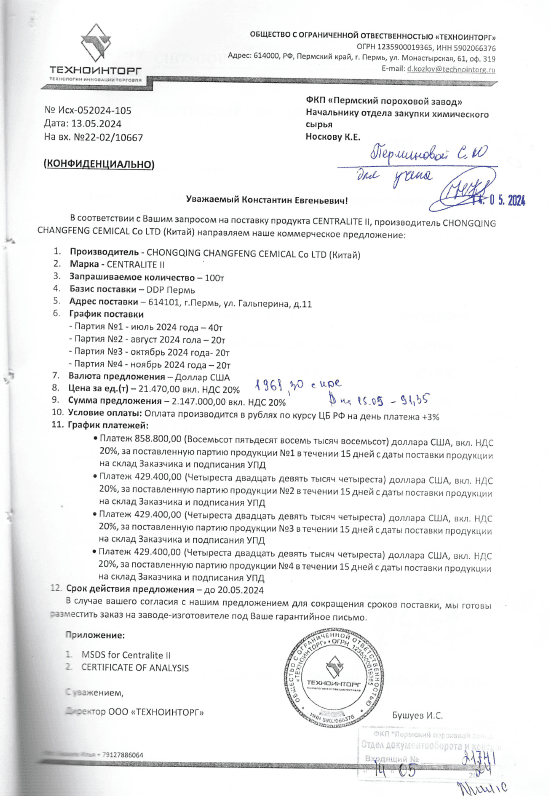
Centralite II, produced by Chongqing Changfeng Chemical Co., Ltd, (Changfeng), is a core stabilizer in ballistic solid rocket propellant. The material is used in components across a wide range of Russian weapons systems, including S-300 and S-400 air defense systems, Kalibr cruise missiles, Iskander ballistic missiles, and Kornet anti-tank systems.
Demand is surging, and 180 tonnes were projected for 2025.
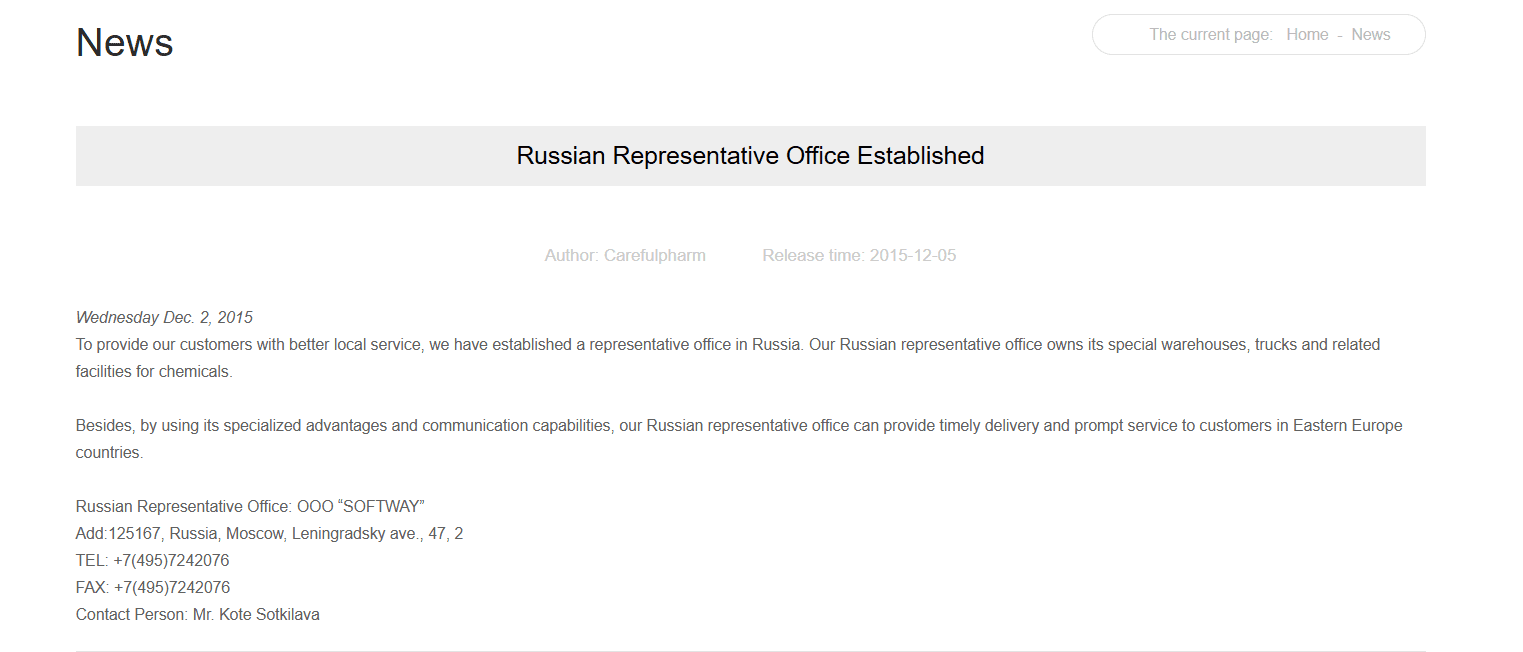
Changfeng positions itself as a global chemical supplier and openly states that it operates representative offices in multiple countries, including Russia. The company supplies directly to these markets, promoting its “premium products” and service as part of a “win-win situation.”
The website is available in English and Russian, underscoring its engagement with Russian clients. Changfeng established a Moscow office in 2015, alongside its own logistics network — including warehouses, transport, and handling infrastructure for chemical distribution. The company has also participated in Russia’s KHIMIA chemical exhibitions, embedding itself within the country’s industrial ecosystem.
In 2023–2024, the key supplying intermediary to Perm Powder Plant was Russia’s INTELL LLC, but sanctions and growing difficulties in sourcing the chemical led to price increases, and INTELL ultimately withdrew from supply altogether.The documents point to a fragile and shifting supply chain, and one supplier document indicates that Chinese authorities attempted to curb the Centralite supply, yet procurement continues.
By 2025, Russia was pushed back into the market with a new domestic supplier, MIR LLC, which was selected to deliver just 23 tonnes worth over 66 million roubles, which was a fraction of the projected demand.
Centralite II is still supplied to major defense enterprises across Russia—from Novator in Yekaterinburg to KBM in Kolomna, Moscow—as well as partner production sites in Azerbaijan.
Ethyl cellulose
Ethyl cellulose (K-100), produced by Chinasun Specialty Products Co., Ltd. in China, is used in the production of 9M22U projectiles for the Grad multiple launch rocket system.
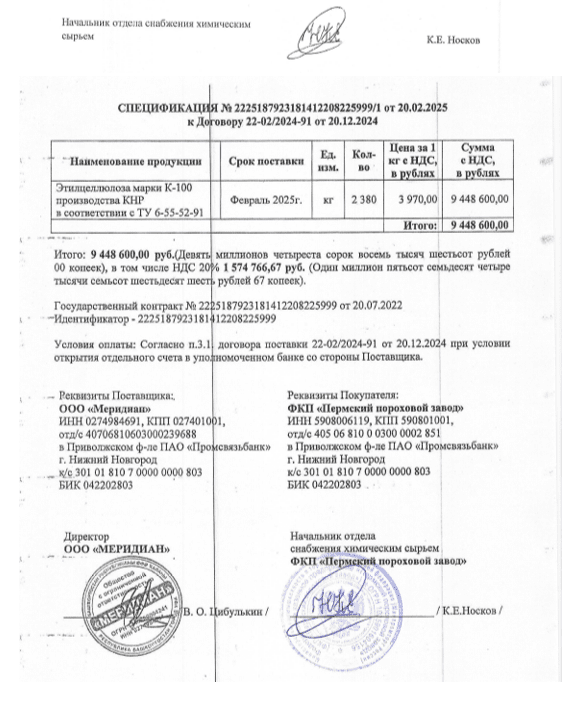
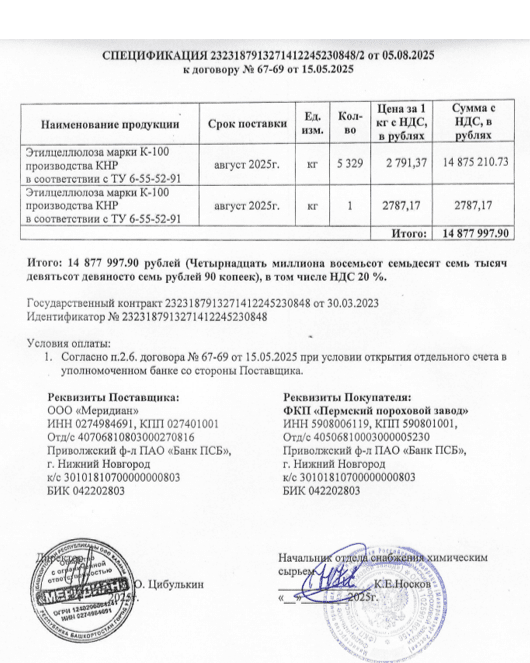
K-100 is supplied via Meridian LLC, a Russian company based in Ufa, Bashkortostan. Procurement is scaling up significantly from 13 tonnes in 2024 to 50 tonnes in 2025, in a contract worth over $1.7 million. Meridian LLC operates with little public visibility, leaving its role largely obscured. But Bashkortostan is a region considered as one of Russia’s petrochemical hubs, where industrial networks are closely intertwined with the country’s military supply chains.
At the same time, Perm Powder Plant is expanding imports of MOSA IIG hardener from multiple Chinese suppliers, which is used in military infrastructure components, including specialized plates and sealants for the Russian Navy, with applications linked to Project 667B “Delfin” nuclear submarines.
Around 9.8 tonnes were projected to be procured between 2024 and 2025 for use in elastomers, adhesives, and sealants under defense contracts.
Toluene diisocyanate
Perm Powder Plant is also procuring TDI T80 (toluene diisocyanate) manufactured by Hanwha Solutions in South Korea, with 20 tonnes planned for 2025. This material is used for military infrastructure and equipment components, including wear-resistant and vibration-dampening parts.
Critically, the introduction of new sealant formulations is also freeing up capacity for rocket fuel production. Documents indicate that shifting to Korean-supplied inputs helps avoid shortages in rocket propellant components, underscoring how these materials feed directly into both infrastructure and weapons production chains.
Methyltrichlorosilane
China remains a key supplier of methyltrichlorosilane (MTS), a critical input in Russia’s defense production chain, feeding directly into missile production as a component of rocket propellants.
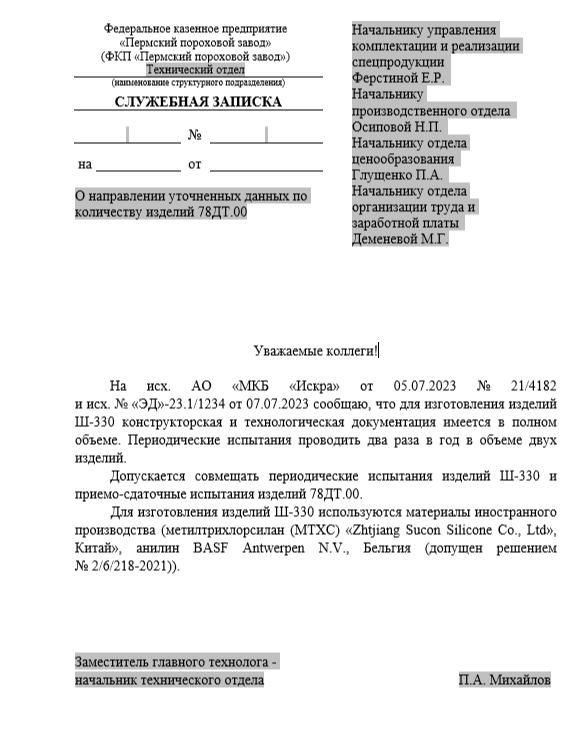
Produced by Zhejiang Sucon Silicone, the material is procured via LLC “Silicon”, with internal documents showing a requirement of 24 tonnes for 2025. At the same time, records indicate checks on legacy stock, pointing to active stockpiling.
MTS feeds into the manufacturing of 78DT and Sh-300 components, which are required for assembling Kh-35 (“Uran”) and Kh-35U (“Uran-U”) anti-ship missiles for the Bal-U coastal defense system.
Banning materials used for Russia’s military industry
Russia’s vast territory and abundant natural resources have not spared it from relying on foreign materials, with domestic substitutes falling short.
The EU and UK have imposed sweeping sanctions to block goods that could support Russia’s military-industrial complex. But these controls are rarely simple lists. Russian sanctions are mostly category-based, commodity-coded, and end-use-restricted, meaning even items not explicitly named can be prohibited under “catch-all” controls if destined for military use.
This creates a grey zone. Dual-use goods—materials with both civilian and defense applications—are restricted only when linked to defense. Procurement networks exploit this, importing goods under civilian cover before diverting them into military production. Through intermediaries and opaque supply chains, foreign-made materials continue to reach Russia, sustaining weapons production despite sanctions.
Some substances, such as Centralite II, sit firmly within the defense sphere. Others—cellulose triacetate and cellulose acetate—are primarily civilian, making them easier to move, though they are still dependent on end use. StateWatch , in collaboration with UNITED24 Media, questioned Cerdia over cellulose acetate supplies to Russia and links to intermediaries; at the time of publication, the company had not responded. Chemicals like methyltrichlorosilane, toluene diisocyanate, and ethyl cellulose fall into a case-by-case category, where risk hinges on how and where they are used.
As long as dual-use goods move through civilian cover and intermediary networks, Russia’s military supply chains will adapt. Closing that gap requires stricter end-use enforcement, real scrutiny of intermediaries, or even a complete ban on these products with accountability across the chain—otherwise, the system doesn’t just have loopholes, it depends on them. Russia has no viable domestic substitutes for these materials, fully cutting off supply would severely disrupt its weapons production chain.
A state-controlled procurement system
These supply chains are often deliberately opaque. Procurement runs through layers of intermediaries and shadow networks, often obscuring the final destination and often distancing the original manufacturers from where their materials ultimately land.
But the pattern is consistent. Foreign chemicals are sourced, routed into Russia, and delivered to the Perm Powder Plant, where they are transformed into components for a wide range of weapons systems. From there, they move through Russia’s defense industry and into the hands of the military.
This network is tightly controlled. Every stage is overseen by military representative offices, Russia’s Ministry of Defense, and the state defense order system. Payments are channeled through specialized defense banking structures, ensuring they can proceed despite sanctions.
Supplies still feed Russia’s war machine
An internal document from Russia’s Perm Powder Plant reveals a system still operating at full scale. The plant continues to procure key chemicals through 2026, with no signs of disruption.
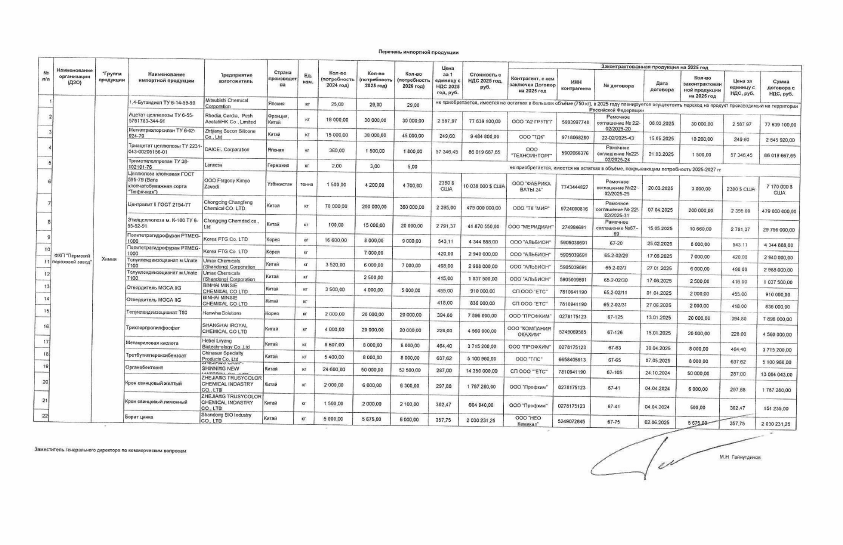
Addressed to the state-linked company Spetshimiya, the letter details a steady pipeline of foreign imports—cellulose acetate, cellulose triacetate, Centralite II, ethyl cellulose, methyltrichlorosilane, and toluene diisocyanate—materials critical to production.
Spetshimiya is a low-profile but critical node within Russia’s Rostec system, a state defense conglomerate. Spetshimiya consolidates demand across military plants, coordinates procurement, and shields end-users behind layers of intermediaries, ensuring sensitive materials continue to reach ammunition, explosives, and rocket propellant production.
Suppliers listed in the letter span China, Germany, India, and beyond, with contracts outlining volumes, prices, delivery timelines, and intermediary networks. Far from isolated transactions, the document maps a structured, ongoing supply chain feeding a Russian defense enterprise.
Behind the layers of intermediaries and paperwork, the outcome is undeniable: the materials are still getting through, and are still feeding Russia’s war.
Discuss this article:
-9bd5e1532102621f8fb1c4ba871a3171.png)


-c439b7bd9030ecf9d5a4287dc361ba31.jpg "Photo of Katherina Popilnichenko")


-111f0e5095e02c02446ffed57bfb0ab1.jpeg "Photo of Roman Kohanets")