- Category
- World
Kallas Says Lasting Peace Requires Russian Troop Withdrawals Beyond Ukraine, Including Georgia and Moldova
 Prefer U24 Media on Google
- Authors

-72b63a4e0c8c475ad81fe3eed3f63729.jpeg "Photo of Cyril Barabaltchouk")
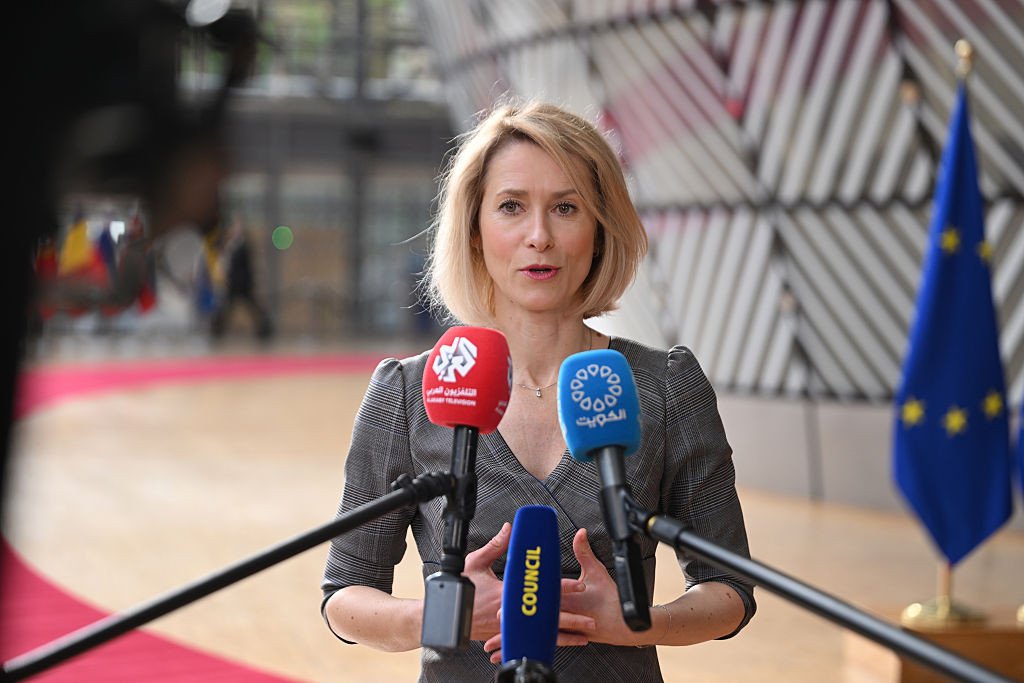
European Union High Representative for Foreign Affairs and Security Policy Kaja Kallas has dismissed recent Russian threats against Western embassies in Kyiv, she stated during the informal meeting of Foreign Affairs Ministers (Gymnich) on May 28.
Kallas said that the Kremlin’s intimidation is a direct consequence of its battlefield failures.
We bring you stories from the ground. Your support keeps our team in the field.
Kallas addressed Moscow’s renewed warnings aimed at forcing foreign diplomatic missions to evacuate the Ukrainian capital.
“This is what Russia does,” Kallas stated. “Because it is not really gaining ground on the battlefield. So, what they are doing now is really increasing the terrorist attacks, because you cannot really describe it in other ways: creating fear inside the society. It has not worked for four years, but I do not think that it is going to work now.”
Kallas praised the resilience of the international community, noting that “all the embassies stayed” and “all the Europeans stayed” despite the threats, indicating that Russia is currently “on a back foot” on the battlefield.
As discussions regarding potential peace talks loom globally, Kallas warned member states against allowing Moscow to dictate the diplomatic terms or select who represents the European coalition at the table. She emphasized that any decisions regarding the easing of sanctions remain strictly European.
“I find that it is a trap that Russia wants us to walk into, that we discuss who talks to them, and they are already picking who is suitable and who is not,” Kallas warned. “Let’s not walk into that trap. Negotiations are always a team effort. You have good cops, you have bad cops, you have strategy on how you go to the table. So that is why the substance is much more important than who.”
Europe’s core demands for long-lasting peace
Kallas reiterated that for the EU to engage in a substantive peace process, it must pursue a comprehensive approach that safeguards European security interests. This includes accountability and demanding reciprocal military limits from Moscow.
According to Kallas, the core requests the EU must bring to the table regarding what Russia should do include:
Respecting International Law: Russia must explicitly uphold its signed international obligations “not to attack their neighbors and respect their sovereignty.”
Mirrored Concessions: Any military limitations or concessions requested of Ukraine within a potential agreement must be “mirrored then to Russia.”
Troop Withdrawals: In the interest of wider European stability, Russian troops must be removed from occupied regions in neighboring states. “If you think about the Russian troops in countries like Georgia, Moldova, that is also in European security interest that these troops are not there, and they are not meddling with elections in different countries,” Kallas noted.
Moscow currently maintains a military occupation of roughly 20% of Georgia following its 2008 invasion, heavily militarizing the breakaway regions of South Ossetia and Abkhazia. In Moldova, the Kremlin continues to deliberately destabilize the country by stationing Russian troops in the unrecognized breakaway region of Transnistria.
Kallas acknowledged that while this constitutes a “maximalist approach,” it is a necessary counterweight because “so is Russia’s approach so far representing maximalist claims.” She concluded by urging the bloc to remain entirely unified, warning that individual EU members are “much, much weaker than we are all together.”
Alongside discussions on countering Russian influence, the European Commission was preparing to propose opening the first thematic cluster for Ukraine’s EU accession. While the process requires unanimous approval from all 27 member states, the shifting political landscape in Hungary following Hungary’s recent elections has altered the dynamic.
Newly elected Hungarian Prime Minister Péter Magyar was anticipated to tie his support for Ukraine’s accession steps to the unlocking of frozen European funds. Concurrently, alternative integration models—such as German Chancellor Friedrich Merz’s suggestion of an “associate membership” without full voting rights—have been met with strong resistance from officials in Kyiv who insist on full integration.
Discuss this article:

-111f0e5095e02c02446ffed57bfb0ab1.jpeg "Photo of Roman Kohanets")