- Category
- World
Russia’s Starlink Rival May Be in Trouble as Two Satellites Fall Toward Earth
 Prefer U24 Media on Google
- Authors

-111f0e5095e02c02446ffed57bfb0ab1.jpeg "Photo of Roman Kohanets")

Two Russian Rassvet-3 broadband satellites intended for a Starlink-style network are rapidly losing altitude and could reenter Earth’s atmosphere within weeks, according to orbital tracking data updated October 13.
SONIKS, a Russian open-source satellite tracking and ground station network that calculates decay forecasts from current two-line element data, lists RASSVET-3 23, NORAD 100089, with an apogee of 250 kilometers and a perigee of 232 kilometers. RASSVET-3 17, NORAD 100083, is at roughly 256 by 236 kilometers.
We bring you stories from the ground. Your support keeps our team in the field.
The service currently projects RASSVET-3 23 to reenter around October 29, and RASSVET-3 17 to reenter around November 1. SONIKS warns that its estimates change as new orbital data arrive and become less accurate farther from the calculation date.
The two spacecraft are clear outliers among the 16 Rassvet-3 satellites launched from Plesetsk on July 19. Most members of the same batch have climbed to roughly 480-512 kilometers, while RASSVET-3 17 and 23 remain near 250 kilometers.
ComNews added that the satellites initially entered an approximately 300-kilometer deployment orbit and were expected to use their own plasma propulsion systems to climb afterward. Following the July launch, Bureau 1440 stated that the spacecraft would begin moving toward their target orbit after completing checks and commissioning. ComNews
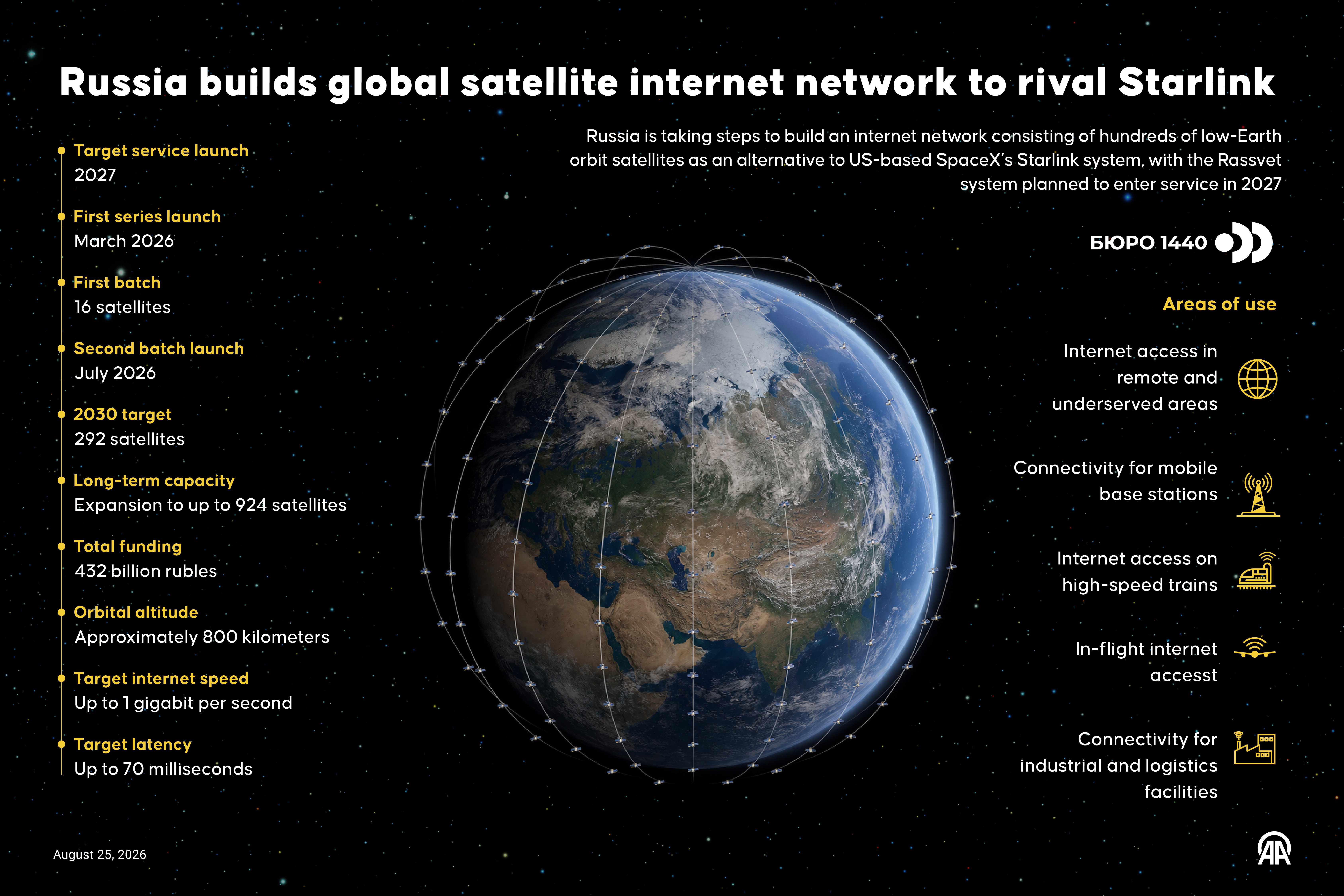
The orbital behavior does not by itself establish why the two satellites are descending or prove that their propulsion systems have failed. Bureau 1440 has not publicly announced the loss of either spacecraft.
Rassvet is being developed by the Russian aerospace company Bureau 1440 as a low Earth orbit broadband network often presented as Russia’s answer to SpaceX’s Starlink. The company describes its satellites as orbital 5G base stations connected through laser links, with planned speeds of up to 1 Gbps and latency below 70 milliseconds.
The program has already faced uncertainty over its intended operating altitude. Bureau 1440 continues to list an 800-kilometer target, while Russian telecom publication ComNews found that most satellites from the first operational batch had instead clustered near 500-540 kilometers.
-417ac3677284a5a23fb66515b725f77f.png)
Experts interviewed by ComNews suggested that Bureau 1440 may have lowered the constellation’s working altitude to around 514 kilometers. A lower orbit can reduce latency but also shrinks each satellite’s coverage area and requires more spacecraft to maintain continuous service.
The potential loss of RASSVET-3 17 and 23 would not be the constellation’s first atmospheric reentry. RASSVET-3 4, launched with the first 16-satellite batch on March 23, reentered on June 6 after spending about 75 days in orbit.
Discuss this article:



-a0d157e1f6f04033b54a1b71f05dabe3.jpg "Russia’s Military Is Expanding Across Africa. Suspiciously, So Is Its Church")



-72b63a4e0c8c475ad81fe3eed3f63729.jpeg "Photo of Cyril Barabaltchouk")