- Category
- World
When Will Russia Run Out of Money for the War? The Matter of Public Debt
Domestic public debt—once touted by Putin since 2012 as being low—has become Russia’s main tool for plugging a widening budget gap as it wages war against Ukraine and tries to keep its economy afloat. For now, it can “patch” budget shortfalls, but the mechanism is fragile. Greater economic pressure could hasten the moment Moscow is forced to the negotiating table.
 Prefer U24 Media on Google
- Authors

-7ab3d055d78b4fffc2530930d91ffaa7.jpg "Khrystyna Borovkova")
“When will Russia run out of money for the war?”—This question concerns many. In the first nine months of 2025, Russia spent $146.4 billion from its budget on military expenditures—four times more than in 2021—accounting for 39% of total government spending. As military expenditures rise, civilian spending is shrinking: the current budget allocates just 25.1% to social spending, the lowest level in 20 years (down from 38.1% before the war).
Overall, Russia’s war expenditures from 2022 to 2025 total $522 billion in taxpayer funds—enough to finance the entire higher education system for 24 years or federally fund healthcare for 22 years.
We bring you stories from the ground. Your support keeps our team in the field.
Russia’s economy—resource-based and low-tech—can hardly be described as strong. In terms of output per capita, it lags behind countries such as Latvia, Lithuania, and Kazakhstan.
Russia is able to continue financing the war while cutting social spending in part because its authoritarian, highly centralized system—facing no meaningful resistance—controls public expectations through repression, targeted financial incentives, and propaganda. Citizens either retreat into private life or become participants in, and beneficiaries of, the system.
Centralized “manual control” simplifies the government’s response to challenges: decisions do not require coordination with other actors, and there is no opposition to central directives. Everything comes down to executing orders from the center. While this approach facilitates control and resource mobilization, it also means that with each cycle, the pool of available resources continues to shrink.
Russia’s money loop
The federal budget deficit of a country waging an aggressive war against Ukraine has been growing annually. In 2022, it stood at $40.7 billion (2.3% of GDP), while in 2025 it reached $69.8 billion (2.6% of GDP)—the largest absolute gap between revenues and expenditures in modern Russian history. Since the start of the full-scale invasion, the deficit has consistently hovered around one-tenth of budget revenues; last year, it accelerated to approximately 15.2%.
$ billions | 2020 | 2021 | 2022 | 2023 | 2024 | 2025 ** |
Revenues | 231,1 | 312,2 | 343,5 | 359,6 | 453,2 | 460,3 |
Oil and gas revenues | 64,6 | 111,8 | 143,0 | 108,9 | 137,4 | 104,7 |
Non-oil revenues | 166,5 | 200,4 | 200,5 | 250,6 | 315,8 | 355,6 |
Expenditures | 281,7 | 305,7 | 384,2 | 399,4 | 496,1 | 529,7 |
Deficit (-) / Surplus (+) | -50,6 | 6,5 | -40,7 | -39,9 | -42,9 | -69,8 |
Deficit-to-revenue ratio (%) | -21,9 | 2,1 | -11,8 | -11,1 | -9,5 | -15,2 |
The author’s calculations are based on data from the Russian Ministry of Finance.
To cover this deficit, Russia relies on domestic borrowing through the issuance of long-term federal loan bonds (OFZs) with maturities of 3–5 years or more, which it began using extensively during the 2022 pandemic. At that time, the Central Bank of Russia—unlike regulators in other countries—encouraged supervised banks to increase purchases of OFZ bonds, while refraining from directly buying them onto its own balance sheet.
This market instrument is used in a highly specific way: primarily through state-controlled banks. If in 2022 the budget deficit was covered by issuing $38.3 billion in OFZ bonds, by 2025, the Kremlin required $87 billion in borrowing.
However, Russia's mechanism does not rely on market-based bond fundraising. Instead, these bonds effectively serve as collateral, enabling banks to act as intermediaries in financing the Finance Ministry. In practice, this is less about market borrowing and more about substituting budget funds with Central Bank resources.
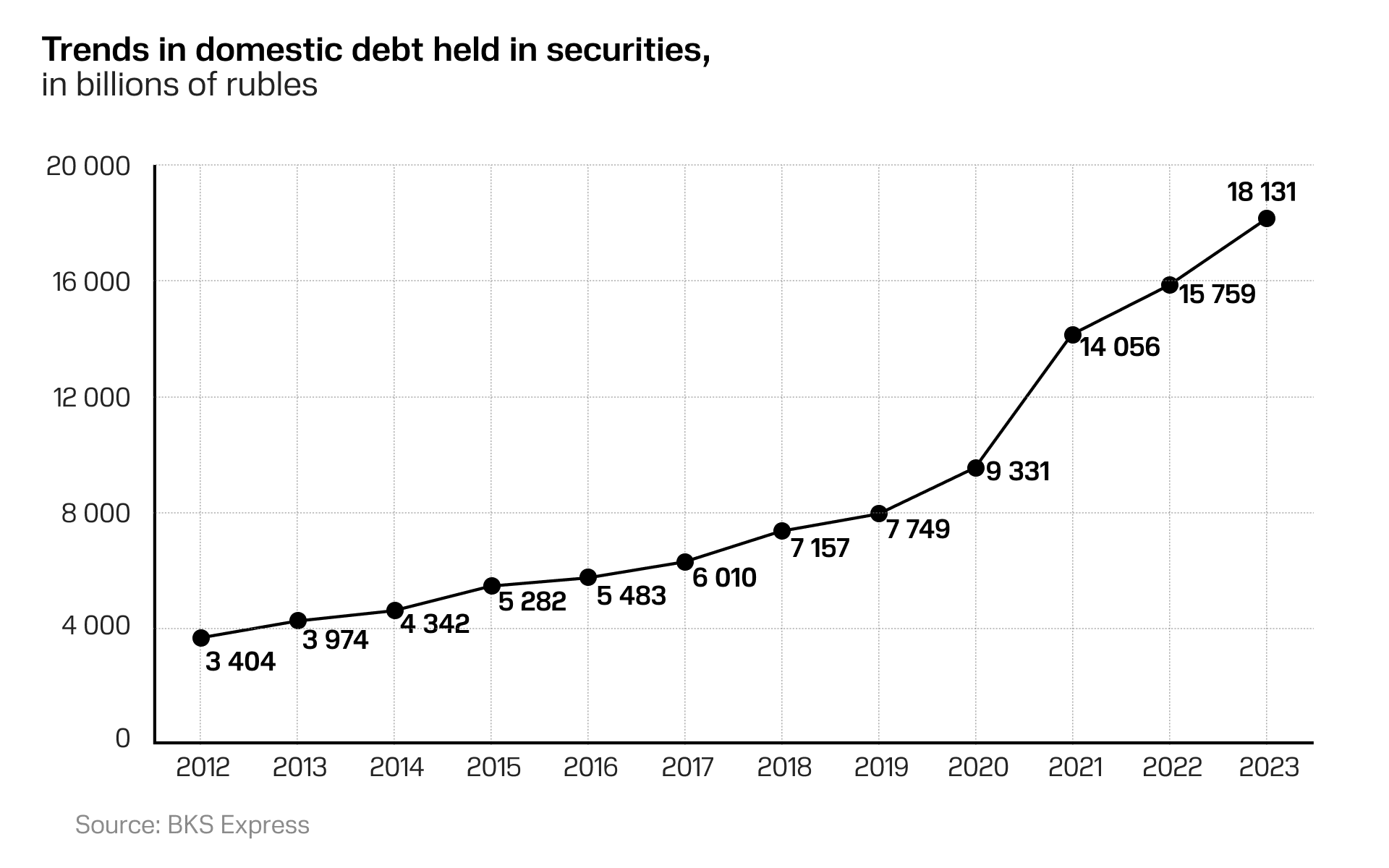
The scheme works as follows: state banks purchase government bonds from the Ministry of Finance, providing it with funds for current spending amid a deficit. Using these bonds as collateral, the Central Bank extends loans to banks through repo operations (credit transactions in which securities—in this case, bonds—serve as collateral). Banks can then use these funds, among other things, to purchase more government bonds.
When the government spends its budget funds, the money flows back into the banking system, allowing banks to repay their debts to the Central Bank. In effect, Central Bank funds temporarily replace budget funds, then return through government spending—a circular transfer of money from one pocket to another.
With each cycle, the volume of money increases, gradually inflating a financial “bubble.” Over time, this process has accelerated: banks increasingly rely on liquidity support, and the scale of such assistance has grown sharply. While repo operations were previously annual, since autumn 2024 they have become monthly, with limits increasing fivefold compared to 2023 to $6.17 billion.
Despite promises to gradually reduce these volumes starting in February 2025, this did not occur. Since April 2025, repo auctions have become weekly, with limits of $24.7–37 billion. In the final week of March 2026, banks borrowed $50.5 billion from the Central Bank through weekly repo operations.
The liquidity shortage is likely driven in part by financially unsound lending to the defense industry. Currently, about 10% of bank assets are problematic, including 19% of corporate loans. Additionally, there has been a significant withdrawal of cash: over the past year, Russians withdrew $12.35 billion from banks.
In 2025, the Central Bank recorded a loss of $2.28 billion for the first time since 2022 (after a $2.47 billion profit in 2024), largely due to non-repayment of repo loans. In total, the Central Bank is still awaiting repayment of $1.48 billion in previously issued loans.
How long can the bubble grow?
It likely has not yet reached its limits. This cycle—where funds move from banks (via Central Bank support) to the Ministry of Finance and back into the banking system through government spending—can continue, particularly given the dominance of state-owned banks.
Moreover, not only banks purchase bonds: Russian citizens, including oligarchs who face restrictions on foreign investments, are also buying OFZ bonds, which offer returns significantly higher than average business profitability. As a result, Russia may be able to increase domestic borrowing to $86–99 billion in 2026.
Is the debt large?
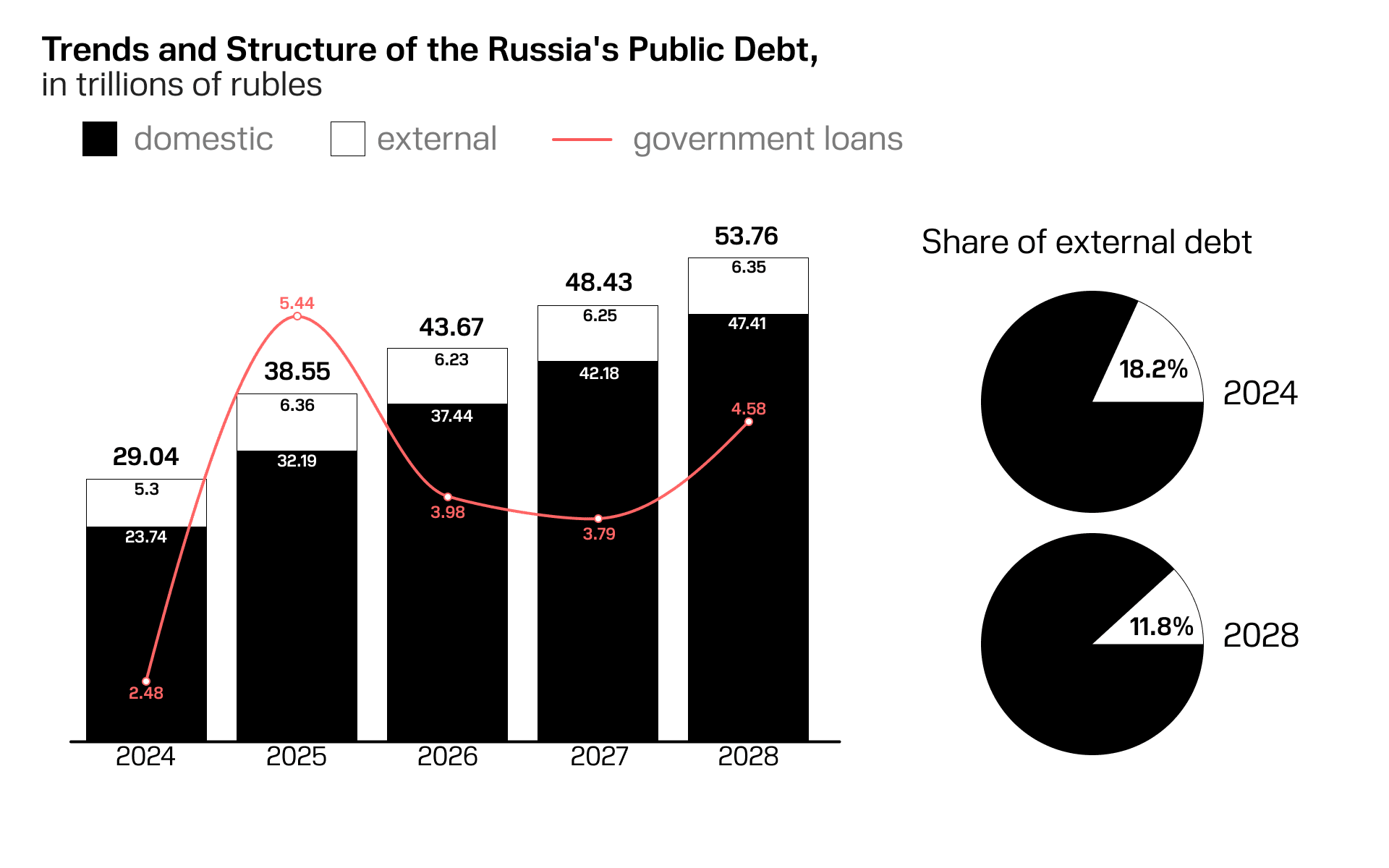
In 2025, Russia’s public debt—total obligations to domestic and foreign entities—stood at approximately $475 billion (17.7% of GDP), with domestic debt accounting for 88.2% ($419 billion). In 2026, it is projected to reach $539 billion (18.6% of GDP), with domestic debt at 85.7% ($462 billion).
Compared to eurozone countries, where the average debt is around 81.8% of GDP, this appears relatively low. However, the Russian ruble is no longer freely convertible, and there is a lack of long-term investment from non-residents.
Furthermore, the Russian government is prepared to operate under chronic budget deficits and rising debt. A long-term plan extending to 2042 anticipates persistent deficits and a sixfold increase in public debt—from $475 billion to $2.94 trillion.
What does the debt cost?
Debt servicing costs have been rising steadily: since the invasion began, they have doubled. In 2026, one out of every ten rubles in revenue will go toward servicing debt. At $48.1 billion, debt servicing already exceeds combined federal spending on education and healthcare ($44.7 billion).
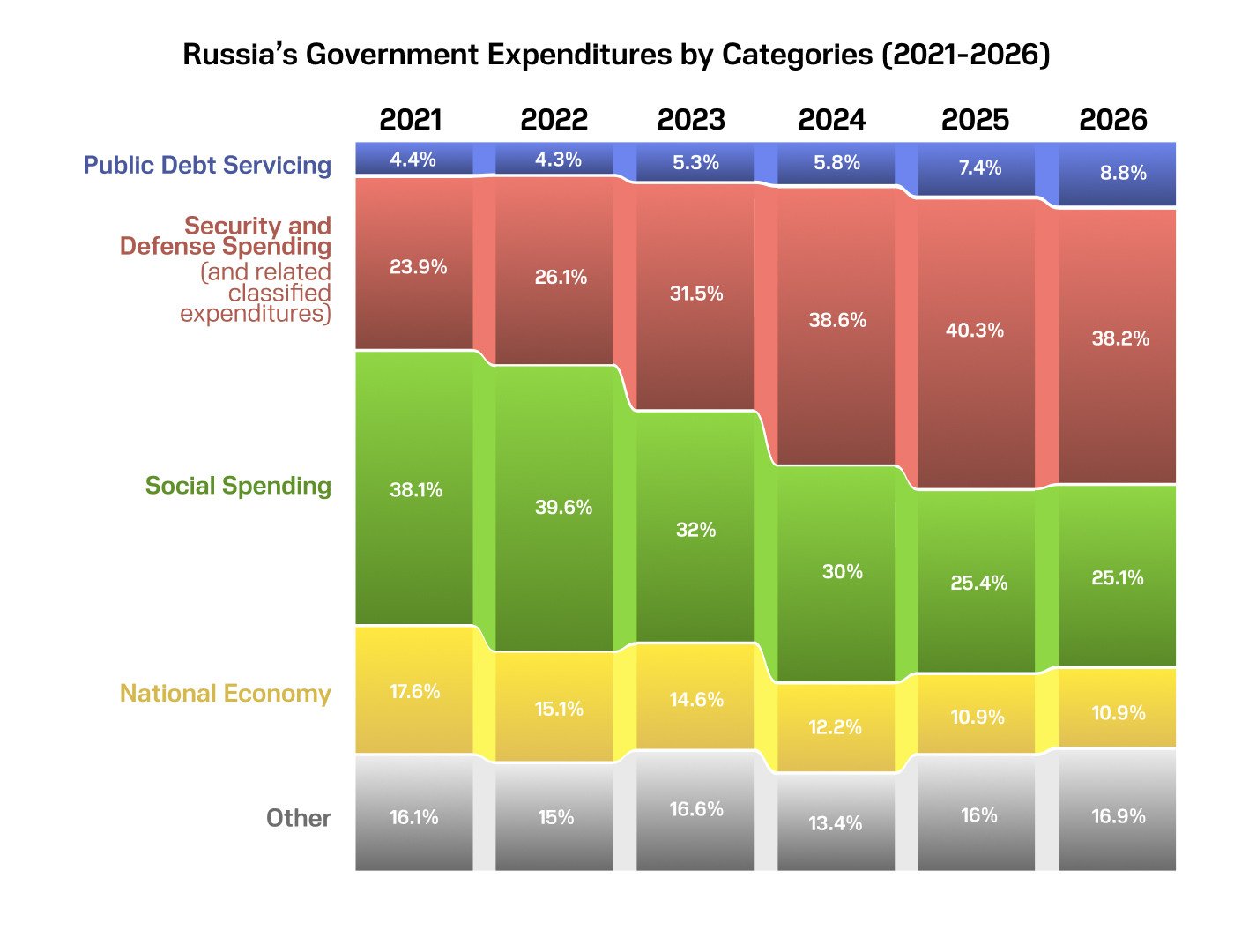
Additionally, when the government borrows to cover current deficits, part of the funds go toward repaying previous debt. For example, of the $87 billion borrowed in 2025, $17.5 billion was used to service past obligations. In other words, today’s debt is repaid with tomorrow’s borrowing, and tomorrow’s debt will be covered by future loans.
Is this a problem?
When a country faces a budget deficit, it may resort to “printing money,” which can trigger high inflation. Financing deficits through domestic borrowing (OFZ) effectively constitutes monetary issuance. However, as long as the government issues bonds at market rates and the Central Bank maintains a relatively high key interest rate—thereby limiting banks’ lending activity—the money supply in the system does not expand materially. As a result, the inflationary impact of this type of deficit financing remains contained for now.
At the same time, economic pressure is increasing. Funds circulating without corresponding production of goods and services are largely directed toward military salaries and weapons procurement—resources that do not generate future economic output or tax revenue. This fuels inflationary expectations, with markets already pricing in rising costs.
Thus, Russia is financing current expenditures at the expense of future income: debt continues to grow, funds are spent without building an economic base, and servicing that debt increasingly depends on new borrowing.
Financing war at the expense of the future
Russia is actively expanding its domestic debt under a system of centralized control, effectively trading time for the scale of a future crisis. However, it would be misguided to wait for internal economic problems—budget deficits, inflation, or policy missteps—to collapse the economy and force Russia to end the war due to lack of funds.
Russia finances its war not only through the state budget: companies such as Rosneft and Gazprom have funded the transport of over 2,000 Ukrainian children from temporarily occupied territories, while individuals close to Putin—such as Suleiman Kerimov, who is under US and Ukrainian sanctions—are prepared to contribute $1.23 billion to the war effort.
Russia has no intention of reducing military spending, even amid negotiations with Ukraine. It uses administrative pressure to recruit students and even schoolchildren, while requiring businesses to supply personnel to the military.
Although Russia can still increase domestic borrowing, it is not limitless. To balance its budget, it would need either to cut expenditures—as discussed in Iran before the war—or increase revenues through higher taxes.
At the same time, the budget deficit is not the only challenge facing Russia’s Ministry of Finance. The economy is experiencing declining production across both civilian and even defense sectors (including a 1.9% drop in bomb and shell production compared to February 2025), as well as mounting corporate debt, with major companies seeking government assistance.
Therefore, continued pressure on Russia is necessary to strain this system from within. No matter how resilient it may appear, every system has a weak link—and breaking that link can trigger the collapse of the entire structure, especially as Russia already lacks sufficient resources to sustain itself and remains cut off from global financial markets.
This material was prepared as part of the cooperation between UNITED24 Media and the international analytical and information community Resurgam.
Discuss this article:


-c439b7bd9030ecf9d5a4287dc361ba31.jpg "Photo of Katherina Popilnichenko")


-111f0e5095e02c02446ffed57bfb0ab1.jpeg "Photo of Roman Kohanets")