- Category
- War in Ukraine
Russia’s War Spending Reaches Levels Rare in the Post-WWII Era, German Intelligence Says
German intelligence estimates that Russia’s true military spending may be 66% higher than officially reported, amounting to roughly 10% of GDP and nearly half of the federal budget. We show how it compares to historical and present examples.
 Prefer U24 Media on Google
- Authors

-605be766de04ba3d21b67fb76a76786a.jpg "Joseph Place")
The official Russian federal budget breakdown is essentially untrustworthy and the Russian war economy is significantly larger than most reports say, German intelligence reported. This was the projected breakdown for 2025 in earlier Western estimates, where the military budget was expected to be “only” around 30% of the budget:
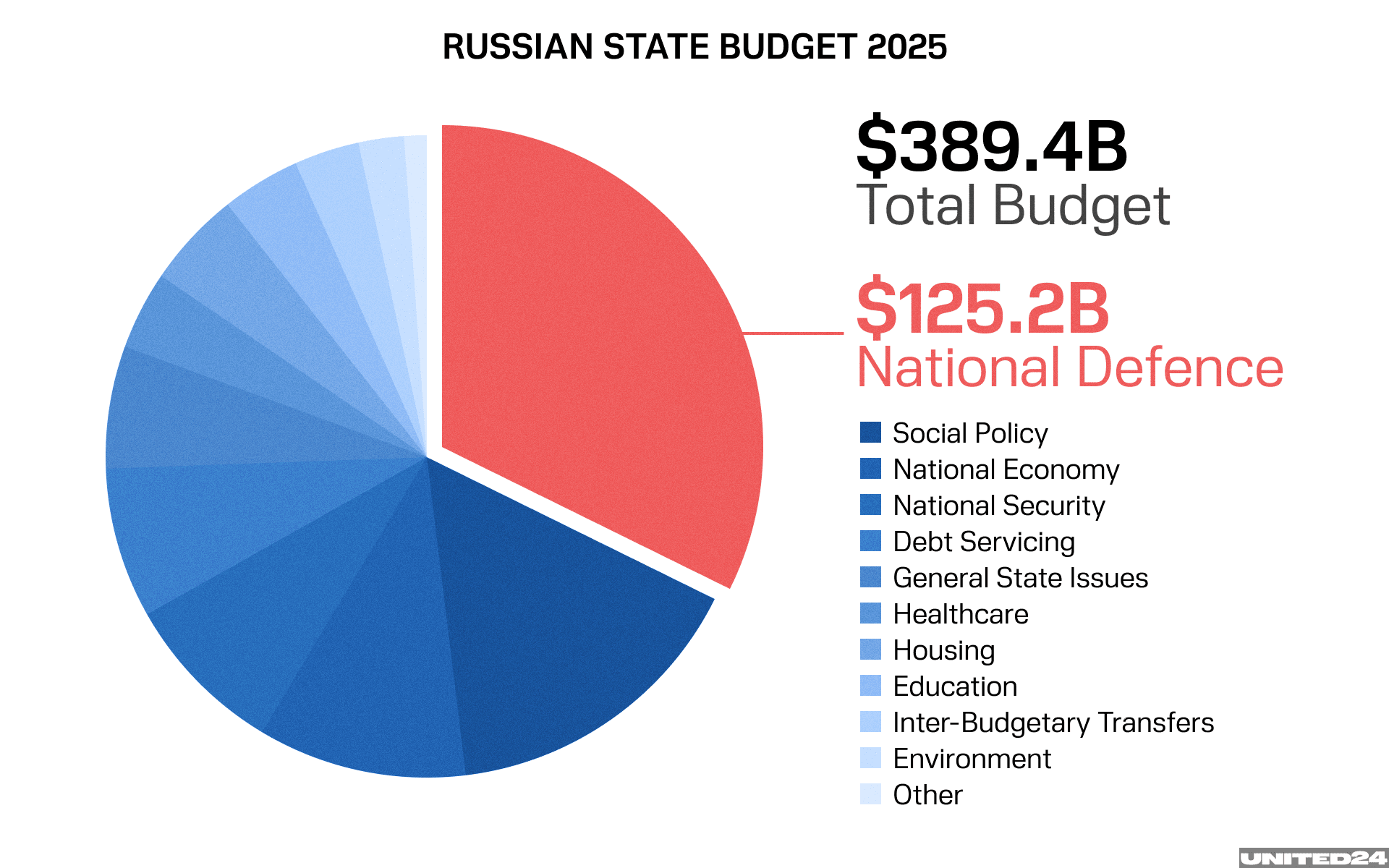
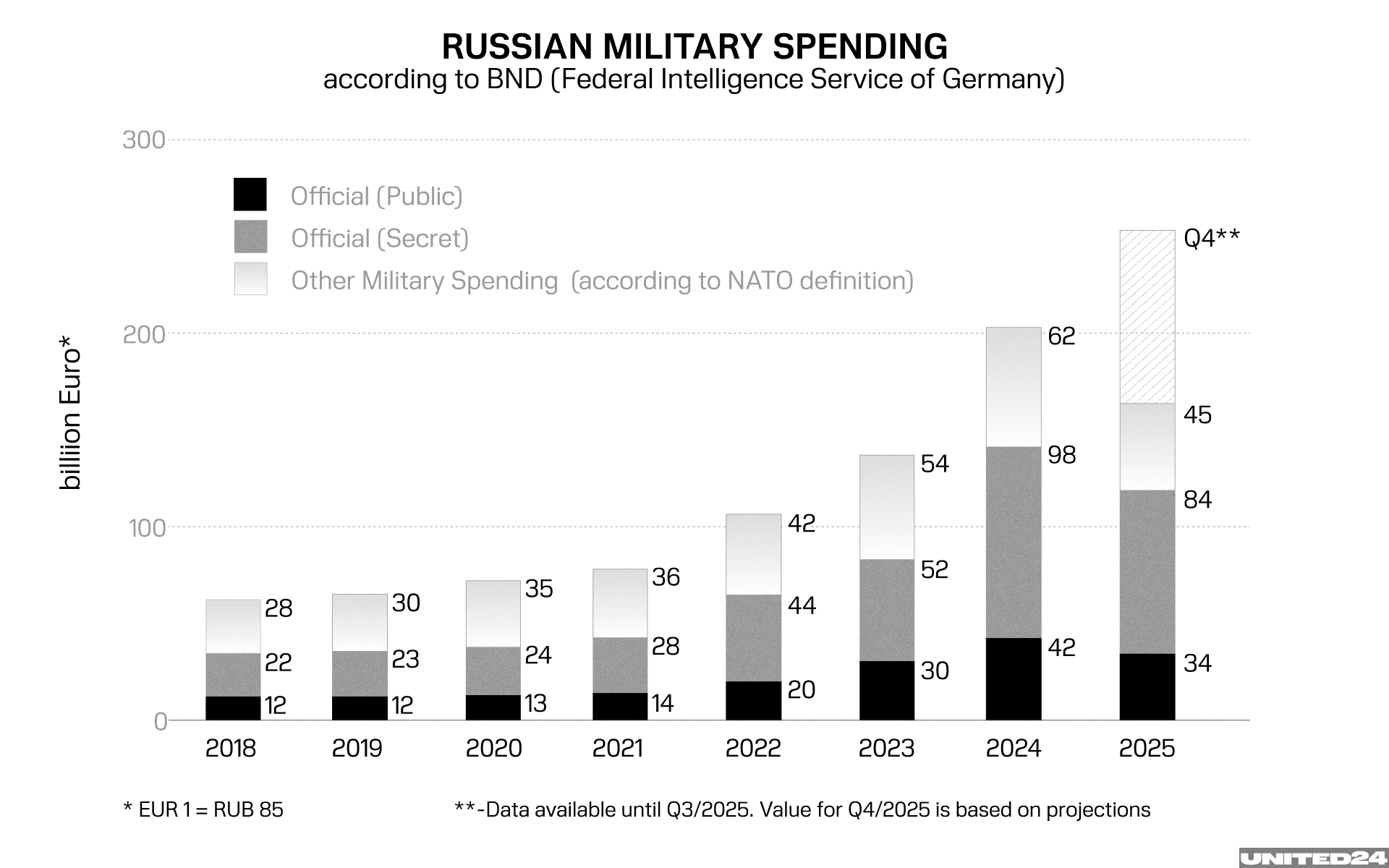
SIPRI had a different estimate for 2025 of around $160 billion. However, the BND, the Federal Republic of Germany’s intelligence service, reported that the Russian definition of defense spending does not match that of NATO’s definition of military spending, such as construction projects of the Ministry of Defense, IT projects of the military, or social benefits for members of the armed forces.
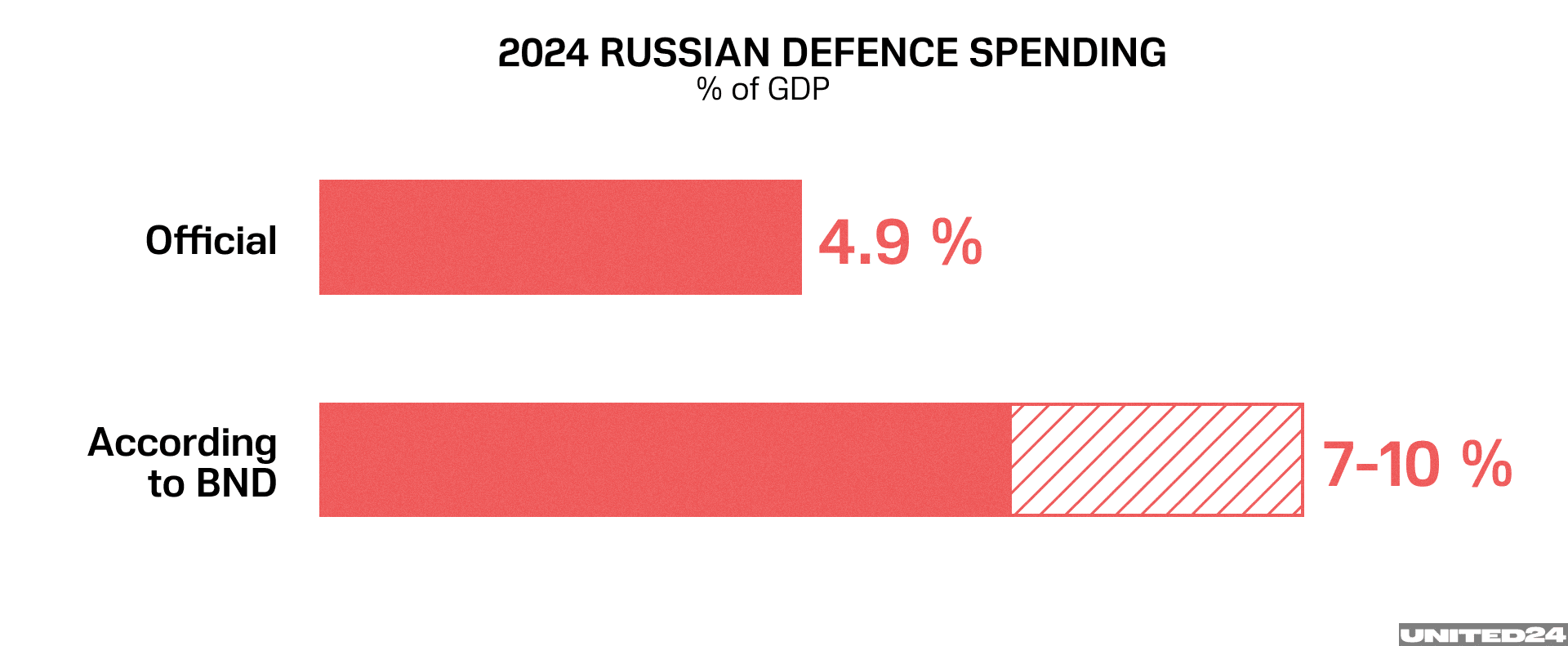
Using NATO’s definition, BND calculates that Russia’s defense-related spending is roughly 66% higher than officially reported, amounting to about 10% of GDP, meaning a significant portion of the economic activity of Russia is derived from defense. In total spending, Russia spends approximately €250 billion ($292 billion) on defense-related expenses, almost half of the Russian federal budget.
For comparison, in 2021, SIPRI assessed that Russia was spending around $66 billion on defense, 10% of the budget, and 3.6% of GDP (though, of course, this figure could also be inaccurate). This means they are spending over four times more after four years of war.
"These figures concretely illustrate the growing threat to Europe posed by Russia,” the BND warns.
How Russia's military budget compares to the US and China
We have to compare both total spending as a share of the budget, as well as GDP, as each alone will not provide the full picture. It’s worth comparing Russia, the USA, and China first as the largest military powers.
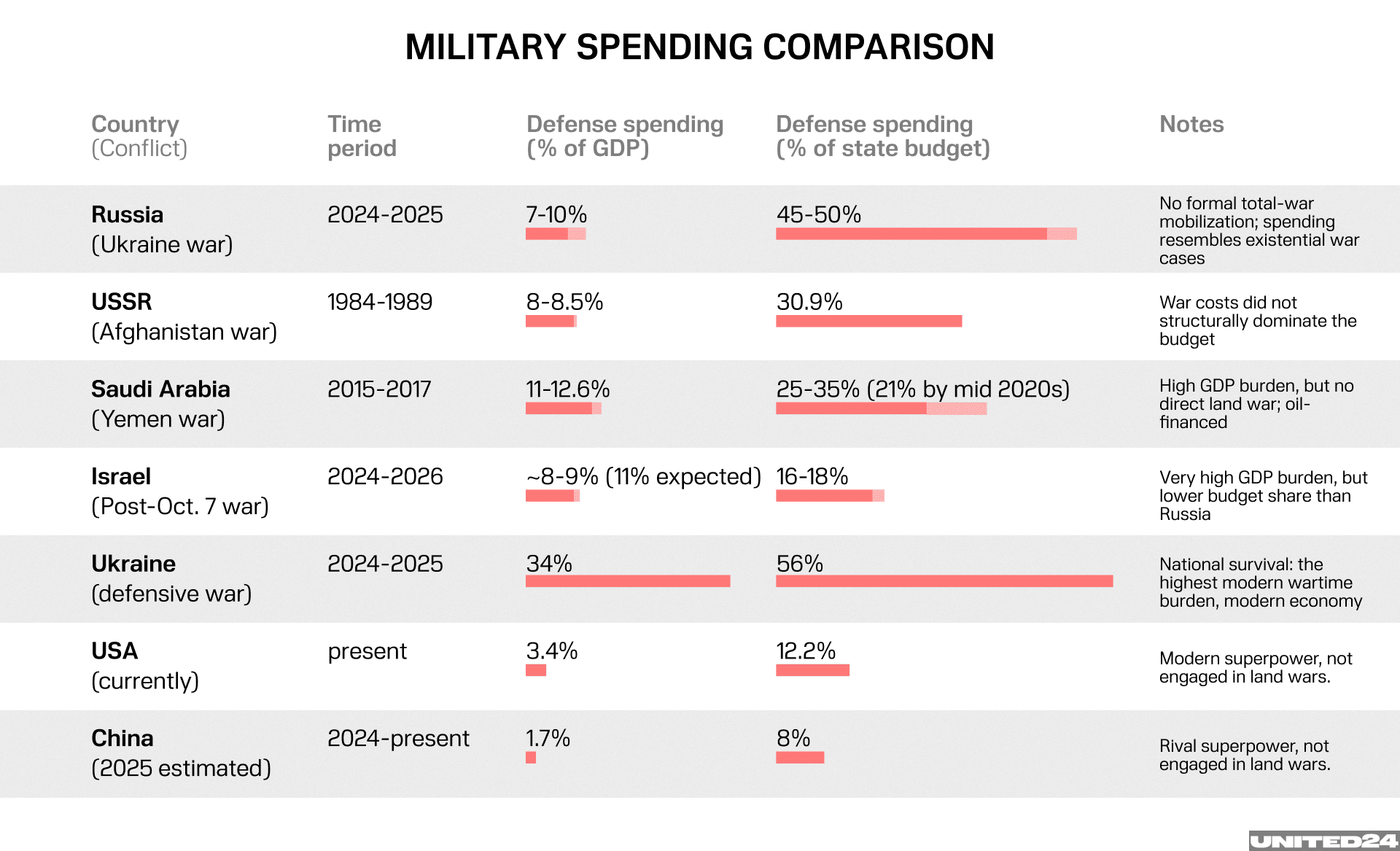
The current US defense budget is $901 billion, which is around 12.2% of the Federal Year 2026 US budget of 1.9 trillion, and around 3.4% of GDP. The highest peak since World War II was during the Korean War, when it reached 14-15% of GDP; however, it was a major global economy with growing influence, compared to other countries, such as Europe, which depended on US money to rebuild after the war.
China has a very different situation. Despite a sizable army, its official 2025 defense budget stands at $247 billion. The International Institute for Strategic Studies (IISS) places the figure slightly higher at $251 billion. Some independent estimates suggest the real total could be closer to $318 billion in 2024, while higher-end calculations reach $471 billion. Even using the larger estimates, China’s military spending remains around 1.7% of GDP, according to SIPRI, and generally under 8–12% of total government spending—far below Russia’s levels.
Russian spending massively outshines both the USA and China. While part of this would be inevitable given that it is at war on a scale rarely seen in modern times, there are a few other countries that have hit high levels to compare to.
Military spending comparison chart
To compare spending with other wars, we should look at historical and other present-day countries.
How Russian spending compares to Soviet spending during the war in Afghanistan
The Soviet invasion of Afghanistan was a significant conflict between 1979–1989, which eventually resulted in the expulsion of the USSR. The USSR spent approximately $7.5 billion on the war between 1984 and 1987, which was barely a fraction of its total annual military budget of $128 billion, according to historian Sergey Radchenko, which aligns with a CIA assessment at the time. The overall defense budget was almost 30.5% of the total Soviet annual budget, however, this was consistent in the USSR with a centralized economy and constant investment in defense due to the Cold War, and did not rise massively as a result of the war.
In terms of GDP, Soviet defense spending was, according to Emeritus Professor of Economics at the University of Warwick Mark Harrison, around 8.4% of GDP in 1989 (higher than official reporting). The percentage is close to current Russian spending levels, and the share of the total defense budget is high. However, the cost of the war did not massively escalate the defense budget, unlike Russia’s war against Ukraine.
Saudi Arabia
Using more modern examples, one country that in recent years has spent a considerable amount on defense is Saudi Arabia, due to its war in Yemen in 2017. The IISS assessed that Saudi Arabia spent 12.51% of its GDP in 2015, 12.61% in 2016, and 11.30% in 2017, rates comparable to Russia's. It is now spending $78 billion, around 21% of total government spending and 7.1% of Saudi Arabia’s gross domestic product, as stated by the Saudi “General Authority for Military Industries” (GAMI). While government sources may or may not be accurate, SIPRI estimated Saudi spending to be around $80 billion, which is similar. However, the significant difference between Russia and Saudi Arabia is that the latter is not engaged in a direct land war, and its economy derives substantial income from oil. In Russia's case, its oil exports, while sizable, are shrinking, and it cannot sustain this level of spending with the economic problems it faces.
Israel
Israel, which is also engaging in a war against neighboring countries, also spends a considerable amount on defense, some calling it unprecedented and second only to Ukraine. Its 2026 budget is $205 billion, with $34 billion for defense, which is 16.59% of the total. This has been the largest increase since 1967, when its defense spending rose massively due to the Six-Day War, peaking after the Yom Kippur War in 1974, causing major economic issues for Israel. This modern spike in spending is still significantly lower compared to Russia’s military-related expenses.
Recently, SIPRI estimates defense spending at around 8-8.8% of the budget, though some expect it to rise further to 11%. This puts Israel as the top spender in terms of GDP in many official counts; however, Russia, if we use the actual BND data, would come out higher in terms of GDP, and it still spends considerably more as a budget share. Israel’s war is notably different from Russia’s, as Ukraine has a standing army and is geographically larger. However, it shows that Russia stands out even among those also at war.
Russia’s spending compared to World War II
Country | Period | Defense Spending (As % of GDP) | Defense spending (as %of total budget) |
United Kingdom (WWII) | 1944–1945 | 45–50% | 69% avg., 80% peak |
USSR (WWII) | 1942–1943 (peak) | 35–36% | 60–65% |
Nazi Germany (WWII) | 1943–1945 | 50–75% (varies by definition) | 70–80% |
The high percentage of high spending is generally not seen in modern times. To see similar cases, we have to go further back into history. The most relevant comparisons are the UK, USSR, and Nazi Germany, as major powers of the conflict, and with Russia's geographical proximity to the conflict, similarly to Russia presently.
The UK spent, on average, 45%-50% of its total GDP on defense during World War II, and an average of 69% of its budget, peaking at an incredible 80%. This led to borrowing from the USA, increased debt, peaking just after the war to 270% of GDP, in part contributing to the decline of the British Empire and dependence on the USA.
By 1942–43, Soviet war spending accounted for around two-thirds of total budgetary spending, according to various academic sources such as Mark Harrison, and a CIA report citing 59% of the budget expenditures on defense. Harrison claims that, as GDP share, defense and military expenditure peaked in 1943 at 35.5%. This means that Russia’s current budget share is close to the levels seen during World War II on its soil, even though its GDP share is lower.
In Germany, the spending on the armed forces, the Wehrmacht, rose to almost 80% of the entire budget by 1943. In terms of GDP, some claim that Nazi Germany spent 25% of GDP on defense in 1939, and some, such as Richard Evans, claim 75% by 1945, and others place it at an average of 50%.
How Sustainable is Russia’s 10% GDP and 50% Total budgetary spending for Russia?
What must be understood is that the Russian economy is struggling and entering a crisis. Its budget deficit is already half of the planned annual deficit for 2026, and foreign trade is down to Soviet levels due to sanctions on Russia. Many regions are bankrupt or nearing it, many workers are going part-time, which will further harm the economy, taxes are going up, inflation is high, and businesses are going bankrupt despite a rising GDP, and oil revenues are down. This isn’t even all the issues. It is unclear how a war economy of this scale can be sustainable.
Russia’s war machine is massive, yet not invincible. Evidently, it is operating at great cost to its economy. Sanctions can help further inflate costs and cause further difficulties regarding acquiring parts for its military, hindering Russia’s ability to maintain the war machine, and can help force it to accept peace. There are many stockpiles running out, shortages of resources, including basic necessities like food and water. Increasing sanctions, reducing the ability for Russia to profit from oil sales further, can cripple its war machine for a significantly long time.
The only other country that would beat Russia as a percentage of the budget and GDP is Ukraine, which is the country Russia is invading. Ukraine spends around 34% of its GDP on defense, and over half of its budget. However, it is actively attempting to survive an invasion by its larger neighbor. Ukraine also has support from many other countries, and many are committed to investing in the post-war period, as European nations recovered and boomed after World War II.
Discuss this article:
-9a7b3a98ed5c506e0b77a6663f5727c5.png)


-c439b7bd9030ecf9d5a4287dc361ba31.jpg "Photo of Katherina Popilnichenko")


-29a1a43aba23f9bb779a1ac8b98d2121.jpeg "Photo of Illia Kabachynskyi")