- Category
- Culture
French Baroque Musician Salomé Gasselin Made Her Kyiv Debut Amid Russian Strikes
 Prefer U24 Media on Google
- Authors

-554f0711f15a880af68b2550a739eee4.jpg "Photo of Lucile Brizard")

French musician Salomé Gasselin’s first journey to Kyiv offered a clear view of Europe’s cultural imprint in Ukraine. As the centuries-old sound of the viola da gamba filled the National Philharmonic, the concert was described as a “small miracle,” affirming Ukraine’s deep cultural ties to Europe in the language of music.
A French musician’s first journey to Kyiv
Life in wartime is anything but ordinary, though in its midst many platitudes arise. “Life goes on,” or, for example, that music “can heal the soul.” As nightly bombings and nationwide blackouts permeate everything, a classical concert can understandably be met with an eye roll.
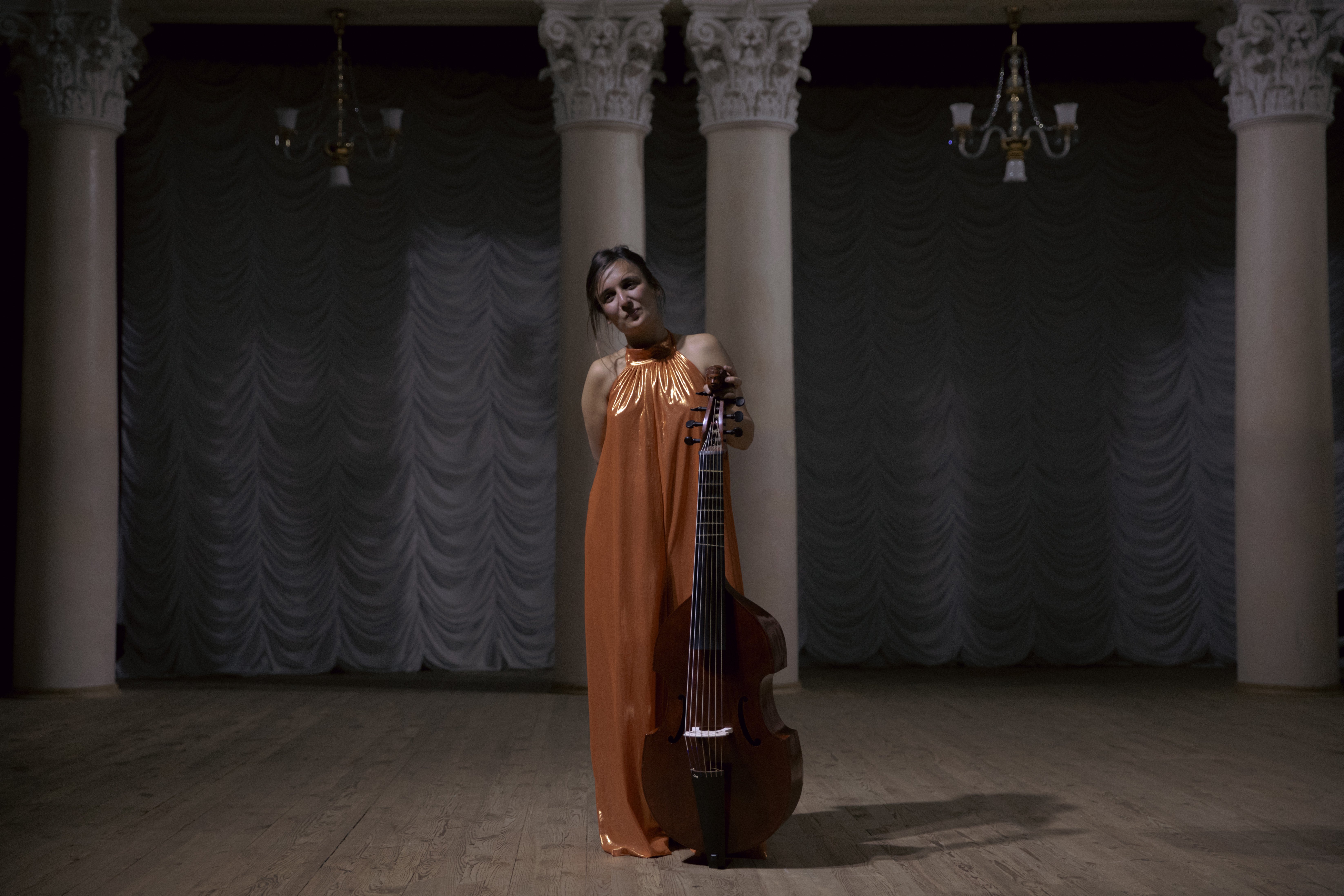
In the case of the French musician Salomé Gasselin’s representation at Ukraine’s National Philharmonic, featured as part of the Kyiv Baroque Festival, founded in 2024 and organized with the support of the Embassy of France and the French Institute in Ukraine, the room was met with a “small miracle,” as the director of the French Institute put it.
Visibly, the audience agreed, Gasselin herself qualifying the moment: “I wasn’t prepared for the intensity, for the quality of the silence. It was one of the most intense performances I’ve ever experienced.” Once imagining a life in rugby, drawing, or genetics, Gasselin instead chose classical music. Studying all over Europe: in Lyon, The Hague, and Salzburg, she garnered prizes in Lugano and Köthen, and released Récit, an album lauded by critics.
Gasselin decided to come to Ukraine despite the war—“very, very quickly,” she told us.
After a missile strike: dignity through sound
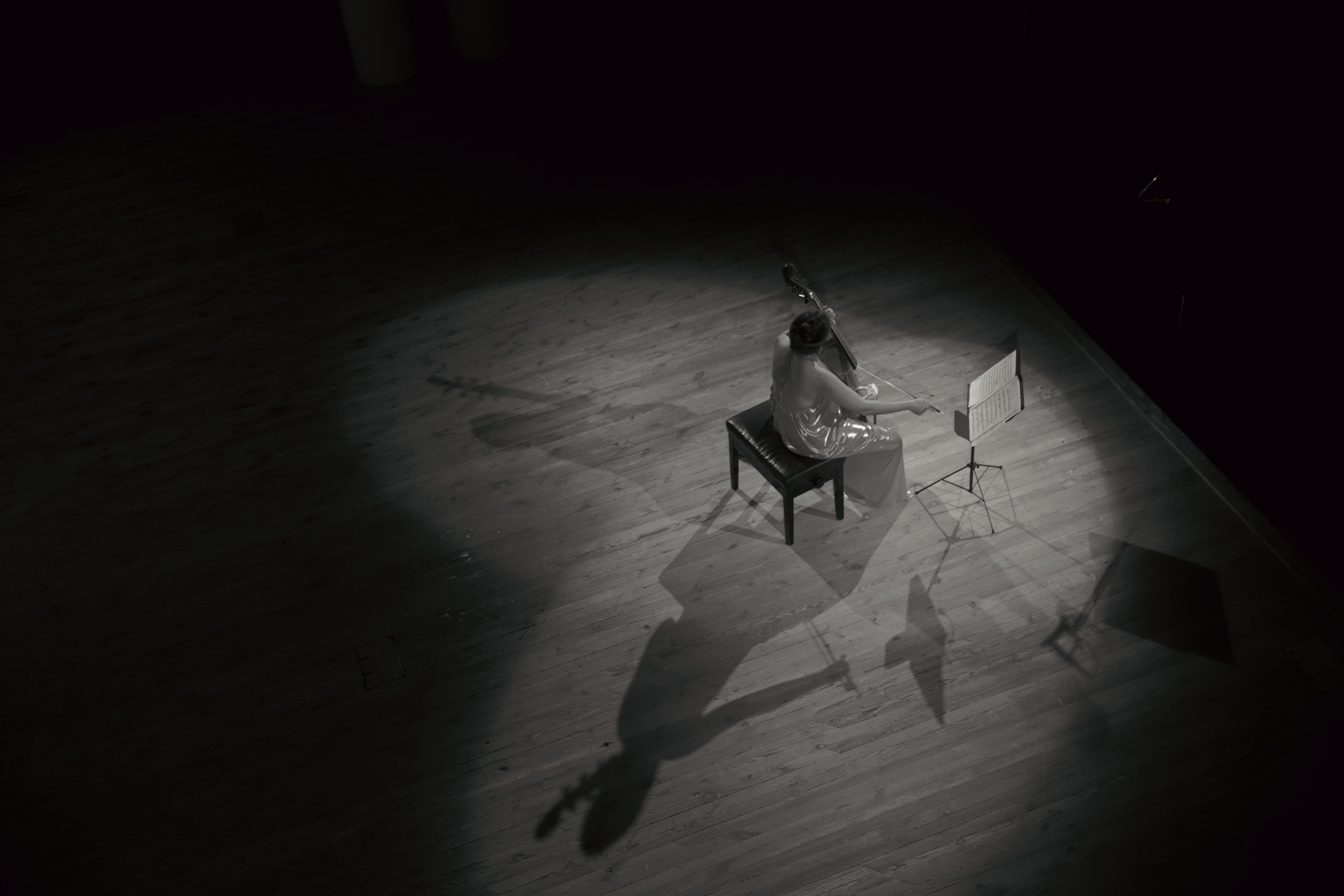
The concert, which took place the night after a Russian ballistic missile attack in the West of Ukraine, which killed 36 people, was a spectacle of dignity. After a minute of silence, the performer sat alone on stage with her instrument, devoid of frills or ornamentation. Muted, yellow lights stayed on low, so Gasselin—who is in the habit of requesting this—could see the first two rows.
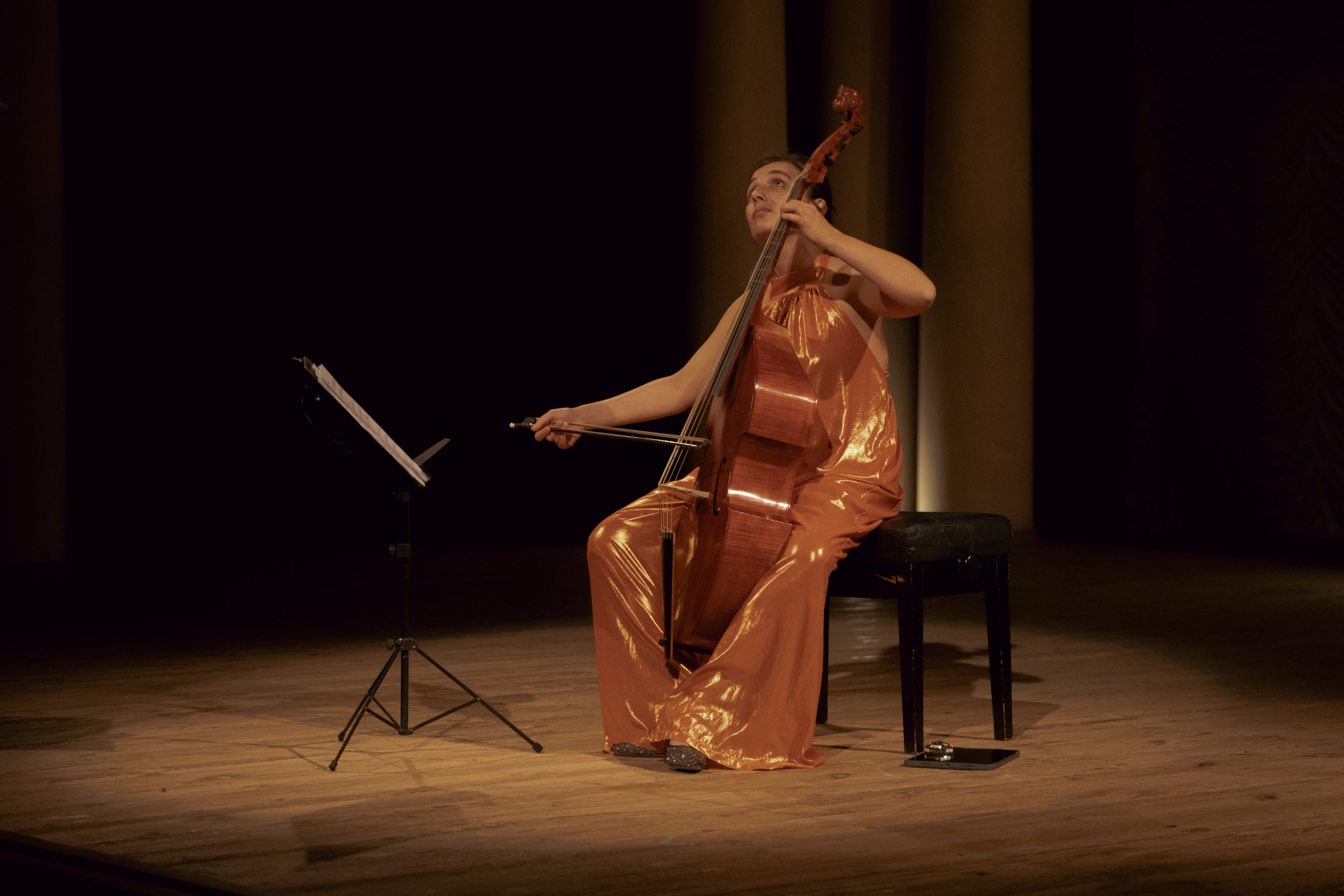
Her process, which is decidedly unorthodox, also includes never practicing alone, with at least one person in the room. And it’s clear why, as the night did feel like a practice session in the best sense—the audience let in on a commanding artist’s intimate relation to the baroque genre. In a written preface, she compares the “ancient” music: “In the world of wine, they have a share to drink—the ‘angels’ share.’ This is the name given to the part of the alcohol that evaporates as the wine ages in barrels. When musicians perform ancient music, they encounter this vanished essence.”
After the second piece—Marin Marais’s Les Voix humaines (Book II)—Gasselin stood to address the audience. Wearing a bright orange dress, her hair in a loose bun, she spoke of her journey, the first to Kyiv. The war has grounded all commercial flights, and trains now ferry foreigners, women, children, and the few men still permitted to travel in and out of the country. That night’s journey resonated with many people and stood as a reminder of Europe’s presence in Ukraine, which, unbeknownst to all, stretches back centuries, long before the European Union’s inception.
Europe’s cultural roots in Ukraine: a musical reminder
It is tempting to dismiss such an event as European soft power, but Ukraine has long sided with the European Union ideal concerning the mutual respect of borders to end the cycle of invasions and annexations that plagued its past. This stands in contrast to Russia, an empire long organized around a powerful center and expansionist desires.
Serving as a reminder of such a legacy, where knowledge can now be shared across fixed borders, Gasselin, in her second address to the audience, stated she believes that music is tangible. Indeed, the tangibility of the sound was palpable, and it was dueling against Russia’s place within the classical scene and the “greats” such as Rachmaninoff and Shostakovich.

This understanding—that Ukraine belongs to Europe—is grounded not yet in constitutional terms but in its philosophy. The exchange of ideas, so central to the European mindset, happens through people, and it seems, even in times of war. And although Europe is often criticized for its slow military and diplomatic response, it shows up where the arts are concerned.
“I will definitely come back”
As a testament to this, Gasselin stated, “At first I needed to be reassured, but now I’m sure that if the festival invites me again, I will definitely come back to Kyiv,” reinforcing her relationship with Ukraine, but also in certain terms, carrying on her own philosophy: “I often like to see a concert as the audience giving energy to a musician, and the musician healing this energy, and sending it back.”
Discuss this article:

-e00d178a31a987cd514e15ad3a8c2131.jpeg "Max Klymenko wearing the Etnodim, featuring embroidery inspired by traditional Ukrainian crafts. (Source: Ian Treherne)")

-e88c01988249cd60b6f04f79d29156b7.jpeg "Damage to “Cosmogony,” the largest painting in Ukraine, following a Russian drone attack on Lutsk on October 13, 2026. (Source: @sashyyna/Instagram)")
-480d70a36b9b34492b0b32ca04af4489.jpg "People attend the funeral ceremony of the famous Ukrainian writer Victoria Amelina at the Garrison Church, in Lviv, Ukraine, on July 5, 2023. (Source: Getty Images)")