- Category
- Culture
Ukraine Is Rescuing Its Ancient Ancestors, the "Stone Babas," From the Frontline
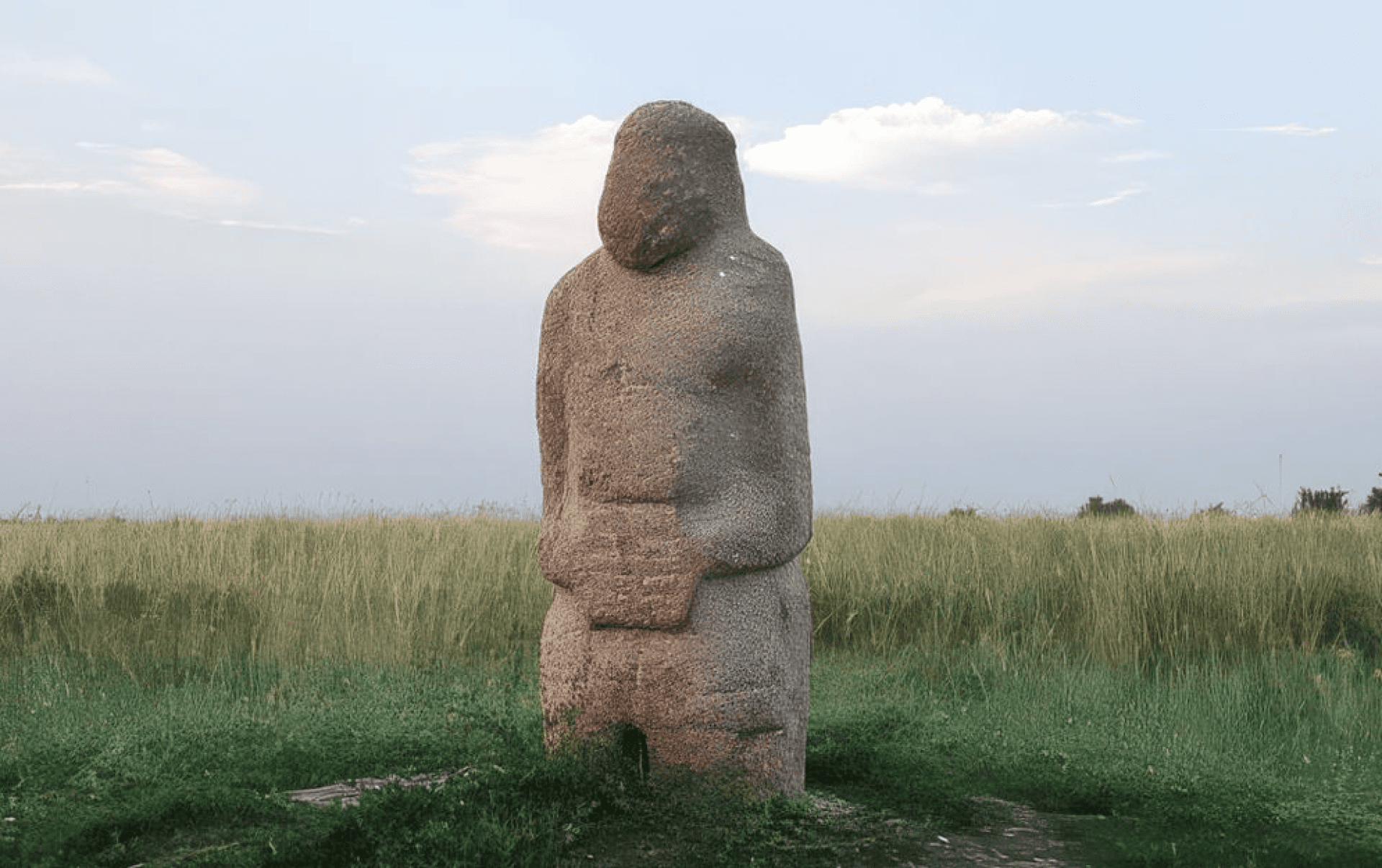
Amid Russia’s relentless assaults in eastern Ukraine, volunteers and soldiers have begun rescuing medieval “stone babas”—statues carved 800 years ago—from the frontline. What are these statues and why do they matter?
 Prefer U24 Media on Google
- Authors

-554f0711f15a880af68b2550a739eee4.jpg "Photo of Lucile Brizard")
One of the latest missions took place in Pokrovske, Dnipropetrovsk region. Under constant Russian fire, historian Yurii Fanyhin and his team moved three intact statues and one fragment to safety in Dnipro — the 20th Baba rescued since the full-scale invasion began.
⚡️ Volunteers and soldiers rescued four ancient stone “babas” from near the front line.
— UNITED24 Media (@United24media) October 9, 2025
Three complete and one partial Polovtsian sculptures from the 11–13th centuries were evacuated from Pokrovske, Dnipropetrovsk region, to Dnipro on September 16. These unique artifacts had… pic.twitter.com/nny6sQQ4tt
Similar rescues have been carried out nearby. “A bearded expert and a group of Ukrainian soldiers arrived in the village on a special mission,” the UK news outlet The Guardian journalist Luke Harding describes the rescue of a Baba in the village of Slovianka. “Their goal did not involve shooting at invading Russian forces. Instead, they had come to rescue a unique piece of history before it could be swallowed up by war and a frontline creeping closer.”
The soldiers placed a carved stone figure—“a woman holding a ceremonial pot, wearing a necklace and with tiny legs”—on a wooden pallet and lifted it onto a flatbed truck. “We didn’t think we would have to evacuate it. But we do. It’s sad,” Fanyhin said.
What is a Baba?
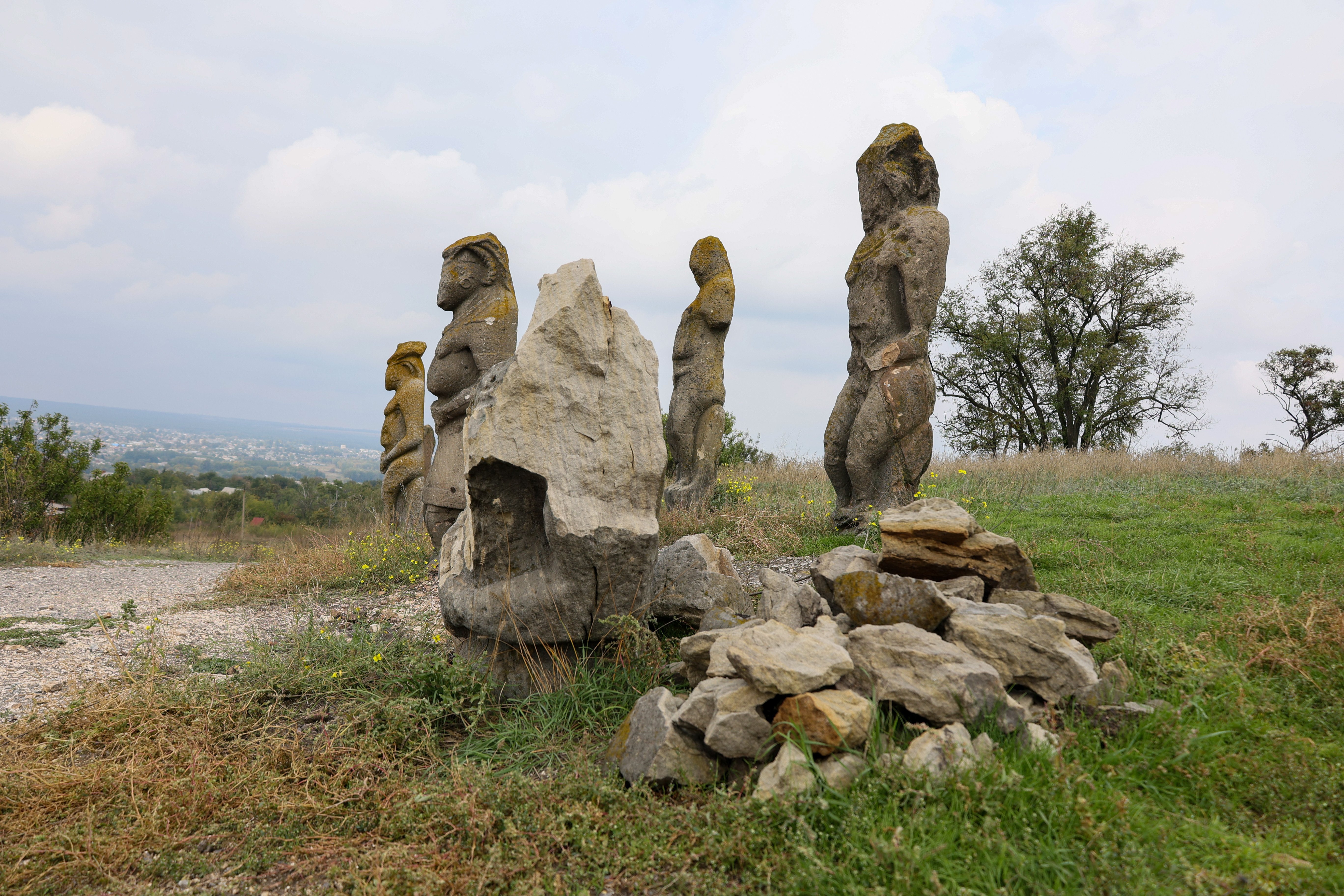
The word “baba” is derived from Turkic balbal, meaning “ancestor” or “grandfather” (rather than the Ukrainian бабуся (babusya) “grandmother.”) A baba is a tall, bulbous stone statue shaped like a human, with a flat face, folded hands, and carved details like cups, belts, or necklaces.
Their functions evolved over thousands of years; babas stood along main roads in the Ukrainian steppe, according to Ukrainian Magazine Art Ukraine. Yet, all relate to honoring the dead and marking sacred or ancestral spaces.
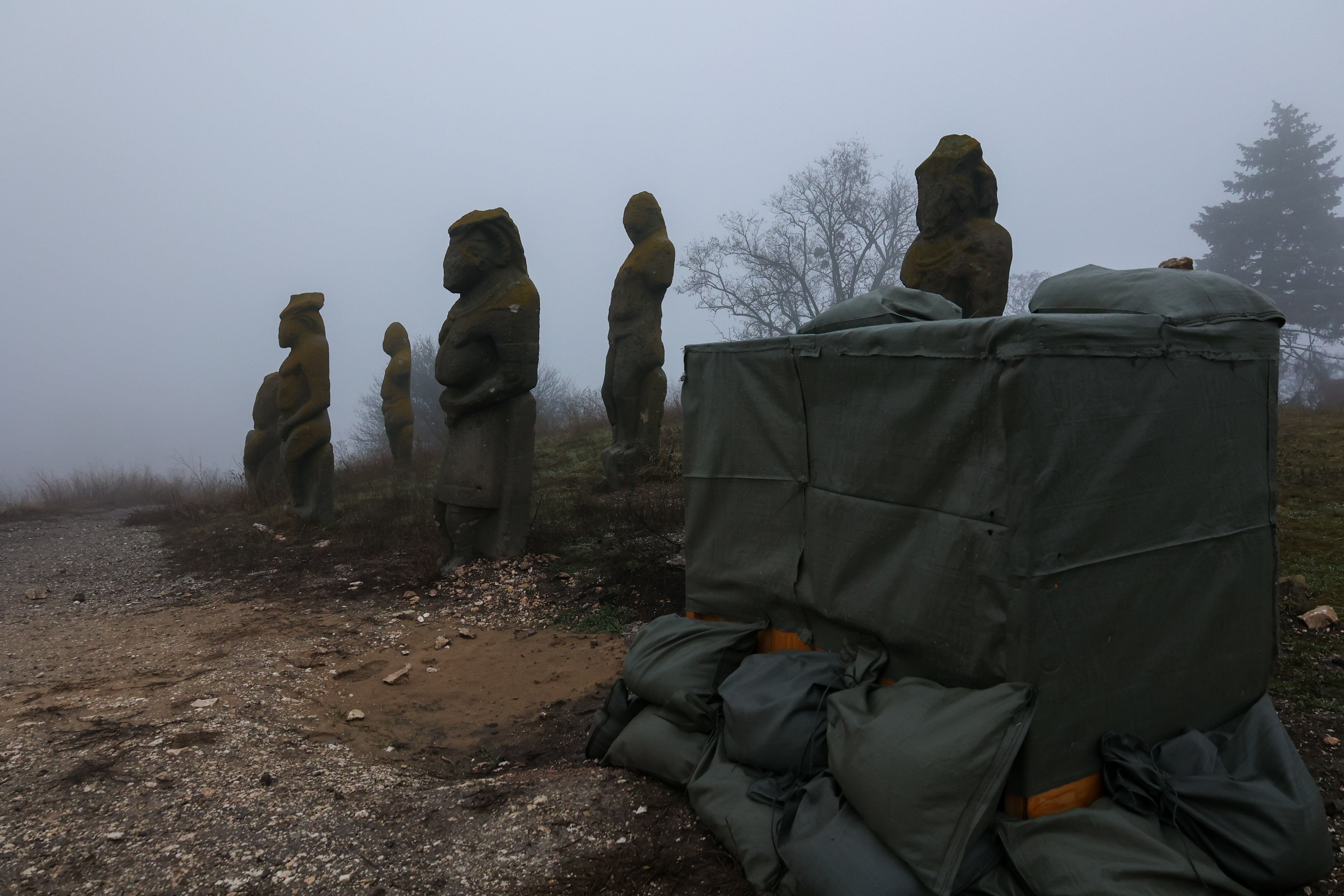
Later, people moved them, using them in parks, buildings, fences, or as grindstones, and many details were lost in the process. A legend says giant warriors once tried to conquer the sun, which turned them into stone. In ancient Rus’, these statues were called “Bovvans.”
They once stood in sight of each other—sentinels of a nomadic cosmology that viewed the land not as property but as a continuum. The Cimmerians, Scythians, and later the Turkic-speaking Cumans (or Polovtsians) placed these statues high up, on mounds. Male figures held weapons, while female ones held bowls or folded their hands. They watched over the steppe. Centuries later, some believe they are still watching.
Saving the statues from pillaging
As Russia’s full-scale invasion ruptured Ukraine’s landscape in 2022, what began as archaeology turned into rescue.
“Ukrainian cultural authorities have accelerated efforts to remove and protect centuries-old stone statues known as ‘Babas’ or ‘Polovtsian figures’ as Russian forces push deeper into the country’s east,” the Spanish news outlet Mundo América reported on November 4.
The emergency operation spans Dnipropetrovsk, Donetsk, and Zaporizhzhia regions—an effort involving the Dnipro National Historical Museum and Ukrainian army units. The goal: to prevent looting or destruction of relics that bind Ukraine to its origins.
“These operations are carried out under constant threat from Russian drones and artillery,” said Fanyhin, who collaborates with Dnipro’s National History Museum.
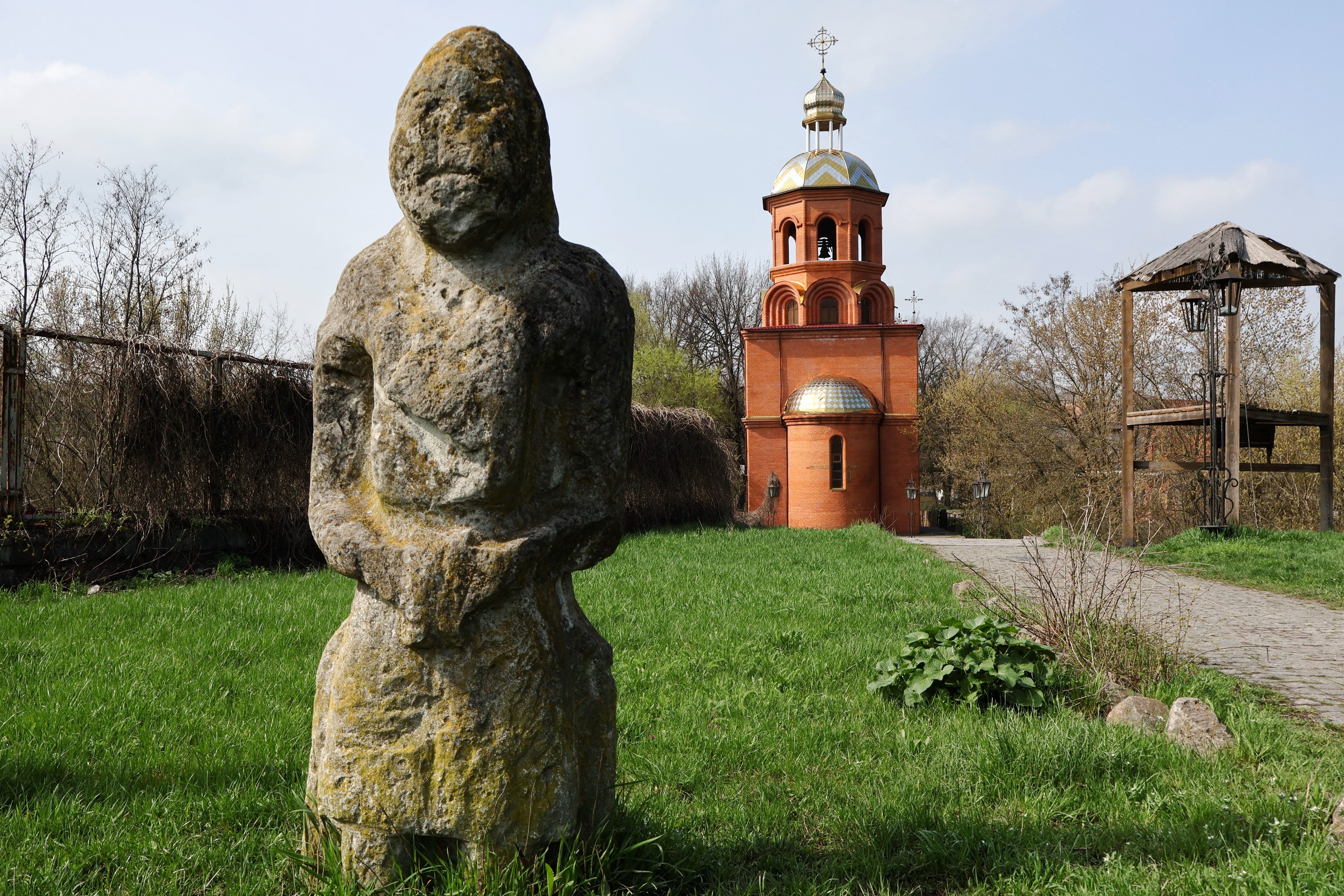
He recalled how they first started spotting the Babas. “It was a soldier from the Territorial Defense . He saw the statue in a village garden and told me about it. By chance, I spoke with a Polish friend who had also seen others nearby. Between February and March, we managed to rescue three.”
For Ukraine’s cultural officials, saving them is both a matter of preservation and defiance. “For Moscow, those territories belong to them—they are Slavic, according to their version,” said Dnipro Museum director Oleksandr Starik to The Guardian. “Nomadic peoples like the Polovtsians do not fit with their (the Russians') myths.”
The rescue of the babas has become a ritual of continuity. Soldiers who once guarded checkpoints now haul one-ton stones under the threat of drone fire. Museum curators coordinate with artillery units. Each evacuation reads like an act of mourning and of renewal.
“Earlier this month, a Russian drone blew up a civilian minibus and a glide bomb destroyed the town’s school,” Harding reported from Mezhova, a city 15 kilometres from the front line. Two statues were retrieved there. In other places, the missions failed. “We need help from the military to get it out. But no one wants to risk their life for a statue. I don’t want to risk mine either,” Fanyhin said.
Still, they continue. The historian said the rescue missions had kept him sane during a stressful period of war and loss: “In some way, the babas saved us.” “We feel we are doing an important and even a great thing. It shows that Ukraine doesn’t forget its cultural landmarks, even statues on the frontline,” he said.
Babas: From steppe symbols to scattered relics
The Babas have seen conquest before—from the Mongol invasion to the Russian Empire. They were reused as fence posts, building supports, and park ornaments. The Polovtsian, however, placed their statues on high ground for a reason.
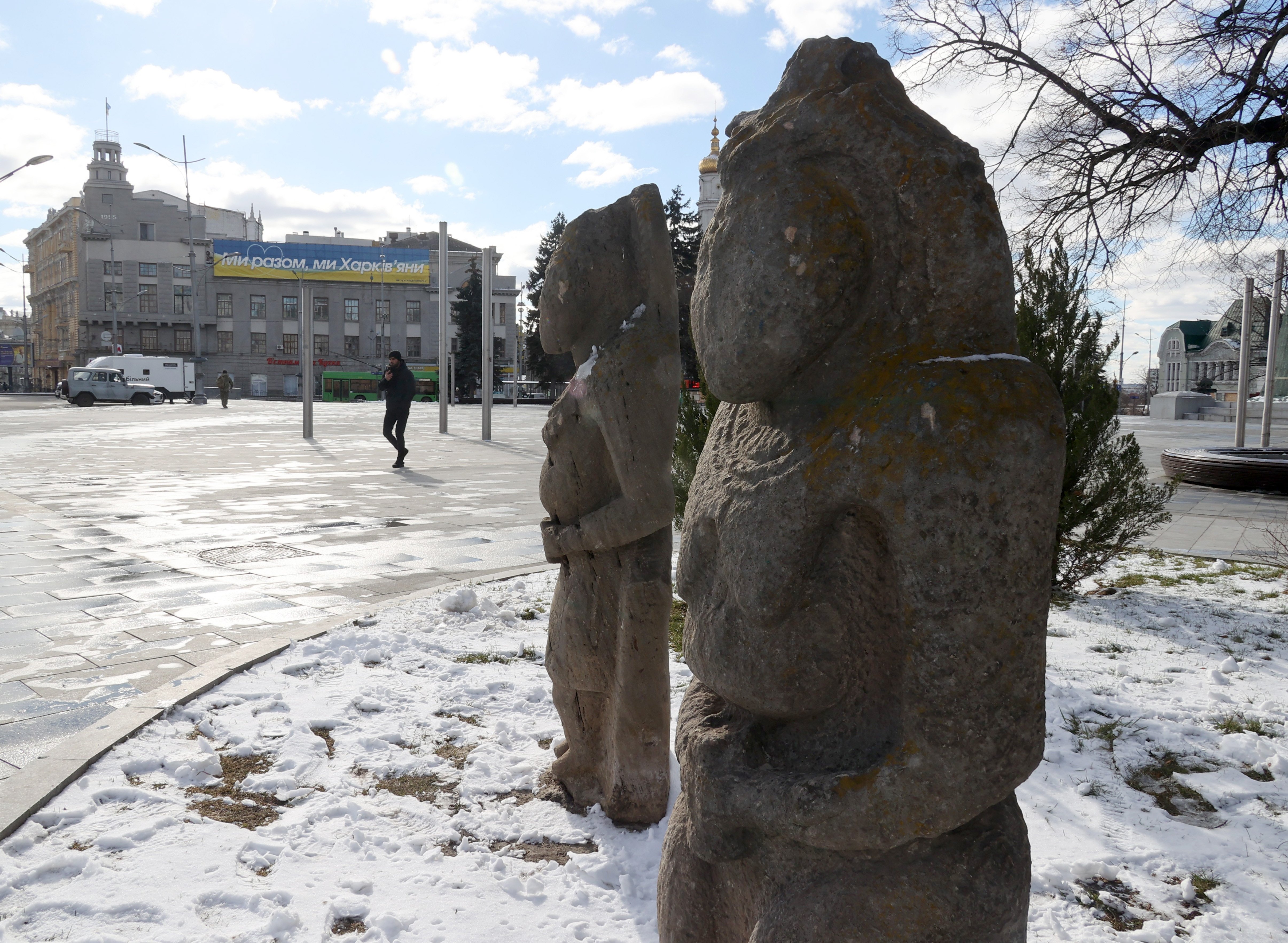
“The figures showed the boundaries of different tribes and were used as easy-to-spot steppe markers,” The Guardian noted. “The figures were seen as alive, and as a way of communicating with ancestors, in accordance with shamanist religious traditions. Sacrifices were carried out at the sites.”
Their placement made them especially vulnerable. In September 2022, several sacred Polovtsian statues on Mount Kremenets in Izyum, Kharkiv region, were destroyed during Russia’s occupation. When the stones fell, the world saw not only destruction but erasure. Izyum’s shattered Babas expose the same intent: to unmake continuity, to collapse lineage into absence.
Multicultural past
The museum in Dnipro now holds more than a hundred Polovtsian sculptures, “the world’s biggest collection.” Some remain smooth and intact; others, worn by rain and shellfire, evoke “abstract works by the twentieth-century sculptor Henry Moore.” The outside pavilion lost its glass when a Russian missile landed nearby.
“Sanctuaries with effigies were a place for performing the memorial cult of ancestors, not directly related to burials,” wrote art historian Oksana Semenik in the UK outlet The Art Newspaper in 2022. The photos she posted—before and after—provoked comparisons to the ancient sites of Palmyra and Bamiyan.
“It’s important for Russia to show that only Slavs lived on this territory and no one else. In fact, the steppe was mixed. There were many different ethnicities,” Starik said. “Our task is to show that it’s our ancestors who lived there. They were nomads who moved all the time and were not connected with the Russian imperium.”
Of Russia’s invasion, he added: “It’s colonial politics. The empire doesn’t work unless you seize new territory. It was important for us to save the statues. The enemy doesn’t care about them. The Russians are completely indifferent to the past. They keep smashing up our monuments using artillery and bombs.”
History, reclaimed
When in 2012 Mystetskyi Arsenal in Kyiv hosted an exhibition featuring nearly 100 stone babas—titled Ancient Forms: A Modern Point of View—for the first Kyiv Biennale, few recognized them as Ukrainian. Yet, the show aimed to highlight the country’s artistic heritage as part of the world’s cultural heritage.
Even then, the text warned of cultural disconnection. “Usually, we do not know what they are called or to which time period they belong,” wrote Ukrainian author Vera Ganzha. “While no one mentioned steppe stone stelae when talking about Ukraine.”
Now, under the Russian bombardment, that amnesia has come to an end.
“After our victory, they will be more valuable,” says Fanyhin. As Russia tries to claim Ukraine’s past, the statues refute this by existing. Their faces—erased yet visible reminders that invaders may pass, but the entrenched figures remain.
Discuss this article:

-480d70a36b9b34492b0b32ca04af4489.jpg "People attend the funeral ceremony of the famous Ukrainian writer Victoria Amelina at the Garrison Church, in Lviv, Ukraine, on July 5, 2023. (Source: Getty Images)")

-32d15505fc2972c43cc64011a4cf60cd.jpg "Sir Paul McCartney performs during a concert at Estadio BBVA on November 8, 2024 in Monterrey, Mexico. (Source: Getty Images)")
-58027ba3c731b844e3279bf1086a8d0b.jpg "Ukrainian DJ KOROLOVA. (Source: @korolova.dj/Instagram)")