- Category
- Investigations
Russia’s Pole-21 Jams Ukrainian Weapons, But Still Gets Tech From Taiwan, Japan, and South Korea
 Prefer U24 Media on Google
- Authors


-746b4b2b462bcc32d9fe98e546a988c4.jpg "Photo of Roman Steblivskyi")
-e20d7931c186fa951fc4dd93e57b8033.png "Photo of Olena Yurchenko")
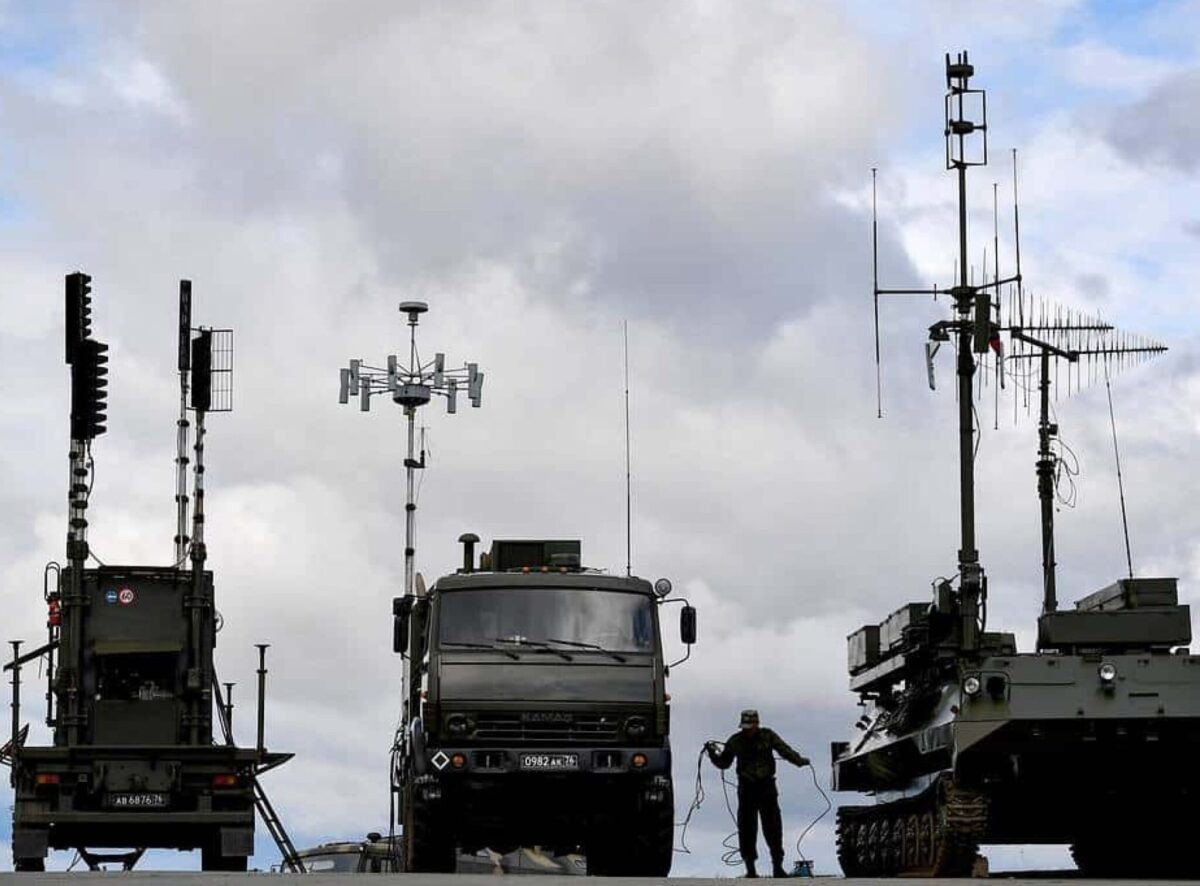
Russia’s Pole-21 is designed to blind some of Ukraine’s most sophisticated weapons by drowning out the satellite signals they need to find their targets. But behind Russia’s powerful electronic warfare system is a vulnerability Moscow has yet to eliminate: its continued dependence on foreign technology.
Despite international sanctions, Russian companies linked to the manufacturer of the Pole-21 electronic warfare system continue to receive foreign components and manufacturing equipment—a new study by the Economic Security Council of Ukraine (ESCU) revealed.
Products made by companies in Taiwan, Japan, and South Korea, worth about $6.4 million in total, reached Russia either directly or through intermediaries in China, Hong Kong, and Türkiye. Russian forces use Pole-21 to jam satellite navigation signals, disrupting the operation of Ukrainian drones and precision-guided weapons.
-91bba1849b6d1f61b658fed5ca551fe3.png)
What is Pole-21?
Pole-21 has been in service with the Russian military since 2016. The system creates a network of electronic interference and can jam GPS, Galileo, GLONASS, and BeiDou signals.
In its war against Ukraine, Russia uses the system to disrupt the navigation of drones, aircraft, cruise missiles, and precision-guided munitions. Without a stable satellite signal, weapons can lose their targets, receive false coordinates, or suffer a significant loss of accuracy.
The sole developer and manufacturer of Pole-21 is Russia’s STC EW JSC, the Scientific-Technical Center for Electronic Warfare. At the same time, as with most other products of Russia’s defense industry, the country is unable to independently manufacture the full range of technologies needed to produce and maintain such systems.
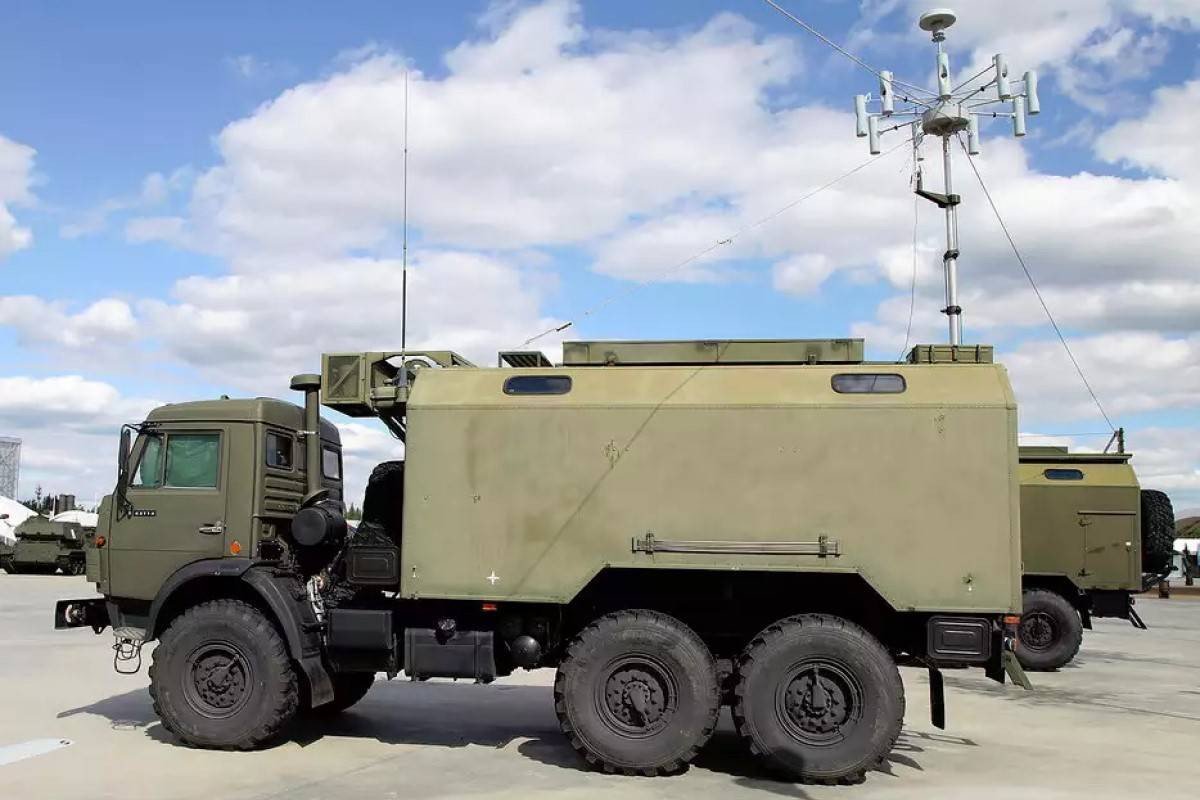
These include microchips, multilayer printed circuit boards, high-frequency connectors, coaxial cables, testing and measurement equipment, and machinery for assembling electronic components.
$3.7 million in Taiwanese components
According to the study, products from Taiwanese manufacturers HannStar Board, Innolux, and Huang Liang Technologies, valued at about $3.7 million, were imported into Russia in 2024.
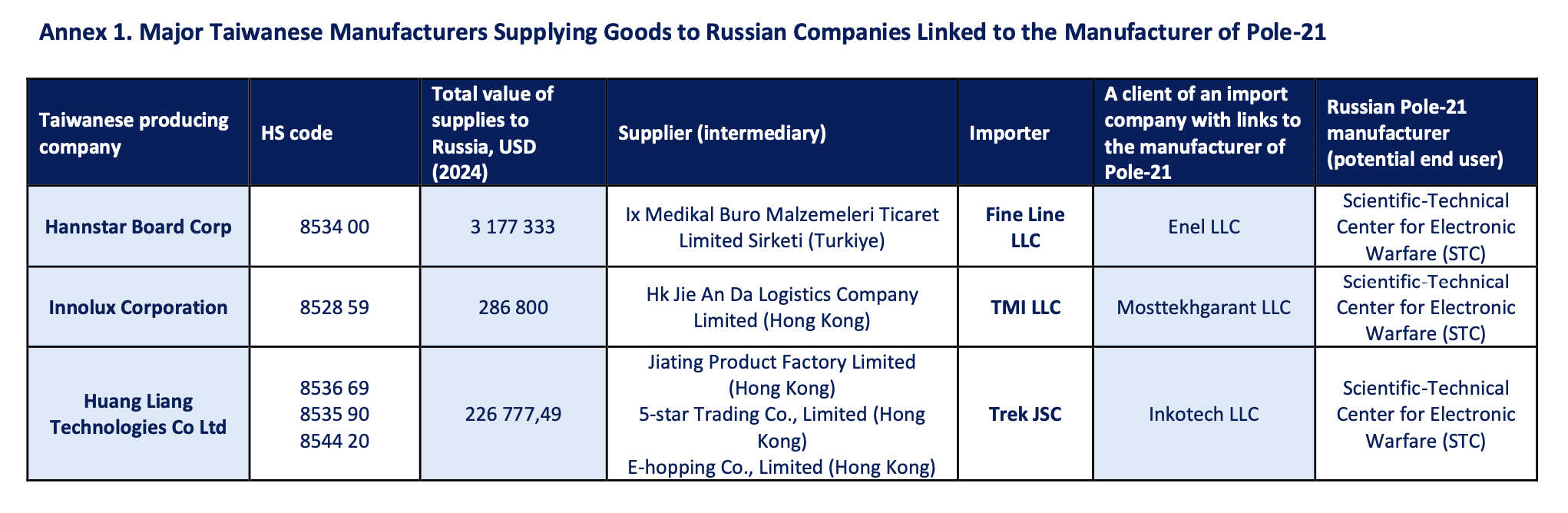
In 2024, sanctioned Turkish company Ix Medikal supplied Russia’s Fine Line with more than $3.1 million worth of HannStar printed circuit boards. Fine Line is part of the supply chain linked to the Pole-21 manufacturer: in 2024–2025, it sold $766,000 in goods to Enel, while Enel separately supplied $1.9 million in equipment to the Scientific and Technical Center for Electronic Warfare.
The study does not establish whether the HannStar boards were included in these subsequent deliveries to the system’s manufacturer, but it demonstrates the importer’s connection to its supply chain.
Innolux monitors, as well as high-frequency components and coaxial cables made by Huang Liang Technologies, also reached Russia. The shipments were routed through companies in Hong Kong and Türkiye.
Panasonic and Hanwha equipment
Another risk comes not only from finished components but also from equipment that enables Russia to assemble electronics domestically.
In 2024, the Chinese company Qinyi Electronics supplied Russia’s SMTtech with manufacturing equipment valued at about $658,000. The equipment was manufactured by Panasonic Factory Solutions Suzhou, the Chinese subsidiary of Japan’s Panasonic Corporation.
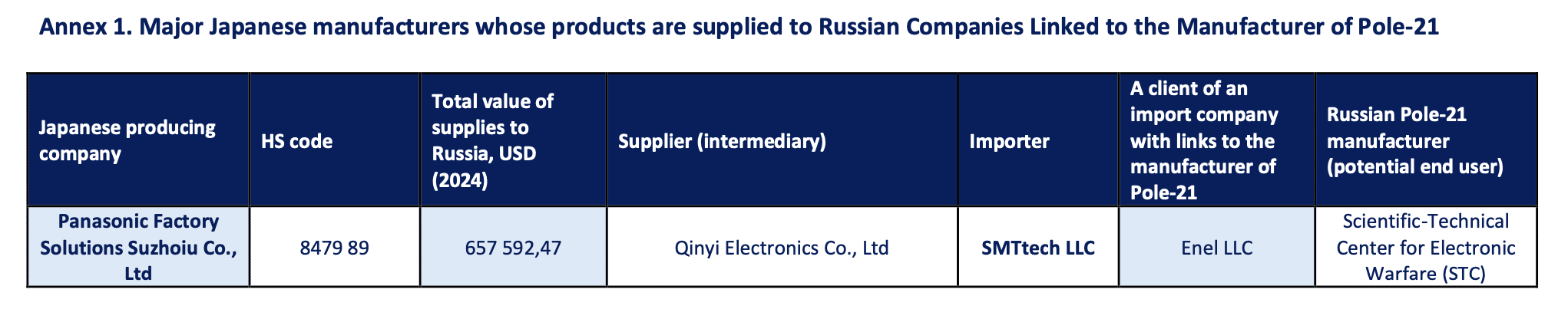
The equipment is used to manufacture printed circuit boards and automate the assembly of electronic components. SMTtech previously serviced companies in Russia’s defense industry and later supplied products to Enel, a direct supplier to the Pole-21 manufacturer.
Products made by South Korea’s Hanwha Vision followed a similar route. From May through August 2024, SMTtech received Hanwha-made equipment and components for printed circuit board assembly worth a total of more than $950,000.
Such automated production lines enable the serial production of sophisticated electronic modules, including those that can be used in electronic warfare systems.
More than $1 million shipped directly from South Korea
From March 2024 through March 2025, more than $2 million worth of South Korean equipment and components reached Russia. More than half of these shipments were sent directly from South Korea.
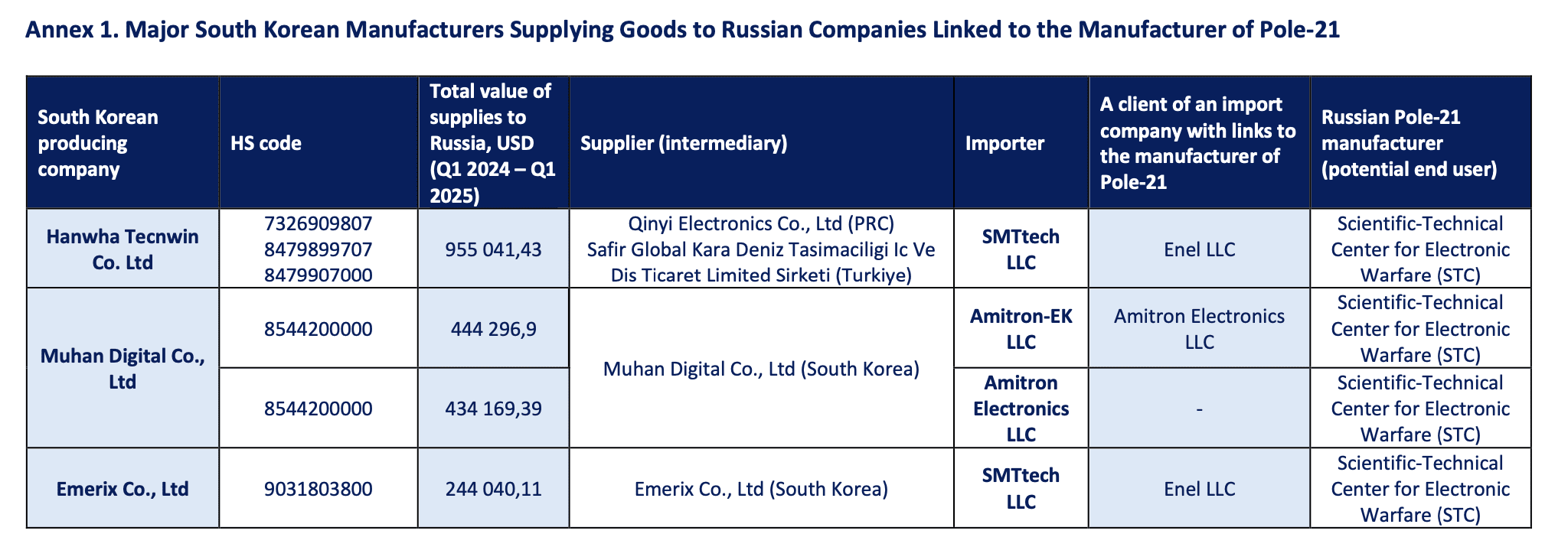
Muhan Digital supplied nearly $878,000 worth of coaxial cables to Russia. The recipients were affiliated companies Amitron Electronics and Amitron-EK. The former supplied products directly to the Scientific and Technical Center for Electronic Warfare.
Coaxial cables are critical to the operation of Pole-21: they connect antennas, transmitters, and signal-processing units. The quality of these connections affects the power and operational stability of electronic jamming stations.
Another roughly $244,000 was spent on testing and measurement instruments made by South Korea’s Emerix. Such equipment is used to test printed circuit boards and perform quality control on electronic components.
Sanctions changed the route but failed to stop the shipments
The data collected in the study point to a systemic problem: foreign components and industrial equipment continue to reach companies linked to Russia’s military-industrial complex.
Some goods pass through multiple intermediaries and are divided into relatively small shipments. This makes the supply chains more difficult to track and allows Russia’s defense industry to maintain access to the technologies it needs.
-69d03af11a3e9f45431b68b50d18e51c.png)
The Economic Security Council of Ukraine is calling on the governments of Taiwan, Japan, and South Korea to investigate the identified supply chains, notify manufacturers about the potential use of their products by Russia’s defense industry, and strengthen controls over re-exports through third countries.
Russia still lacks an independent technological base for producing modern electronic warfare systems. Cutting off these supply chains is therefore not merely a matter of sanctions compliance. It is an opportunity to directly constrain the production of weapons that Russia uses against Ukraine and regularly threatens the world with.
Discuss this article:


-206008aed5f329e86c52788e3e423f23.jpg "Photo of Oleksandr Moiseienko")


-8a4f2909bd0ef7bd15e5baecedbfa2f9.webp "Unboxing Russia’s Geran-4 Drone: Nearly All Its Electronics Are Made Abroad")
-605be766de04ba3d21b67fb76a76786a.jpg "Joseph Place")