- Category
- Latest news
Russia Is Reviving Half-Century-Old T-55 Tanks for a Battlefield They Were Never Built For
 Prefer U24 Media on Google
- Authors


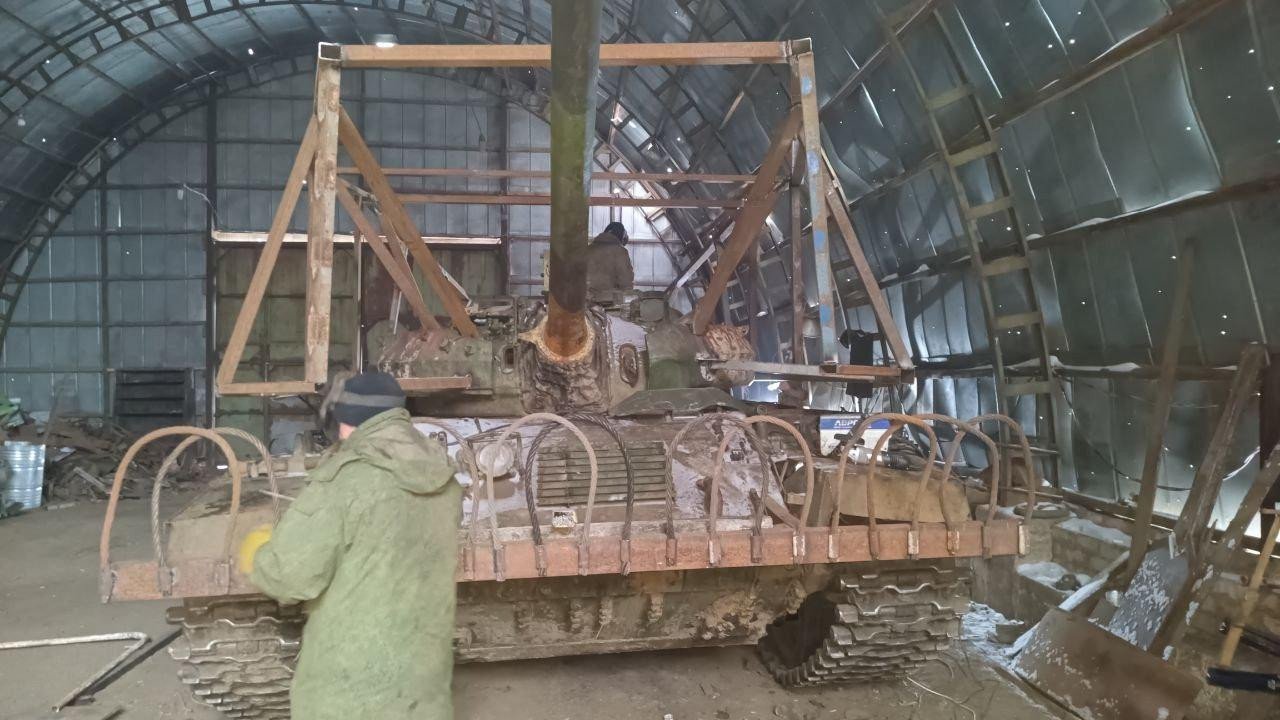
Images circulating online show a Russian T-55AM tank fitted with additional armor and an overhead metal frame—often referred to as a “cope cage”—reportedly located at a repair facility linked to the 218th Tank Regiment of the 127th Motor Rifle Division, according to open source imagery posted on Reddit on February 16.
While reports of T-55AM reactivation have surfaced periodically since 2024, this is among the first visual indications suggesting the vehicles may again be entering operational circulation.
The T-55 itself dates back to the late 1950s and early 1960s, making it one of the oldest tank designs still appearing on a modern battlefield.
We bring you stories from the ground. Your support keeps our team in the field.
The T-55AM upgrade package, often portrayed in Russian narratives as “advanced”, was in fact developed in the early 1980s—technology now more than four decades old.
That modernization introduced additional turret armor modules, reinforced upper-hull protection, and limited improvements to fire-control and optics.
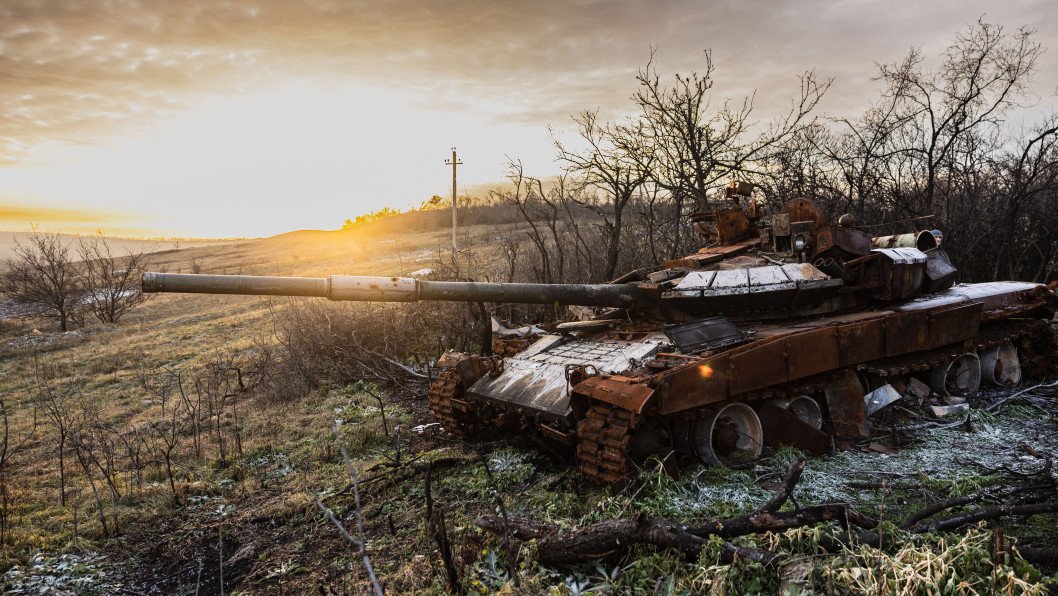
Similar protection concepts were used on T-62M tanks during the Soviet war in Afghanistan, underscoring the Cold War origins of the design.
Despite these upgrades, the platform remains fundamentally constrained by its mid-20th-century architecture, far removed from the survivability, sensors, and firepower expected of contemporary main battle tanks in 2026.
The photographed vehicle shows improvised additions such as a metal overhead frame, intended to reduce vulnerability to top-attack threats—an increasingly common but limited battlefield adaptation.
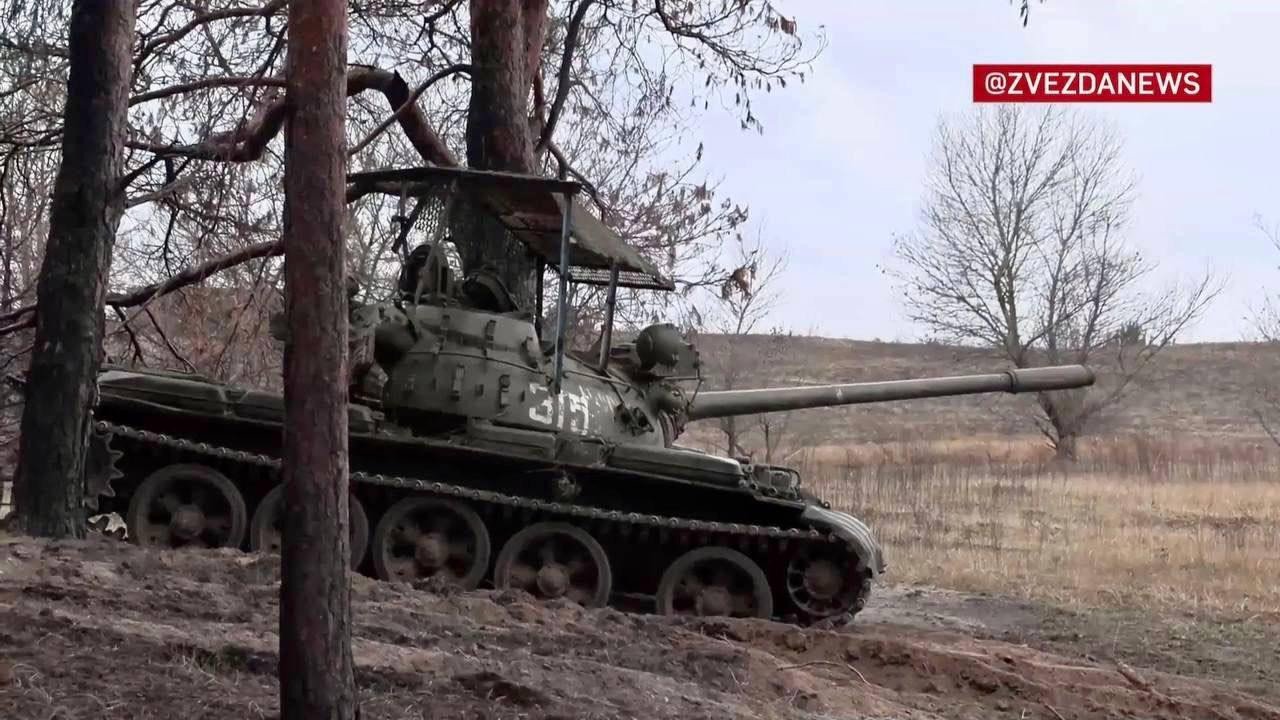
Other features associated with the T-55AM include enhanced mine protection, a turbocharged diesel engine producing roughly 690 horsepower, and a 100-mm rifled main gun capable of firing both conventional shells and guided munitions via an upgraded fire-control system.
Even with these modifications, the tank’s 41-ton weight, 50 km/h top speed, and Cold War-era weaponry place it well below the performance standards of modern armored vehicles.
Defense analysts widely interpret the renewed visibility of T-55 variants as evidence of continued reliance on long-stored Soviet-era equipment, rather than the introduction of meaningful new capabilities.
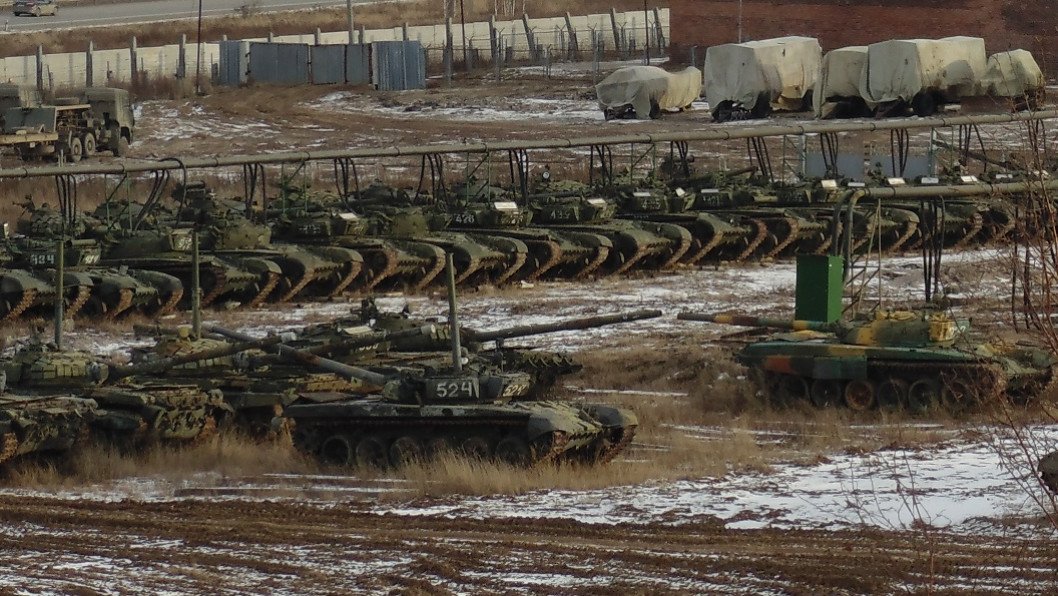
The T-55AM upgrade was originally conceived to confront 1960s–1970s Western tanks such as the American M60 and German Leopard 1—itself an indicator of how outdated the platform is relative to present-day armored warfare.
In the context of a 2026 battlefield dominated by drones, precision munitions, and modern anti-tank systems, vehicles of this generation face severe survivability challenges.
The appearance of refurbished T-55AM tanks, therefore, highlights attrition pressures and equipment shortages, not a technological leap—despite narratives in Russian media framing the upgrades as significant.
As of February 15, 2026, during nearly four years of its full-scale war against Ukraine, Russia has lost over 11,600 tanks, Ukraine’s General Staff reported. At that pace, Russia’s tank arsenal is disintegrating faster than it can be rebuilt. Ukraine has managed to cripple Moscow’s armored forces with the drone industry that, just four years ago, barely existed.
Earlier, reports emerged that Russia has begun modernizing older T-72A tanks, likely due to the depletion of its remaining T-72B stocks. Newly released footage from Russia’s Uralvagonzavod (UVZ) tank manufacturer shows T-72A tanks undergoing upgrades.
Discuss this article:


-c439b7bd9030ecf9d5a4287dc361ba31.jpg "Photo of Katherina Popilnichenko")


