- Category
- Latest news
Russia Tries to Catch Up With Ukraine as Lys-2 Interceptor Drone Enters Service
 Prefer U24 Media on Google
- Authors


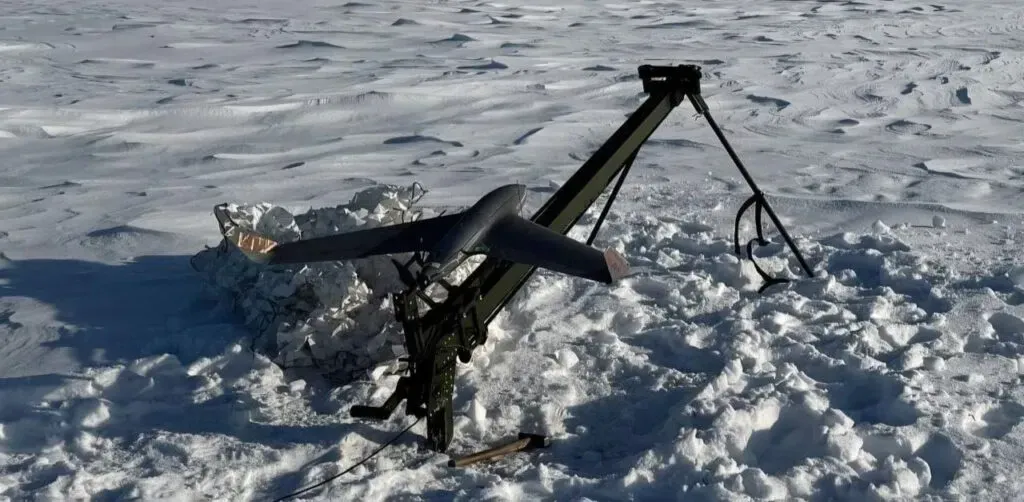
Russia has begun deploying its Lys-2, also known as the Fox-2, interceptor drone directly to front-line units in Ukraine, marking a transition from testing to active operational use, according to reporting by Defense Blog on April 20.
Multiple accounts indicate that Russian formations along the contact line are now receiving the system in growing numbers, suggesting it has moved beyond initial evaluation and cleared internal approval for wider field deployment.
We bring you stories from the ground. Your support keeps our team in the field.
The timing reflects mounting pressure on Russian forces, as Ukraine continues to expand its use of long-range strike drones capable of reaching deep behind enemy lines.
Moscow has struggled to counter these systems at scale with cost-effective solutions, prompting a push toward dedicated counter-drone platforms.
Russia has begun front-line deployment of the fixed-wing Lys-2 counter-drone interceptor after a test phase, distributing it directly to combat units.The Lys-2 uses a catapult launch system & autonomous terminal guidance, with reported range up to 15 km and speed up to 160 km/h. pic.twitter.com/9B6ICDDQLL
— Valhalla (@ELMObrokenWings) April 20, 2026
The Lys-2 is a fixed-wing unmanned aircraft launched via a mechanical catapult, allowing it to operate without a runway or prepared airstrip.
Unlike conventional drones used for reconnaissance or strike missions, the Lys-2 is specifically designed to intercept and destroy other drones.
Open-source footage and descriptions suggest it can autonomously detect and engage targets during the final phase of flight, reducing reliance on continuous operator control.
According to Defense Blog, while official specifications have not been publicly confirmed, available data suggest the system has a range of up to 15 kilometers, a speed between 120 and 160 kilometers per hour, and an operational ceiling of around 4,000 meters.
These characteristics would position it to target low-altitude threats, including many of the long-range strike drones used by Ukraine.
While the deployment of the Lys-2 marks a notable step forward for Russia’s counter-drone capabilities, similar concepts have already been actively developed and fielded by Ukraine over a longer period.
Ukrainian forces have been operating interceptor drones at scale, integrating them into layered air defense systems and refining their use through sustained combat experience.
As a result, Ukraine has established a measurable lead in this segment of drone warfare. Its interceptor systems have demonstrated higher operational maturity, broader deployment, and proven effectiveness against incoming aerial threats, highlighting a gap Russia is now attempting to close with systems like the Lys-2.
Systems like the Lys-2 are typically deployed as part of a layered defense, working alongside electronic warfare tools designed to jam or mislead incoming drones, as well as short-range air defense systems that provide a final line of protection.
Previously, a Ukrainian drone pilot, who recently set a world record by downing 2 Russian Shahed drones from 500km, stated in an interview that Ukrainian interceptor drones achieve about a 95% success rate. At most, his unit loses one drone out of ten.
Discuss this article:
-9a7b3a98ed5c506e0b77a6663f5727c5.png)



-efa69d4733b5af9f7cd0a642f85424a6.jpeg "Thick black smoke rises from the heavily damaged Proton-Electrotex plant in Orel, Russia, following a reported strike. (Source: Exilenova+)")