- Category
- Latest news
Tiny, Baguette-Sized Missile Poised to Crush Russia’s Drone Advantage
 Prefer U24 Media on Google
- Authors


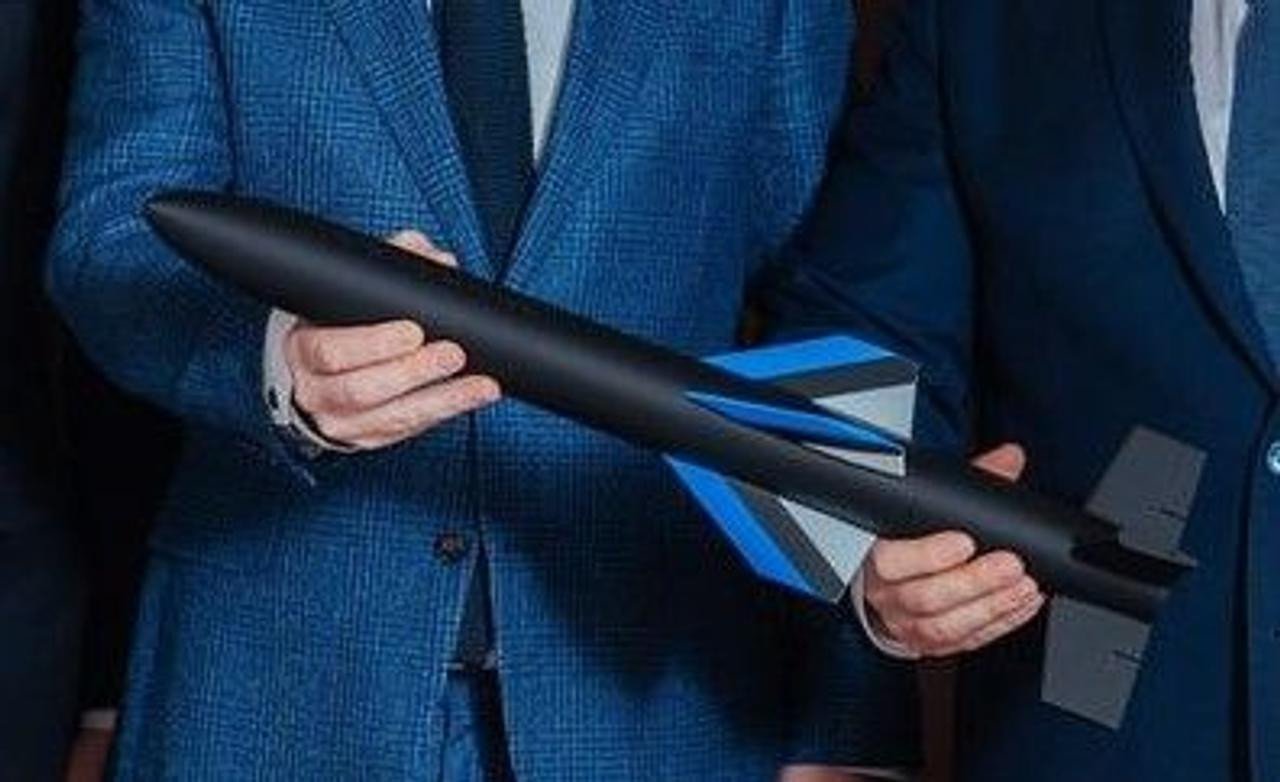
An Estonian defense company has unveiled a miniature missile designed to counter mass drone attacks—a low-cost alternative aimed at strengthening NATO’s air defenses against Russia’s expanding use of unmanned systems, according to The Telegraph, on November 10.
Frankenburg Technology, based in Tallinn, is developing the “Mark 1,” a compact interceptor roughly the size of a baguette.
The missile measures 65 centimeters in length and is designed for short-range defense, with a reach of about 1.2 miles and a price near $50,000 per unit, according to The Telegraph.
Kusti Salm, the company’s chief executive and former Estonian defense official, said the project’s goal is to make air defense affordable and scalable. “We are not afraid to say we are manufacturing them to take down Russian long-range drones,” Salm told The Telegraph, adding that such systems will be essential for Western defense in the coming decade.
The Mark 1 is guided by artificial intelligence and engineered to operate independently after launch, without a continuous data link to a control unit. This feature reduces vulnerability to jamming and network disruptions. Despite its small size, the missile integrates a warhead, fuel, and sensors, making precision a major engineering challenge.
At present, the Mark 1 achieves about 56 percent accuracy, with the company aiming for 90 percent as production advances. Its affordability contrasts with high-end Western systems like the Patriot interceptor, which costs millions of dollars per missile.
According to The Telegraph, Frankenburg has set up manufacturing facilities in two NATO countries, with the goal of producing hundreds of missiles per day. The company’s engineering team includes specialists who previously worked on Europe’s Iris-T and Spear III missile programs.
Missile technology analyst Fabian Hoffmann told The Telegraph that integrating multiple subsystems—from propulsion to guidance—remains one of the hardest aspects of missile development. He noted that only a small number of experts possess the experience to make such systems operational.
Russia’s frequent drone attacks on Ukraine and its neighbors have intensified NATO’s efforts to strengthen low-cost air defense options. In September, NATO jets reportedly used costly air-to-air missiles to intercept Russian Shahed drones that entered Polish airspace — at an unsustainable expense ratio, The Telegraph reported.
In response, European nations have announced plans for a “drone wall” along NATO’s eastern border, combining electronic warfare tools and interceptor systems like the Mark 1.
Salm said the initiative has also drawn engineers motivated by a shared mission: “There’s a lot of people who wake up in the morning, read the news and are angered by the injustice going on in the world. We’re one of the few places in Europe where you can put your talent to work in somehow ending this madness,” he told The Telegraph.
Earlier, on October 4, The Telegraph reported that Swedish company Nordic Air Defense unveiled the Kreuger 100—a $5,000 kinetic mini-missile designed to intercept drones without explosives, offering a low-cost, civilian-safe solution to the growing threat of Russian drone incursions over Europe.
Discuss this article:



-c439b7bd9030ecf9d5a4287dc361ba31.jpg "Photo of Katherina Popilnichenko")