- Category
- War in Ukraine
Russia Promotes Boeing Rival While Keeping Fleet Flying by Dismantling Aircraft
 Prefer U24 Media on Google
- Authors


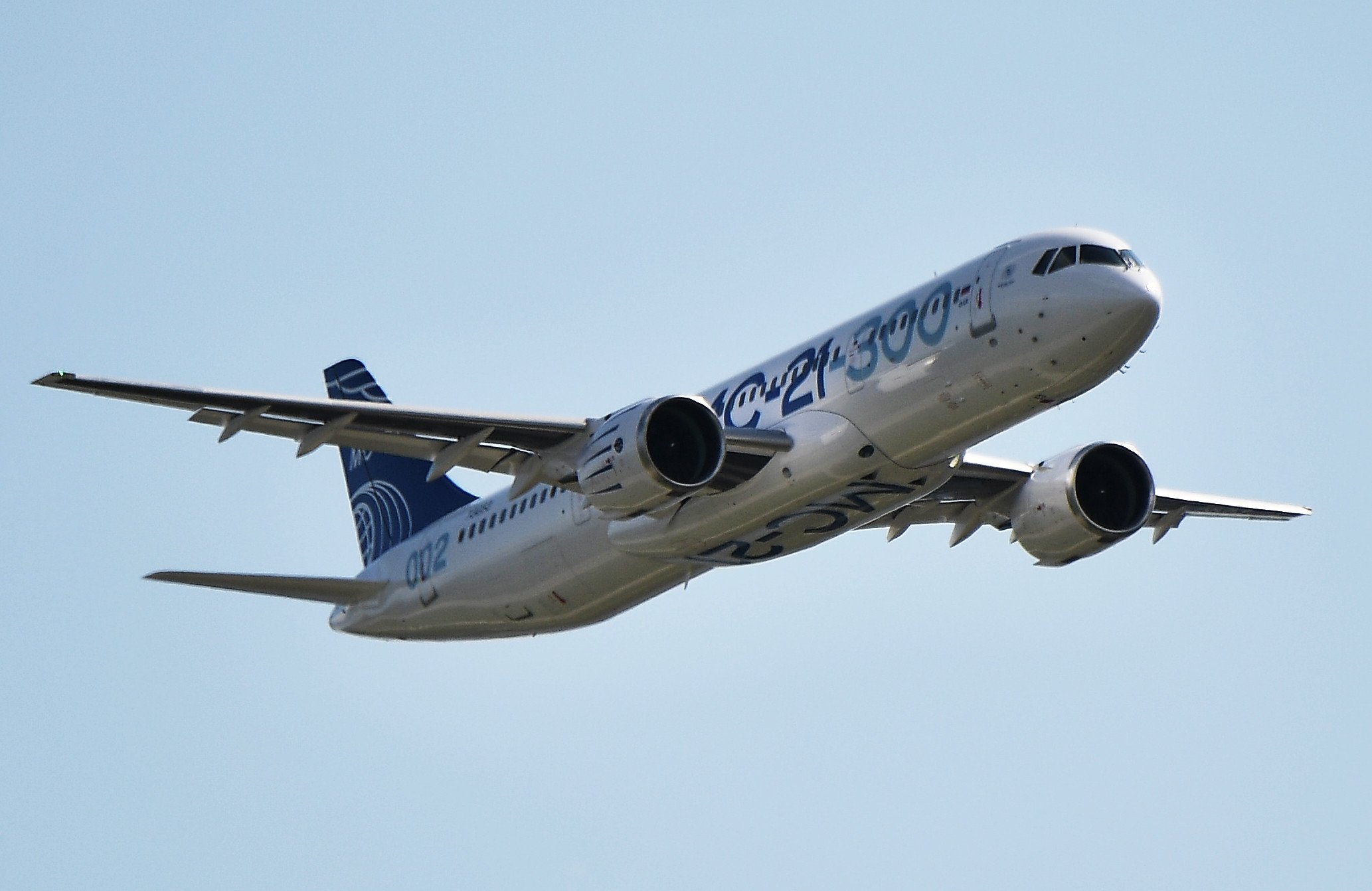
Russian state media has once again revived claims about the country’s MC-21-310 passenger jet, portraying it as a breakthrough aircraft despite mounting setbacks, Ukraine’s Foreign Intelligence Service said on April 29.
According to the agency, the renewed promotion comes against the backdrop of recent failures in Russia’s aerospace sector, including a stalled lunar program and problems with the Baikal light aircraft project.
We bring you stories from the ground. Your support keeps our team in the field.
Before Russia’s full-scale invasion of Ukraine, the MC-21-310 prototype showed promising performance, the agency reported.
In 2017, the aircraft—equipped with a US-made engine and imported composite materials in its wing—had a maximum takeoff weight of 72.56 tons and a range of up to 5,100 kilometers (about 3,170 miles) in a two-class configuration seating 175 passengers.
However, after sanctions forced Russia to replace foreign components with domestic alternatives, the updated version has gained roughly six tons in weight and seen its maximum range drop to around 3,830 kilometers (about 2,380 miles).
Meanwhile, Russia’s commercial aviation sector remains heavily dependent on Western aircraft. Around 90% of passenger traffic is still carried by Boeing and Airbus jets.
To keep those planes operational under sanctions, Russian airlines have resorted to cannibalizing parts from grounded aircraft to maintain others in service.
The shift to the Russian-made PD-14 engine has also increased fuel consumption, significantly raising operating costs. As a result, routes such as St. Petersburg to Krasnoyarsk still require Western-built aircraft.
By comparison, the Airbus A320neo offers a range of up to 6,500 kilometers, while the Boeing 737-800 can reach about 5,700 kilometers—placing the MC-21-310 at a disadvantage even before entering full production.
Russian designers have also proposed a shorter variant, the MC-21-210, which could fly slightly farther but carry fewer passengers. Even Russian aviation experts have suggested such a configuration is unlikely to be attractive to domestic airlines.
Certification timelines for the aircraft have repeatedly slipped, moving from initial expectations of 2023 to successive delays in 2024, 2025, and 2026. Current projections now point uncertainly to 2027.
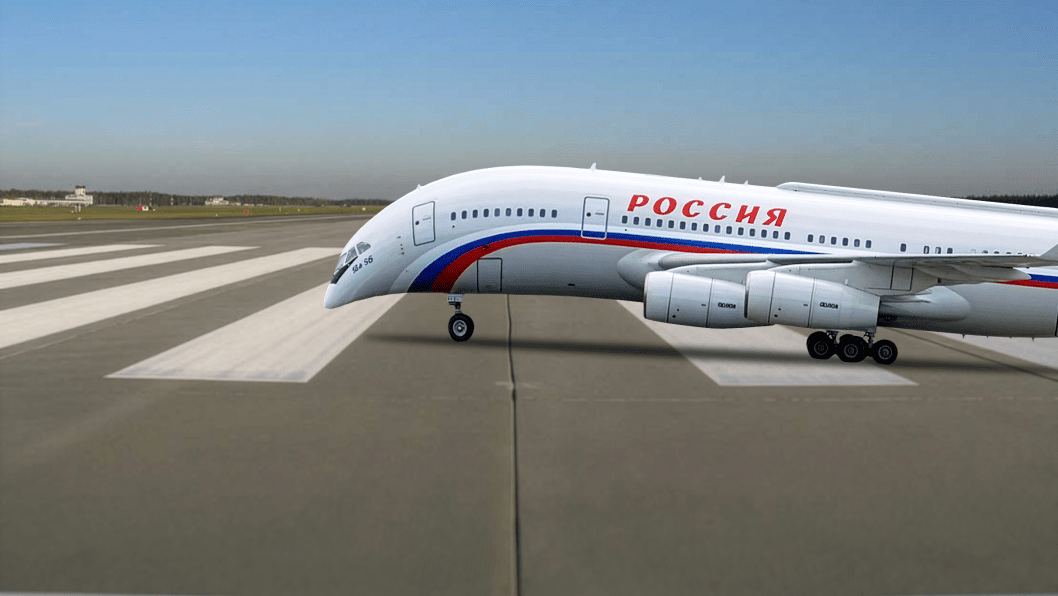
At present, only three MC-21-310 aircraft are undergoing flight testing, with roughly 30% of the required trials completed as of early spring.
Even if the aircraft reaches mass production—still not guaranteed—its effective range in a standard single-class layout could drop to around 3,000 kilometers (about 1,860 miles).
Earlier, reports emerged that Russia was considering restoring up to 700 Soviet-era An-2 aircraft currently in storage after efforts to develop a modern replacement failed.
Discuss this article: