- Category
- War in Ukraine
Russia’s Failed 2026 Spring Offensive Cost It Nearly 100,000 Troops as Ukraine Retakes Ground
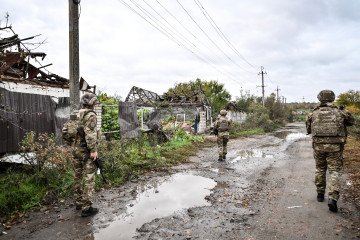
Russia entered spring expecting another grinding advance across Ukraine’s front lines. It burned through tens of thousands of troops for marginal territorial gains instead, while Ukrainian drone warfare has been steadily dismantling Russia’s logistics, reserves, and offensive momentum.
 Prefer U24 Media on Google
- Authors

-29a1a43aba23f9bb779a1ac8b98d2121.jpeg "Photo of Illia Kabachynskyi")
The first third of 2026 proved difficult for the Russian army, with only minimal advances. Considering that Ukraine managed to liberate between 400 and 500 square kilometers of territory in February and March, the effectiveness of Moscow’s operations can be called into question altogether: January through April 2026 became Russia’s worst period since 2023, and after an active 2025, it can be described as a failure. The trend is also worsening.
We bring you stories from the ground. Your support keeps our team in the field.
“Russian forces have failed to achieve any significant operational progress over the past year,” despite continued offensive operations across multiple sectors of the front, the Institute for the Study of War (ISW) reported on May 10.
Russia occupied even less territory in April than in March—about 300 square kilometers in total over the two months, Ukrainian open-source intelligence (OSINT) project DeepState reported. The largest advance was in the Donetsk region, where Russian forces captured 53 square kilometers. For context, over the past month, Russia suffered its heaviest losses precisely in the Donetsk sector—more than 25,000 killed and wounded. That is 471 troops per square kilometer. DeepState says each square kilometer of captured territory costs Russia 36 assaults.
Ukraine still controls about 7,000 square kilometers of territory in the Donetsk region. Based on April’s statistics, capturing these territories would take decades—and cost millions of casualties.
Disrupting the offensive campaign
UNITED24 Media previously reported that Russia’s March offensive campaign had failed: in the middle of the month, Russia organized a dozen assaults on different sections of the front—and all of them were destroyed. In three days, losses surpassed 5,000 troops killed and wounded, while various Ukrainian units reported record enemy losses in their sections of the front.
The situation continued in April: over the month, Russian losses exceeded 35,000 troops, bringing the two-month total to more than 70,000. Should the trend continue—and daily reports from Ukraine’s General Staff indicate that it is continuing—total Russian army losses by the end of spring could exceed 100,000 troops.
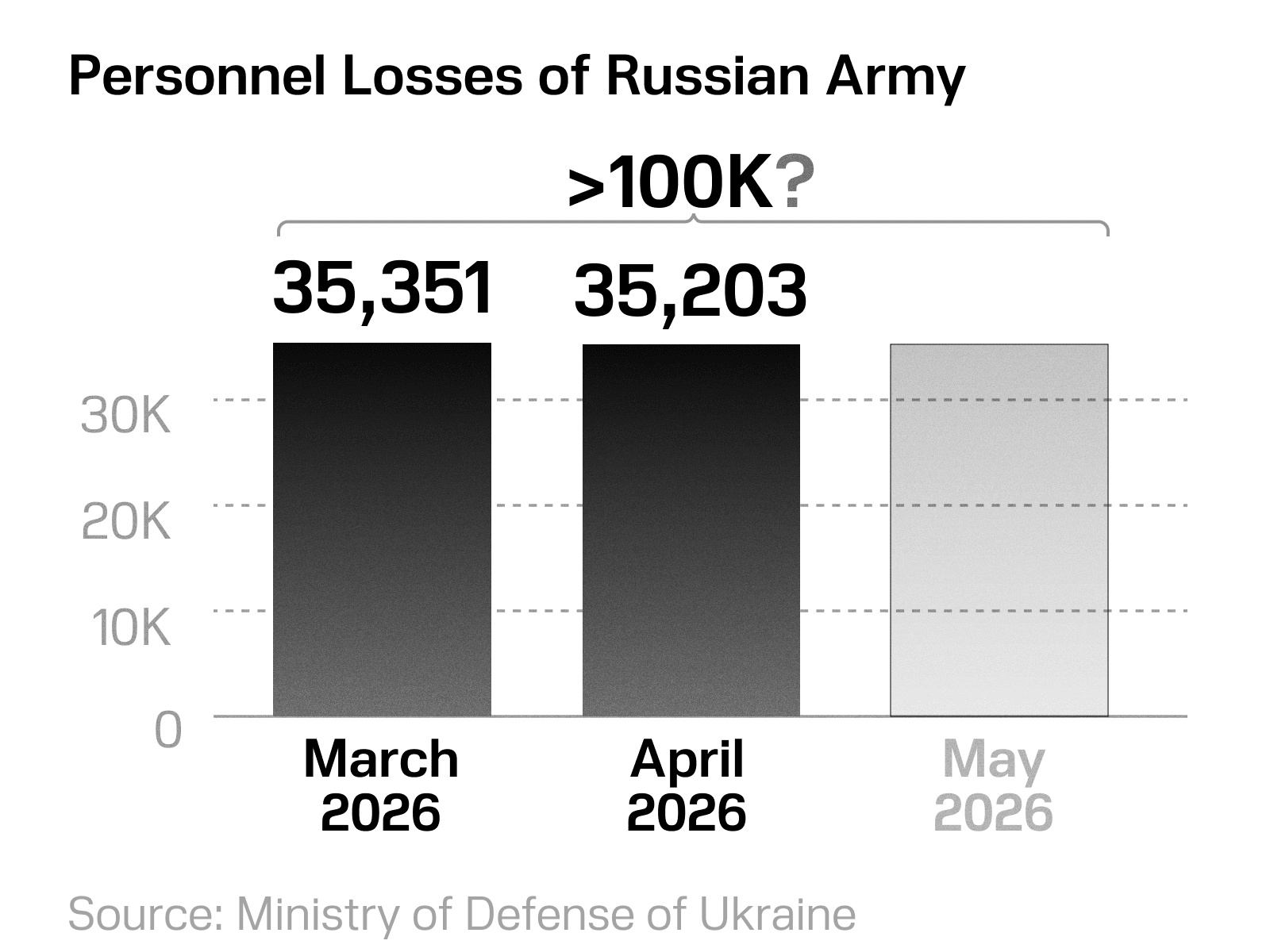
At the moment, however, these losses do not appear justified for Russia: occupation forces cannot claim any serious results from their offensives. Meanwhile, the number of assaults increased by 2.2% in April compared with March.
Moreover, one-third of the captured territories are border areas in the Sumy region, where Russian military groups entered in recent months: overall, 44 square kilometers have been captured there. Minor advances, involving the capture of several villages, were recorded in the Kharkiv and Zaporizhzhia regions, while almost all of the Dnipropetrovsk region has been liberated.
The statistics are unforgiving for the Russian army: the spring offensive campaign has been disrupted, despite record losses of manpower and equipment.
0–200 km
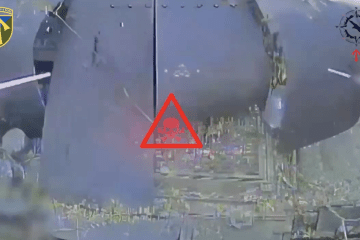
The slowdown in Russia’s advance is attributed to the saturation of the line of contact with drones. But it would be incorrect to point only to FPV drones, even though they are indeed responsible today for more than 90% of the Russian army's losses.
In recent months, Ukraine has also begun actively deploying so-called Middle Strike attacks—drones that fly up to 200 kilometers deep. These strikes make it possible to destroy ammunition depots, weapons arsenals, drone and equipment storage sites, and to attack command posts. The middle Strike strategy has shaken Russian logistics, forcing equipment farther back from the border and lengthening logistics routes—for example, troops now take longer to reach their positions.
Thanks to Middle Strike, Ukrainian forces can now even strike Mariupol, through which, among other things, runs the land corridor to Crimea and to Ukraine’s occupied southern territories. This creates additional transport challenges for the Russian army and further complicates logistics.
This comprehensive approach, using different types of drones, prevents Russia from carrying out coordinated assaults while also making it difficult to build reserves near the front. Everywhere is dangerous.
Russia is now preparing for a new offensive campaign—the summer one. But it faces a new challenge: manpower. In recent months, recruiting new soldiers has become harder. Information that the life cycle of a Russian soldier may be measured in weeks has already reached every region of Russia, where people understand very well that even if they receive a payment worth tens of thousands of dollars, it is a one-way trip.
Discuss this article:
-4a56a6b482ec132402c16ef6fcabf9a2.png)

-37d0c4e589b794d453938c254fb3d00d.png "Comoros-flagged tanker KHORYV, Dnipro city, Ukraine, 2021.")


-111f0e5095e02c02446ffed57bfb0ab1.jpeg "Photo of Roman Kohanets")