- Category
- War in Ukraine
Russia’s “Zebra” Vehicles Are Still Easy Prey for Ukrainian Drones, Commander Says
 Prefer U24 Media on Google
- Authors


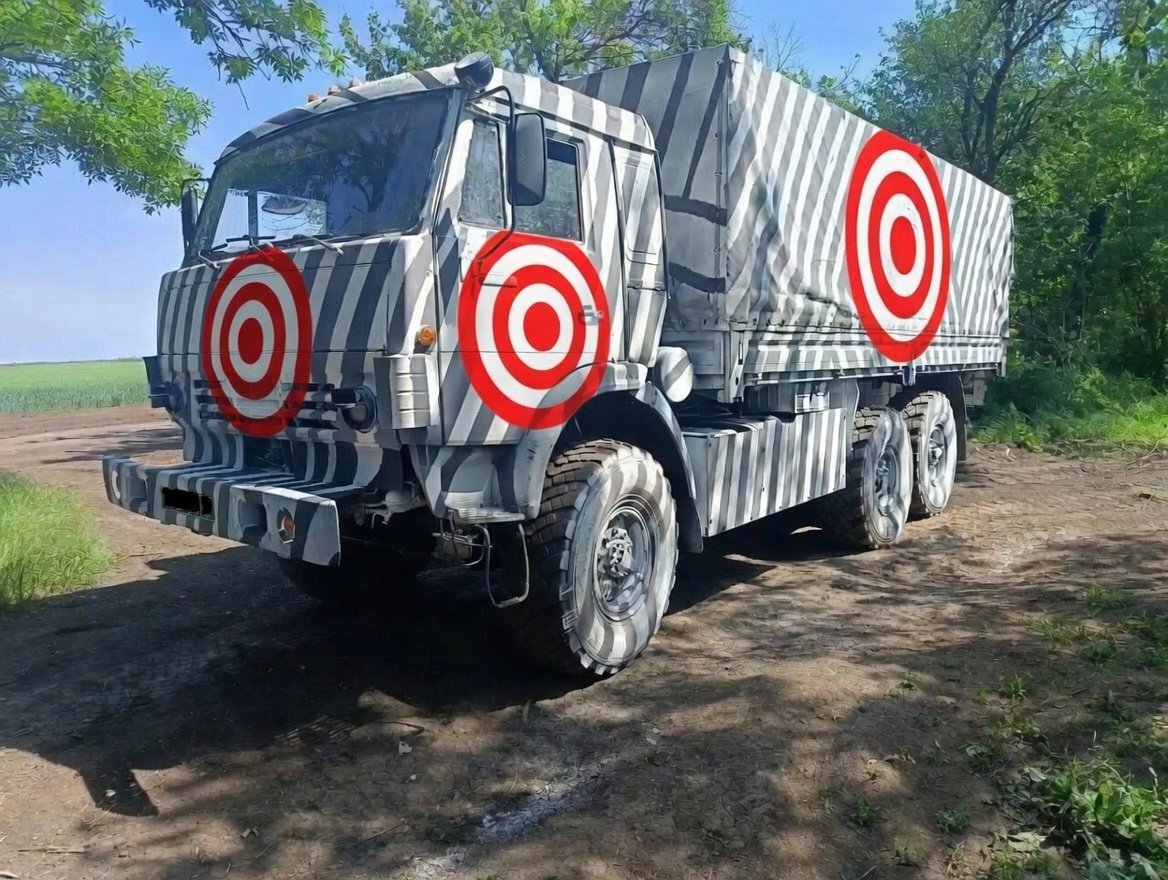
Russian troops may be trying to hide their vehicles under unusual “zebra” paint schemes, but Ukrainian drone operators say the camouflage will not stop them from burning the equipment on the battlefield, according to Major Mykola Kolesnyk, commander of the 422nd Separate Unmanned Systems Regiment “Luftwaffe” of Ukraine’s 17th Army Corps on Army TV on June 3.
Kolesnyk said modern loitering munitions and targeting systems can still strike Russian vehicles regardless of how they are painted.
We bring you stories from the ground. Your support keeps our team in the field.
“We will hit these zebras, ostriches, rhinos, whatever they paint themselves as,” Kolesnyk added.
He said Russia’s unusual camouflage efforts, which have been nicknamed “zebras” online, would not affect the effectiveness of Ukrainian strikes.
“I responsibly state that this will not prevent us in any way from burning this equipment if it is painted like that,” the officer said.
Kolesnyk also commented on Ukraine’s efforts to disrupt Russia’s so-called land corridor to occupied Crimea, saying Ukrainian strikes on Russian logistics are producing a cumulative effect that could seriously worsen the situation for occupation forces over time.
Russian forces are increasingly painting their trucks in a "zebra" camouflage pattern, hoping to deceive the machine vision systems of Ukrainian UAVs. This type of camouflage was actively used during the First and Second World War to mask warships. It worked at sea; we'll see if… pic.twitter.com/8Qfv929MKR
— WarTranslated (@wartranslated) June 1, 2026
He said it is impossible to completely cut off all transport links, but systematic attacks on logistics hubs, fuel infrastructure, and supply routes can significantly reduce the combat capability of Russian forces.
“If we deprive them of the delivery of ammunition, the delivery of weapons and military equipment, the delivery of fuel, they will face a critical situation,” Kolesnyk said.
According to him, selecting the right priority targets helps create better conditions for Ukrainian infantry, assault units, and drone operators on the front line.
Russian forces started painting military vehicles with gray-and-white "zebra" stripes in an attempt to make them harder for Ukrainian AI-assisted drones to identify, according to Russian military Telegram channels.
— Anton Gerashchenko (@Gerashchenko_en) June 1, 2026
However, even Russian military bloggers and war correspondents… pic.twitter.com/YYXNA4RNJZ
Kolesnyk said Ukrainian units are systematically working to disrupt Russian supply lines by hitting both major transport facilities and fuel infrastructure.
“When you knock out major nodes, major hubs, heavy-tonnage logistics, what will they do? They will switch to road transport,” he said.
The officer noted that several fuel tankers on Russian supply routes had been hit in recent days. In his view, the combined effect of such operations will eventually be felt directly on the battlefield.
“Without logistics, conducting active operations is extremely difficult, and sometimes impossible,” he said.
-3e0ce9cc15df48bb33986204cd936bb2.jpg)
Ukraine has increasingly targeted Russian supply routes in the south, including the logistics network connecting Russia to occupied Crimea. These strikes are aimed at limiting the flow of ammunition, fuel, weapons, and military equipment to Russian forces operating in occupied southern Ukraine.
Earlier, footage circulating online showed what was described as a Russian brigade-level underground command post in a rear area, featuring reinforced corridors, workrooms, communications nodes, ventilation, and living spaces.
Discuss this article: