- Category
- Investigations
Russia Is Arming Iran Through 2027 With Missiles That Could Target US and Israeli Jets
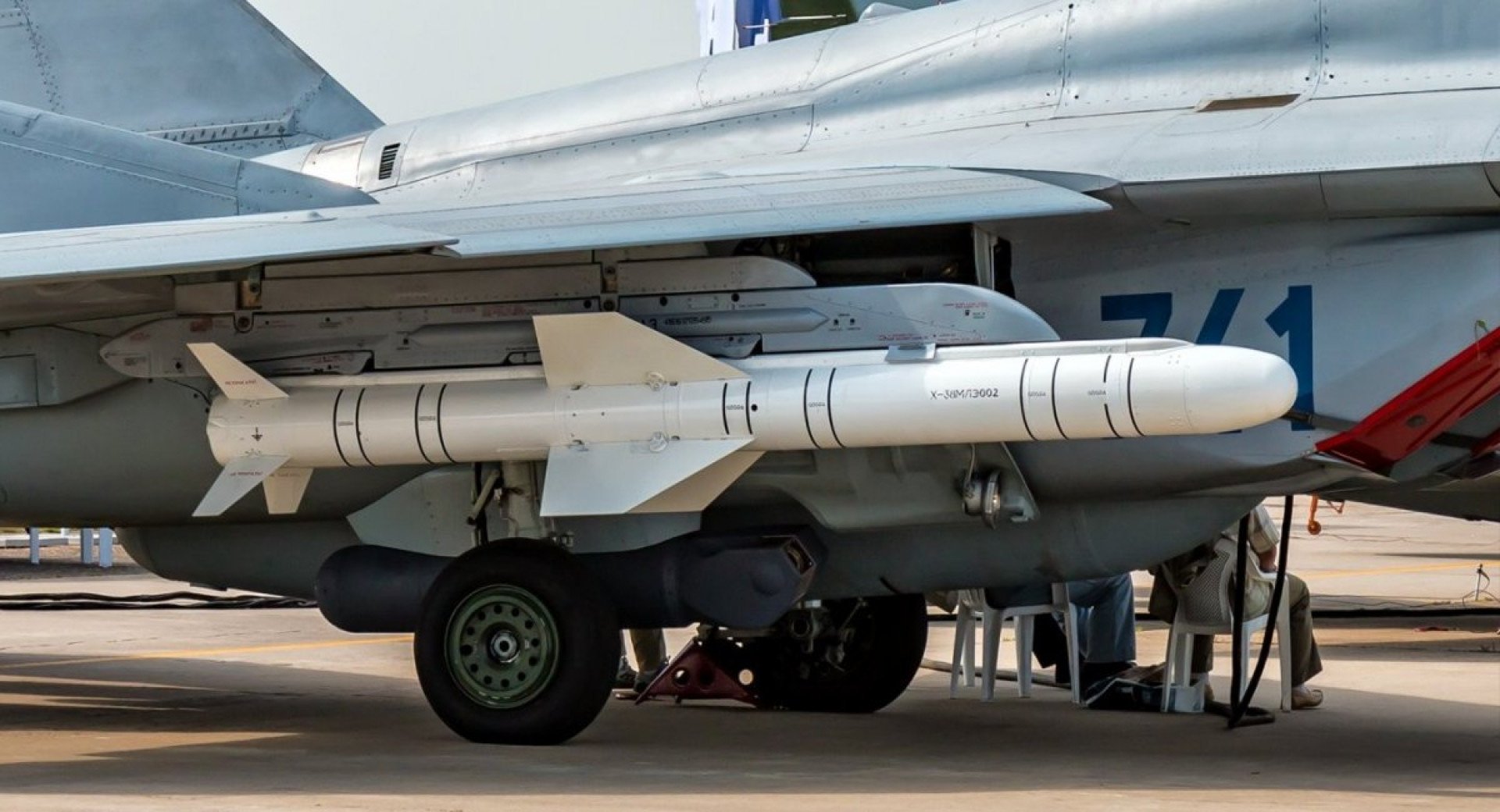
Russia is a major military partner for Iran, supplying Tehran with fighter jets as well as weapons for them, including missiles, leaked documents reveal. Their purpose is clear—to destroy enemy aircraft.
 Prefer U24 Media on Google
- Authors

-29a1a43aba23f9bb779a1ac8b98d2121.jpeg "Photo of Illia Kabachynskyi")
The editorial team at UNITED24 Media has obtained classified documents detailing agreements between Moscow and Tehran on the supply of fighter aircraft and their associated weaponry, including air-to-air missiles. These are used for aerial combat against enemies. In Iran’s case, the United States and Israel.
We bring you stories from the ground. Your support keeps our team in the field.
The discovered documents reference several contracts. The earliest, No. R/19K1011141768 dated June 10, 2021, covers the production of Su-35 aircraft and their combat components. We have previously reported on Russia’s Su-35 contracts for Iran.
However, aircraft are of limited value without their combat payload. Starting in 2023, contracts began to be signed specifically for the supply of munitions, namely missiles. These contracts are scheduled to be fulfilled by 2027, making them directly relevant to ongoing hostilities in the Middle East.
The missiles identified include several types:
Kh-38—a guided medium-range air-to-surface missile carried by the Su-35.
K-73—an air-to-air missile. A Su-35S fighter can be equipped with four R-77-1 air-to-air missiles and up to six R-73 (K-73), depending on configuration.
K-77 (R-77)—an air-to-air missile.
Kh-31—an air-to-ground missile, also used as an anti-ship weapon; the Su-35 platform can also launch it.
Weapons contracts between Moscow and Tehran
The primary contract underpinning cooperation between Russia and Iran is No. R/19K1011141768, mentioned above, covering the production of Su-35 aircraft and their combat components. Russian contract documentation lists a foreign customer designated as “K10”—a codename referring to Iran. Weapons for the aircraft, along with other components, are specified in several subsequent contracts.

Kh-38 missiles
In 2023–2024, for the benefit of foreign customer K-10, Russia’s largest machine-building enterprises ISKRA submitted a request to the federal state-owned enterprise Perm Powder Plant for the production and delivery of components 65DU.S-Sh, 65DU.M-Sh, 65DU.M-V, V-287, 65DU.S-Sh IN, 65DU.M-Sh IN, and assembly of item 65DU.00, totaling 120 units.
In the Perm Powder Plant catalog, item 65DU is a component of the Kh-38 missile.
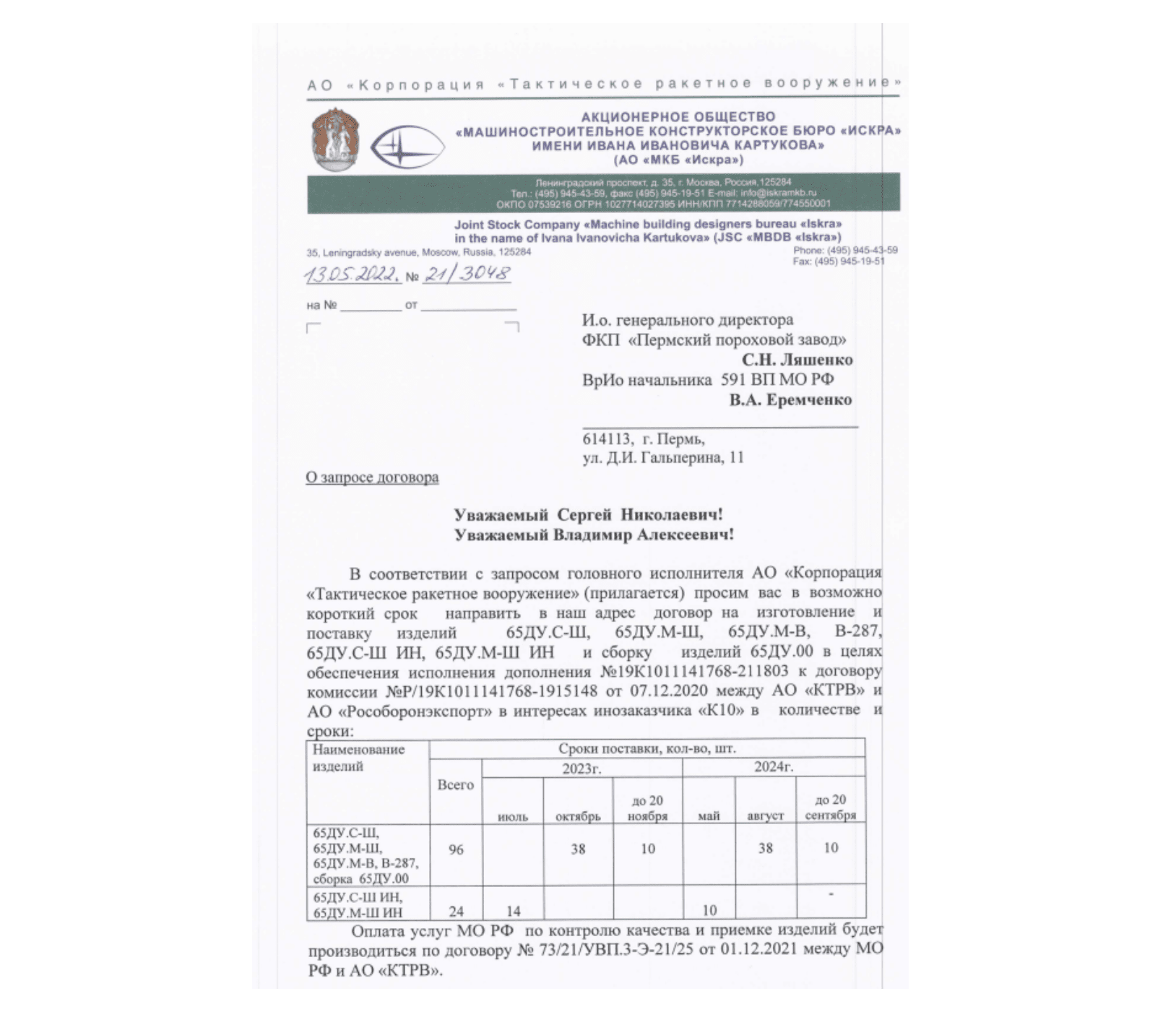
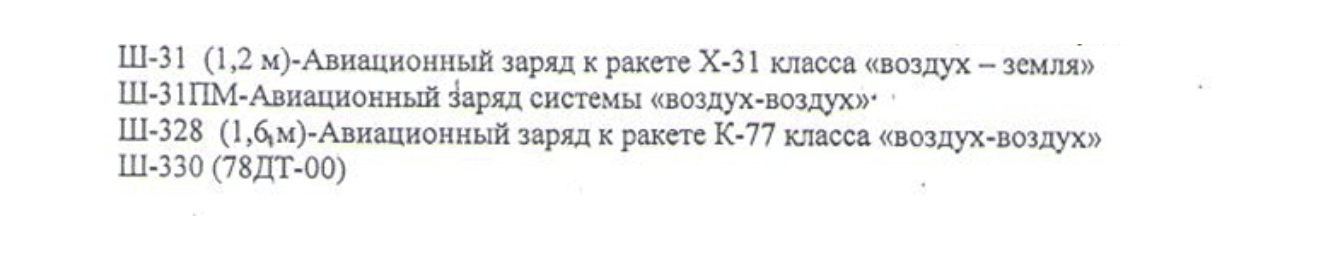
Importantly, Perm Powder Plant maintains a wide range of missile systems in its catalog and procures the necessary components accordingly—including both air-to-air and air-to-ground missiles.
K-73 missiles
In 2023, contracts were signed between FKP Perm Powder Plant and ISKRA for the supply of Sh-295 “Variant” units—123 in total, worth 54,986,924 rubles (now $674,689).
The Sh-295 “Variant” is a warhead used in the K-73 air-to-air missile.

K-77 missiles
JSC “Machine-Building Design Bureau ‘Iskra’ named after I.I. Kartukov” submitted a request to FKP “PPZ” regarding the production in 2025–2027 of components Sh-328, ISh-328, and V-328, as well as assembly services for item 542.U-00—42 units in total.
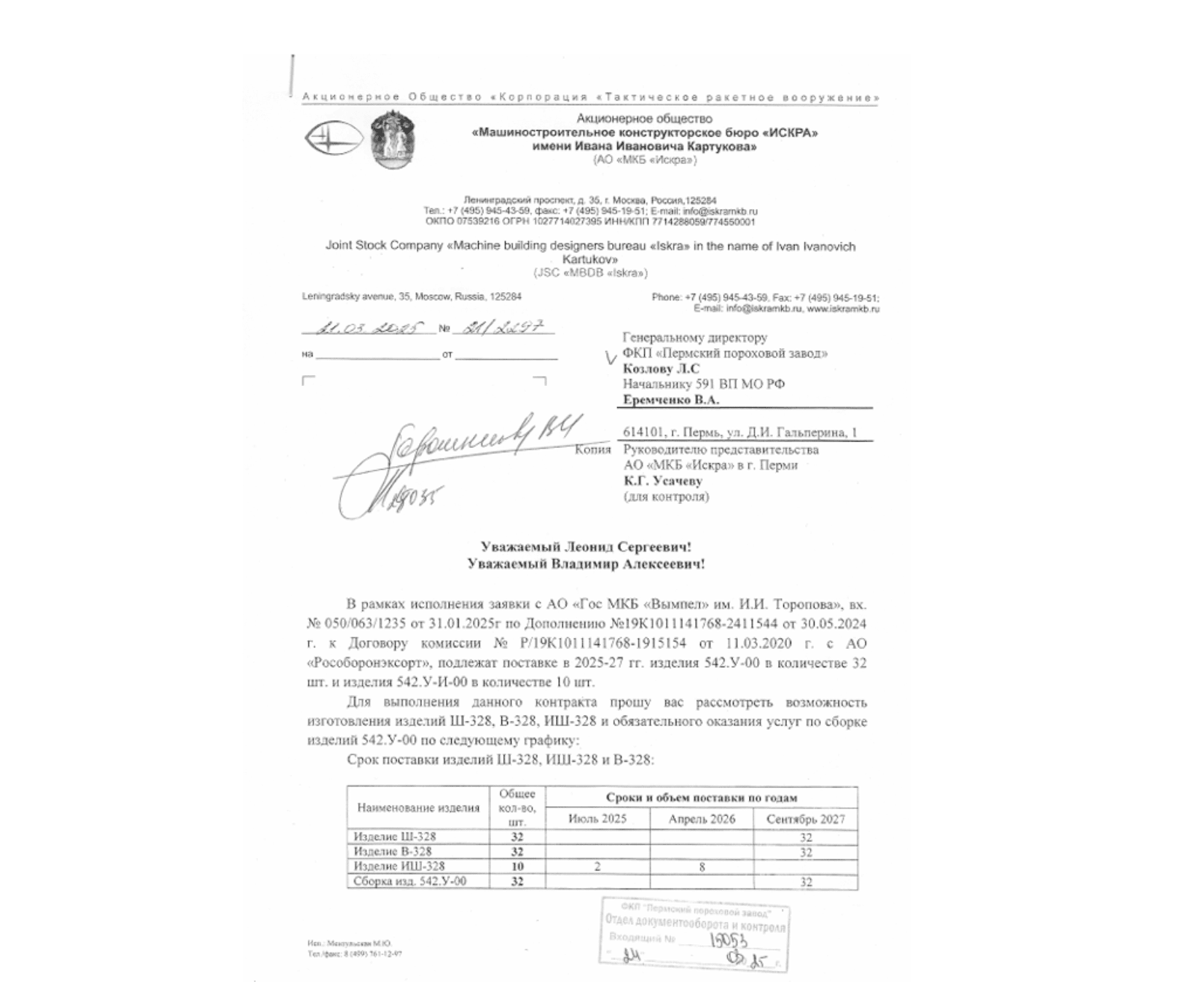
These components form part of the engine assembly for the K-77 (R-77) air-to-air missile.

Kh-31 missiles
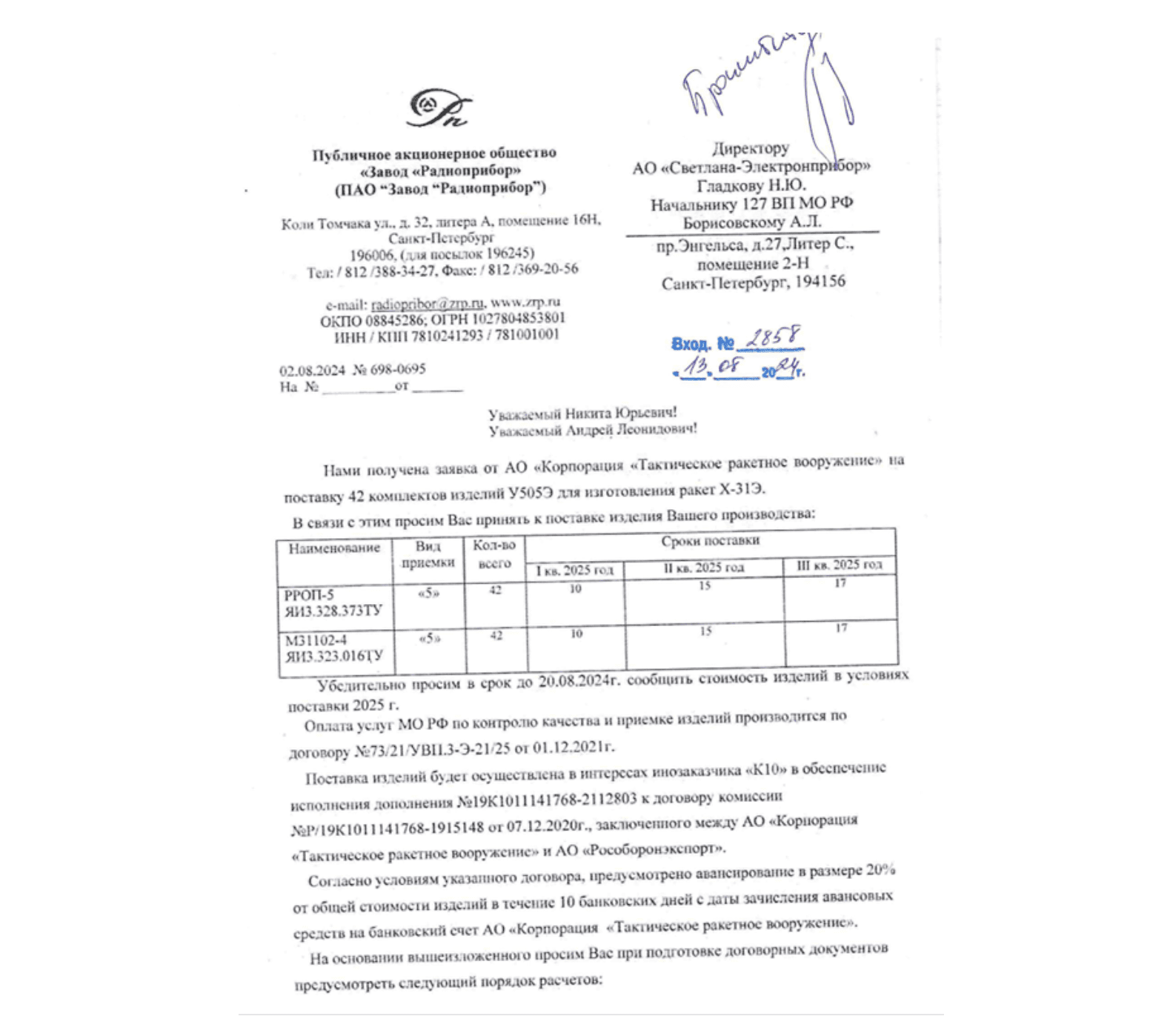
Russia’s Radiopribor Plant, a St. Petersburg–based defense manufacturer, requested that electronics firm Svetlana-Electropribor manufacture and supply items RROP-5 and M31102 in 2025. These are components of item U505E, produced for Kh-31E missiles. Deliveries are scheduled quarterly, totaling 42 units.
Missile propellant charges
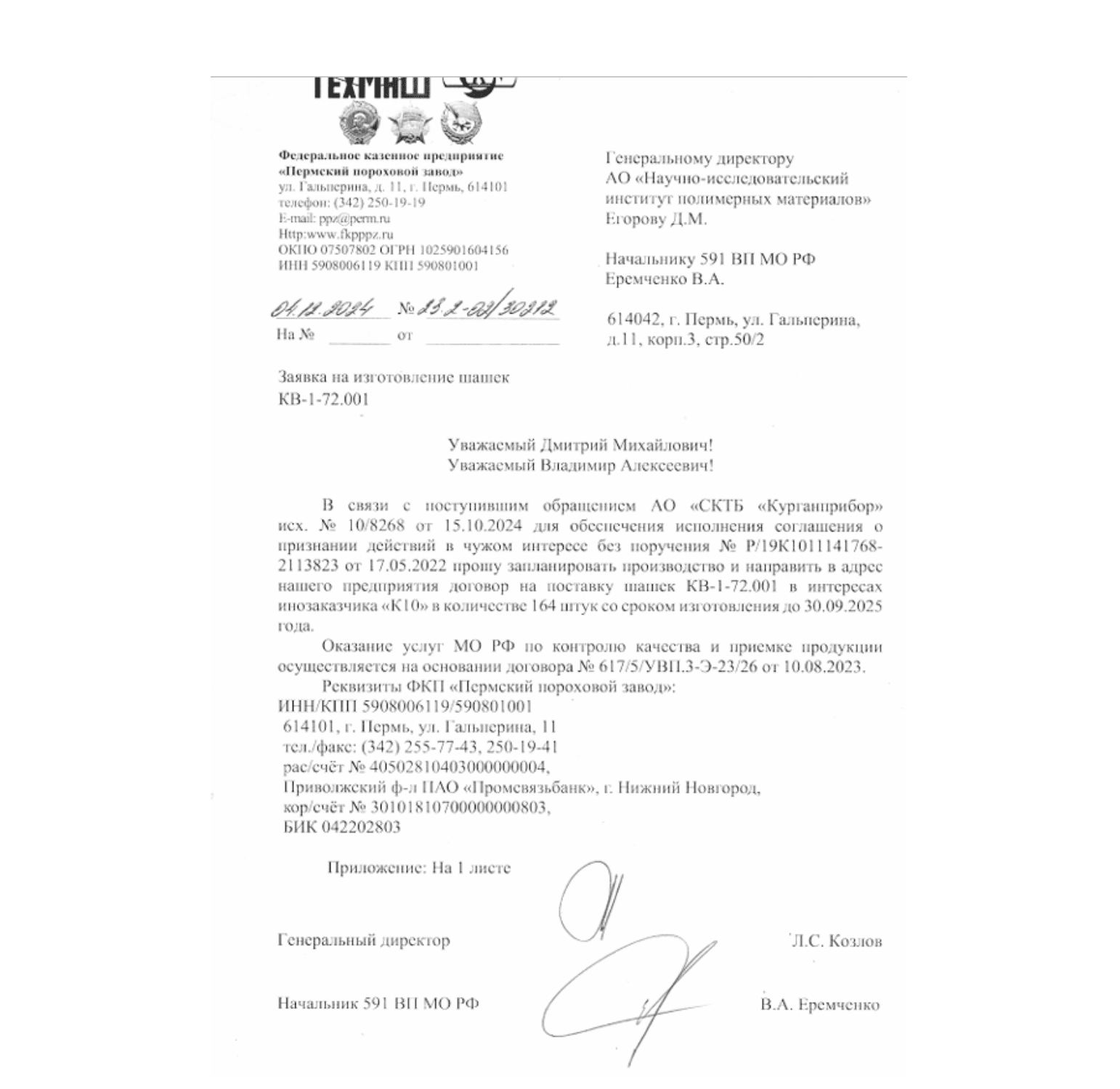
UNITED24 Media also obtained information about another major contract—for the supply of KV-1-72.001 propellant charges for foreign customer K-10, totaling 164 units, with production scheduled through September 30, 2025.
The production chain is as follows:
SF-4 propellant is manufactured by Perm Powder Plant for the production of KV-1-72.001 blanks;
The blanks are produced by the Scientific Research Institute of Polymer Materials (NIIPM JSC);
The KV-1-72 item is an armored unit (KV-1-72.010: 82-1 / 0 – 119-1) bonded into a metal casing using PGS-6 compound;
The Yu5801 gas generator (GG-72) consists of the KV-1-72 unit assembled with a VG-1-72 igniter, while the gas generator casings are supplied by the customer.
This represents a standard technological chain for producing gas generators—or gas sources—used in missile systems. Such components are typically used in:
gas supply systems,
or as elements of solid-fuel engines and control systems (e.g., fins, actuators).
These assemblies are characteristic of guided aviation missiles in both air-to-air and air-to-surface classes.
How Russia is aiding Iran’s war effort
Since February 2026, Israel and the United States have been conducting a military operation against Iran aimed at neutralizing Tehran’s nuclear capabilities. A number of military facilities, launch systems, launch sites, as well as parts of Iran’s aviation and naval forces, have been destroyed.
Iran has escalated destabilizing actions across neighboring countries, while its ideology remains unchanged. For Ukrainians, this pattern is familiar—Russia behaves in much the same way. It appears that Moscow is exporting not only its ideology but also the means of warfare.
From the outset, reports indicated that Russia was providing intelligence. President Volodymyr Zelenskyy says Russian satellites have been continuously monitoring and photographing US bases in the region.
Later, reports emerged of drone deliveries, as Russia succeeded in scaling up mass production. However, as the documents obtained by our editorial team show, from 2022 to the present, Russian enterprises have been manufacturing and supplying Su-35 aircraft along with their full combat payloads, which Iran is expected to use in warfare.
Russia’s support for the Iranian regime is not speculative—it is documented.
Discuss this article:
-4a56a6b482ec132402c16ef6fcabf9a2.png)


-111f0e5095e02c02446ffed57bfb0ab1.jpeg "Photo of Roman Kohanets")

-b7da0e3033ba5fc9d5f47439cb28c6ad.png "Illustration featuring the logos of AI chatbots Claude (left) and Mistral (right). (Illustration: UNITED24 Media)")