- Category
- Defense Tech
Fire Point’s Denmark Plant Could Solve One of Europe’s Biggest Missile Production Bottlenecks
 Prefer U24 Media on Google
- Authors


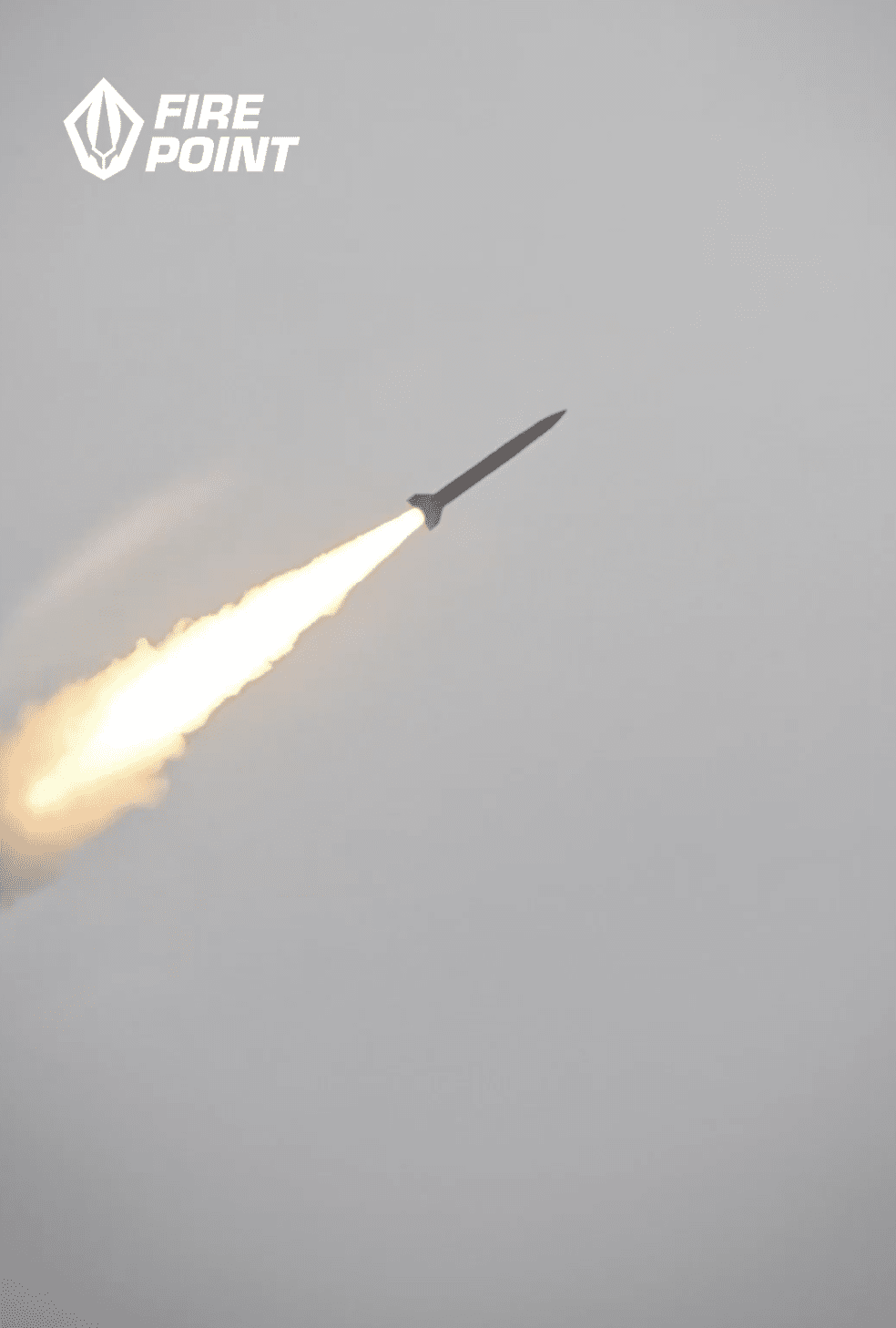
Ukraine’s Fire Point has offered one of its clearest updates yet on its expansion into Denmark, saying construction is underway on a major solid rocket propellant plant that will become the company’s first production facility outside Ukraine—and the first Ukrainian defense manufacturing site on NATO territory, according to Vector on August 19.
The update came at DALO Industry Days in Herning, Denmark, where Fire Point returned for a second year and laid out a much broader European strategy than simply exhibiting its missiles and drones.
We bring you stories from the ground. Your support keeps our team in the field.
Fire Point Rocket Technologies, the company’s Danish subsidiary, is building a plant intended to produce solid rocket propellant first for Fire Point’s own weapons and eventually for other defense manufacturers.
The company argues that Europe’s shortage of solid propellant has become a fundamental production bottleneck that cannot be solved by defense spending alone because additional factories are needed to turn that money into actual weapons.
“We are going to open a plant here with enormous capacity to produce a lot of solid rocket propellant—first for Fire Point, and also so that we can supply other companies. We are currently at the construction stage, but we already have all the necessary permits to launch it,” Fire Point COO Viacheslav Bondarchuk said.
🇺🇦 Fire Point at DALO Industry Days 2026 🇩🇰
— Fire Point (@FirePointUA) August 16, 2026
This year, we’re heading to Denmark – one of Ukraine’s strongest allies and most committed supporters.
At our booth, you’ll get to see full-scale FP-1, FP-5 “Flamingo,” FP-7 and FP-9 up close. A chance to see what Ukrainian defence… pic.twitter.com/nNMKY7hI2f
The scale of the project has grown substantially. Its original budget was around $58 million, but the estimated cost has now climbed above $175 million.
For Fire Point CEO and CTO Iryna Terekh, the Danish project is also about reducing Europe’s dependence on outside suppliers for critical defense capabilities. She said European countries remain heavily dependent on the United States, China, and other suppliers whose availability or political decisions could change unexpectedly.
“I cannot overstate how important it was that Denmark had the balls to make a decision that was very unfashionable at the time,” Terekh said.
The Danish operation remains relatively small while construction continues. Fire Point Rocket Technologies currently employs around 15 people directly, primarily in administration and project management, with no production workforce yet in place.
-690b7eae913bfbbcb34c2d02f700db53.png)
Roughly another 100 people are involved through partners, subcontractors, and consultants, although they are not formally employed by the Danish subsidiary. Once production begins, Fire Point expects the plant to employ several hundred factory workers, alongside roughly 100 administrative and engineering staff.
That makes the Danish facility potentially far more consequential than simply another overseas branch. Fire Point intends it to become a large-volume source of one of the most important inputs for modern missiles at a time when Europe is trying to rapidly expand its own weapons production.
At DALO Industry Days, the company also showed how much its weapons portfolio has expanded alongside that industrial push. Fire Point displayed full-scale models of the ground-launched FP-1 strike drone, the FP-5 Flamingo cruise missile, and the FP-7 and FP-9 ballistic missiles.
Just one day to go until DALO Industry Days 2026 🙌🏼
— Fire Point (@FirePointUA) August 18, 2026
See you at booth U2202 pic.twitter.com/E0E0uFccLj
The company presented the lineup as a visual representation of its evolution from a mass-produced long-range drone manufacturer into a developer of cruise and ballistic missile systems.
The FP-7, with a stated range of up to 300 kilometers, or about 186 miles, is being positioned as a lower-cost alternative to ATACMS. The missile is undergoing its final tests, with its first combat use expected by the end of September.
The larger FP-9 has a stated range of roughly 800 to 850 kilometers, or about 500 to 530 miles. Fire Point plans to conduct its first test launch before the end of the year.
Fire Point is simultaneously working on FREYJA, a European ballistic missile defense project in which the Ukrainian company is responsible for developing and producing the FP-7.x interceptor missile.
Fire Point is also integrating the project’s various components—from command-and-control systems to launchers—into a unified missile defense architecture.
-faa0805607bc8eb0482b2116759ee844.png)
The company’s press conference centered on three areas: the rollout of Fire Point Rocket Technologies production in Denmark, cooperation with Europe’s defense industry, and the FREYJA ballistic missile interception project.
“We should not measure by missiles—number nine or number seven. We should measure by capabilities. And at this moment, the Ukrainian army cannot strike Moscow accurately and at scale, without those targets being intercepted,” Terekh said.
Fire Point says its technologies were developed in Ukraine by Ukrainian engineers during the full-scale war and continue to be refined using lessons from combat employment. That battlefield experience feeds directly into engineering choices, system architecture, and production methods.
Previously, reports emerged that Ukraine has sharply increased its use of domestically produced Flamingo cruise missiles against targets inside Russia this summer, with the pace of attacks nearly doubling over the past six months.
Discuss this article:


-111f0e5095e02c02446ffed57bfb0ab1.jpeg "Photo of Roman Kohanets")