- Category
- Latest news
How the Moon Should Be Divided According to the Russian Academy of Sciences
 Prefer U24 Media on Google
- Authors

-c439b7bd9030ecf9d5a4287dc361ba31.jpg "Photo of Katherina Popilnichenko")
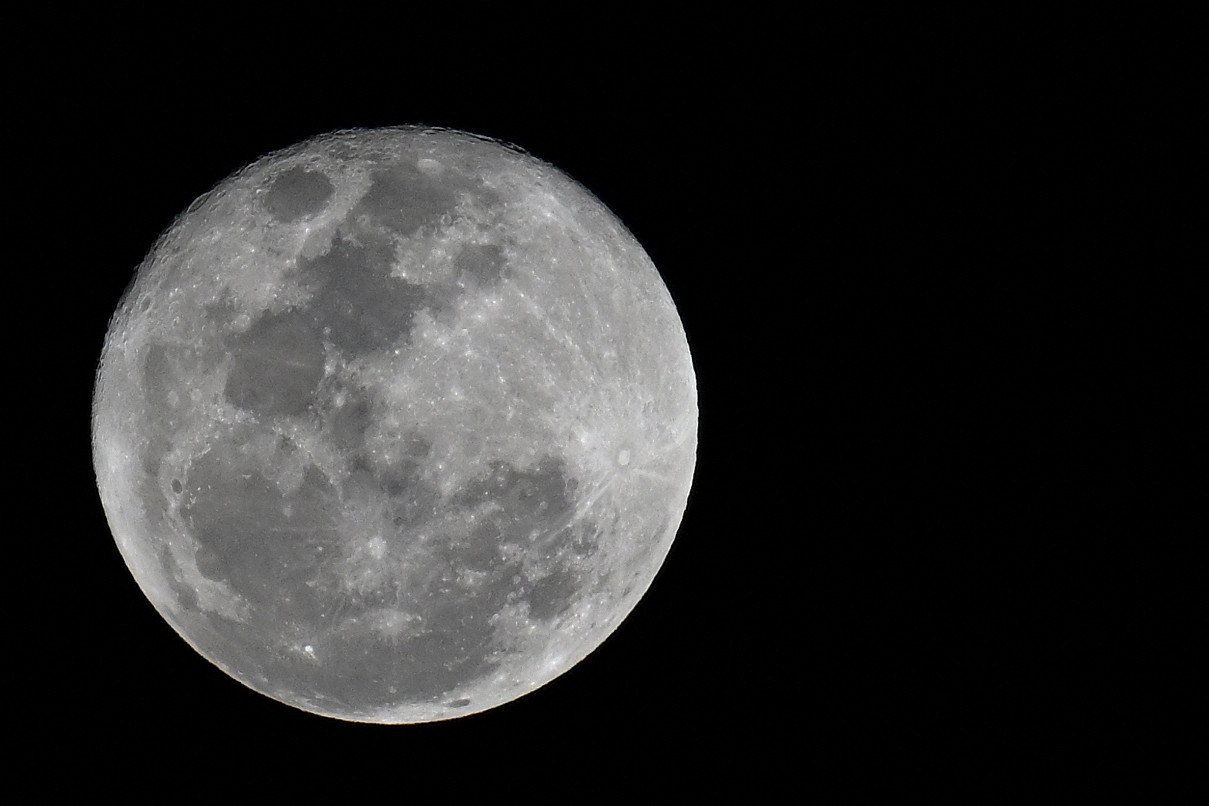
The Russian Academy of Sciences has proposed a plan to divide the Moon.
Suggesting that Russia could establish its own "sovereign territories" through a federal project called "Space Science," according to The Moscow Times on April 7.
We bring you stories from the ground. Your support keeps our team in the field.
Sergei Chernyshev, vice president of the academy and head of the Zhukovsky Central Aerohydrodynamic Institute, announced this during a meeting about space research.
He stated that "the Moon program will allow Russia to remain among the leading space powers actively exploring the Moon. It will provide new knowledge and technologies in Moon exploration research. And ultimately, it will allow for the allocation of sovereign territories of Russia on the surface of the Moon."
The program is planned to take place in two stages. The first stage involves mastering the technologies required for landing and conducting research on the lunar surface.
The second stage focuses on constructing components for lunar bases and developing technology to travel beyond landing zones. According to academician Anatoly Petrukovich, the budget for this lunar project through 2036 is approximately 700 billion rubles ($7.5B), while the total funding for the "Space" national project is 4.4 trillion rubles ($47.2B).
International law regarding the Moon and other celestial bodies is governed by the 1967 Outer Space Treaty. The treaty states that "outer space, including the Moon and other celestial bodies, is not subject to national appropriation by claim of sovereignty, by means of use or occupation, or by any other means."
Dmitry Bakanov, the head of Roscosmos , previously mentioned that the academy approved a project for a Russian segment of the International Scientific Lunar Station, which is a joint effort with China.
Development of equipment to study the interior of the Moon is set to begin in 2026. Russian specialists then plan to scan the lunar surface to find locations for landings and future bases.
In December 2025, Roscosmos announced plans to build a power plant on the Moon by 2036 with the help of Rosatom and the Kurchatov Institute. This facility is intended to provide energy for lunar rovers, an observatory, and the international station.
Russia’s last lunar mission occurred in August 2023 with the Luna-25 module, which was the first since the Soviet era. However, the craft crashed onto the lunar surface. The mission was seen as an attempt to restart Moscow’s lunar goals after years of limited activity in space and increasing isolation from the West.
Roscosmos signed a state contract to develop a lunar power station, with the project scheduled to run from 2025 through 2036. The agency stated that the facility was intended to provide a long-term power supply for lunar rovers, observatories, and infrastructure within the International Scientific Lunar Station.
While the cost was not disclosed, the project involved the state nuclear corporation Rosatom and the Kurchatov Institute, suggesting a nuclear power source.
The contract covered the entire process from spacecraft development and ground-based testing to the final deployment of infrastructure on the Moon.
Discuss this article:
-9a7b3a98ed5c506e0b77a6663f5727c5.png)