- Category
- Latest news
Iran Rushes to Protect Isfahan Nuclear Site From Possible US Airstrikes
 Prefer U24 Media on Google
- Authors


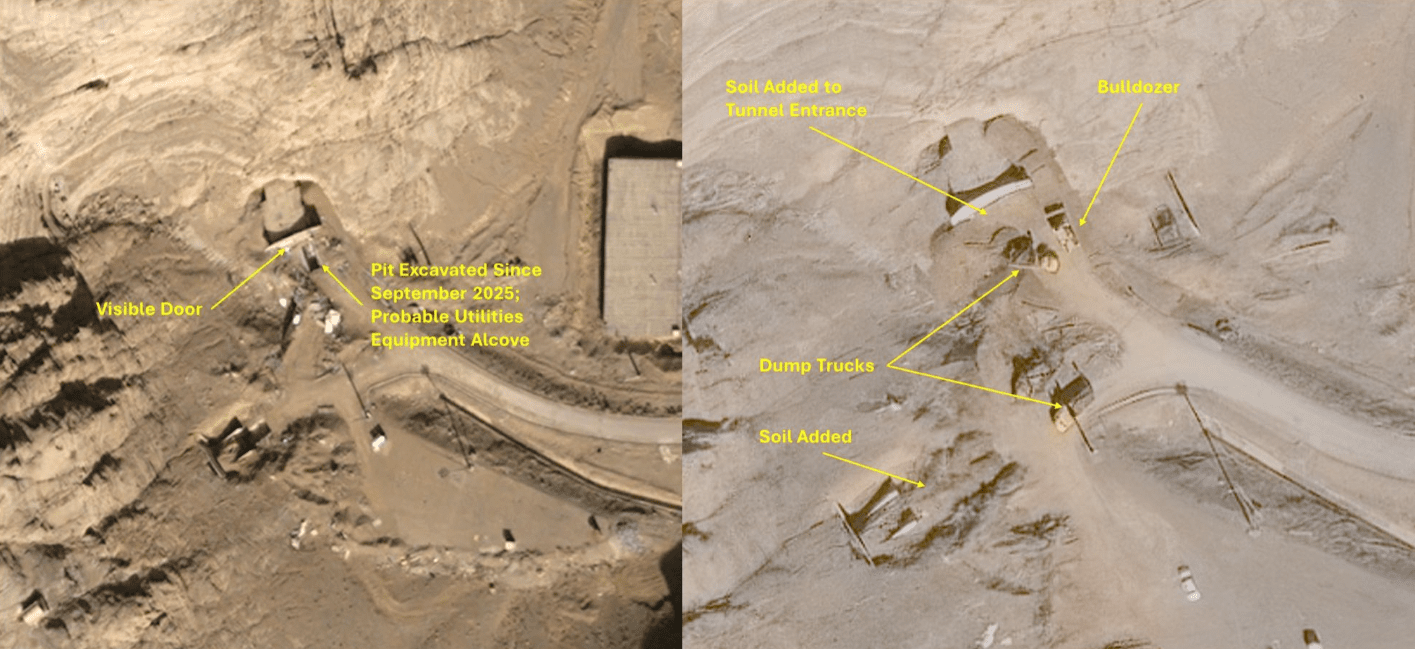
Iran has stepped up protective measures around its nuclear complex in Isfahan, reinforcing tunnel entrances and restoring damaged surface facilities as concerns grow over a potential US strike, according to a new analysis by the Institute for Science and International Security published on January 29.
Satellite imagery shows intensified construction activity near multiple tunnel entrances at the site. Analysts report that Iran has been piling earth and debris around the central and southern tunnel openings, effectively sealing them off.
We bring you stories from the ground. Your support keeps our team in the field.
As of late January, the doors to the central tunnel and an adjacent alcove appear completely buried.
The scope of activity inside the tunnel network remains unclear. However, analysts say the pattern suggests Iran may be moving sensitive equipment deeper underground rather than removing it from the site.
NEW: Satellite imagery of the Esfahan nuclear site taken today shows new activity at the tunnel entrances. As of today, Iran has re-buried the middle entrance with soil and is adding more fresh soil to the southernmost entrance. The northernmost entrance, which was reworked after… pic.twitter.com/7ujiku8VRg
— Inst for Science (@TheGoodISIS) January 29, 2026

Activity has also increased near a surface building within the Isfahan complex that was previously damaged. While earlier work focused mainly on clearing debris, recent imagery shows Iran installing a new roof atop the surviving steel frame of the structure. The move suggests Iranian authorities consider the building worth preserving.
Although the building’s function has not been officially confirmed, multiple indicators point to a possible link with centrifuge production.
“Such activity inevitably raises concerns about the possible resumption of Iran’s gas centrifuge program,” the analysts wrote.
Tunnel entrances show new fortifications
Satellite images dated January 24 and January 29, 2026, document sustained efforts to reinforce access points to the underground complex.
Fresh soil piles were visible near the southern tunnel entrance on January 24, with construction equipment arriving days later. Convoys of dump trucks carrying earth were also observed along access roads, likely supporting continued sealing of the central entrance.
Analysts note that Iran has used similar measures in the past ahead of anticipated US strikes, reinforcing the interpretation that the current work may be defensive in nature.
By contrast, activity at the northern tunnel entrance—strengthened in recent months with zigzag blast-resistant passages—has been more limited. The entrance remains open as of January 29, with nearby equipment suggesting possible relocation of assets from other facilities into the tunnel system.
Damaged surface facility rebuilt
Imagery from December 2025 and January 2026 shows Iran repairing the steel framework and installing a new roof on a building damaged by an Israeli airstrike on June 20, 2025. By January 17, the frame and roof were in place, though wall panels—at least on the southern side—had not yet been installed as of January 22.
Cleanup at the site began in early July 2025 and accelerated in November, clearing the way for reconstruction. Analysts believe the roof serves a dual purpose: protecting remaining equipment from the elements and obscuring activity from satellite surveillance.
While the Israel Defense Forces have not officially identified the building’s role, its layout and expansion history closely resemble known centrifuge-production facilities elsewhere in Iran, including the TESA/TABA site near Karaj, which was hit by a drone strike in 2021.
Experts say the renewed activity in Isfahan—combined with developments at the Natanz enrichment facility and the nearby mountain complex—suggests Iran is prioritizing the preservation and restoration of infrastructure linked to uranium enrichment.
Earlier, Iran’s Islamic Revolutionary Guard Corps moved its so-called aircraft carrier Shahid Bagheri out to sea amid heightened internal and regional tensions.
Discuss this article: