- Category
- Latest news
Russia Turns Back to 1990 Hulls: Strelok Corvette Relaunched With Missile Upgrade
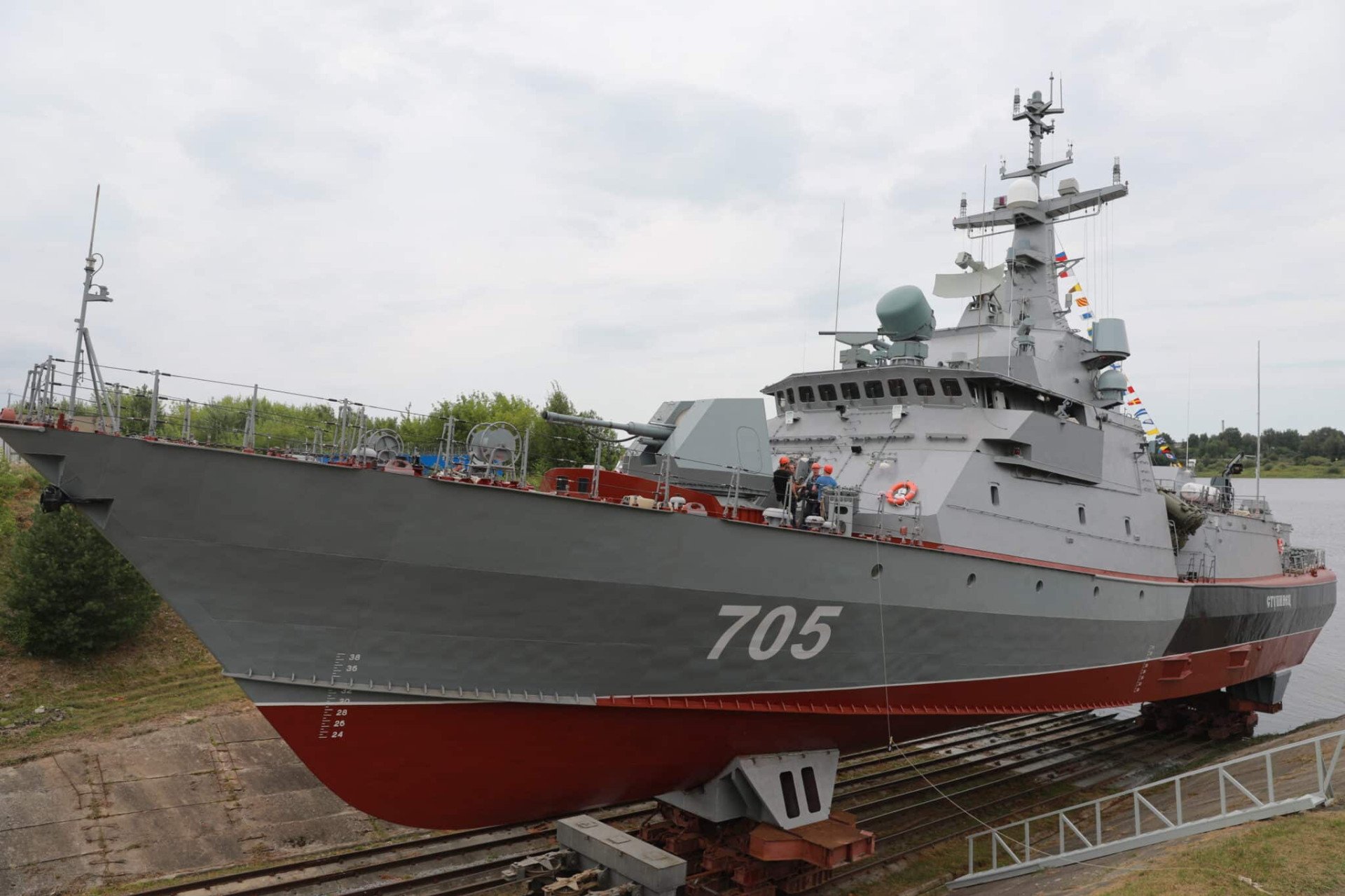
Russia has quietly relaunched an upgraded Tarantul-class corvette after years of delays, converting a 1990s hull into a modern coastal strike ship armed with Kh-35 “Uran” anti-ship missiles. The vessel—now sailing as Strelok under Project 12418—represents a low-cost way for the Russian Navy to add missile punch to littoral patrol forces while the country’s new-build shipyards struggle to keep pace.
 Prefer U24 Media on Google
- Authors


The Vympel shipyard in Rybinsk launched the “Strelok” after completing a lengthy modernization of an older Project 12421 hull, Army Recognition reported on October 1.
The 580-ton corvette carries the 2×4 Uran (Kh-35 family) anti-ship missile fit, new diesel engines, upgraded radar and electronic warfare suites, and close-in guns—an armament package designed for coastal defense and short-range strike.
Vympel shipyard launched Project 12418 Molniya/Tarantul-class missile corvette Stupinets(705) .
— Massimo Frantarelli (@MrFrantarelli) July 29, 2024
Details:https://t.co/ze9uPKEkNw pic.twitter.com/uAR2OaL8kB
The Tarantul series (Project 1241, NATO: Tarantul/Molniya) dates to the Cold War’s response to Western fast-attack craft.
Hundreds were produced from the late 1970s through the 1990s. Project 12418 is a later modernization that trades top speed for reliability and extended range via diesel propulsion and updated sensors.
Project 12418 Molniya/Tarantul-class missile corvette "Stupinets".
— Massimo Frantarelli (@MrFrantarelli) May 27, 2025
Vympel shipyard.
📸 - "skuter"/forums.airbase (May 27) pic.twitter.com/sIb1hKFHff
Modernized Tarantul returns: Kh-35 missiles, new diesels
Vympel’s conversion program, originally contracted in 2016, envisioned finishing two long-idle hulls by 2018–19, Army Recognition noted.
That schedule slipped repeatedly; the sister ship Stupinets was launched in July 2024 and later sent for trials in the Caspian Sea, while Strelok completed its waterline events in mid-2025 and carries hull number 705.
Key specs for the 12418 conversion include a roughly 56.9-metre length, ~580 tonnes full load, a top speed around 29 knots, and an endurance of about 10 days—typical figures for coastal missile corvettes built to operate in confined seas. Designers replaced older gas-turbine machinery with twin M521 diesel-reduction units to boost range and simplify maintenance.
Small corvette, big bite: Uran missiles give coastal punch
Army Recognition wrote that weapons and sensors center on the Uran system: two quadruple 3S24 launchers for Kh-35/3M24 missiles (reported ranges roughly 130 km for baseline rounds and longer for upgraded variants).
A single forward AK-176M 76 mm gun provides surface-engagement capability, while two AK-630M six-barrel CIWS mounts and man-portable air defense missiles cover close-in defense.
The ship’s electronic suite reportedly includes the Mineral-ME and Positiv-ME1 radars, MR-123-02 gun fire control, the 3R-60U missile fire-control interfaces, and a range of jammers and decoy launchers for survivability.
Analysts note the conversion approach reflects Russian naval priorities: upgrade existing hulls to restore missile capacity quickly and affordably, rather than depend solely on slower, costlier new construction.
The Strelok is likely earmarked for littoral patrols, coastal strike missions, and integration into fleet task groups—particularly in constrained theaters such as the Baltic, Black Sea, and Caspian.
Earlier, reports emerged that Russia faced renewed debate over the future of one of its largest surface combatants, the nuclear-powered battlecruiser Pyotr Velikiy, amid growing concerns about the cost-effectiveness of maintaining such legacy platforms.
Former Pacific Fleet commander Admiral Sergey Avakyants stated in an interview with Izvestia that funding a refit of the vessel would be an inefficient use of state resources.
Discuss this article:
-331a1b401e9a9c0419b8a2db83317979.png)