- Category
- War in Ukraine
In Drone Warfare, Can Journalists Shoot Down FPVs?
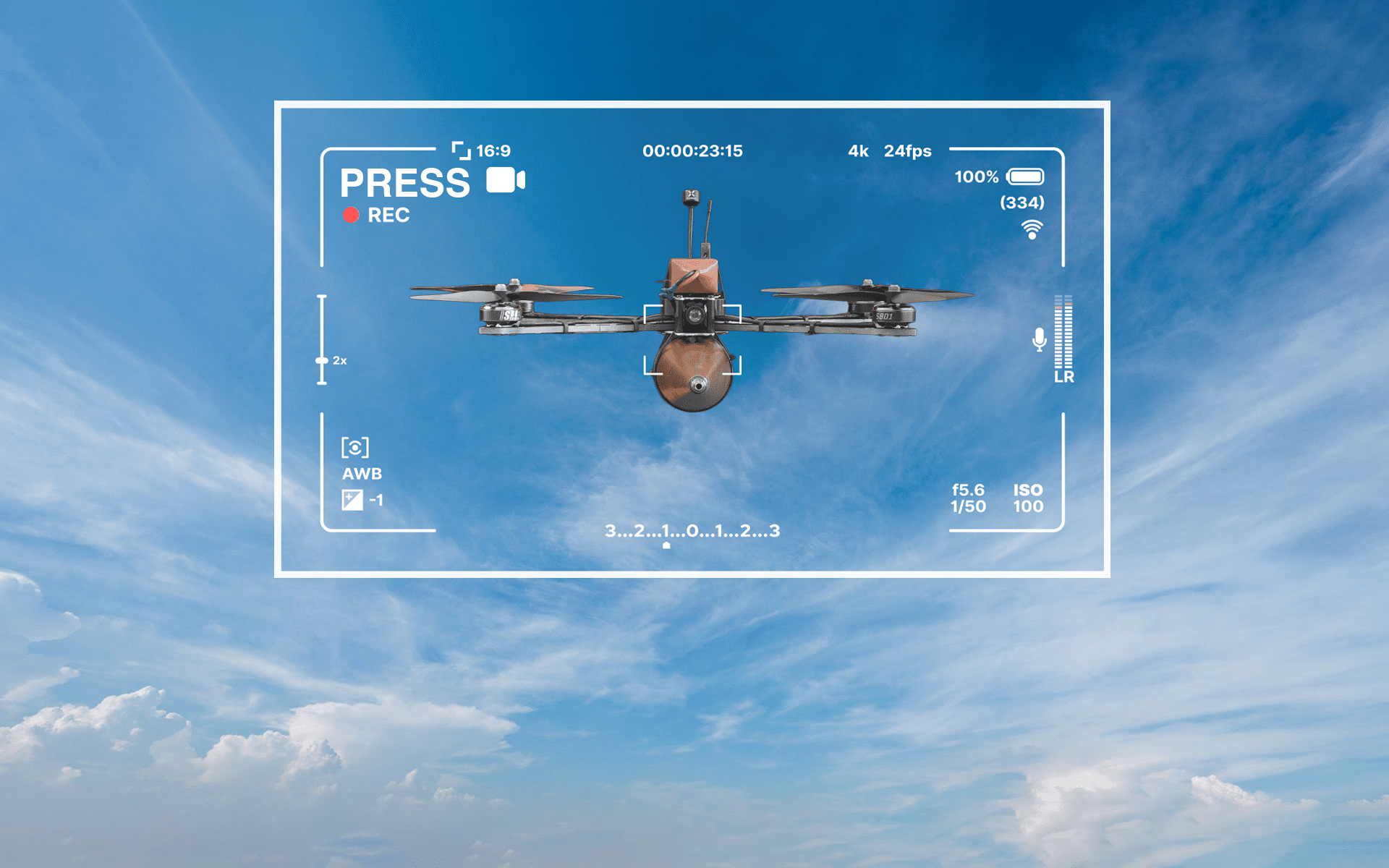
In Ukraine, Russian drones are killing journalists miles from the frontlines. As reporters dodge deadly machines, the question arises: should they fight back? In a war where survival trumps neutrality, old rules might not stand a chance.
 Prefer U24 Media on Google
- Authors

-554f0711f15a880af68b2550a739eee4.jpg "Photo of Lucile Brizard")
On the frontline, you don’t wear a seatbelt, and you drive very fast. The reason: drones. In this case, the FPV was sitting by the side of the road, waiting.
As “Sheva,” a Ukrainian commander, drove UNITED24 Media reporter Philip Malzahn and cameraman Yegor Terletskyi across drone-saturated southeastern Ukraine, suddenly, he shouted, “Out!” In an instant, Malzahn found himself in a position all frontline journalists dread.
All three men survived the attack, the Russian FPV pilot going instead for the car. Many are not so lucky, as the charred remains of vehicles now line every highway leading east.
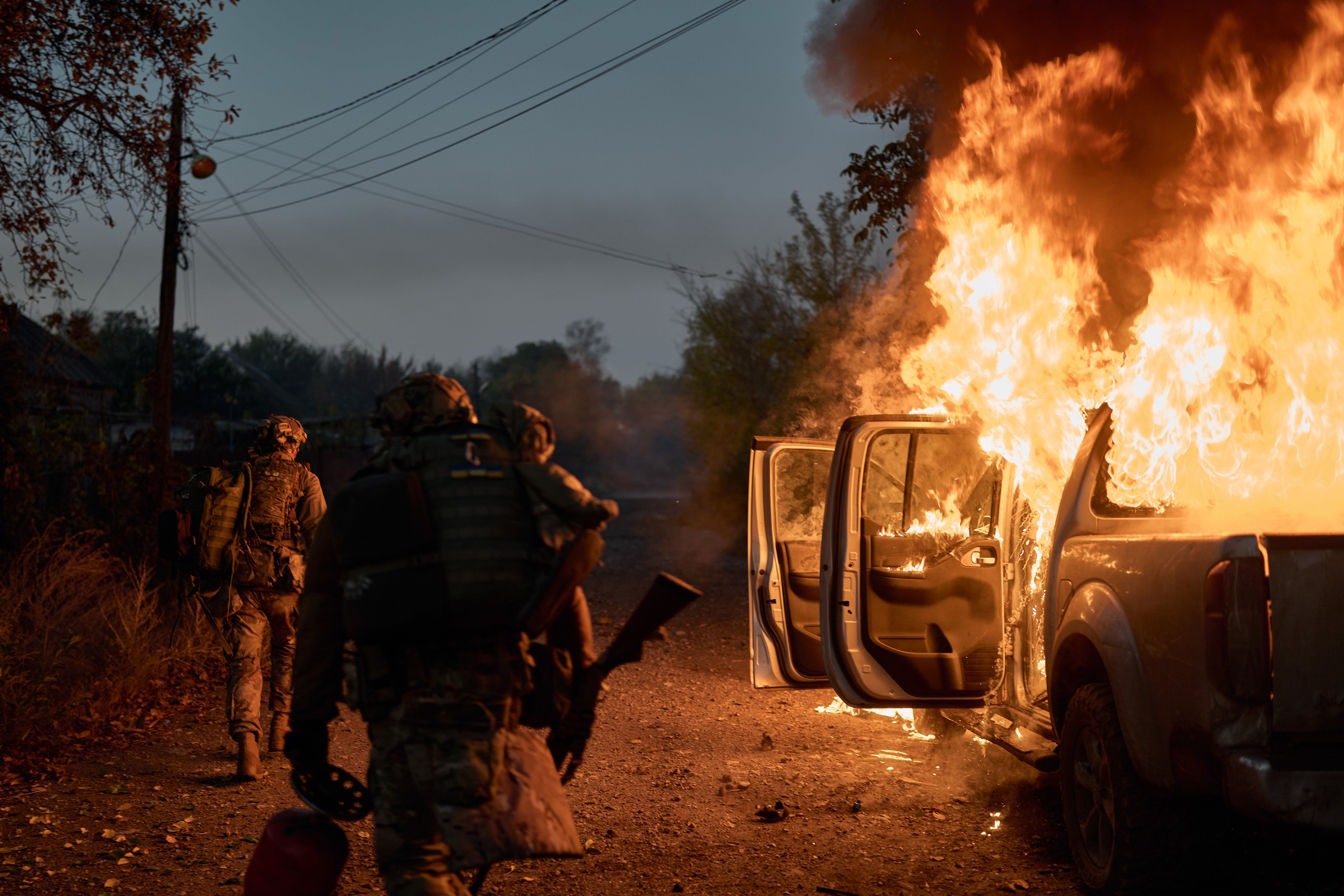
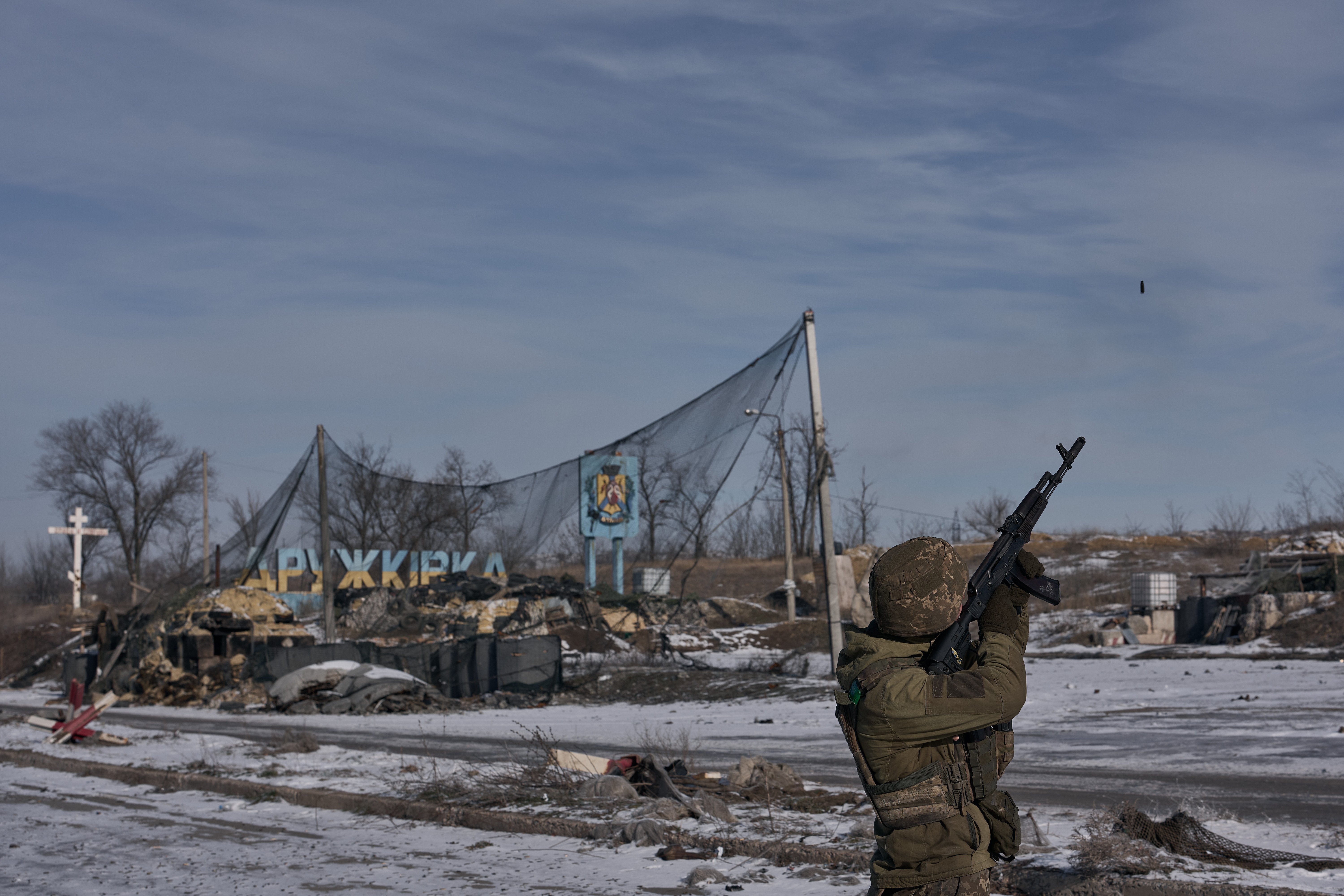
Today, FPVs are a bane for soldiers, civilians, and journalists alike. In Ukraine, 2025 proved the deadliest year for journalists since the war began. Three reporters were killed by drones: French journalist Anthony Lallican near Druzhkivka, and Ukrainians Alyona Gramova and Yevhen Karmazin in Kramatorsk.
At an average cost of $400, FPV drones have become one of the deadliest weapons in Ukraine, surpassing all others in civilian casualties, according to the UN Human Rights Monitoring Mission. In January 2025, FPVs accounted for 27% of civilian deaths and 30% of injuries, with operators able to target civilians with chilling precision.
Are journalists allowed to shoot drones under international law?
As these drones become deadlier, concerns about compliance with International Humanitarian Law (IHL) have grown. Major news organizations, aware of the risks, now face a dilemma: whether to allow journalists to defend themselves in a warzone. And today, self-defense in modern warfare usually no longer means endangering or killing a human; rather, it’s about shooting down a robot that costs less than most vacuum cleaners.
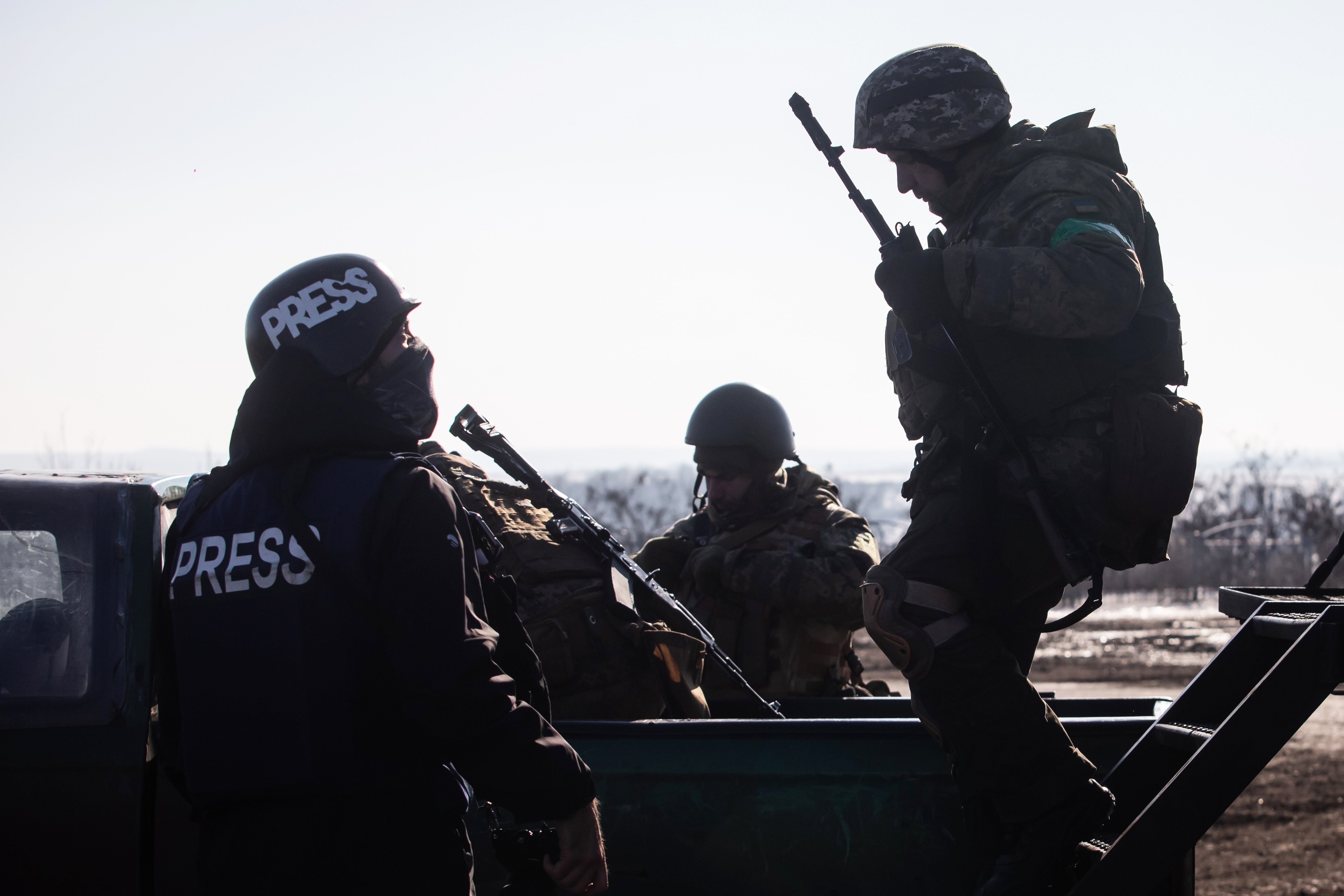
Under IHL, there are two main distinctions: combatants and civilians. Journalists, unless directly involved in hostilities, are considered civilians and are afforded the same protections as other non-combatants, such as medical workers.
“First, there must be an act harmful to the enemy, such as striking someone with a weapon or firing at them,” Volodymyr Hryshko, Senior Legal Counsel at Truth Hounds, told UNITED24 Media, explaining what legally qualifies as direct participation in hostilities.
The second criterion is a link between the harmful act and its resulting harm, implying that the harmful act must directly cause harm: if you shoot at someone, the harm must result from that action. Simply taking an action without causing harm wouldn’t meet this criterion.
The third is the belligerent nexus—for an action to qualify as a belligerent nexus in a conflict, it must benefit one side while causing harm to the other. Simply possessing a weapon or firing it does not automatically qualify someone as a combatant.
For Hryshko, the key distinction lies in intent: self-defense does not strip individuals of protections under IHL, as long as there is no intent to aid another party.
If a journalist is filmed holding a weapon, such as a shotgun, and using it to shoot down an FPV drone, claiming self-defense, “the legal stance is that it would likely be justified,” says Hryshko, adding, “In this case, the journalist would not be prosecuted for engaging in warfare.” While national courts may not always accept a self-defense argument, IHL does, and ideally, national courts should recognize the journalist’s actions as justified and refrain from prosecution.
While Hryshko argues that self-defense is legally justifiable in certain circumstances, international bodies like the Committee to Protect Journalists strongly caution against journalists carrying weapons, as it could undermine their neutrality, underlining that “In some particularly dangerous conflicts, journalists have hired armed guards, but this too can undermine their neutrality.”
Weapons for self-defense or reckless risk?
In our conversation with Luke Harding, The Guardian’s foreign correspondent in Ukraine since 2014, he was blunt about journalists using weapons for self-defense:
A journalist carrying weapons? You’re kidding me.
Luke Harding
The Guardian foreign correspondent in Ukraine
Unwavering in his convictions, Harding concedes that since the death of journalists like Lallican in October 2025, travel to the “kill-zone” has become more difficult. “The conversation with editors back in London has become more difficult, because obviously they have a duty of care,” he told us.
Risk assessment can culminate for him in the inability to travel to cities like Kherson in the south of Ukraine, where FPV’s deliberately hunt civilians, dubbed a "human safari“: ‘That may change, but the road seems to be a bit of a lottery […] I know if I were to suggest going there, I’m not sure I would get approval.’
When asked how he plans to keep covering the frontline, Harding said that, “we need to adapt, you know, because technology is changing so quickly on both sides.” Though, he clarified, adapting would never culminate in him carrying a weapon.
While Harding firmly insists that carrying weapons is never the answer, others, like Zarina Zabrisky, who has spent countless hours dodging drones on the frontlines of Kherson, see things a bit differently.
Zabrisky, an American freelance reporter based in Kherson for the last two and a half years, illustrates the current situation: “drones here are like flies.” Very much embedded, she grasps her position is different to other journalists working for major news outlets, who avoid such high-risk zones. “I did consider having a rifle,” she says, mentioning that she had hid from drones five times that day, “it’s a daily, almost hourly occurrence,” Zabrisky said.
Zabrisky’s call for legal reform echoes concerns raised by experts like Hryshko, who believes that while international law is mostly equipped to handle new battlefield technologies, compliance remains a major issue.
“One of my strongest points,” she states, “is that we need a change in international law. Otherwise, it’s the Wild West out there.”
Zabrisky argues that international law has not kept pace with the realities of the front line.
In her view, that gap could justify self-defense against drones and reinforce legal liability for anyone who deliberately targets journalists.
Hryshko, believes the Geneva Conventions and international humanitarian law is 90% to 95% equipped to address the tech developments we are seeing on the battlefield. The problem is compliance and enforcement. Russia violates the Geneva Conventions by deliberately targeting journalists and vehicles marked as press, and the Red Cross, among many other documented war crimes.
If a journalist uses self-defense, Hryshko argues, and the case goes to court, the context would be viewed through the lens that the journalist carried light weapons for protection, not to target the enemy. With Russia’s deliberate targeting of journalists, this violation of the Geneva Conventions strengthens the argument: “While it doesn’t change the rules, it strengthens the case for self-defense,” states Hryshko, adding: “the arguments of the other party would become stronger based on recorded history and incidents.”
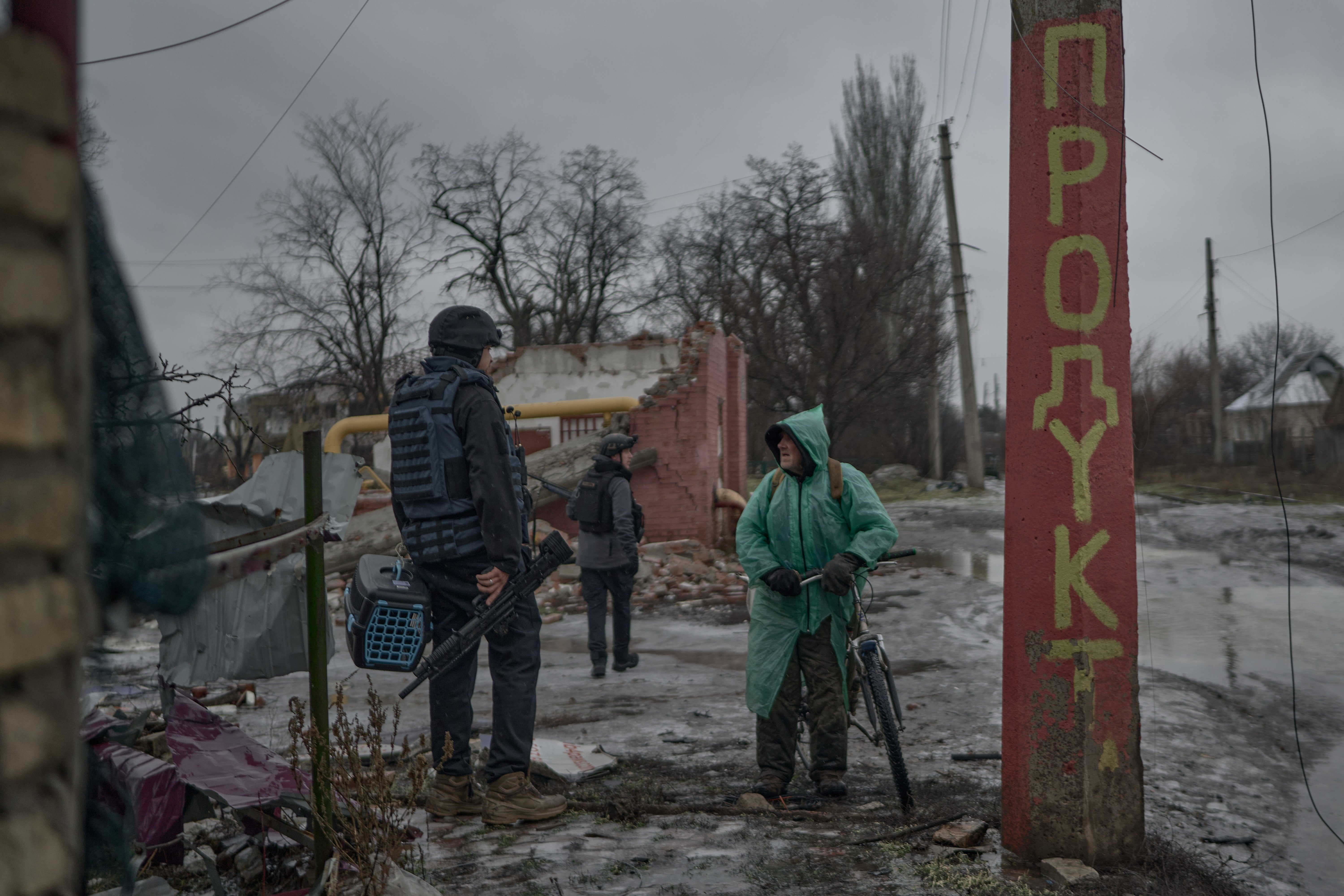
The PRESS marker has undergone such a shift during the war, that, again, in Kherson, journalists working in the “kill-zone” have abandoned PRESS labels completely, understanding that what was once a safeguard is now a target for drone operators. Oleksandr Kornyakov, a local journalist, shared his harrowing experience of drones altering their flight paths to target him and his colleagues with visible press markings on their cameras or body armor.
Zabrisky believes the stark challenges of ensuring journalists' safety as they cover the frontline in Ukraine today is neglected: “I think it’s very relevant. It’s not being discussed enough, it needs to be addressed,” she says.
As access tightens, journalists risk everything to report from Ukraine’s kill zone
The influx of local and foreign journalists into the kill zone continues unabated.
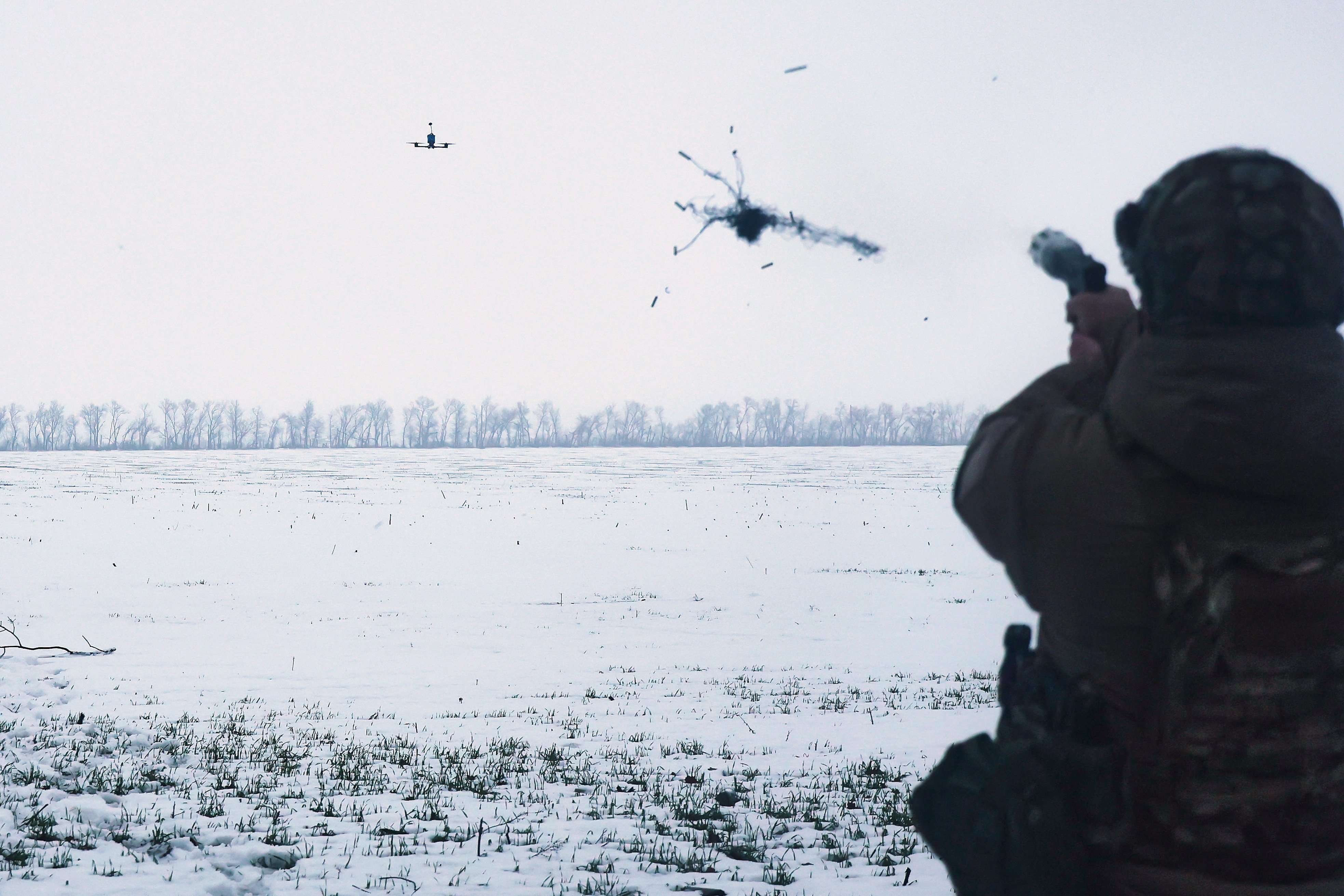
Oleg Petrasiuk, a photojournalist who joined the Armed Forces of Ukraine in early 2024 as a press officer with the 24th Separate Mechanized Brigade, has become known for escorting journalists and shooting down FPV drones over Kostiantynivka with remarkable precision.
“Every time I go to the front line, whether it’s in Kostiantynivka or elsewhere, it’s at the request of journalists,” he says. “In fact, there are far more requests from journalists than we can physically handle.”
When asked whether the number of FPVs he saw each day in the city could be measured at, say, ten, he paused before answering: “No. Hundreds.”
As a journalist himself, Petrasiuk stresses the importance of the frontline reporter: “Why do we do this? Because it’s our job. As press officers, we are trying to get people in who can show the real picture of war.”
Very aware of the technical difficulties of shooting down a drone, which can zoom towards you at 200 km an hour (120 mph), Petrasiuk says, “It’s very hard.” Morally, he adheres to the belief that journalists should not carry weapons, even as a last resort, asserting that it’s the military’s responsibility.
While not all journalists have the luxury of traveling with press officers, he breaks it down matter-of-factly: “Imagine a journalist has firearms. He needs to be very well trained, trained in combat stress. It costs a lot to train an accurate marksman, and I don’t believe that it is possible to train someone to become a marksman when he is on the frontline only from time to time.”
Of utmost importance to Petrasiuk is the need for Ukraine to abide by the Geneva Conventions whether or not Russia does. “If our enemy refuses to follow these rules, does that give us the right to break them? It doesn’t give us an excuse to abandon those rules,” he says. For Petrasiuk, awareness of danger comes with the acceptance that you may be a target; he says that: “The war became more dangerous, more difficult, more complicated. You can only accept this and then decide to take the risk.
Journalists are losing access to the front
While some, like Petrasiuk, still bravely escort journalists into the kill zone, others, such as Elisabeth Pierson, a correspondent for Le Figaro, underscore the growing stranglehold on accessibility, as reporters are increasingly locked out of the most perilous, yet vital, frontlines.
On one of her first assignments to the east of Ukraine in September 2025, Pierson remembers seeing anti-drone nets being raised all over. Travelling with the photographer Albert Lores, she recalls, “he was driving extremely fast,” —standard protocol for evading FPVs.
As she sees it, it’s “absolutely certain” that access to the frontlines has become markedly more difficult. Retelling certain interactions, when Pierson pushed for further access, it went something like this: “Now we keep getting doors shut on us. I have been clearly told that no, we don’t take journalists to positions anymore. It’s a hard no. They want to take us to the rear, of the rear, of the rear.”
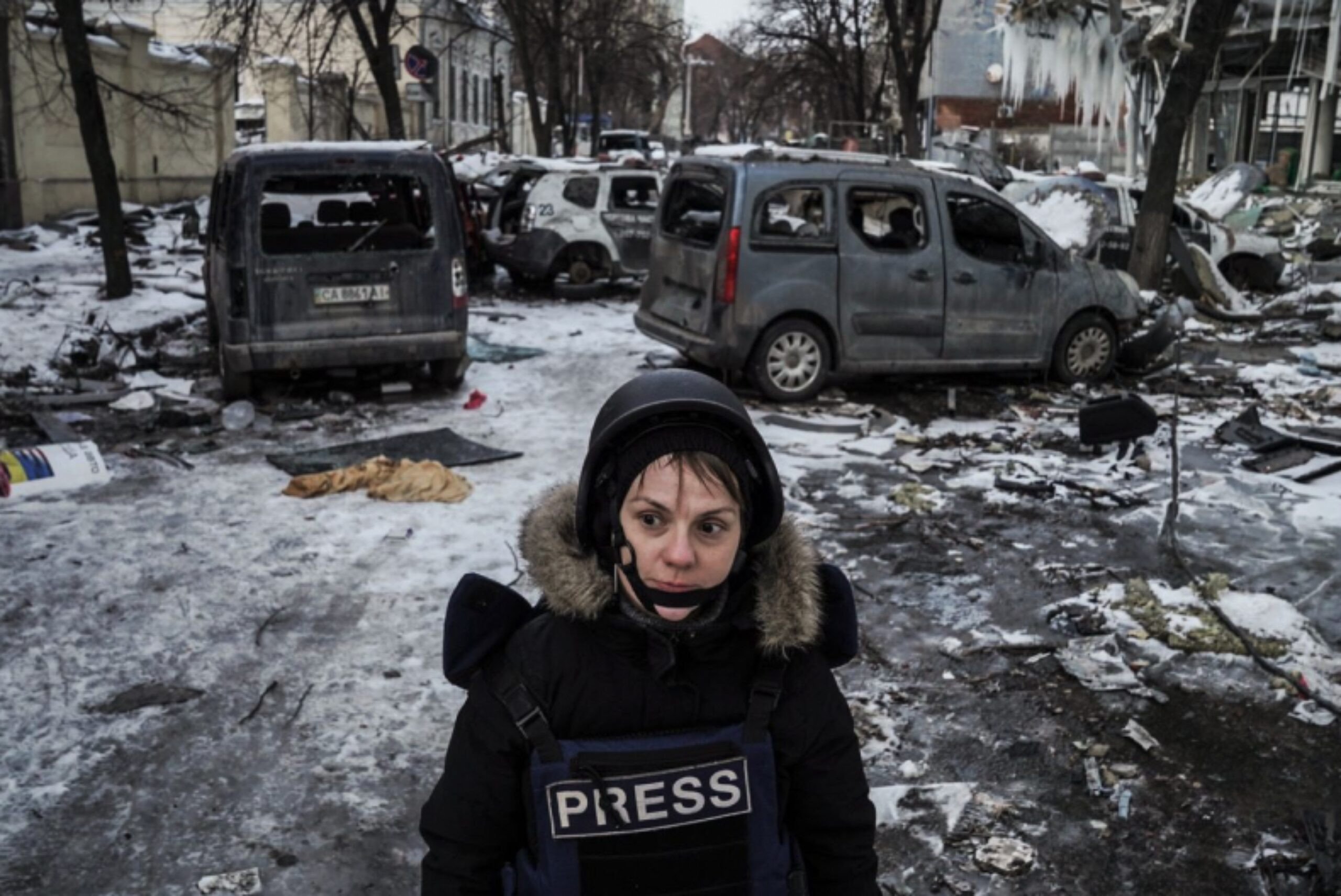
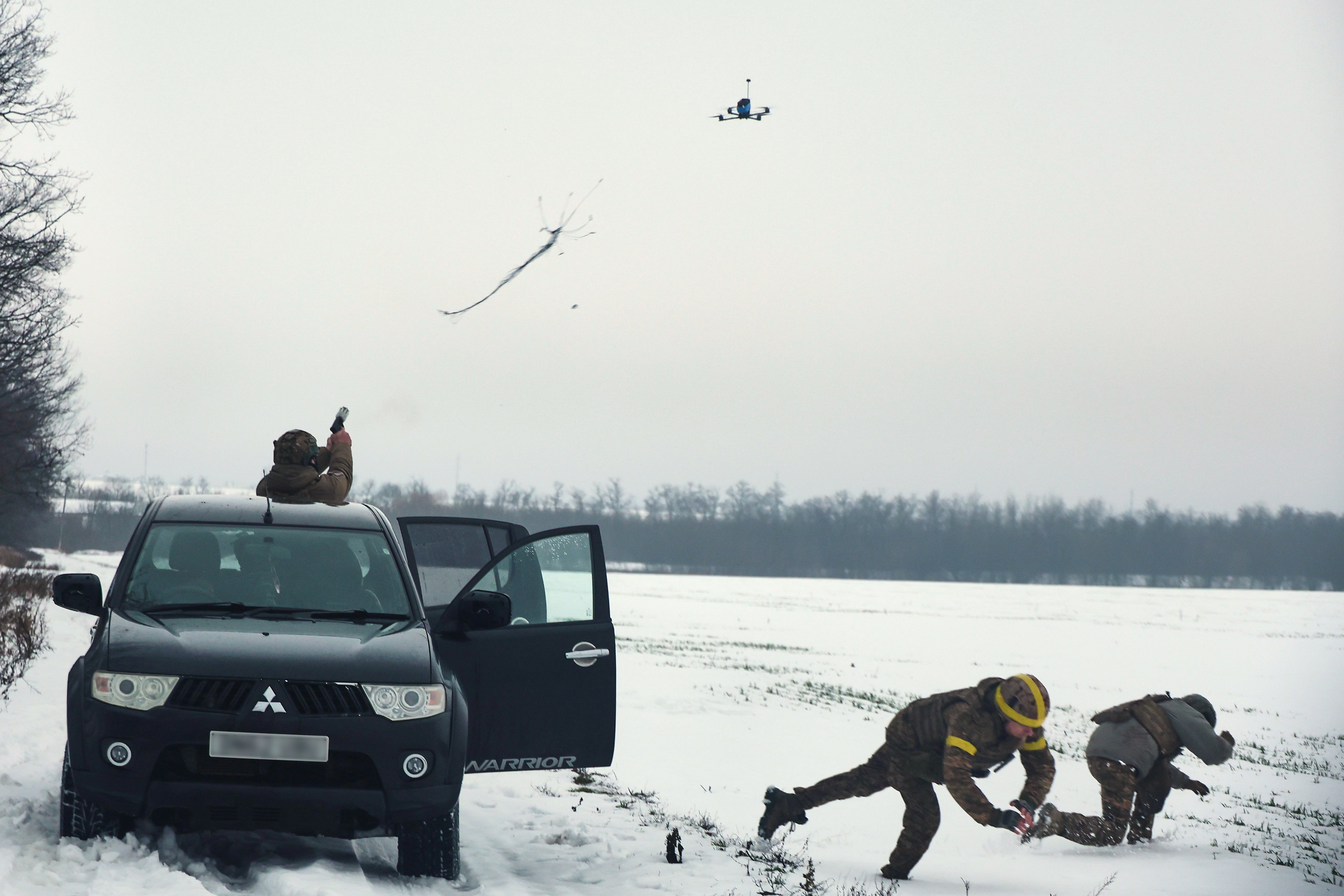
As Malzahn and Terletskyi sheltered in the brush on the side of the road, some 7 km from the first Russian positions, the commander they were traveling with started shooting at the drone. He missed. As the three men watched the car they had been driving in explode, Malzahn was holding a net gun: a contraption that captures drones by entangling them. They serve as defensive weapons, neutralizing threats without the fuss of real damage.
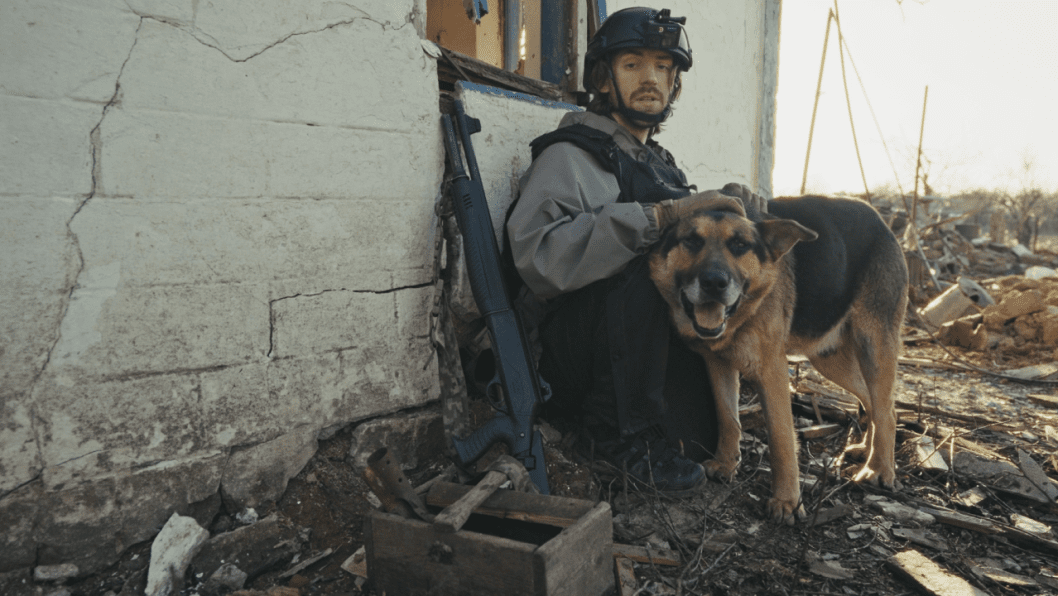
The gun can halt a drone at some 30 meters, but really it has become clear that the most effective weapon against FPVs when electronic jamming fails are 12-gauge pump-action shotguns loaded with buckshot, reliable only at ranges of roughly 50 to 60 meters (55–65 yards). Since they first appeared on the frontlines in early 2025, they are now ubiquitous.
In a later conversation, Malzahn puts it like this: “It’s definitely never been as easy to die so far away from the enemy. Here, you can get killed in a place where no Russian ever was.”
A frontline reporter for ten years, working consistently in Ukraine since March 2022, Malzahn defines drones as “topic number one,” adding that the subject has “started to overtake everything, now almost everything is drones.”
Though he categorizes the idea of journalists carrying weapons as “undesirable,” Malzahn is well placed to acknowledge that war has changed.
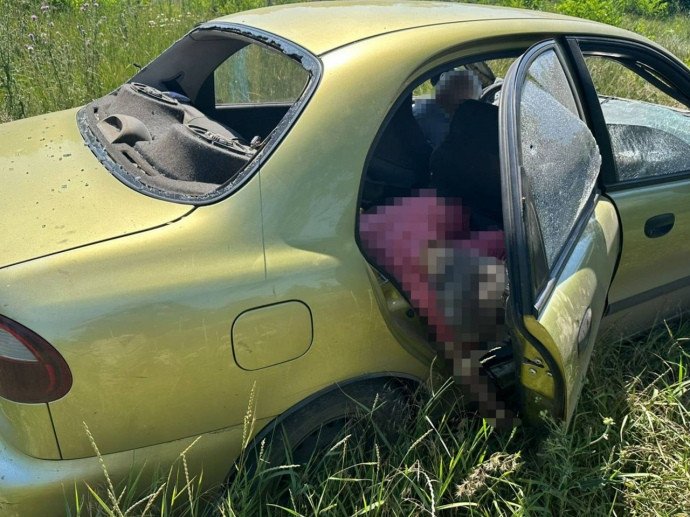
When he covered asymmetrical conflicts such as Afghanistan or Syria, the lines were often blurred between soldiers and civilians, on top of that, IED’s and kidnappings were the major dangers, he explains.
In such situations, “having some sort of weapon wouldn’t have helped you anyways, right?” he states.
Facing a militia while armed could easily escalate into violence, he said, something no journalist should allow to happen. But drones are a separate issue. “They’re tricky.”
A drone is a machine operated by a human watching a live stream, enabling surgically precise hits. “Considering the fact that if I get hit, it’s my life, but if I hit the drone, it’s only a machine, why in the world would I just stand there and let myself get killed for some kind of principle made before the invention of flying killer machines?” says Malzahn, continuing: “I say fuck it. I mean, it’s your life.”
Discuss this article:




-c439b7bd9030ecf9d5a4287dc361ba31.jpg "Photo of Katherina Popilnichenko")