- Category
- War in Ukraine
Why Russia’s New Jet-Powered Drones Are Harder to Stop
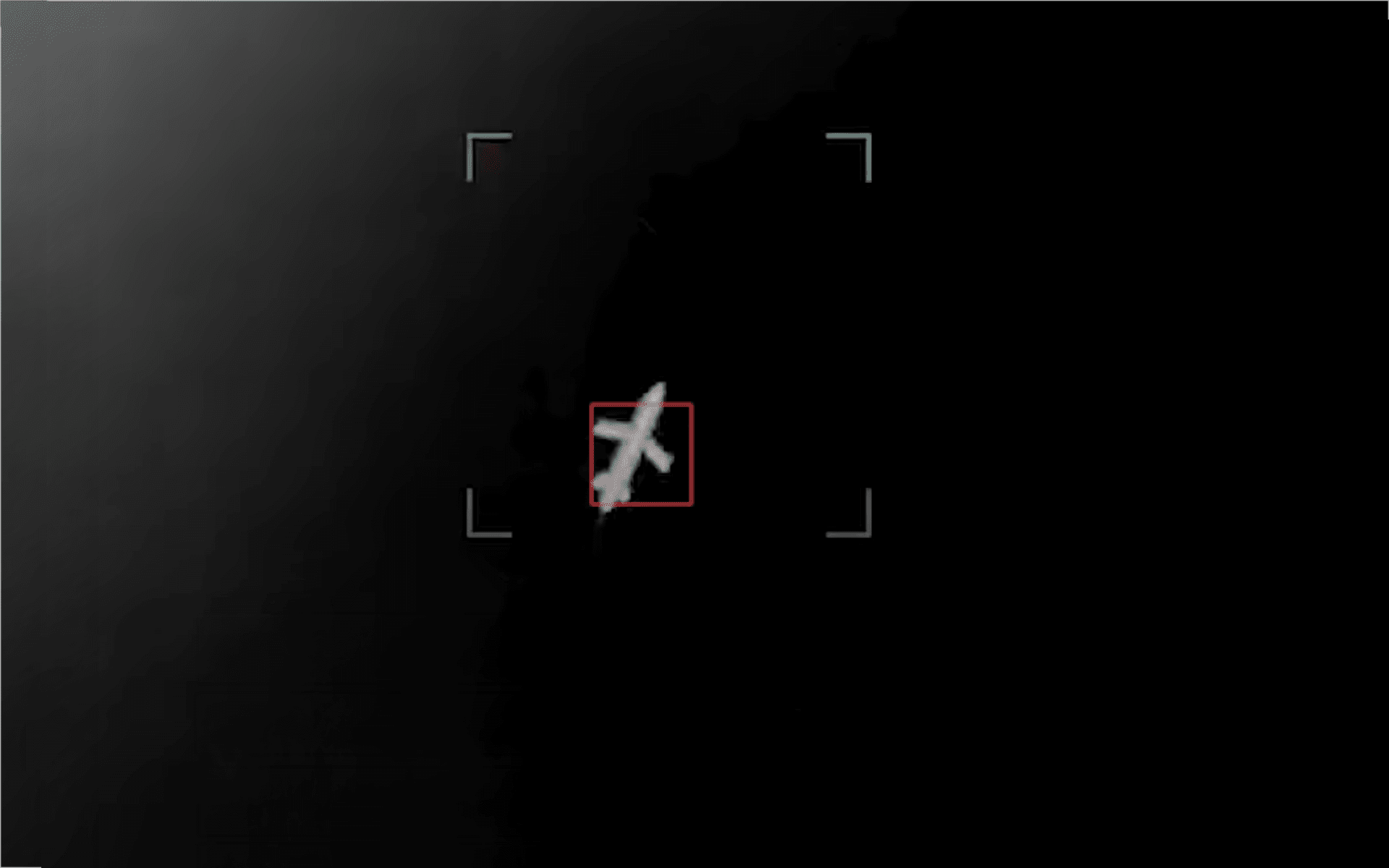
Russia’s Shahed-type drones used to give Ukrainians more time to react. Its newest jet-powered weapons can close that window dramatically, with some reaching speeds of over 500 km/h, making them harder to intercept. Russia is now producing them in massive quantities.
 Prefer U24 Media on Google
- Authors

-605be766de04ba3d21b67fb76a76786a.jpg "Joseph Place")
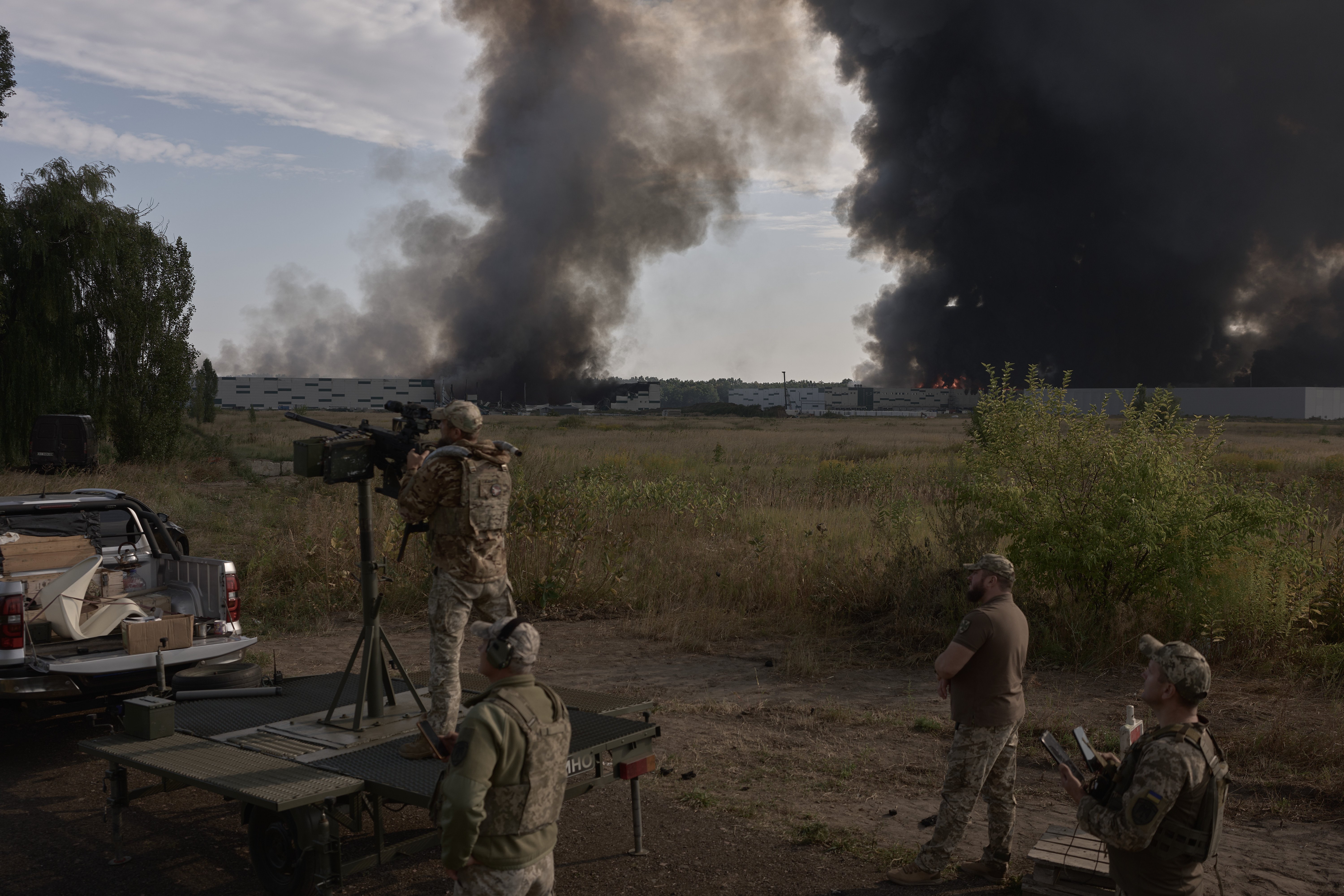
Faster, more deadly, and harder to shoot down, these jet-powered Russian drones have been raining down on Ukrainian cities in greater numbers. As a result, explosions occur moments after an air alert is declared, making life more dangerous for those in Ukraine. In August 2026, Russia launched around 2,800 jet-powered drones, compared to roughly 350 in June. We explore what makes them so much more dangerous and how Ukraine is reacting to this threat.
What is a jet-powered Shahed-type drone?
The name says it all. The typical Shahed-type drone—such as the first two Russian-made Geran models based on the original Iranian Shahed drones—uses a propeller and a fuel engine. These newer drones have jet engines, giving much greater speed, as well as a reinforced structure to withstand the increased weight.
The difference in speed is immense. The typical Shahed cruises at 180 km/h, whereas these jet-powered Russian UAVs can travel at 400–1000 km/h, depending on the variant. As a result, the interception rate is lower for this type of drone. Furthermore, their entire assembly and guidance systems are far more complex. These jet-powered drones have infrared thermal cameras, AI-assisted guidance, anti-jamming antennas, and mesh-network radio modems to enhance their operational capabilities and evade interception.
Iran designed the jet-powered Shahed 238, and Russia has developed its own models as well, although the initial differences were minimal. The Geran 3 was the first main variant of the Shahed-type drone to be jet-engine-powered, with a Chinese Telefly JT80 turbojet engine, a flight speed of 300 to 370 km/h, and an operational range of up to 1,000 kilometers. Since then, Russia has made other similar and more deadly jet-powered drones. Russia is launching Geran-3s from bases near Ukraine, alongside other high-speed UAVs.
Why did Russia switch to jet-powered drones?
As Ukraine achieved interception rates of around 90% or higher against older Shahed-type drones, Russia began introducing faster jet-powered variants. Now, Russia can hit rear positions on the front and Ukrainian cities faster and with more deadly impact. The propeller-driven UAVs are still produced in huge quantities and used, usually in the border regions; however, Russia uses more and more jet-powered drones to strike deeper into Ukraine.
Geran-4, Geran-5, and Banderol: What do we know about Russia's new drones?
In addition to the initial Geran-3, there are three newer drones.
Geran-4 drone
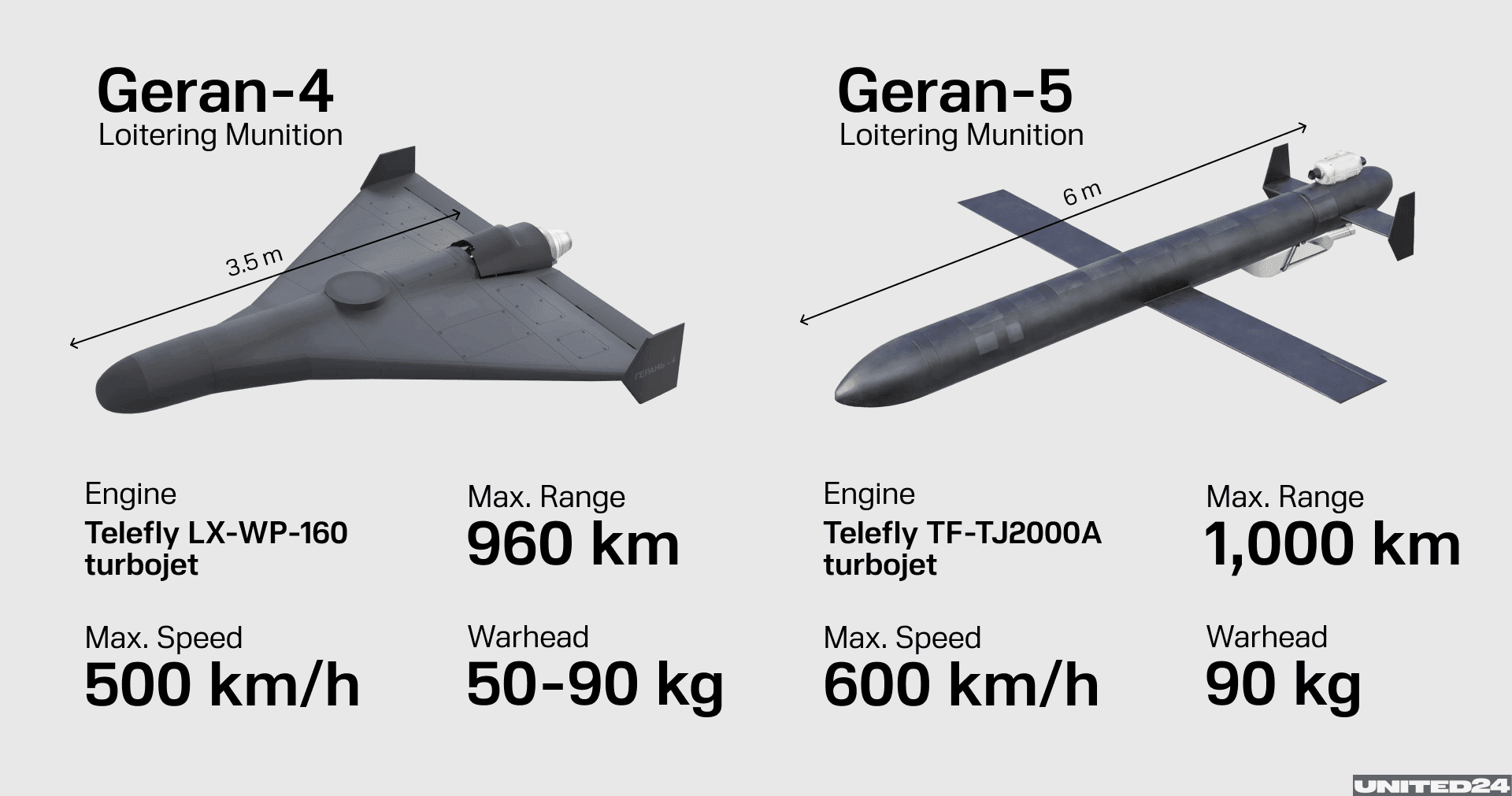
In 2026, Ukraine’s Defense Intelligence Directorate (HUR) revealed the existence of the Geran-4 drone, developed to reduce interception rates. It is not a completely different drone from the Geran-3; rather, it is a significant upgrade, leading to the cessation of production of the third model. The Geran-3 had a top speed of around 370 km/h and a few other modifications compared to the earlier propeller-powered Geran-2. The Geran-4, however, has a top speed of 500 km/h, and can operate at an altitude of 5,000 meters. While estimates originally gave a range of 500 km, a Geran-4 was observed travelling up to around 960 kilometers.
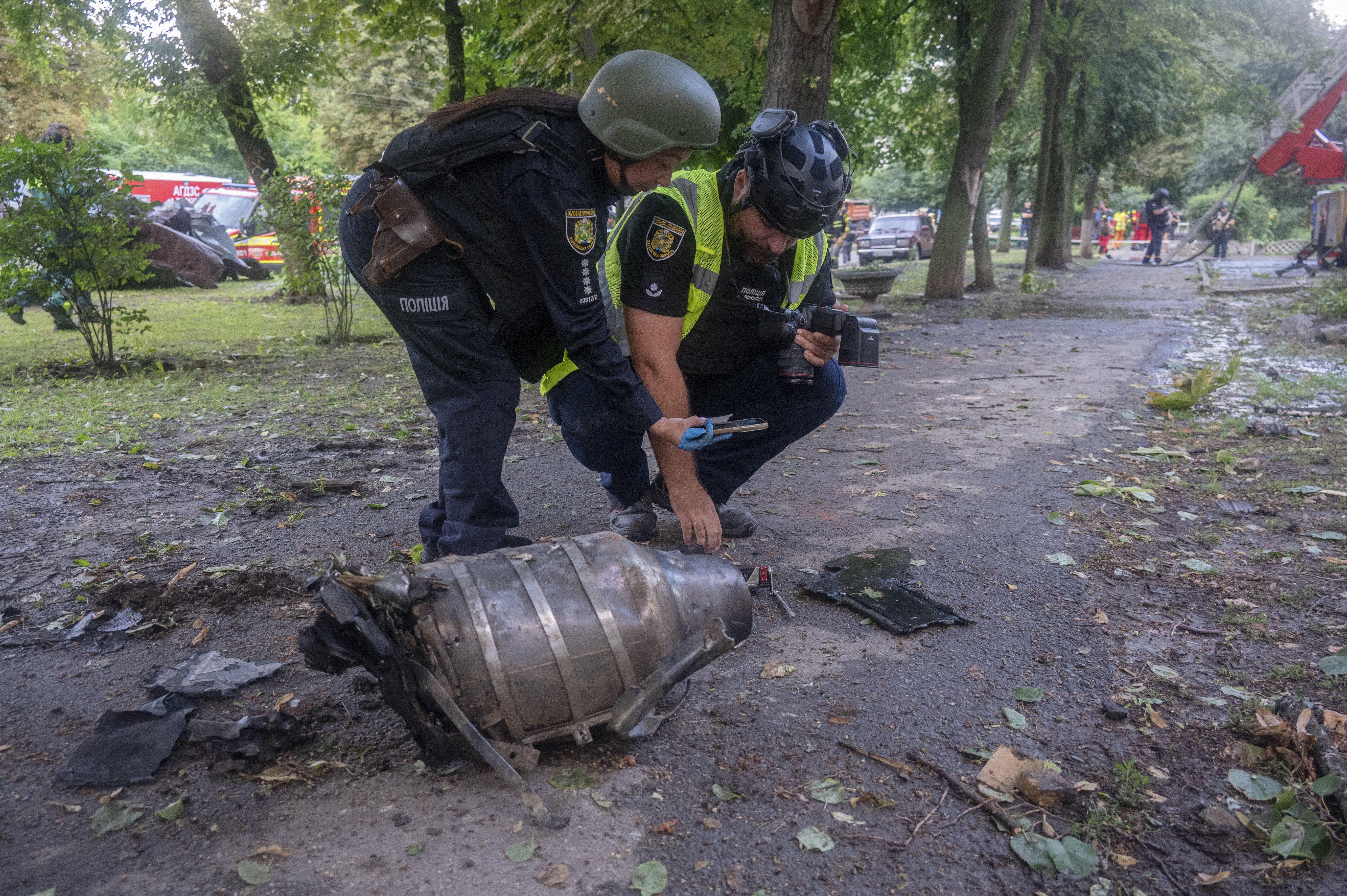
HUR identified two Chinese-made turbojet engines: the Telefly LX-WP-160, producing 160 kg of thrust, and the Telefly TF-TJ2000A, producing 200 kg of thrust. It can carry different warheads, such as a 50-kilogram high-explosive fragmentation or thermobaric payload, or a 90-kilogram thermobaric warhead. This drone has been used extensively against Kyiv, even striking the SBU headquarters in the city center.
Geran-5 drone
The Geran-5 is a greater threat and the latest variant. According to HUR, it has more in common with the Iranian Karrar drone and a distinctive appearance—looking similar to a cruise missile rather than the typical Shahed—and it also has a Chinese Telefly TF-TJ2000A engine with a greater boost than that of the Geran-3. It also relies not only on Chinese parts, but also on others from the USA and Germany.
It has a wingspan of up to 5.5 meters and a length of 6 meters. It is controlled via a 12-channel Comet satellite navigation system, a tracker based on a Raspberry Pi microcomputer, and 3G/4G modems. It has a reported range of up to 1000 km, can carry a 90kg warhead, and operates at a cruising speed of 280–330 km/h to 450–600 km/h. Russia produces around 3,000 Geran-5s and Geran-4s per month, according to HUR.
Banderol missile-drone
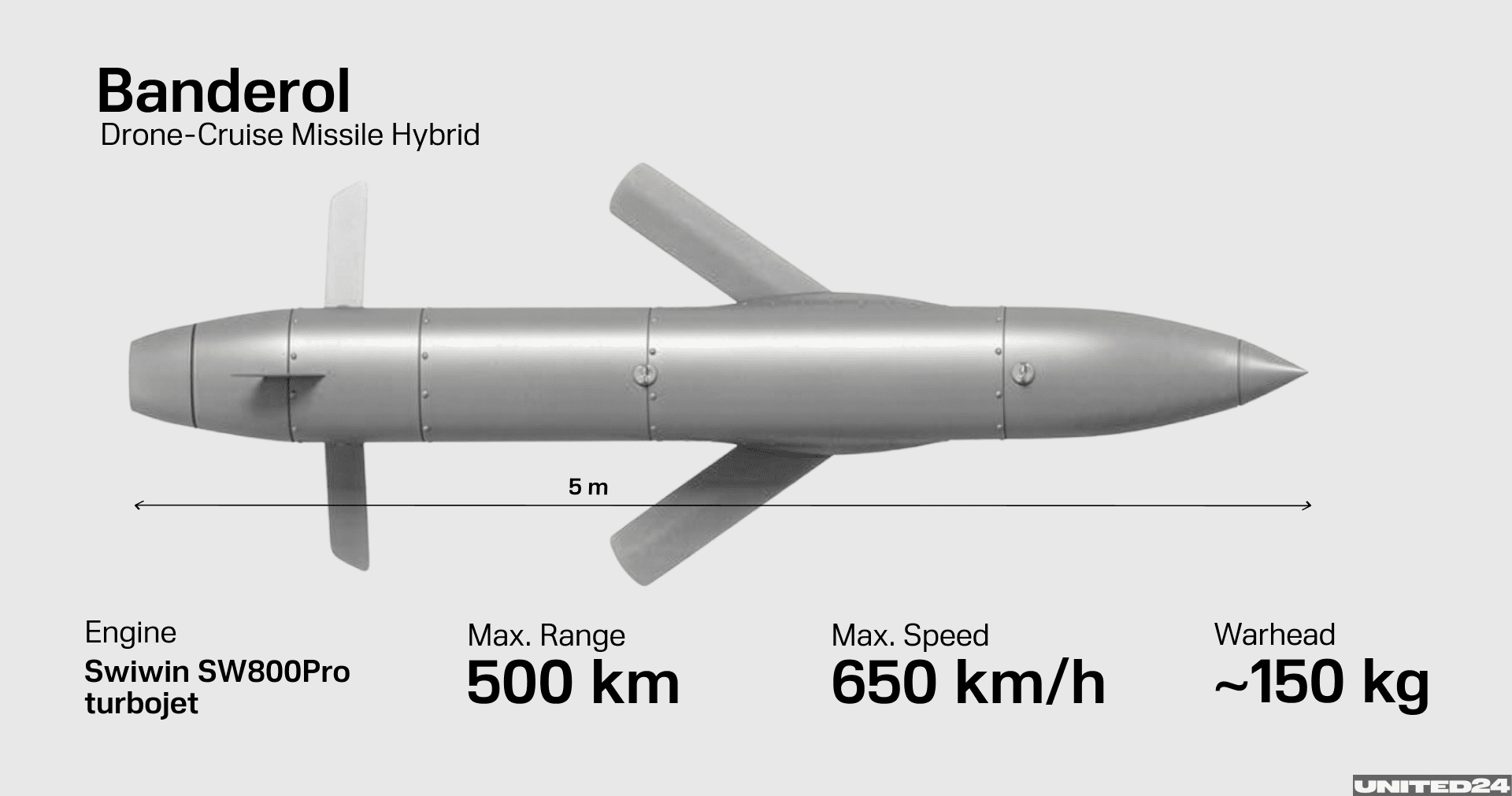
The S8000 Banderol is referred to by HUR as a missile-drone. It can be launched from Orion drones, from the ground, and Mi-28N helicopters. It features a Chinese-made SW800Pro-A95 turbojet engine produced by Swiwin, can strike within a range of up to 500 kilometers, and can reach a top speed of 650 kilometers per hour. Foreign parts from at least six nations have been found inside them, namely from the United States, Japan, China, South Korea, Switzerland, and Australia.
Russia has mostly fired Banderols in the south of Ukraine, routinely terrorizing Odesa. Banderols can turn sharply and, due to their high speed, are incredibly hard to detect and intercept in time.
Standard Shahed vs. jet-powered variants
Drone | Propulsion | Speed | Range | Warhead |
Standard Shahed-type (Shaheds, Geran 1 and 2) | Propeller | 180 km/h cruising | 2,500 km | 50–52 kg; newer variants up to 90 kg |
Geran-3 (Analogue of the Shahed-238) | Jet | 300–370 km/h | Up to 1,000 km | 50–90 kg |
Geran-4 | Jet | Up to 500 km/h | Up to 960 km | 50–90 kg |
Geran-5 | Jet | Up to 600 km/h | Up to 1,000 km | 90 kg |
S8000 Banderol | Jet | Up to 650 km/h | Up to 500 km | 150 kg |
Essentially, the Geran-4, Geran-5, and Banderol are significantly faster and carry greater payloads, meaning they can inflict greater damage due to higher impact speeds. A propeller-powered Shahed or Geran can destroy an apartment and damage surrounding buildings. A Banderol can destroy a whole house or multiple apartments.
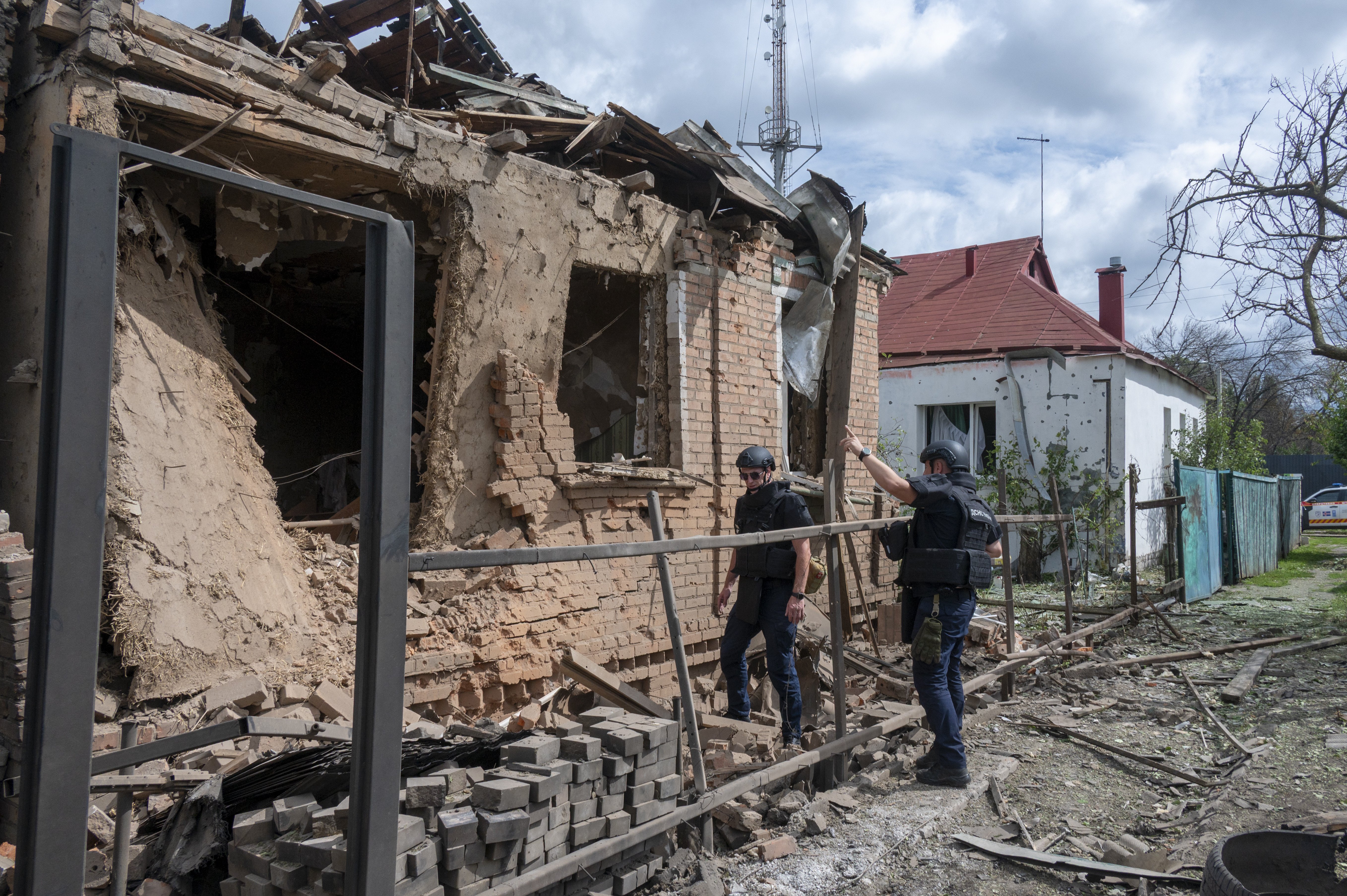
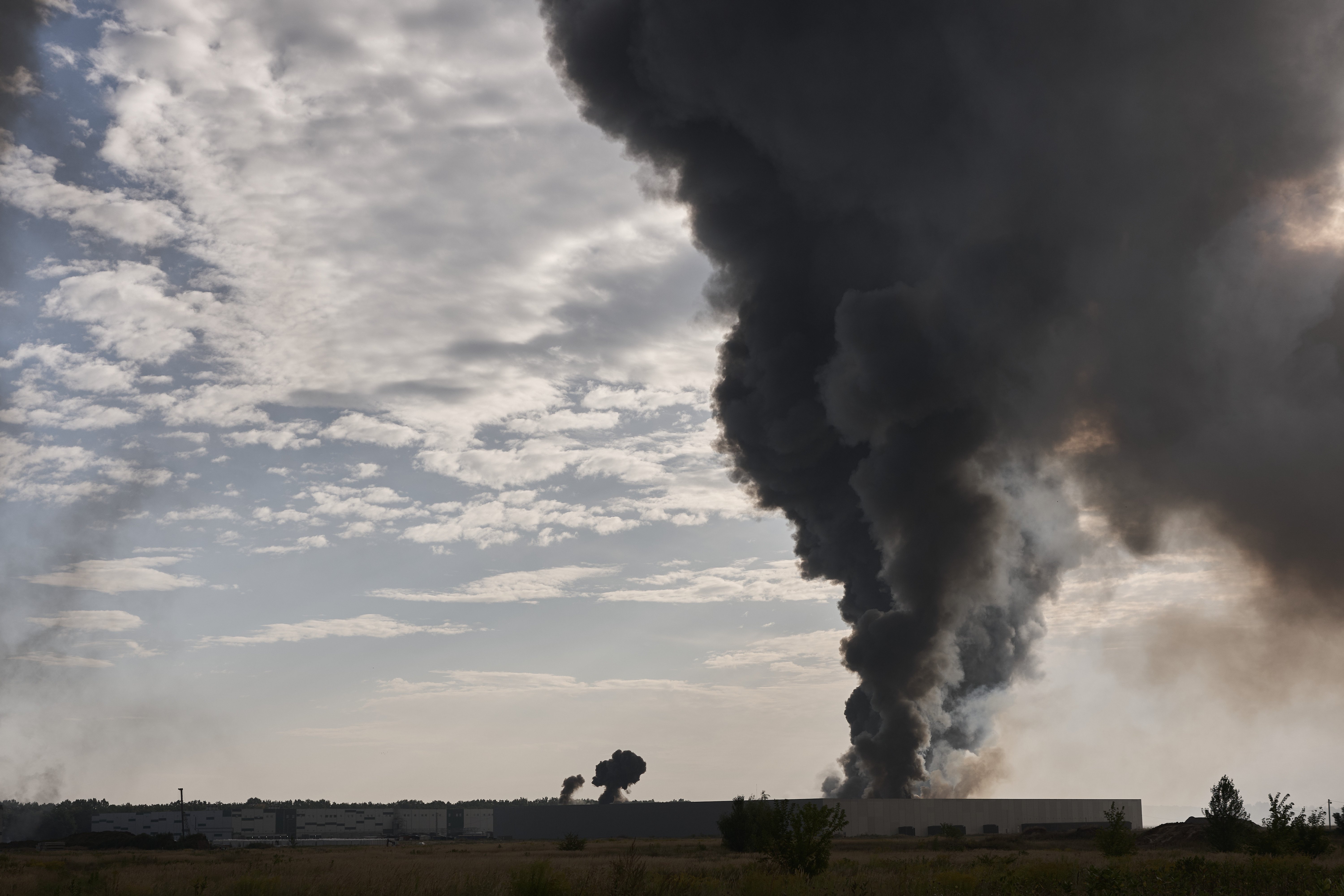
For example, a Banderol drone destroyed the roof of a private home and burned neighboring properties in Odesa, and a Geran-5 drone struck an apartment block in Chernihiv, damaging multiple homes and injuring at least 20 people.
Interception capabilities: existing and under development
These jet-powered drones have posed a massive difficulty for Ukrainian air defense. Only around 60% of these drones are intercepted, according to Yurii Ihnat, a colonel in Ukraine’s Air Force. The typical interception approaches used on the earlier drone models are not suited to high-speed drones. Many different interceptors are in development, and four are being tested. There have already been cases of these UAVs being intercepted, and Zelenskyy announced that there had been a breakthrough with a Ukrainian-made interceptor taking down such a drone.
Ukraine has been developing solutions with private partners under a government initiative to restore a higher drone interception rate. The LITAVR+ interceptor drone, designed to hit jet-powered targets, was unveiled this year and has undergone testing. The drone-manufacturing NGO Wild Hornets is developing the Sting 2.0 to target high-speed, jet-powered UAVs. Brave1 reported that one of their technologies was used to hit Banderol drones at a fraction of the cost of the missile itself. Nonetheless, further cooperation between the private and public sectors and foreign partners is needed to reduce the risk to Ukrainian lives and create a safer sky.
Discuss this article:
In a Nutshell


-80134f2dc17b4a887d01513a1c7bc929.png "Illustration of Russian military infrastructure targeted by Ukrainian strikes in temporarily occupied eastern Ukraine. (Source: General Staff of the Armed Forces of Ukraine)")