- Category
- Anti-Fake
Putin’s Party Won a Record Majority in Russia. Here’s How the Kremlin Got It
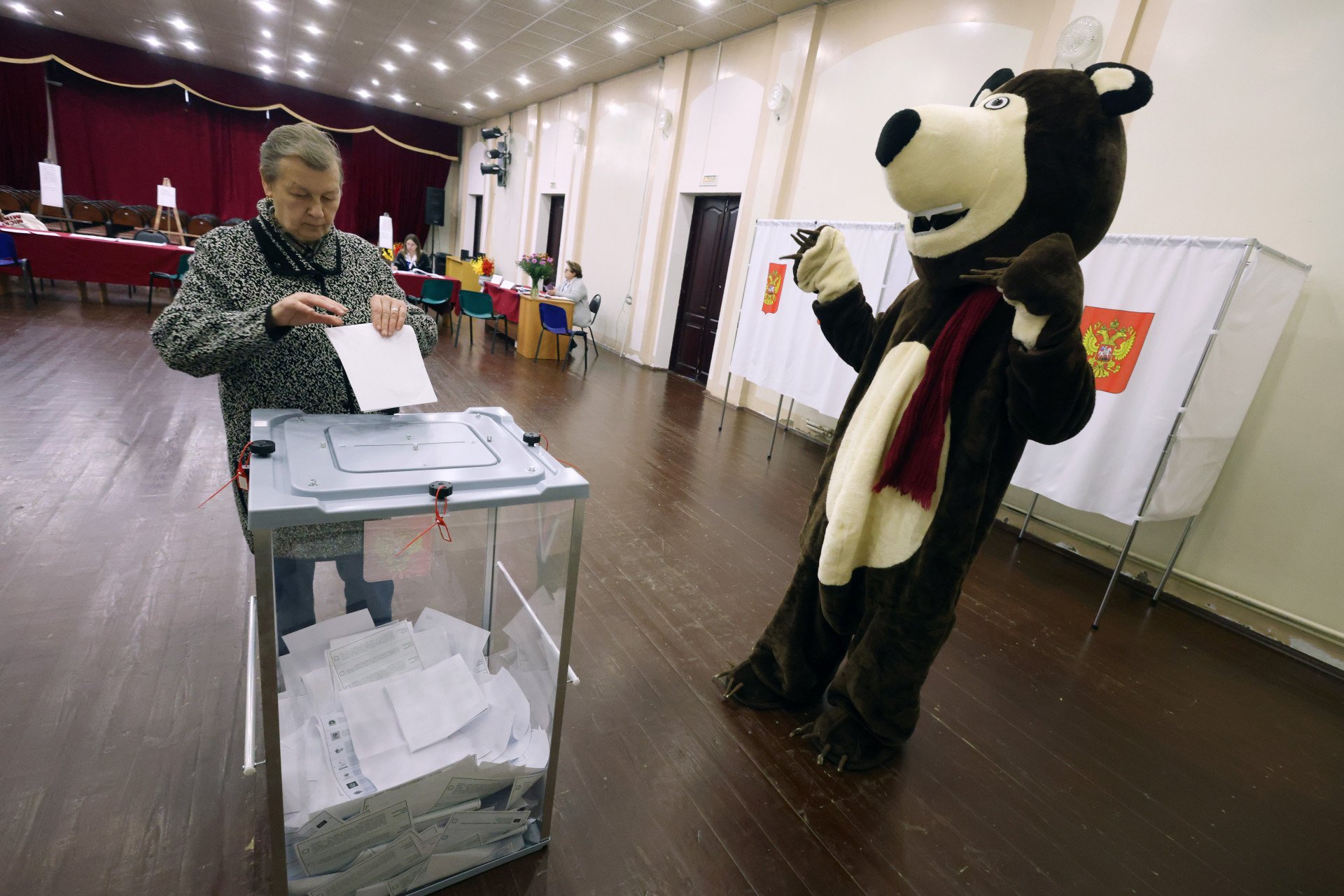
Russia has voted in its Duma election, and the result is nearly 58% for Putin’s ruling United Russia party. How did the Kremlin get those numbers? Pressure, statistical anomalies, and illegal voting.
 Prefer U24 Media on Google
- Authors


Nearly 58% for United Russia, the highest turnout in years, and a constitutional majority in parliament. That is how the Russian authorities are presenting the results of the first State Duma elections since the start of the full-scale invasion of Ukraine. But behind the impressive numbers are pressure on public-sector employees to vote, statistical anomalies, obstacles to independent election monitoring, and voting organized by Russia in occupied Ukrainian territories in violation of international law.
Russia’s 2026 election results
Voting in Russia’s State Duma elections took place over three days, from September 18 to 20.
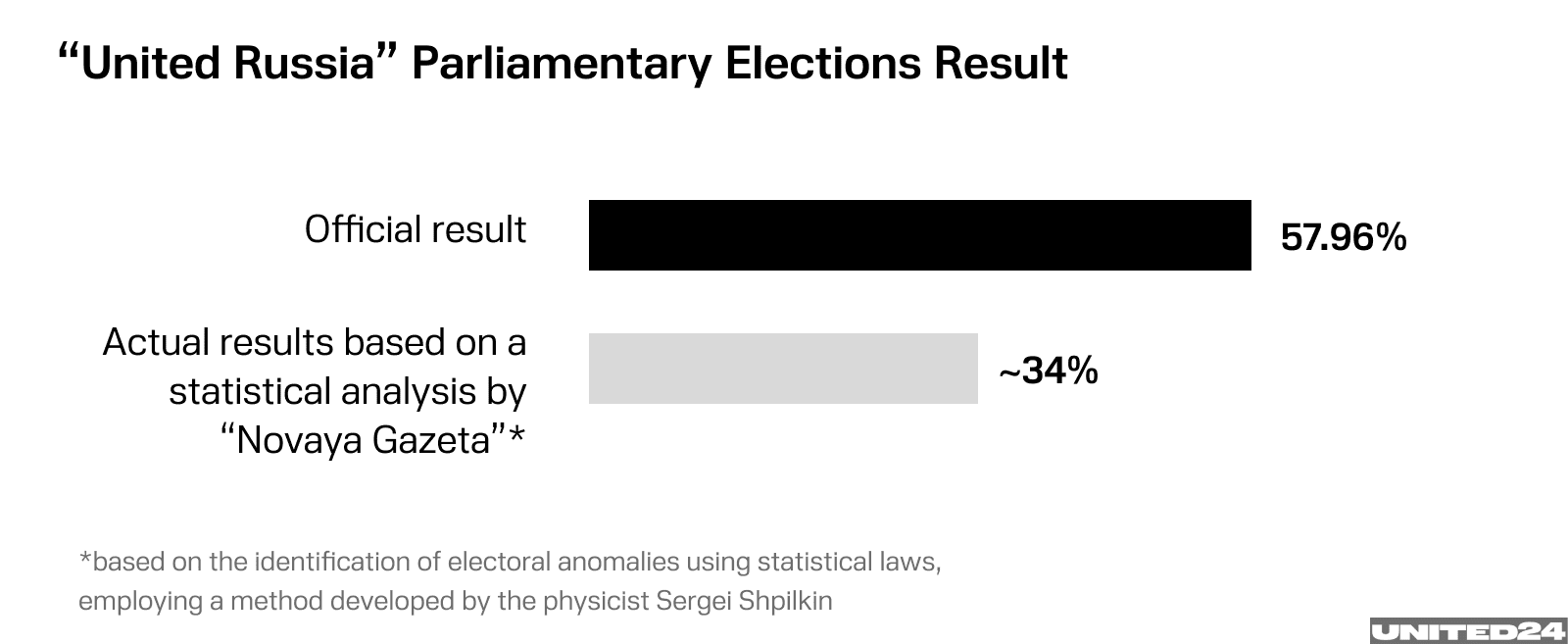
According to preliminary figures released by Russia’s Central Election Commission, with nearly 98% of precinct protocols processed, Vladimir Putin’s United Russia had received 57.96% of the party-list vote. The Communist Party of the Russian Federation (CPRF) had 13.67%, the Liberal Democratic Party of Russia (LDPR) 8.96%, New People 7.91%, and A Just Russia 5.1%.
Under the preliminary distribution of seats, United Russia is expected to receive about 355 of the State Duma’s 450 seats—the largest parliamentary faction in the party’s history and well above the two-thirds threshold required for a constitutional majority. In 2021, the party received 49.8% of the party-list vote.
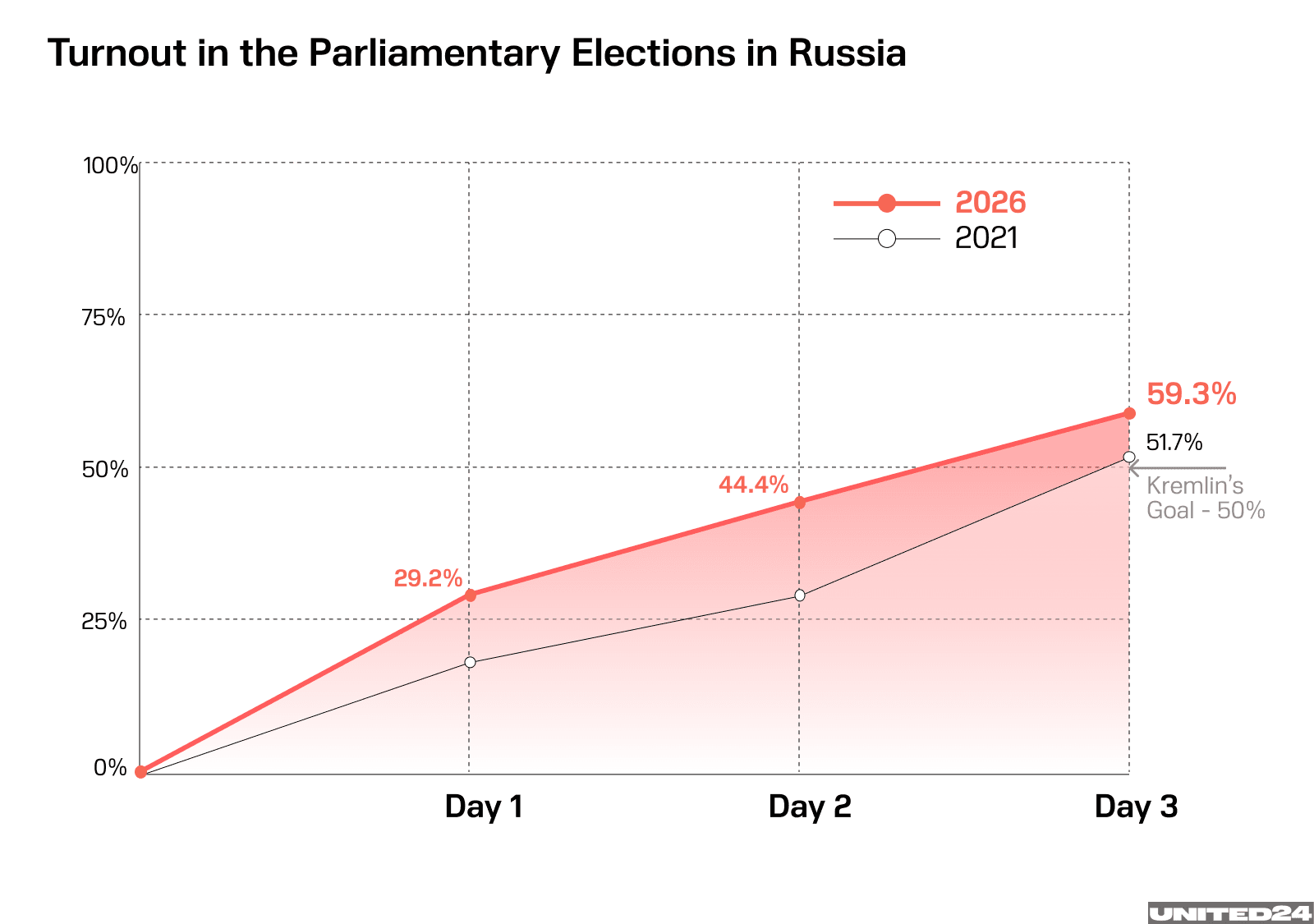
Official turnout exceeded 59%, the highest figure in a State Duma election since 2011. Ella Pamfilova, head of Russia’s Central Election Commission, called the vote “clean,” saying authorities had recorded only two cases of physical ballot stuffing nationwide.
There is just one problem: independent observers, journalists, and election analysts describe a very different picture.
How Russia boosted election turnout
Even before the election, sources reported that the Kremlin had set a target: regions were expected to deliver 50% turnout. The initial target had been even higher, at around 55%, but it was lowered over the summer amid declining approval ratings for the authorities, rising prices, and war fatigue.
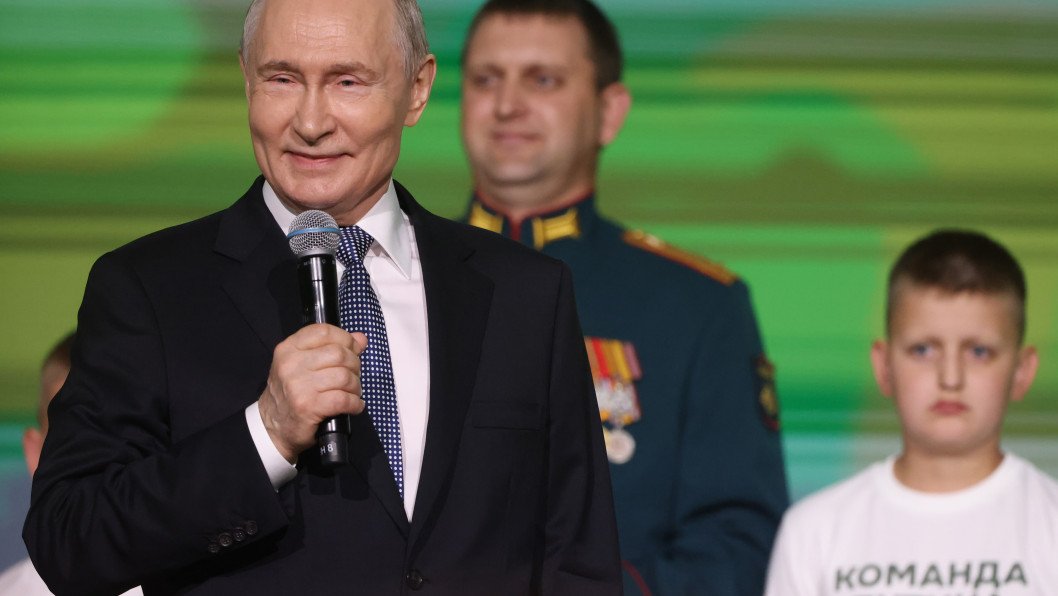
Still, the system went to work.
Official turnout had already reached 44.38% after the first two days, according to Russian outlet Vedomosti, citing Central Election Commission data. The CEC reported turnout of 29.19% by the end of Friday, the first day of voting and a workday. By comparison, first-day turnout in the 2021 parliamentary elections was just 18.39%.
There were reports of so-called corporate mobilization: managers at state-owned companies, public institutions, and other organizations dependent on the authorities were tasked with ensuring that employees took part in the election. Small groups of employees were assigned “mobilizers” or “brigade leaders” who monitored whether their subordinates had voted.
At the same time, remote electronic voting was used in 33 Russian regions, including Moscow. Those regions are home to a total of about 48.4 million voters.
Remote electronic voting has long been one of the least transparent parts of Russia’s electoral system, with independent verification of electronic results severely constrained.
There was also no independent OSCE monitoring of the vote. Russia did not invite observers from the organization, which said the decision was inconsistent with Moscow’s commitments as an OSCE participating state and deprived voters of an independent assessment of the election.
There were problems with paper voting as well. According to Election Atlas, a Russian election-analysis project, numerous reports of possible violations and incidents had already been submitted on the first day, with obstruction of election observers among the main categories of complaints. In Moscow on September 20, some polling stations stopped issuing paper ballots for several hours because of a reported electronic system failure. Voters were instead encouraged to use electronic voting.
How much support did United Russia really have?
Nearly 58% is the official result. Statistical analysis produces roughly 34%.
Novaya Gazeta Europe analyzed precinct-level results using a method developed by election analyst Sergei Shpilkin. The method looks for statistical correlations between abnormally high turnout and disproportionately strong results for a particular party.
According to the outlet’s calculations, the core group of polling stations without such statistical anomalies showed roughly 34% support for the pro-government United Russia party. Two other election analysts agreed with that estimate.
Moscow was excluded from the analysis because electronic voting was so widespread that its results could not be meaningfully compared with paper-ballot precincts. Several other regions were also excluded or treated separately where researchers suspected different forms of manipulation.
This does not mean the method can identify which specific ballots were falsified—statistical analysis has its limitations. But the gap between roughly 34% at statistically “normal” polling stations and the official result of nearly 58% points to the scale of the anomalies.
The contrast with the official results is even more striking outside Russia. The Vote Abroad project conducted an exit poll of nearly 15,700 voters at 27 polling stations in 22 countries. New People, which presents itself as a moderate alternative to the ruling party, received 43%, the Communists 18.3%, and United Russia just 5.5%.
Another independent exit poll, conducted by the Vesna movement and the Progress project at 18 polling stations in 17 countries, produced a similar picture: New People received 47.3%, the CPRF 19.2%, and United Russia 2.8%. By comparison, Russia’s Central Election Commission reported nearly 58% for the ruling party inside Russia.
Voting abroad cannot be directly extrapolated to Russia as a whole: Russian emigrants include a higher proportion of people who oppose the war and the current government. But the results illustrate just how different the outcome can be in places where Russia’s administrative machinery has far fewer opportunities to control voter participation.
Especially in comparison with official results in some Russian regions.
Chechnya produced some of the most extreme official numbers. In the separate election for the head of the republic, held alongside the Duma vote, United Russia candidate Ramzan Kadyrov was officially re-elected with 99.85% of the vote, while turnout was reported at 95.19%. His two opponents received just 0.05% each.
The record official turnout has raised doubts. Russia’s Central Election Commission said more than 59% of voters took part—the highest level in more than a decade.
Mathematician Boris Ovchinnikov, however, analyzed the first 20,000 published precinct protocols and estimated actual turnout at less than 40%. Analyst Pyotr Zhizhin reached a similar conclusion. Commenting on those calculations, election-monitoring expert Roman Udot said the scale of the anomalies indicated that the authorities had effectively exhausted their administrative resources and that the artificial inflation of the results may have amounted to roughly 20 percentage points.
По оценке Бориса Овчинникова:
— Roman Udot (@romanik_) September 21, 2026
Реальная явка меньше 40%. У ЕР около 37%
(https://t.co/jNQtyfQMXI)
Если 55% голосов ЕР сфальсифицирована, то:
Если принять явку за 40%, то, учитывая официальные данные Петра Жижина, у ЕР - 37% от принявших участие в голосовании.
(L - список. Явка =… pic.twitter.com/RBnXDVYCyg
How A Just Russia crossed the 5% threshold
A Just Russia, one of the Kremlin-aligned parties represented in the outgoing State Duma, was at risk of losing its party-list representation in parliament. To qualify for the distribution of party-list seats, a party needs at least 5% of the vote.
On the morning of September 21, with the Central Election Commission having processed more than 95% of precinct protocols, the party stood at 4.96%—below the threshold.
Then the situation changed.
According to reports, between 1:29 p.m. and 2:29 p.m., 67,330 votes were added to A Just Russia’s total on the Russian Central Election Commission’s website. In the batch of precinct protocols that appeared during that period, the party suddenly averaged 14.5%, while the CPRF received just 4.5% and New People 3.1%. As a result, A Just Russia’s share rose above the required 5%.
Election analyst Stanislav Andreychuk estimated the anomalous increase at roughly 60,000 votes and attributed it to administrative interference.
Russia’s “elections” in occupied Ukraine
Another part of Russia’s election results came from the territory of another country.
Russia included occupied Crimea in the vote, as well as parts of Ukraine’s Donetsk, Luhansk, Zaporizhzhia, and Kherson regions. Russian authorities claim that the four territories Moscow declared annexed in 2022 have more than 3.5 million voters.
In the Zaporizhzhia region, the identities of soldiers killed in action were allegedly used to fabricate ballots for the ruling United Russia party. Clerical staff reportedly delayed death registrations so the names remained active, allowing ballots to be cast in occupied Melitopol, Berdiansk, and Tokmak.
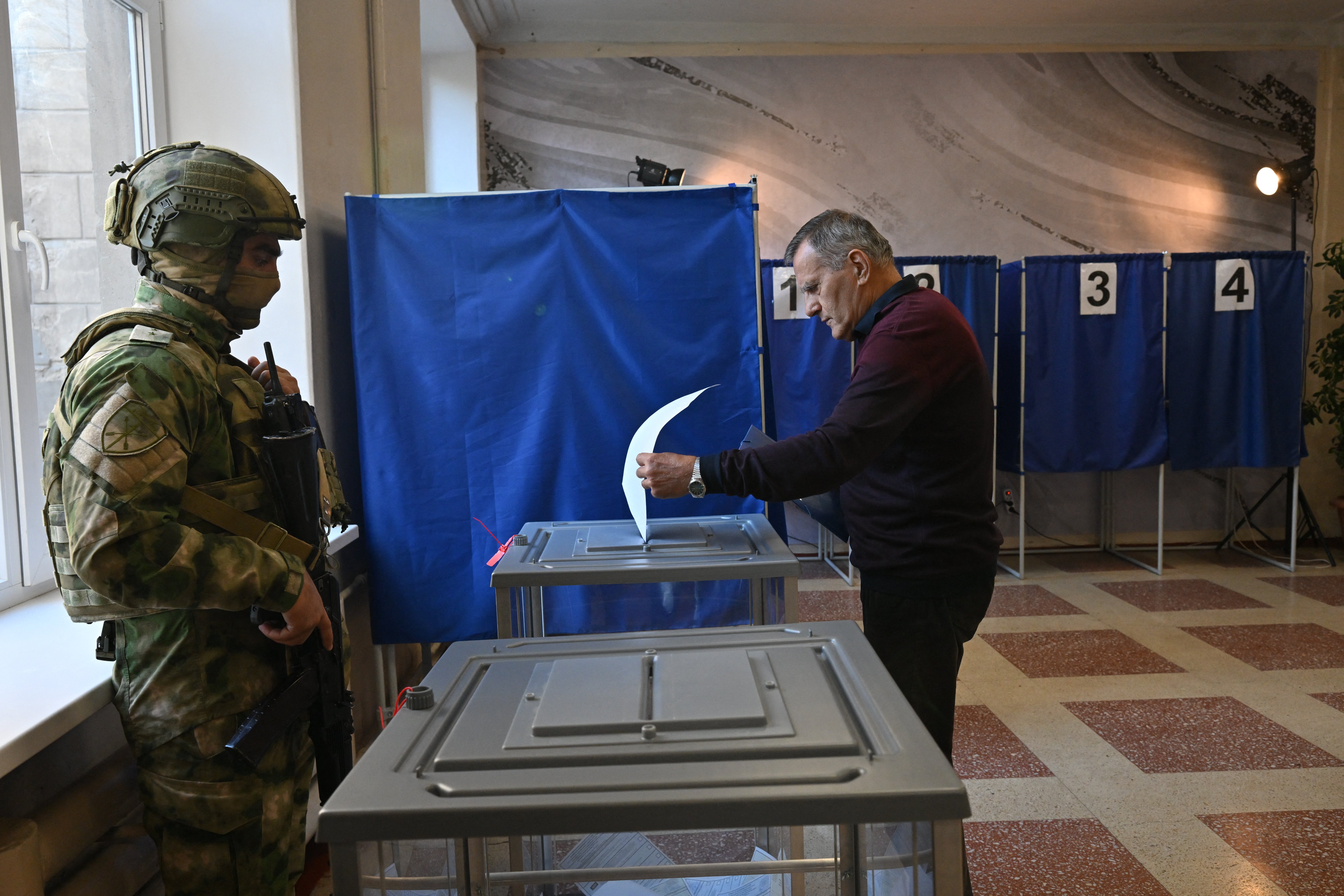
The Associated Press documented, among other things, a polling station in the occupied part of the Donetsk region where people cast ballots in the presence of an armed Russian serviceman. Ukrainian human rights advocates cited by the AP also reported that members of occupation election commissions went door to door accompanied by armed men, and that people who refused to vote were threatened with dismissal from their jobs and the loss of social benefits.
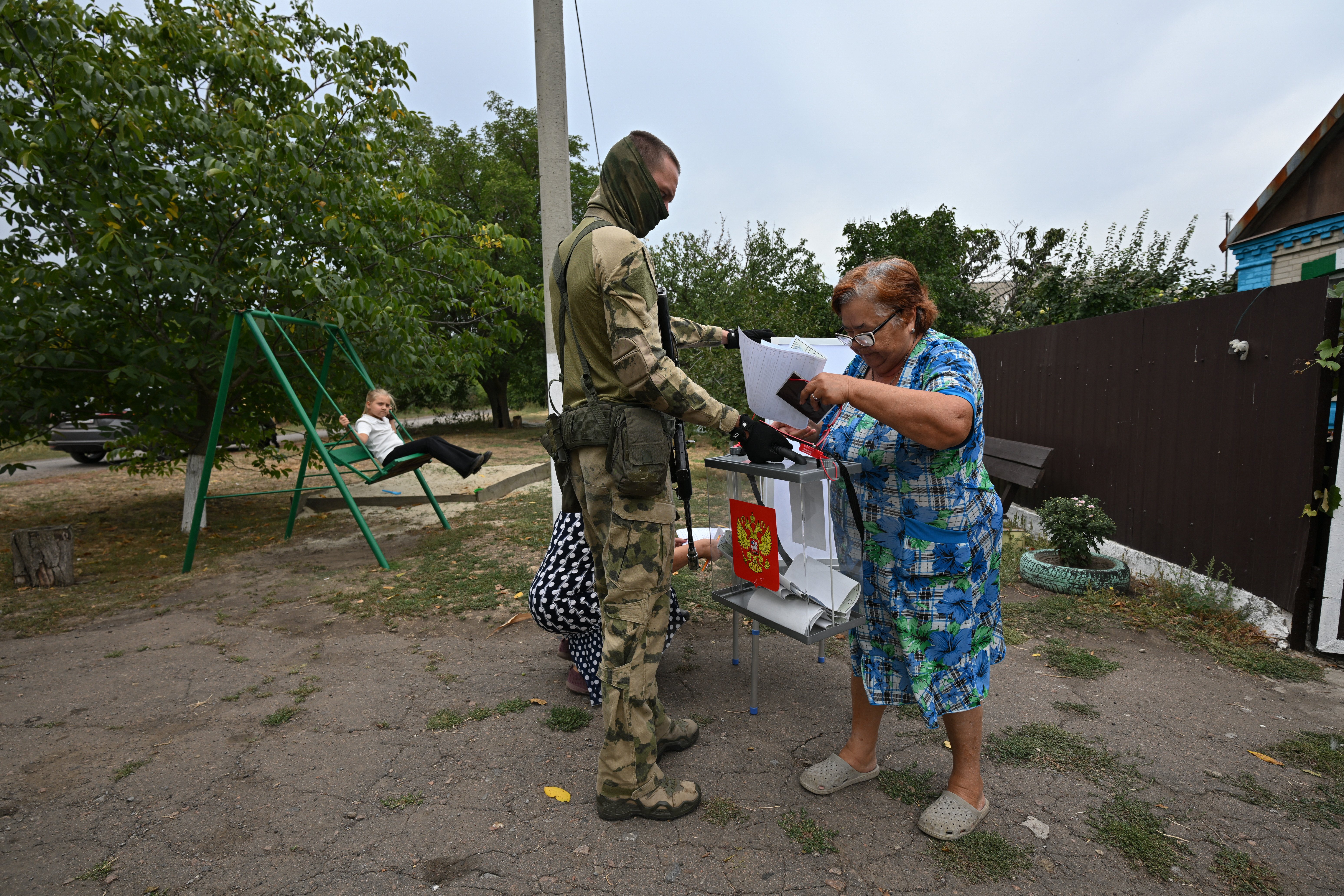
Independent observers have effectively no way to verify the actual turnout or results in these territories.
Ukraine called Russia’s organization of elections in the occupied territories illegal and said the results provide no legal basis for extending Russian jurisdiction over Ukrainian land.
The European Union likewise said that voting in Crimea and Sevastopol and in the occupied parts of the Donetsk, Luhansk, Zaporizhzhia, and Kherson regions violated international law, including the UN Charter, and that the EU would recognize neither the holding of these “elections” nor their results.
In other words, Russia included in the results of its own parliamentary elections votes cast on internationally recognized Ukrainian territory under the control of Russia’s occupation authorities.
How Russia restricted election competition
The manipulation did not begin on September 18.
Yabloko—the only registered Russian party running on an anti-war platform—was barred from the federal party list. Russia's Supreme Court removed it from the nationwide ballot in August after a legal challenge to its registration. The court’s stated grounds included alleged campaign-finance violations and intellectual-property/copyright violations. One of the disputed campaign materials was an image generated using ChatGPT.
Some of its candidates in single-member districts were able to remain on the ballot, but the party did not participate at the federal level. In its assessment of the election, the EU specifically cited Yabloko’s exclusion, the use of administrative and judicial tools against opponents of the war, repression of civil society, and restrictions on Russians’ access to independent information.
Russia’s 2026 parliamentary elections, then, were not simply a story about what happened to ballots over the course of three days.
They were an entire system.
Meaningful anti-war competition was restricted before polling stations even opened. Public institutions and state-dependent employers were used to mobilize turnout. A significant share of the voting took place electronically, in a format that severely limits independent external verification. Observers reported obstruction of their work and other violations. Statistical analysis revealed large-scale anomalies benefiting United Russia. And when one party fell fractions of a percentage point short of the threshold for entering parliament during the count, tens of thousands of additional votes appeared in its tally within an hour.
Moscow also added millions of people in occupied Ukrainian territories to this electoral arithmetic—places where the very presence of Russia’s electoral system is itself a consequence of military occupation.
In the end, the Kremlin got what it wanted: record turnout, nearly 58% for United Russia, and a constitutional majority in the State Duma.
Discuss this article:
-4a56a6b482ec132402c16ef6fcabf9a2.png)

-206008aed5f329e86c52788e3e423f23.jpg "Photo of Oleksandr Moiseienko")
-72b63a4e0c8c475ad81fe3eed3f63729.jpeg "Photo of Cyril Barabaltchouk")