- Category
- Interview
Why Spain Is Investing €570 Million in Ukraine Before Russia's War Is Over
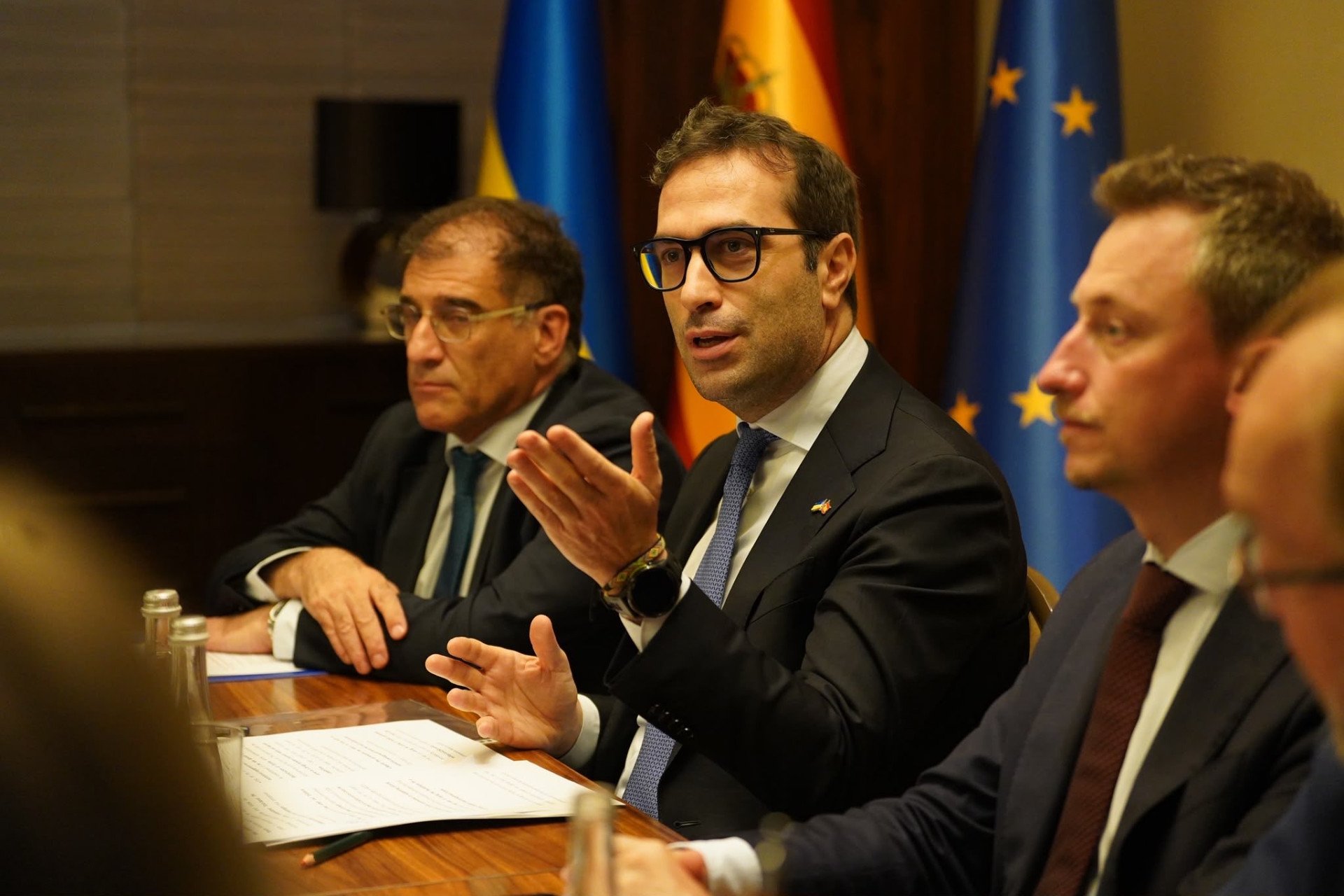
Hours after Russian ballistic missiles struck Kyiv, Spain put €570 million on the table for Ukraine. Not for rebuilding after the war, but for projects that will begin while the fighting continues. What is Spain willing to invest in, and why now?
 Prefer U24 Media on Google
- Authors

-21f402f6f32da8b0165ae48804a71feb.jpeg "Photo of Gonzalo Leon Bustos")
In the early hours of July 16, Russian ballistic missiles struck Kyiv again. The attack hit the Darnytskyi and Sviatoshynskyi districts, killing two men and injuring five people, including a 16-year-old boy. A residential building, vehicles, and warehouses were damaged as emergency crews worked through the morning to extinguish the resulting fires.
We bring you stories from the ground. Your support keeps our team in the field.
Hours later, Spain’s First Vice President and Minister of Economy, Trade and Business, Carlos Cuerpo, sat down with UNITED24 Media in the Ukrainian capital.
The timing gave the conversation an unavoidable point of departure. Spain had arrived in Kyiv with around 50 companies from sectors including energy, railway transport, infrastructure, digitalization, security, and defense. But this was not a conventional trade mission to an emerging market. It was taking place in a country still fighting for its survival, in a city where ballistic missiles had once again demonstrated that no economic discussion can be separated from the war surrounding it.
Reconstruction needs do not begin when the war ends. It is continuous, and we want to be present during these difficult moments as well.
Carlos Cuerpo
First Vice-President of the Government of Spain and the Minister of Economy, Trade and Business
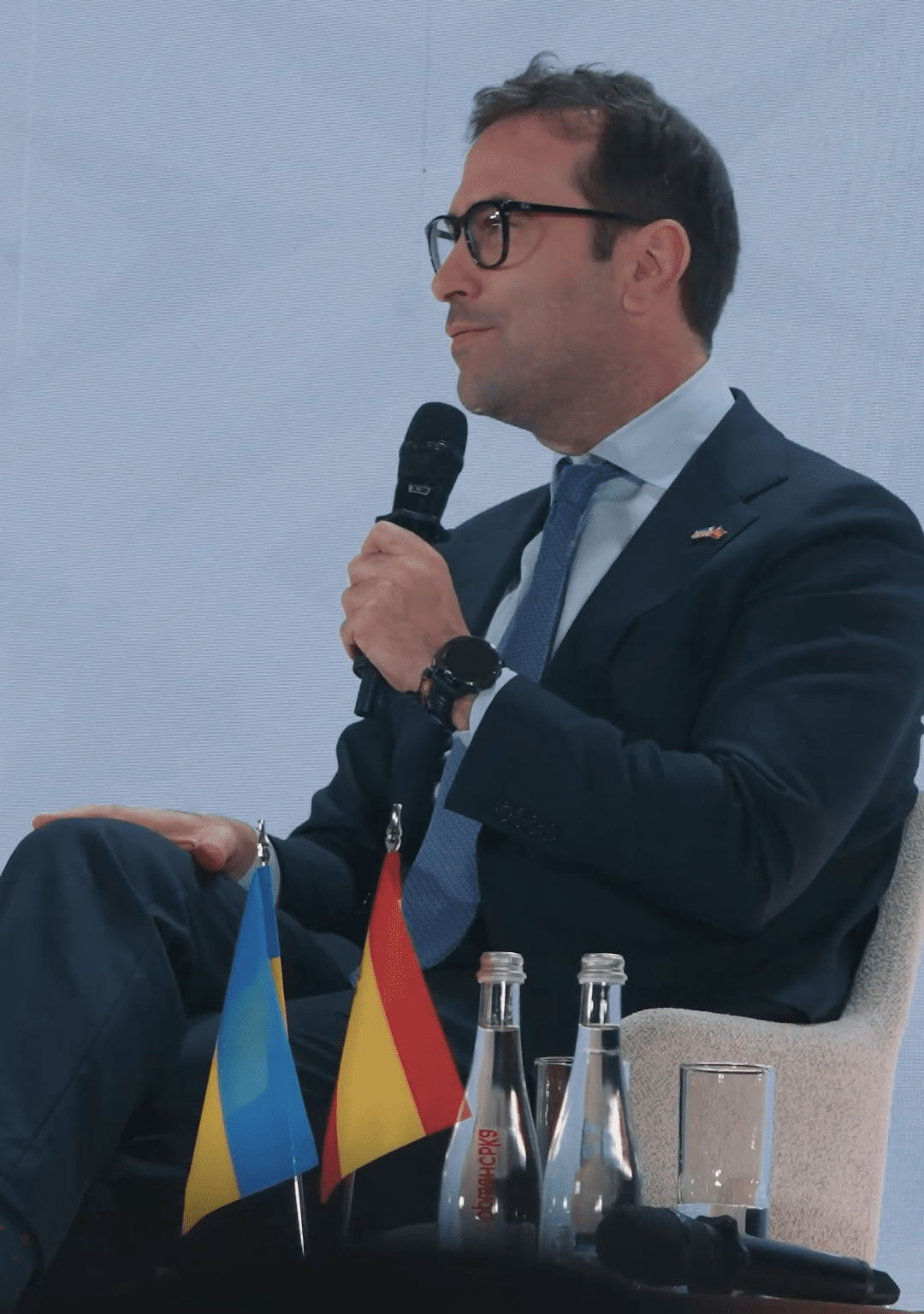
A business delegation arrives in a country at war
Spain’s visit was the largest business mission it has sent to Ukraine since Russia launched its full-scale invasion in February 2022. The delegation included approximately twice as many companies as the group that accompanied Cuerpo during an earlier visit in 2024.
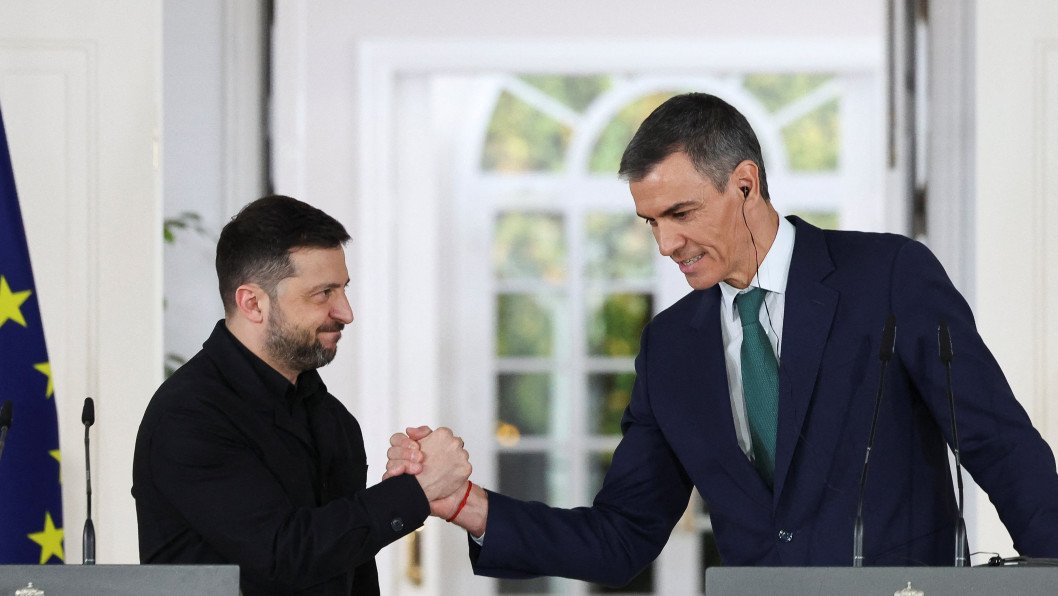
For Spain, this relationship and this support do not begin now. Since the start of the war, we have supported Ukraine in every way we could: bilaterally, through cooperation, and defense assistance. With the €1 billion committed for 2026, we have now pledged almost €4 billion specifically in the field of security and defense.
Carlos Cuerpo
First Vice-President of the Government of Spain and the Minister of Economy, Trade and Business
It has also received approximately 345,000 Ukrainian refugees, making it one of Europe’s largest host countries.
It also supported the European Union’s €90 billion loan for Ukraine in 2026 and 2027. The package includes €30 billion in macroeconomic assistance and €60 billion to strengthen Ukraine’s defense-industrial capacity and finance defense procurement.
What is changing now is the growing role of the private sector. “More than twice as many companies have accompanied us as in 2024, and I believe that is a very positive sign.”
The Spanish government has also established an Office for the Reconstruction of Ukraine, intended to serve as a point of contact for companies looking to enter the Ukrainian market and participate in priority projects.
But persuading companies to invest in a country under continuous Russian attack requires more than political declarations. It requires mechanisms capable of absorbing risks that businesses would not otherwise accept. That is the purpose of the €570 million package announced during the visit.
What Spain’s €570 million package actually contains
The figure is substantial, but it is not a single transfer to the Ukrainian government. It is a package of guarantees, loans, and investment instruments designed to make Spanish participation in Ukraine economically possible:
€250 million in expanded Cesce insurance coverage to protect Spanish companies against risks associated with exporting to or operating in a country at war.
€200 million through the Fund for the Internationalization of Companies (FIEM), half of it non-repayable and may be used not only for technical cooperation but also for specific investment projects.
Up to €100 million through Spain’s development finance institution COFIDES for private-sector projects benefiting Ukraine, with priority sectors including defense, energy, infrastructure, transport, water management, and agro-industry.
€20 million through an agreement between Spain’s Instituto de Crédito Oficial and Raiffeisen Bank Ukraine, directed principally at smaller companies linked to Spanish-Ukrainian projects: businesses that often face the greatest difficulty taking the initial step into a high-risk market.
Cuerpo said the structure of the package emerged from conversations with companies about what had prevented them from moving ahead.
They requested stronger guarantees, more flexible conditions, and access to non-repayable instruments. Spain responded by broadening the range of eligible sectors and allowing the financing to cover both technical assistance and direct investment.
It is important to listen to companies and understand what they need when launching these projects and contributing to Ukraine’s reconstruction.
Carlos Cuerpo
First Vice-President of the Government of Spain and the Minister of Economy, Trade and Business
The government has already identified several areas where Spanish capabilities correspond closely with Ukrainian needs.
Energy is among the most urgent. Russia has repeatedly targeted Ukraine’s generation facilities, substations, and transmission networks, making decentralized energy production and infrastructure protection central to the country’s survival.
Railways are another area of strategic cooperation. Ukraine is gradually integrating its railway system with the European network, but much of its infrastructure uses a different track gauge. Spain has decades of experience developing automatic gauge-changing technology and sees an opportunity to contribute to Ukraine’s physical integration with the European Union.
Other potential areas include water management, precision irrigation, agro-industry, satellite communications, cybersecurity, and air-traffic systems.
One of the first projects financed under the package involves preparing the safe recovery of Ukraine’s air-traffic management and communication systems. The Spanish company ALG will work with UkSATSE, the Ukrainian state air navigation provider, on the project.
These are technically reconstruction projects. But many are also instruments of wartime resilience. Electricity, communications, railway connections, and water systems are not secondary concerns for a country under attack. They determine whether cities can continue functioning and whether people can remain in them.
A key step in strengthening Spain–Ukraine industrial cooperation. 🇪🇸🇺🇦
— Carlos Cuerpo (@carlos_cuerpo) July 15, 2026
✍️Today’s public and private agreements bring our businesses closer together, opening new opportunities for investment, innovation and technology while supporting Ukraine’s recovery. pic.twitter.com/rlBmFFavfu
Investment under fire
The conventional model of reconstruction begins with peace: the fighting ends, risks decline, and capital enters. Ukraine does not have the luxury of waiting for that sequence.
Homes, power stations, hospitals, and factories destroyed by Russia today must often be restored immediately because the same infrastructure remains essential to the civilian population and the war effort. A damaged substation cannot wait for a peace agreement. Neither can a railway connection carry evacuees, military supplies, or humanitarian assistance.
Cuerpo argued that the first step towards overcoming companies’ concerns about investing in a country at war is direct contact with Ukraine.
The companies travelling with us can see for themselves what the reality of the country and of a city such as Kyiv is.
Carlos Cuerpo
First Vice-President of the Government of Spain and the Minister of Economy, Trade and Business
Companies visiting the capital can speak directly with Ukrainian businesses, government institutions and local partners, examine specific projects and understand how economic activity continues despite the war.
Companies visiting Kyiv can speak with Ukrainian businesses, ministries, and local institutions rather than relying only on external risk assessments. They can examine specific projects and see how economic activity continues despite Russia’s war.
The second step is to clearly identify Ukraine’s priorities. Spanish businesses need to know which projects are urgent, which institutions are responsible, and where their technology can be deployed effectively.
The third is to ensure that public financing absorbs enough initial risk for private investment to become viable.
The presence of the European Investment Bank, the European Bank for Reconstruction and Development, and other multilateral institutions provides another layer of protection. Their involvement can give companies access to financing, guarantees, and project oversight that would be difficult to establish independently.
Spain’s approach, therefore, rests on a combination of public guarantees and private execution. The state reduces the risk; companies provide the technology, investment, and industrial capacity.
Can frontline cities be rebuilt while russia continues to bomb them?
The dilemma becomes sharper outside Kyiv. Across the east and south of Ukraine, entire districts have been destroyed in cities located only kilometers from Russian positions. In places such as Kramatorsk, Kherson, and towns across the frontline areas, reconstruction is repeatedly overtaken by new attacks.
Homes are repaired and struck again. Electrical networks are restored and targeted again. Roads used by civilians, emergency services, and humanitarian workers increasingly come under attack from Russian drones.
Asked how Spain could support regions that remain under daily bombardment, Cuerpo divided the challenge into stages.
That means preventing cities from becoming isolated by preserving the infrastructure that keeps them functioning: electricity first, followed by transport links, housing, and water systems. Together, these are the foundations that allow communities to remain habitable and local economies to stay connected.
“We are talking about energy and being able to maintain the flow of electricity, which is critical infrastructure,” said Cuerpo. “Here, Spain, and Spanish companies have capabilities that can help.”
Rather than waiting to launch large reconstruction projects after the war, Spain’s immediate role could be to apply its existing industrial and technical expertise to the systems that enable frontline communities to continue functioning today.
-fbddc5227eb14c712eb409089c24632c.jpg)
The human dimension of reconstruction
Reconstruction is often measured in bridges, power stations and housing. Human recovery is harder to quantify and takes much longer.
A veteran adapting to a prosthetic limb, a child living with the psychological effects of repeated Russian attacks or a displaced worker retraining for a new profession cannot be restored through a single contract.
Cuerpo pointed to the experience of Ukrainians living in Spain as one basis for deeper cooperation. Of the approximately 260,000 Ukrainian refugees in the country, he said nearly 80,000 are now registered with Spain’s Social Security system and working. Around one-third of those who arrived were minors, many of whom have entered Spanish schools.
Spain has also supported programs that offer Ukrainian families temporary stays away from the conditions of war. Cuerpo referred to approximately 800 families who had spent time on the Spanish coast, including in Alicante, as part of initiatives intended to provide psychological respite. But rehabilitation cooperation can go further.
Ukraine has been forced to develop extensive expertise in prosthetics, physical rehabilitation, trauma medicine, mental-health treatment, and medical robotics. Spanish institutions and companies can provide resources, training, and technology, while also learning from Ukrainian specialists who treat injuries rarely encountered elsewhere in Europe on such a scale.
Cuerpo also raised the possibility of professional training and reskilling programs outside Ukraine, including for workers in critical sectors.
-9a81c4970d5b9c8540a2df315ceb8213.jpg)
Ukraine as a defense-industrial partner, not only a recipient
Everyone is currently aware of Ukraine’s leadership in many areas of defense.
Carlos Cuerpo
First Vice-President of the Government of Spain and the Minister of Economy, Trade and Business
That leadership has been built under battlefield pressure. Ukrainian companies develop, test and modify drones, electronic-warfare systems, military communications, radars, artificial intelligence and autonomous platforms in direct contact with combat units.
Systems that prove effective can be scaled quickly, while those that fail are rapidly adapted or replaced. For European defense industries accustomed to much slower procurement and development cycles, that experience has become increasingly valuable.
Much of the technology developed during the war has applications beyond the battlefield, he said. Drone systems, robotics, secure communications, and satellite technology are often dual-use, giving them potential value across civilian industries.
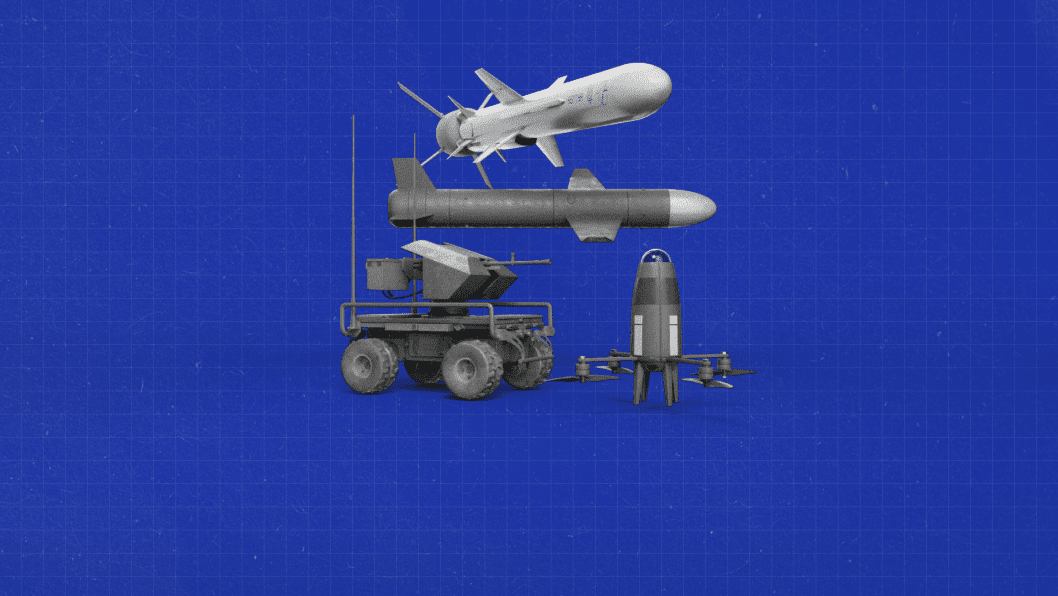
For Spain, cooperation, therefore, cannot be limited to selling equipment to Ukraine. The more durable model is joint development and joint production.
Spanish companies—including both major groups and specialized SMEs—are already establishing agreements, partnerships, and joint ventures with Ukrainian businesses in areas such as drones, cybersecurity, and air-traffic technology.
Indra, one of Spain’s largest defense and technology companies, already has a presence in Ukraine. The next stage would involve partnerships between companies of different sizes, supported by public financing and multilateral institutions.
We are talking about agreements and joint production involving companies from both countries, because technological transfer works in both directions.
Carlos Cuerpo
First Vice-President of the Government of Spain and the Minister of Economy, Trade and Business
This is an important distinction.
Ukraine is bringing battlefield-tested knowledge, engineers, manufacturing experience, and a defense sector that has expanded under conditions of extreme pressure. Spain, in turn, offers access to European markets, established industrial infrastructure, capital, and experience in aerospace, radar, transport, and communications.
Cuerpo described such cooperation as a “win-win” for both industries. But he also identified one potential obstacle: financing.
It is important that financing does not become a bottleneck.
Carlos Cuerpo
First Vice-President of the Government of Spain and the Minister of Economy, Trade and Business
Governments can provide the initial capital and guarantees. European institutions can coordinate procurement and set common industrial priorities. But companies must ultimately transform that support into systems that can be manufactured quickly and at scale.
The technologies being developed in Ukraine are already influencing how Europe understands modern warfare, and countries that build industrial links now will be better positioned to adapt their own defense capabilities.
Reconstruction does not begin with peace
Waiting until the war ends may appear safer. It would also mean arriving after many of the central partnerships, standards, industrial networks, and areas of specialization have already been established.
Ukraine’s future energy system is being designed now because Russia is attacking the existing one. Its defense industry is being transformed now because the weapons are needed now. Its railway integration with Europe, rehabilitation system, and digital infrastructure are all developing under the pressure of immediate necessity.
The countries and companies participating in those processes are influencing what postwar Ukraine will look like. Spain’s €570 million package is therefore less significant as a single financial announcement than as evidence of a broader decision: Madrid no longer sees reconstruction exclusively as a future humanitarian undertaking.
It sees Ukraine as a long-term economic, technological, and defense partner. The ballistic missiles over Kyiv provided the harshest possible context for that decision. They demonstrated the risks facing every company entering Ukraine, as well as why Ukraine cannot wait.
Discuss this article:


-930ed56b9d4c7f0232c62eddea7edc08.jpg "Ukraine’s Mindset Has Changed Faster Than Most of Europe—What 35 Years of Data Show")
-d6c21a19c8fd931d512b5818298453c4.jpeg "Maryna Starodubska")
-29a1a43aba23f9bb779a1ac8b98d2121.jpeg "Photo of Illia Kabachynskyi")

-554f0711f15a880af68b2550a739eee4.jpg "Photo of Lucile Brizard")