- Category
- War in Ukraine
How Are Sanctions Pushing Russia to Negotiate? Hemingway Answered It Best
For years, the Kremlin insisted sanctions didn’t matter while warning that any further pressure would trigger escalation. That contradiction may now be resolving itself, as the slow economic strain Russia once dismissed begins to accelerate.
 Prefer U24 Media on Google
- Authors


“Russia can wage war indefinitely,” the Kremlin claims — while masking deep economic troubles through manipulated data and spending cuts. The era of low oil prices has laid bare Russia’s vulnerability, with its weaknesses increasingly reflected in statements by senior officials in Brussels.
I like to quote Ernest Hemingway. When asked, ‘How did you go bankrupt?’, he replied: Gradually and then suddenly. I believe the Russian economy will collapse in exactly the same way — first gradually, and then, suddenly.
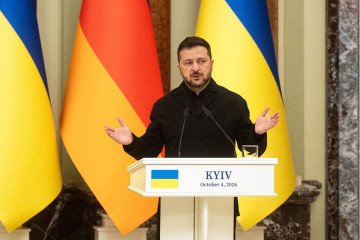
EU Sanctions Commissioner
This remark followed an even stronger statement by the commissioner, in which he noted: “Russia is on the brink of a financial collapse similar to the crisis of 1998. Of course, a dictator intent on continuing the war at any cost may do just that. But sooner or later, the situation will become unbearable.”
So why have typically cautious Brussels politicians begun speaking in such terms?
Phase one: Gradually
The fact that four years of full-scale war have unfolded under unprecedented sanctions may create the impression that this approach simply does not work. By the end of April 2022, a total of 9,741 sanctions had been imposed on Russia — already exceeding the combined total imposed on Iran, Syria, North Korea, Myanmar, Venezuela, and Cuba. Yet the war continued. As of 2026, the number of sanctions against the Kremlin has reached 30,711.
Despite everything, the Kremlin has continued its invasion for four years, seemingly without end. But the root of this cognitive dissonance lies in inflated expectations.
“Some may have expected an immediate effect [from sanctions], but that is not how it works,” O’Sullivan said. “Still, I am absolutely convinced: four years of sanctions have dealt a serious blow to the Russian economy.”
Can a tool be deemed ineffective if the issue lies not in the tool itself but in unrealistic expectations of its impact? Can it be called ineffective if one ignores both its measurable effects and the countermeasures taken by the sanctioned party to mitigate losses?
Russia’s buffers
At the time sanctions were imposed following the invasion of Ukraine, the Russian economy had several buffers to soften the blow:
1. “Putin’s piggy bank” — the National Wealth Fund
At the start of the full-scale invasion, the fund held over 8.8 trillion rubles ($140 billion) in liquid assets, accumulated from oil revenues. These reserves served as a cushion against initial sanctions shocks and as capital for state investment, particularly to accelerate industrial militarization after the failed attempt to quickly seize Kyiv in February–March 2022.
We bring you stories from the ground. Your support keeps our team in the field.
2. The underestimated factor of a globalized economy
Sanctions initially targeted Russian officials and companies directly, overlooking a key reality: while war brings suffering and destruction, it also creates opportunities for profit. Early sanctions policy did not fully account for the Kremlin’s ability to circumvent restrictions through third countries — often those friendly to Russia.
For example, in 2022, Armenia quadrupled exports to Russia (from $85 million to $325 million), Kyrgyzstan increased them tenfold (from $30 million to $325 million), and Türkiye nearly tripled them (from $500 million to $1.3 billion). These same countries simultaneously increased imports of sanctioned goods from the EU and the United States. Only in the second half of 2024 did the EU begin to seriously consider secondary sanctions against entities that enable such circumvention.
The Kremlin did not invent these mechanisms — it scaled up practices used by Venezuela, Iran, and Cuba, particularly Iran’s experience with shadow fleets.
3. Shock energy prices
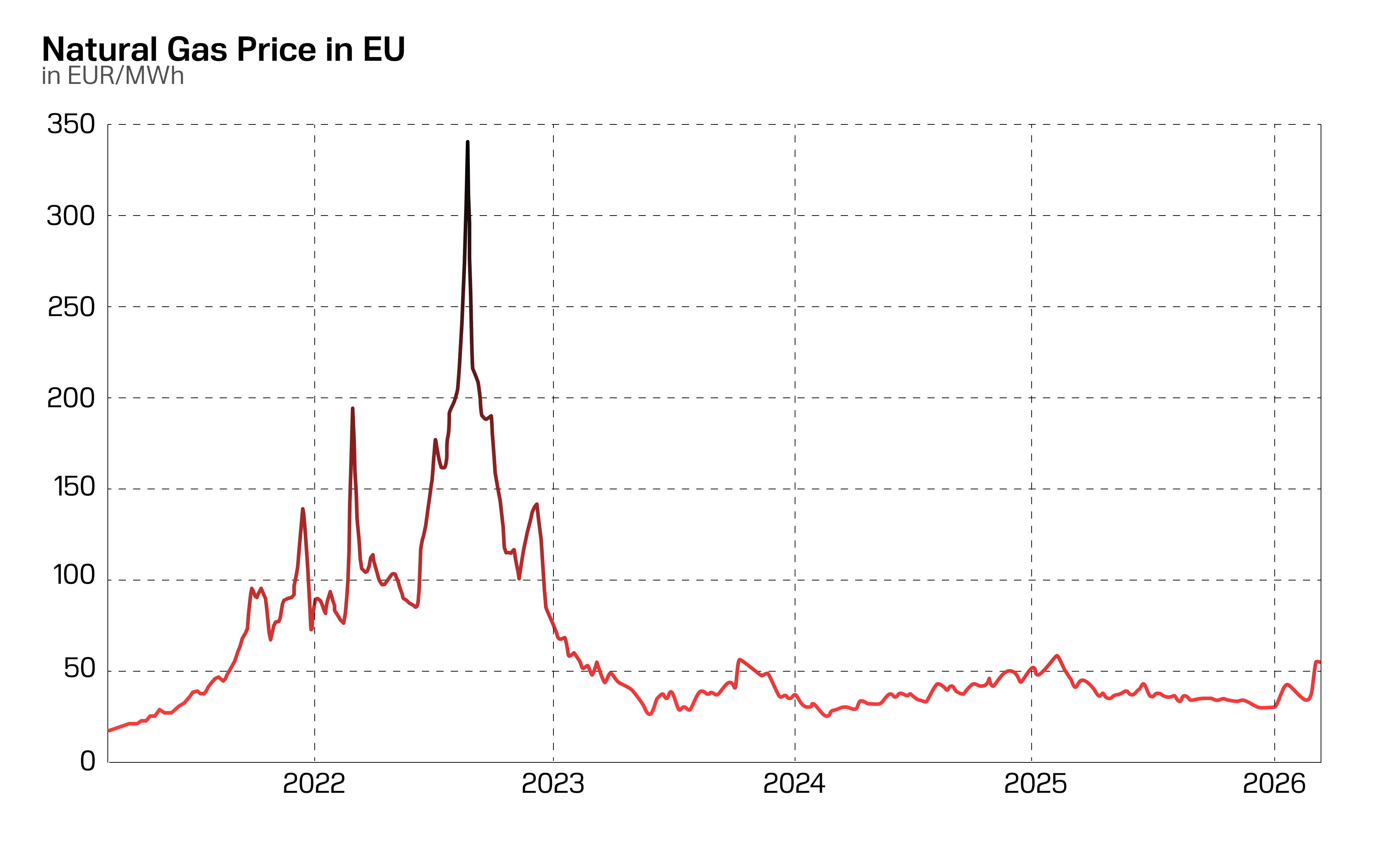
Russia’s invasion, combined with post-COVID recovery, triggered price spikes: oil traded at $120 and above, while gas prices in Europe at times reached €350 (now $403) per MWh. In the short term, this offsets sanctions losses. In the long term, however, the loss of the European market has made it impossible for Russia to redirect two-thirds of its pipeline gas exports to China due to infrastructure constraints, including the limited capacity of the “Power of Siberia-1” pipeline.
Despite Russian narratives and some rhetoric from European politicians, sanctions and the phaseout of Russian gas did not cause sustained price spikes in Europe beyond the initial 2022 shock. On the contrary, diversification and increased competition pushed prices down in 2025, below prewar levels for most of the year, until disruptions linked to developments in Iran.
4. Russian propaganda
The informational dimension of the war was underestimated. Russian intelligence networks enabled the spread of narratives about the “ineffectiveness of sanctions.” Operations such as “Matryoshka” (deepfake distribution) and “Doppelganger” (fake media and government websites) delayed and complicated the implementation of sanctions. Threats about “red lines,” often bluffs, nonetheless influenced decision-making.
Delayed effect
Yet sanctions still worked. Slowly — but they worked.
By early 2026, liquid assets in the National Wealth Fund had halved to $45–50 billion. Economic growth driven by military spending no longer offsets losses in the civilian sector. The civilian economy contracted for three consecutive quarters in 2025, indicating a recession. As a result, 70 out of 92 manufacturing sectors are in decline, and 21 out of 27 major industries ended the year in negative territory, according to Rosstat, Russia’s Federal State Statistics Service.
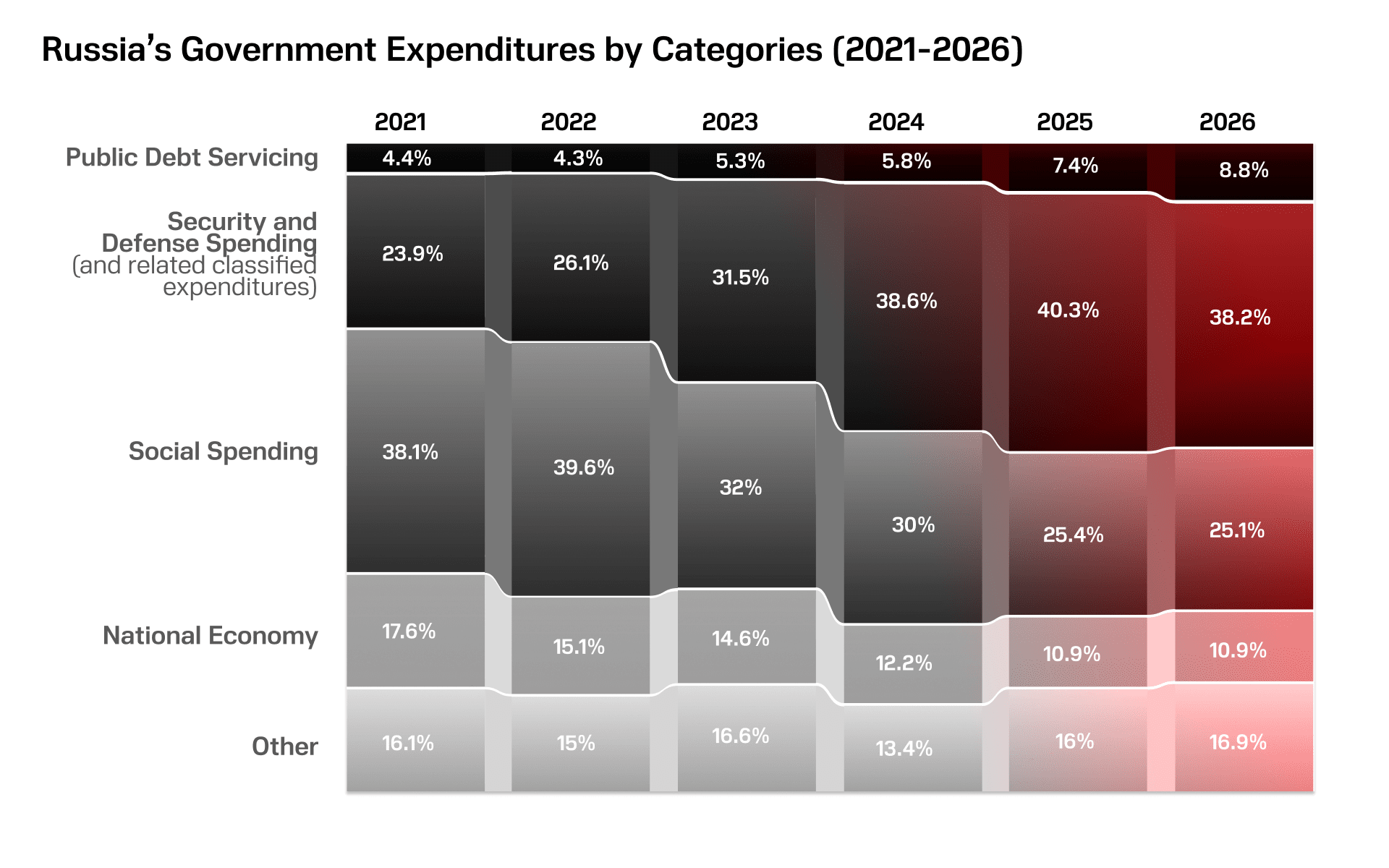
Meanwhile, debt servicing in Russia’s budget has doubled — from 4.4% to 8.8%—with significant acceleration in 2025.
Russian economic institutions, including the Center for Macroeconomic Analysis and Short-Term Forecasting (CMACP), reported a sharp rise in its leading recession indicator, reaching 0.32 in October 2025—well above the critical threshold of 0.18 that typically precedes deep downturns. This suggests an active recession phase by mid-2026.
Sanctions faced three main forms of resistance:
Pre-existing global know-how for evasion, which Russia scaled up.
Financial reserves provided flexibility and time.
Slow and fragmented responses from allied countries.
All of this slowed the impact. But slow does not mean ineffective.
Phase two: Suddenly
Crisis dynamics intensified in the second half of 2024, as early stimulus faded and the Kremlin confronted hard realities: dwindling reserves, a lack of civilian-sector investment, a structural imbalance between the civilian and military industries, a labor shortage of 2.4 million workers, and declining oil and gas revenues.
Putin’s directive to compensate for falling investment by attracting Asian capital failed. Foreign direct investment dropped by 62.8% in 2024 compared to 2023 and by 11.7% compared to pre-war 2021 levels. In 2025, economic growth slowed fourfold—from 4.2% to roughly 1%.
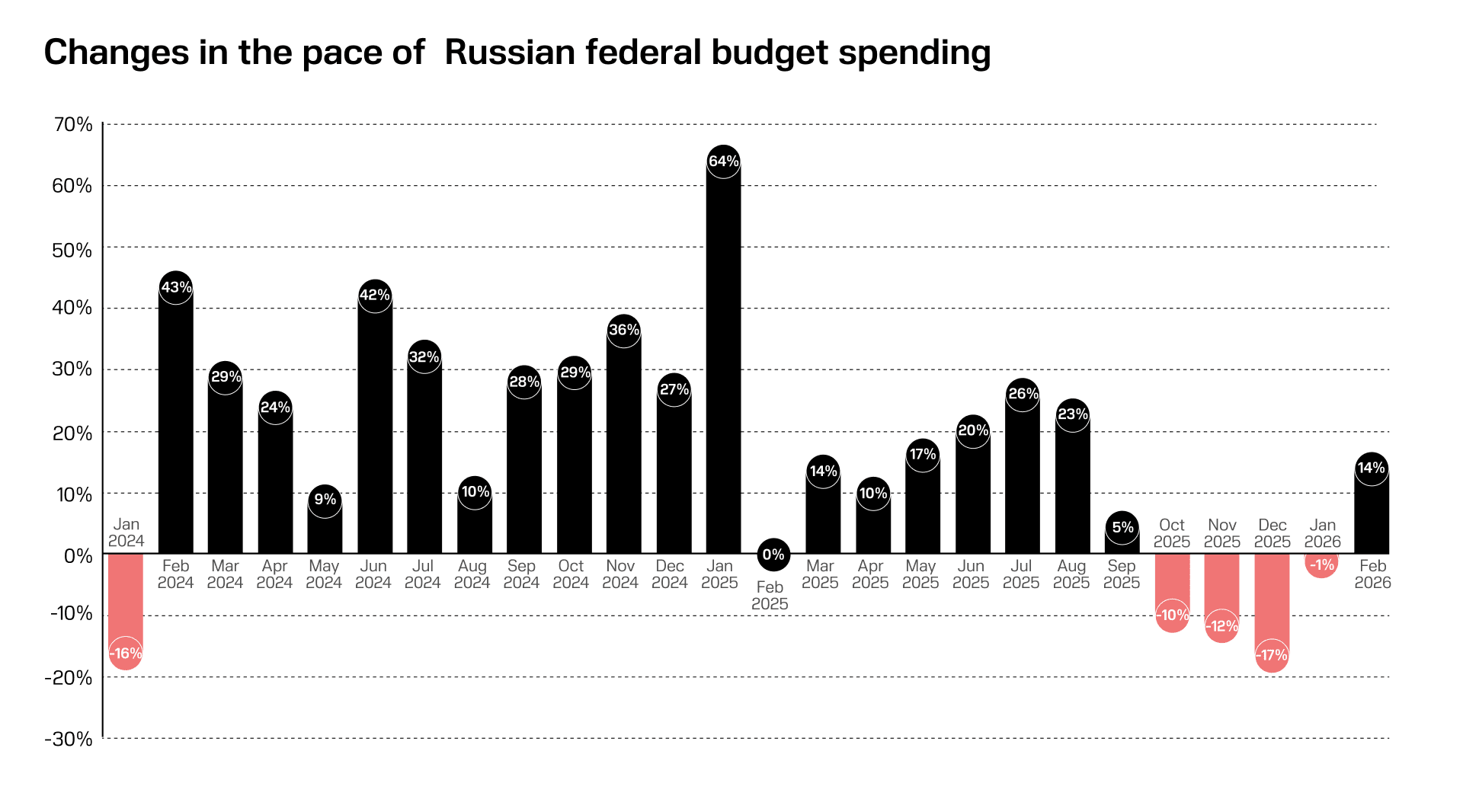
Economic crises do not accelerate linearly. What begins as “slow” becomes “fast” once buffers are exhausted.
To maintain the narrative that “Russia can fight forever,” the Kremlin manipulates statistics and cuts spending. Germany’s Federal Intelligence Service (BND) estimates that Russia’s actual 2025 budget deficit was 8.01 trillion rubles ($89 billion)—over 2.3 trillion ($25–26 billion) more than officially reported, and more than six times higher than originally planned.
This estimate is highly likely to be accurate, given that in the first two months of 2026, Russia’s budget deficit reached 3.44 trillion rubles ($43 billion), compared with 3.7 trillion rubles ($46.25 billion) planned for the entire year. That is 41% higher than in the same period of 2025 — a year that was already the worst for Russia in terms of economic strain over the past decade.
This suggests that, for propaganda purposes and to avoid revealing the true scale of the deficit, Russia’s Finance Ministry shifted part of the 2025 shortfall into so-called “advance payments” for 2026.
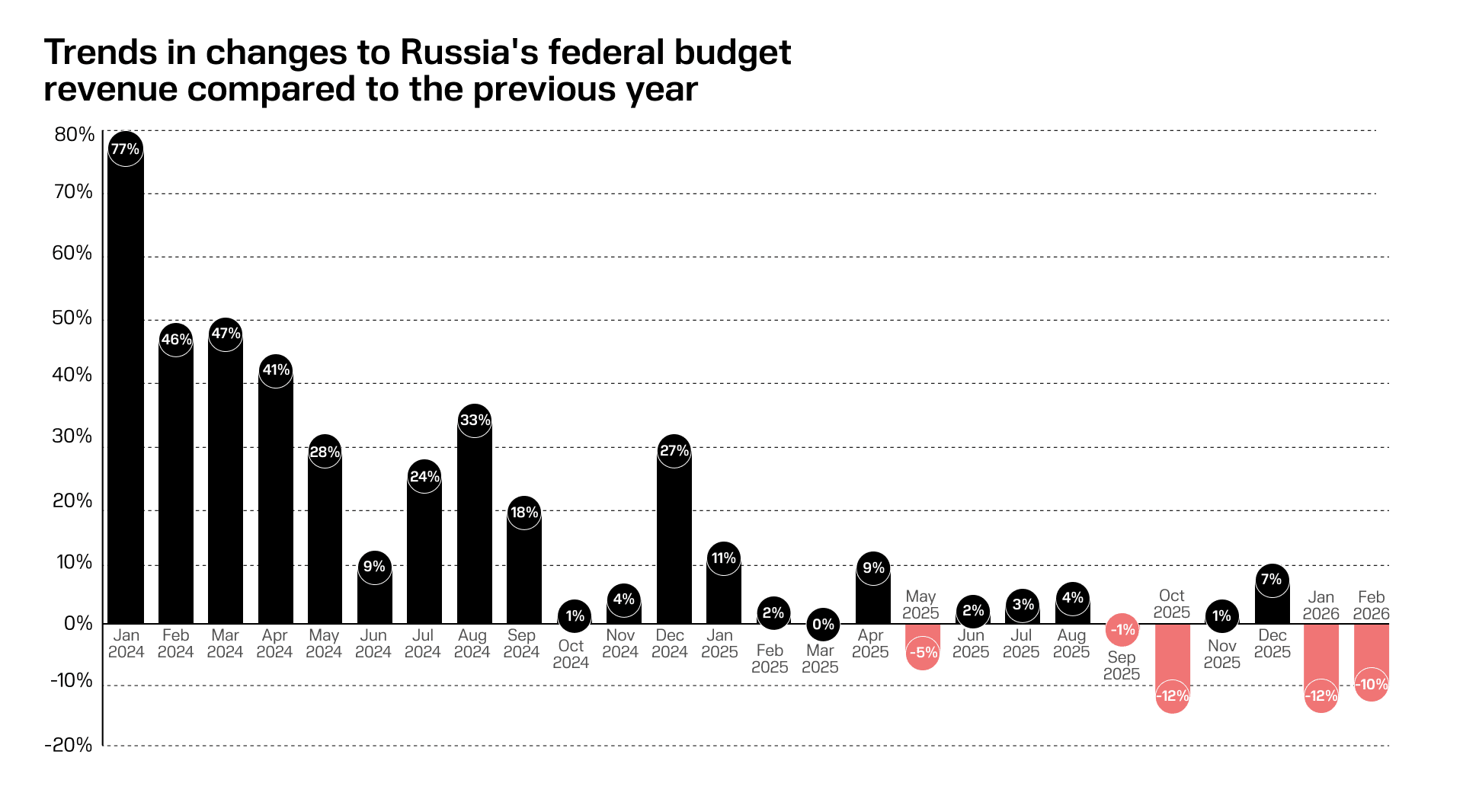
At the same time, from October through December 2025, the Kremlin cut spending each month by 10% in October, 12% in November, and 17% in December. This came despite the Finance Ministry borrowing a record 7 trillion rubles ($90 billion, or roughly one-fifth of the federal budget) in 2025.
Efforts to close the deficit through tax increases in 2025–2026 have fallen short due to structural imbalances. Key tax revenues underperformed: import VAT by 24%, customs duties by 19%, corporate tax by 4%, personal income tax by 4%, and recycling fees by 44%.
Revenues from all major taxes fell short of targets in 2025: import VAT by 1.3 trillion rubles (about $16 billion), 24% below plan; import duties and excise taxes by 328 billion rubles (about $4 billion), 19% below plan; corporate profit tax by 160 billion rubles (about $2 billion), 4% below plan; personal income tax by 36 billion rubles (about $400 million), 4% below plan; and the recycling fee by 888 billion rubles (about $11 billion), 44% below the budgeted level, according to CMACP.
Although Middle East tensions (notably the war in Iran) may give Russia’s budget a chance to generate additional revenue, this would only be meaningful if the conflict in the region drags on for several months or longer.
Despite elevated oil prices and supply shortages in recent weeks, which could be described as a “golden opportunity” for the Kremlin to boost earnings, Russia is unable to fully capitalize on it due to structural weaknesses in its economy. Even as OPEC+ policy allows for increased output following earlier cuts, Russia has been unable to raise production. OPEC data shows that over the past four months, Russia has reduced output by 200,000 barrels per day, to 9.184 million barrels per day, below its quota of 9.574 million.
Where is the end?
Wars end through diplomacy — but the effectiveness of that diplomacy is determined either by military defeat (capitulation can also be seen as a form of diplomacy), economic failure (an inability to sustain the war effort), or the achievement of parity between the sides.
Russia does not accept parity and seeks more than it can achieve militarily. Ukraine, meanwhile, refuses to replace parity with capitulation disguised as diplomacy — particularly when it comes to surrendering fortified areas in the Donetsk region or legally recognizing Ukraine’s occupied territories as part of Russia.
For Europe, incentivizing aggression carries serious risks:
It would reinforce a perception of victory within Russian society and elites, framing territorial gains — especially those not achieved militarily — as proof of European weakness. Putin is raising the stakes. The weak global response to Russia’s aggression against Georgia paved the way for the occupation of Crimea in 2014. The weak response to Crimea, in turn, paved the way for the full-scale invasion. Where the Kremlin could be emboldened next—should even part of its objectives in Ukraine be realized — is a question for expert debate.
An agreement perceived by Ukrainian society as “unjust,” and as one imposed on Ukraine through a betrayal by its allies, could lead to the country’s “political occupation,” similar to what occurred in Georgia. This raises a broader question: what happens if Ukraine becomes a second Belarus — where the country’s resource base and military experience serve not to strengthen and defend Europe, but to destabilize it?
The most effective path to ending the war is therefore economic coercion — forcing Russia to scale back its ambitions to match reality. This means pushing the Russian economy to a point where it can no longer sustain the war financially or industrially, while facing systemic collapse risks.
This is what could force the Kremlin to hit the brakes.
Sanctions have worked slowly. Russia is becoming bankrupt slowly — but the pace is accelerating. As the Kremlin’s adaptability declines and reserves are depleted, each additional restriction now has a multiplicative effect — far greater than a year or two ago.
What should be done?
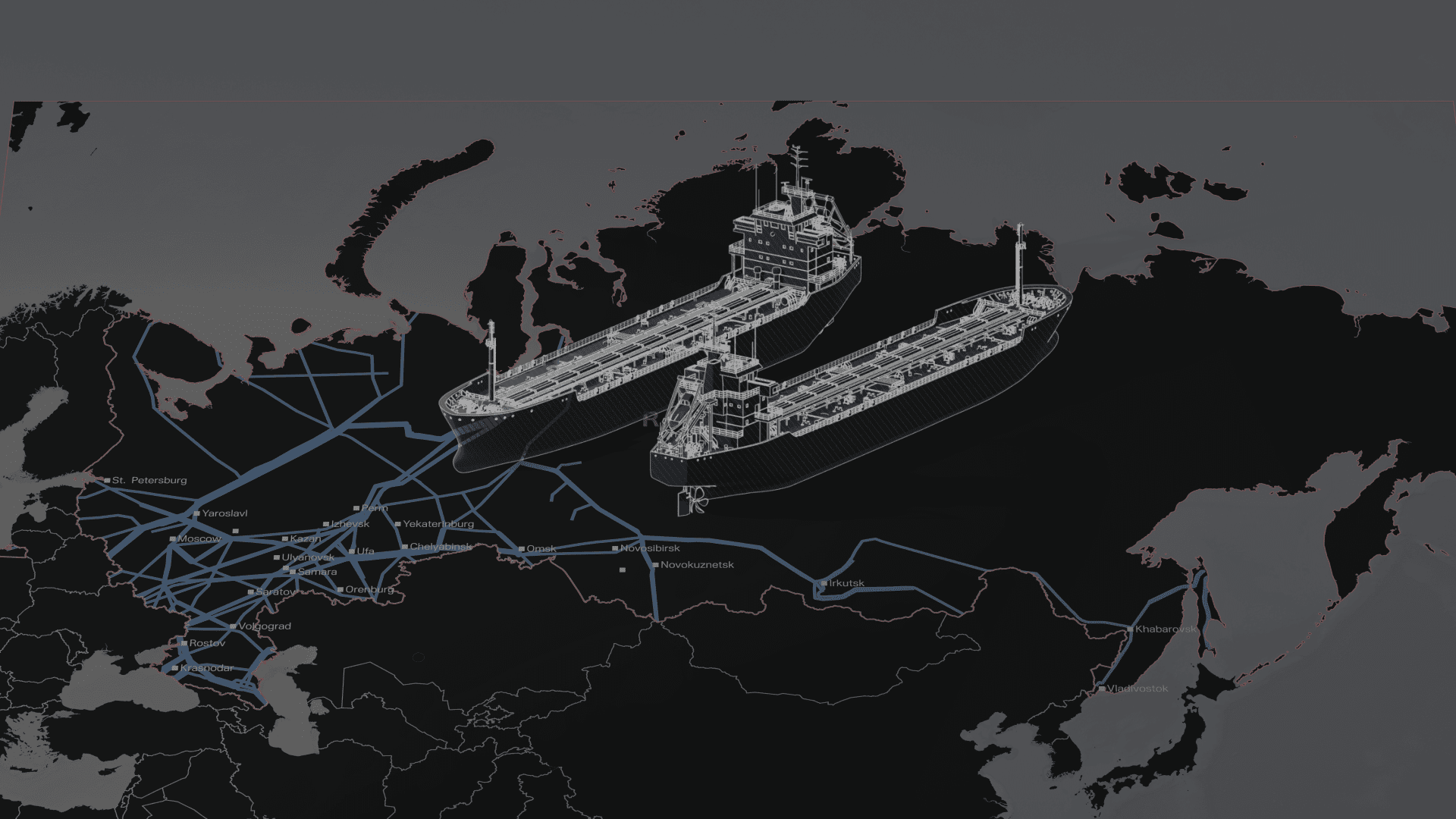
The most obvious solution lies in plain sight — on the water: Russia’s shadow fleet tankers, operating freely in European waters in the Baltic and Mediterranean.
These vessels are not merely environmental hazards or sanctions violators — they are no longer purely civilian. At least three such ships were used to deploy drones over European military facilities last year, says Germany’s Vice Admiral Jan-Christian Kaack.
This is critical because 55–60% of Russia’s oil exports pass through Baltic and Black Sea ports. Each week, Russia loads around 30 tankers, with up to 18 departing from ports like Primorsk, Ust-Luga, and Novorossiysk.
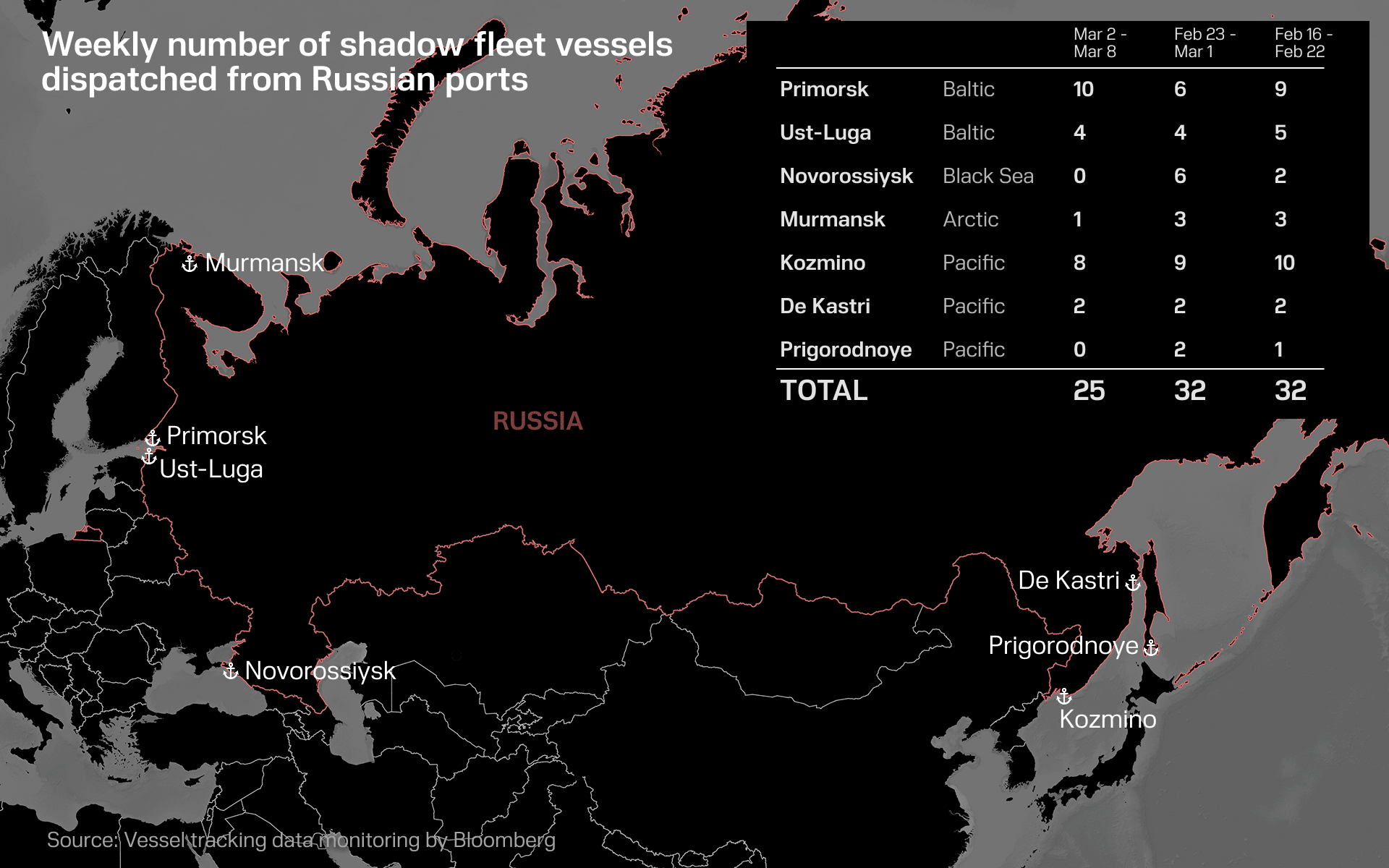
Russia’s oil logistics, designed in Soviet times, were oriented toward Western markets. Redirecting flows eastward is structurally constrained.
A sharp disruption in Russia’s ability to transport sanctioned oil—amid broader economic exhaustion — would accelerate the path to peace, and with it a period of development for both Ukraine and Europe. However, such a peace cannot come “at any cost,” as that would risk even greater instability. Economic coercion, therefore, remains one of the most effective tools for exerting pressure on the Kremlin.
It is precisely the sensitivity of this pressure for Russia that has driven the Kremlin’s corresponding behavior:
On one hand, it spreads disinformation claiming that sanctions do not work;
On the other hand, it threatens escalation, warning that seizing shadow fleet tankers would be considered an act of war.
In February 2026, Nikolai Patrushev—one of Putin’s closest associates, a presidential aide, former head of the FSB, former secretary of Russia’s Security Council, and currently head of the Maritime Board — threatened Europe with a military response to the detention of shadow fleet tankers.
Yet when Belgium, with French naval support, detained the tanker Ethera on March 1, and Sweden seized another vessel days later, those threats proved empty. French President Emmanuel Macron described it as a “serious blow” to Russia’s shadow fleet. As of the time of writing, 11 days have passed, and the threats made by Patrushev and other Russian officials remain just words.
Detain ten such tankers, and it will become clear that these “red lines” are as hollow as previous ones.
There is no need for complex diplomatic constructs when the solution lies on the surface — quite literally. Economic pressure remains one of the most effective ways to force the Kremlin toward peace.
This material was prepared as part of the cooperation between UNITED24 Media and the international analytical and information community Resurgam.
Discuss this article:
-4a56a6b482ec132402c16ef6fcabf9a2.png)

-c439b7bd9030ecf9d5a4287dc361ba31.jpg "Photo of Katherina Popilnichenko")
-72b63a4e0c8c475ad81fe3eed3f63729.jpeg "Photo of Cyril Barabaltchouk")