- Category
- War in Ukraine
Ukraine’s Record Deep Strikes Are Knocking Out Russia’s Industrial Heartland
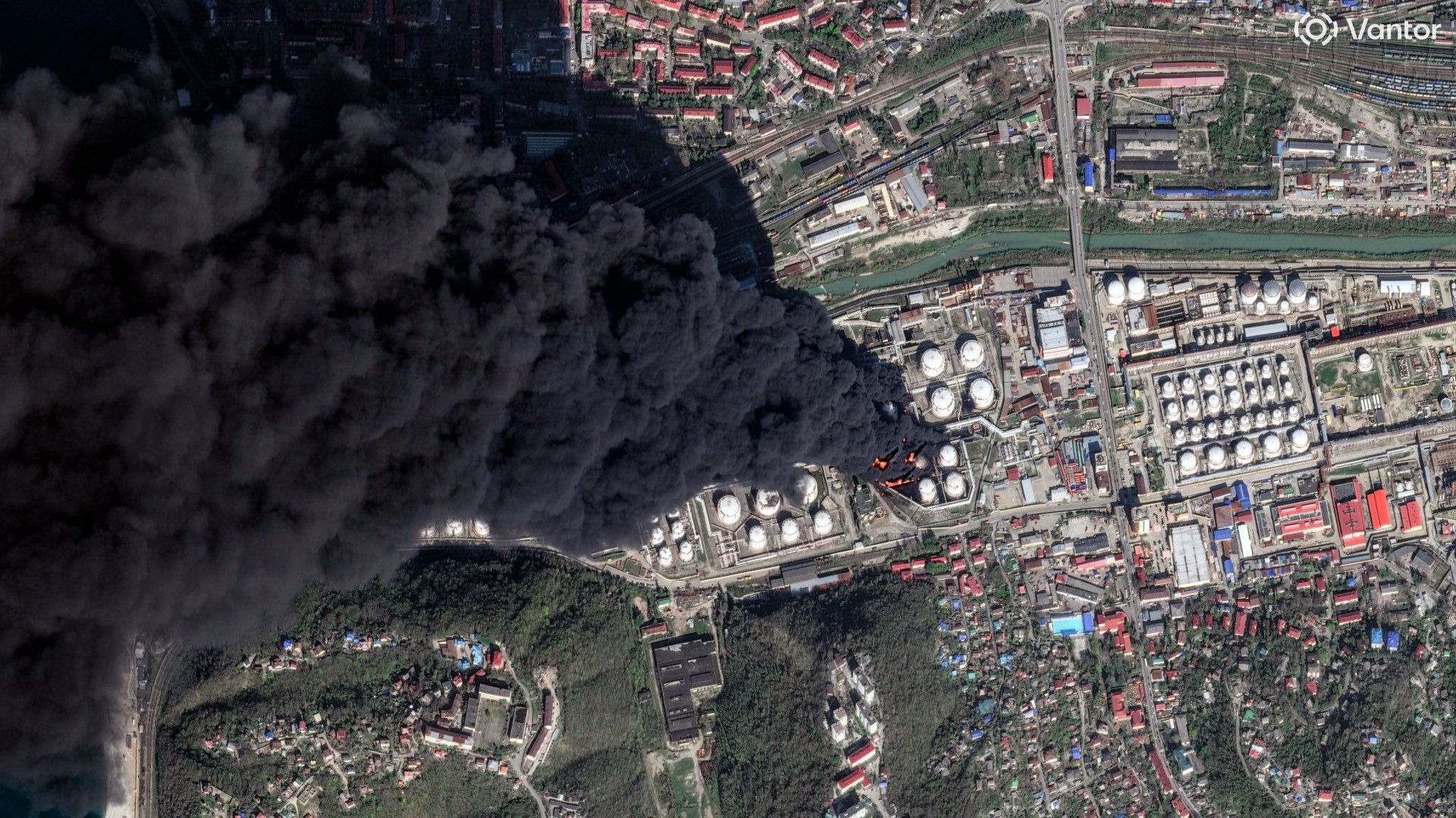
In April and March 2026, Ukraine launched many long-distance strikes on Russian military and industrial targets over 1000km away multiple times. This has shown Ukraine’s increased capacity to target Russia even past the Ural Mountains routinely.
 Prefer U24 Media on Google
- Authors

-605be766de04ba3d21b67fb76a76786a.jpg "Joseph Place")
Ukraine has been able to consistently strike military and military-industrial targets within Russia before, challenging the “safe rear” notion. However, 2026 has featured record levels of consistency.
We bring you stories from the ground. Your support keeps our team in the field.
Ukraine launched over 7,000 long-range drones against Russia in March 2026, hitting multiple targets across the country, including Tuapse, Perm, Ufa, Omsk, and Chelyabinsk, demonstrating that these are not one-off strikes. Multiple industrial and military sites were hit, and the Ministry of Defense (MoD) reported that the strike zone had increased by 2.5 times. We list key strikes and compare their distances with those of the previous year to demonstrate how Ukraine’s capacity has grown.
Ukraine’s strikes in April 2026
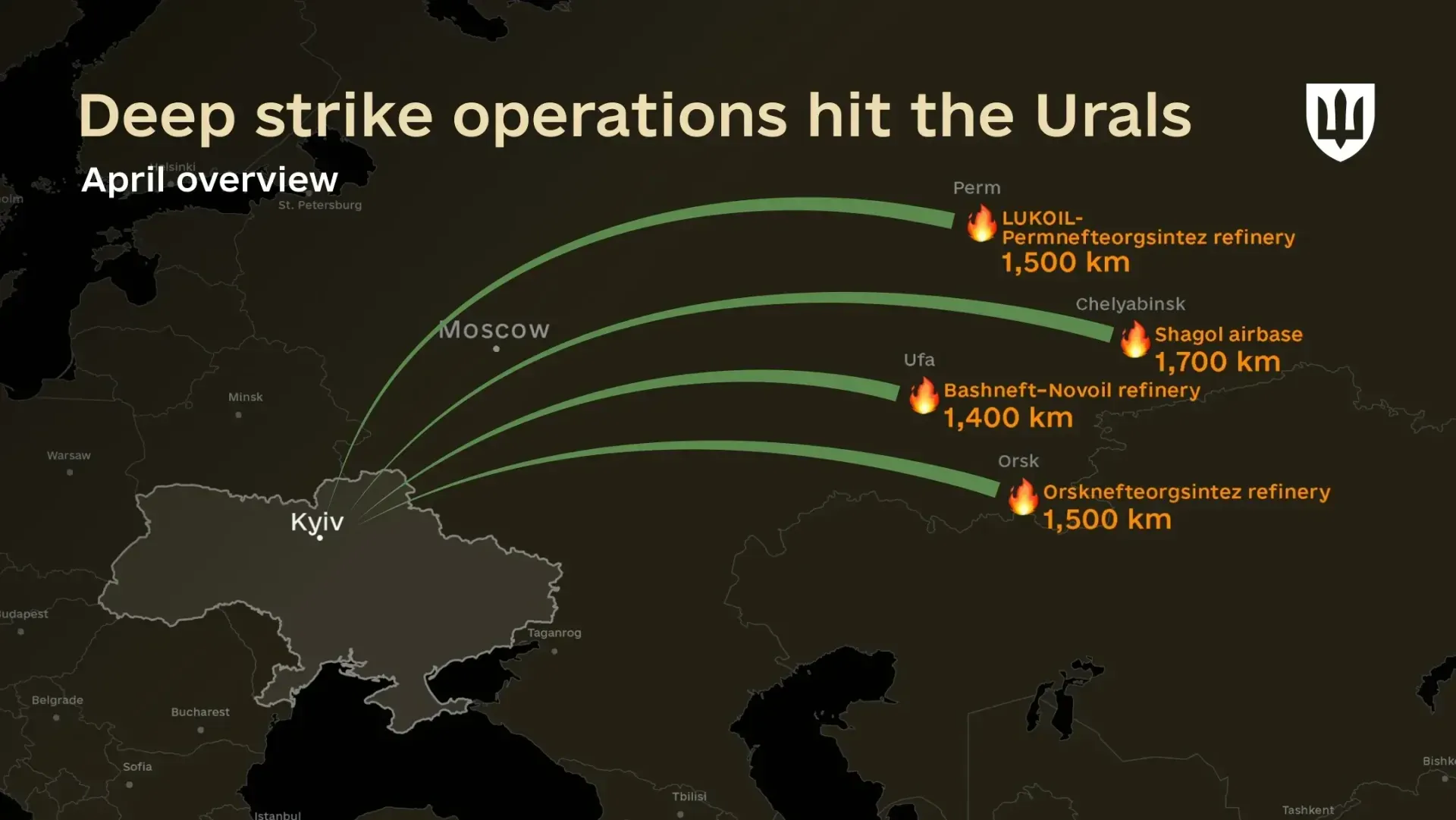
Ukraine hit military targets deep inside Russia throughout April 2026, reported the Ukrainian MoD. These have been in the Ural Region and beyond, and have involved a combination of Fire Point-1-7 drones and missiles and Neptune missiles.
Site/facility | Location | Approx. distance | Context |
Shagol airfield | Chelyabinsk region | ~1,700 km | Ukraine’s MoD called it one of the longest-range Ukrainian deep strike operations; Su-57s, a Su-34, and another aircraft were hit. |
Orsknefteorgsintez refinery | Orsk, Orenburg region | 1,500+ km | Deep Ural-region energy target, which supplies oil to the military. |
Lukoil-Permnefteorgsintez refinery / Perm LPDS | Perm, Perm Krai | 1,500+ km | A major oil site in the region and further proof of Ukraine’s expanded reach into Russia’s deep rear. |
Tuapse Oil Refinery | Tuapse, Krasnodar Krai | ~1,500 km | Hit multiple times in April, causing them to cease operations, disrupting oil flow in the region. |
Bashneft-Novoil refinery | Ufa, Bashkortostan | ~1,400 km | Another key oil site, showing Ukraine’s capacity to slow down Russia’s oil industry. |
Satellite imagery showing the aftermath of the strikes on Su-57 and Su-34 aircraft at the Shagol airfield in the Chelyabinsk region. pic.twitter.com/VOP0i5PzK3
— WarTranslated (@wartranslated) May 1, 2026
Here is a larger list of long-distance strikes (300km+) in Russia.
Shagol airfield — Chelyabinsk region — ~1,700 km
Su-57, Su-34, and unidentified aircraft — Shagol airfield, Chelyabinsk region — ~1,700 km
Tuapse Oil Refinery — Tuapse, Krasnodar Krai — ~1,500 km
Orsknefteorgsintez refinery — Orsk, Orenburg region — ~1,500 km
Lukoil-Permnefteorgsintez refinery — Perm, Perm region — ~1,500 km
Perm linear production and dispatching station — Perm region — ~1,500 km
Bashneft-Novoil refinery — Ufa, Bashkortostan — ~1,400 km
Novokuybyshevsk Petrochemical Company— Novokuybyshevsk, Samara region — ~1,000 km
LSP-1 + LSP-2 oil platforms, Graifer field — Caspian Sea — ~1,000 km from the line of contact
LRPK-Vysotsk Lukoil-2 oil loading terminal — Vysotsk, Leningrad region — ~950 km
Syzran Oil Refinery — Syzran, Samara region — ~900 km
Ust-Luga Oil terminal — Ust-Luga, Leningrad region — ~900 km
Port “Primorsk” oil infrastructure — Primorsk, Leningrad region — ~850 km
Lukoil-Nizhegorodnefteorgsintez refinery — Kstovo, Nizhny Novgorod region — ~800 km
Yaroslavsky Refinery — Yaroslavl, Yaroslavl region — ~750 km
Sheskharis oil terminal — Novorossiysk, Krasnodar Krai — ~420 km
Tikhoretsk oil pumping station — Tikhoretsk, Krasnodar Territory — ~300 km
Strela missile production plant — Suzemka, Bryansk region — 300 km+
Atlant Aero UAV plant — Taganrog, Rostov region — 300 km+
Ukraine’s strikes in March 2026
This month was reportedly the month where Ukraine surpassed Russia in terms of long-distance drone launches and shows a notable shift towards consistent, long-distance strikes.
Site / facility | Location | Approx. distance | Context |
Bashneft-Ufaneftekhim Oil Refinery / Ufa refinery area | Ufa, Bashkortostan | ~1,300+ km | One of the 10 oil-industry facilities hit in March 2026, showing the consistent, high-volume attacks on the oil infrastructure deep inside Russia. |
Uralchem / KCKK chemical plant | Kirovo-Chepetsk, Kirov Region | ~1,000+ km | Ukraine hit drones at this facility linked to military production, such as chemicals for explosives. |
KuibyshevAzot chemical plant | Tolyatti, Samara Region | ~900–1,000 km | This plant, struck by Ukraine, is a leading producer of chemicals, particularly nitrogen fertilizer, and plants like this are now manufacturing materials for military purposes. |
Togliattikauchuk petrochemical plant | Tolyatti, Samara Region | ~900–1,000 km | Hit in the same strike as KuibyshevAzot, disrupting the military manufacturing process that relies on these chemicals. |
Patrol icebreaker Purga / Vyborg Shipyard | Vyborg, Leningrad Region | ~900+ km | Ukraine’s General Staff reported a strike on the Project 23550 Purga, a ship under construction. These ships are designed as dual-purpose platforms, both icebreakers and armed patrol vessels |
March also had a sizeable amount of deep strikes. In fact, in March, Ukraine beat Russia in long-distance strikes, and its range evidently reached a benchmark: consistently and sustainably striking targets thousands of kilometers inside Russia.
Here is a larger list of targets hit that month:
Bashneft-Ufaneftekhim Oil Refinery — Ufa, Bashkortostan — 1,300+ km
Ufa refinery area/Bashkortostan refinery targets — Ufa, Bashkortostan — 1,300+ km
Uralchem/KCKK chemical plant — Kirovo-Chepetsk, Kirov Region — 1,000+ km
KuibyshevAzot chemical plant + Tolyatti Industrial Area— Tolyatti, Samara Region — 900–1,000 km
Primorsk and Ust-Luga oil and port infrastructure— Leningrad Region — 850+900 km
Patrol icebreaker Purga/Vyborg Shipyard — Vyborg, Leningrad Region — 900+ km
Aviastar-SP Aircraft Plant — Ulyanovsk, Ulyanovsk Region — ~800+ km
Kirishi Oil Refinery/Kirishinefteorgsintez — Kirishi, Leningrad Region — 800 km
Yaroslavl Oil Refinery/Slavneft-YANOS — Yaroslavl, Yaroslavl Region — 750 km
Engels-2 military airbase area — Engels, Saratov Region — ~700 km
123rd Aircraft Repair Plant — Staraya Russa, Novgorod Region — ~600+ km
Saratov Oil Refinery — Saratov, Saratov Region — ~600+ km
Sheskharis oil terminal — Novorossiysk, Krasnodar Krai — 420 km
Afipskiy Oil Refinery — Afipsky, Krasnodar Krai — 400 km
Labinsk oil depot/oil facility — Labinsk, Krasnodar Krai — 400 km
Port Kavkaz — Krasnodar Krai / Kerch Strait area — 300 km+
Tikhoretsk oil hub/oil pumping station — Tikhoretsk, Krasnodar Krai — 300 km
Compared to March and April 2025
If we compare the attacks to just a year ago, we can see the shift in Ukraine’s capabilities. Ukraine was already launching strikes over 1000km+ into Russia by this point; however, the average distance was lower, showing that the average range of the strikes has consistently grown over the year.
Period | Approx. average distance | Maximum distance | Longest-distance example |
March 2025 | ~608 km | ~1,300 km | Kombinat Burevestnik oil depot — Cheboksary, Chuvash Republic |
April 2025 | ~667 km | ~1,150 km | 112th Missile Brigade / Shuya military base area — Ivanovo region |
March 2026 | ~727 km | ~1,300–1,400 km | Bashneft-Ufaneftekhim / Ufa refinery area — Bashkortostan |
April 2026 | ~977 km | ~1,700 km | Shagol airfield — Chelyabinsk region |
If we look at the number of strikes 1000 km+, we see the notable shift, using the most conservative, identified estimate of strikes. In March to April 2025, the number of (confirmed) long-distance strikes over 1000km was 3. In the same period of 2026, that number was 12.
If we compare the course of Russia’s full-scale invasion of Ukraine in terms of distance, 2024 is the turning point. Volume has jumped up the most, however. Ukraine first surpassed 1,000 long-range drones launched into Russia in a month in August 2024. By July 2025, that monthly figure had risen to 3,000, and by March 2026 it reached 7,000.
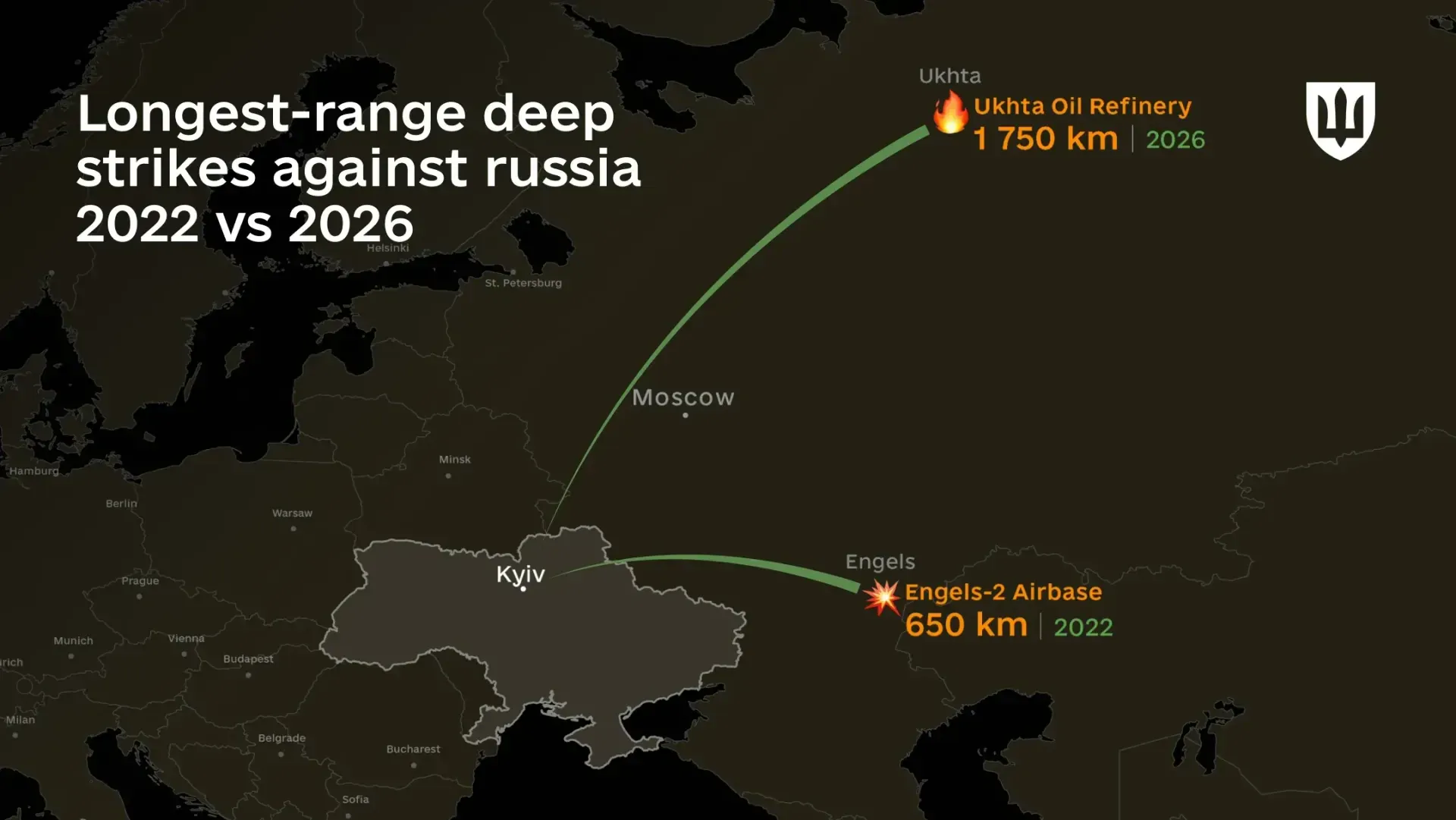
Ukraine’s long-distance strikes, the sheer volume of them, and increasing range are thanks to innovations in Ukraine’s drone and missile manufacturing, the removal of restrictions on long-distance strikes, and the expertise and experience of those using them, four years into a full-scale invasion.
Russia’s military and oil infrastructure are now being consistently disrupted by Ukraine, and nowhere is safe for them, as much of it is within its 2000km range. Additionally, much of 80%+ of Russia’s population can and likely will see for themselves the air strikes on military and industrial infrastructure close to home, and feel the effects of the war, which changes the perception that it is something “far away”. Ukraine continues to pressure Russia, damage its military-industrial complex, and shows no signs of slowing down.
Discuss this article:


-7647a088f8ed2b81f52ab779f3a93cd0.png "Equipment and personal gear belonging to Ukrainian troops from the 425th Separate Assault Regiment “Skelya” are transported on a small wagon through an underground gas pipeline near Kupiansk. (Source: 425th Separate Assault Regiment “Skelya”)")
-72b63a4e0c8c475ad81fe3eed3f63729.jpeg "Photo of Cyril Barabaltchouk")