- Category
- World
Why Are So Many Tankers Suddenly Flying African Flags? Follow Russia’s Oil Money
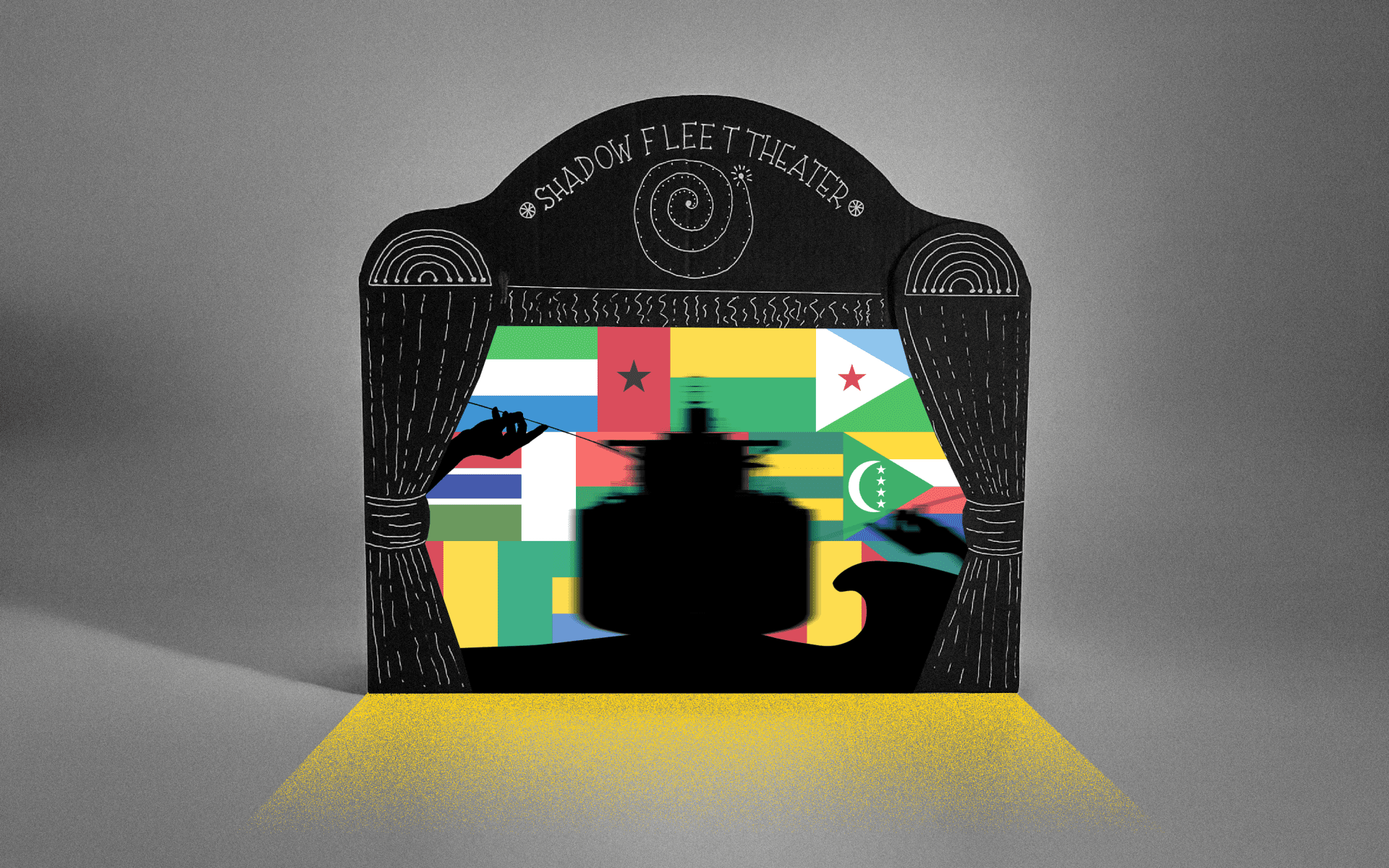
The West imposed the largest sanctions regime in modern history on Russia. Moscow responded by building a parallel maritime system stretching from the UAE to Africa, where weak maritime registries became cover for its shadow fleet.
 Prefer U24 Media on Google
- Authors

-92ecbb2b41f23705e2667acbfda7f06d.jpg "Photo of Aliona Chudnovets")
African states that had previously been minor players in shipping entered the International Chamber of Shipping rankings within months, displacing traditional maritime registries. Russia deliberately turned the structural weakness of African jurisdictions into an operational advantage for a fleet that, in March 2026, was generating €713 million ($827 minnion) per day.
How Russia turned African flags into a sanctions loophole
In 2025, the International Chamber of Shipping added the African states of Eswatini, Gabon, and Guinea-Bissau to its rankings, while the British Virgin Islands, Costa Rica, and Uruguay were removed because of the relatively small size of their fleets.
African states that had only recently been minor players in shipping displaced traditional maritime registries within months.
Under international maritime law, every merchant vessel sailing beyond national waters is required to fly a flag. The flag state, which does not necessarily have to be the shipowner’s country, assumes jurisdiction and regulatory responsibility for a fee: it undertakes to exercise control over administrative, technical, and social matters. Accordingly, the “flag of convenience” became a tool for creating a new profile for a vessel, concealing its sanctioned status and allowing Russia to earn money from exports of oil, gas, and stolen Ukrainian grain.
The scale of Russia’s “shadow fleet” makes any strategic shift visible: each wave of re-registrations left a clear statistical trace, making it possible to reconstruct how Russia gradually mastered new “flags” and why it lost them. Since the start of the full-scale invasion in 2022, Russian vessels, mostly from Western registries, began moving en masse to the world’s largest open registries—Panama, Liberia, and the Marshall Islands, which together account for more than 40% of global shipping capacity by total carrying volume, or deadweight tonnage.
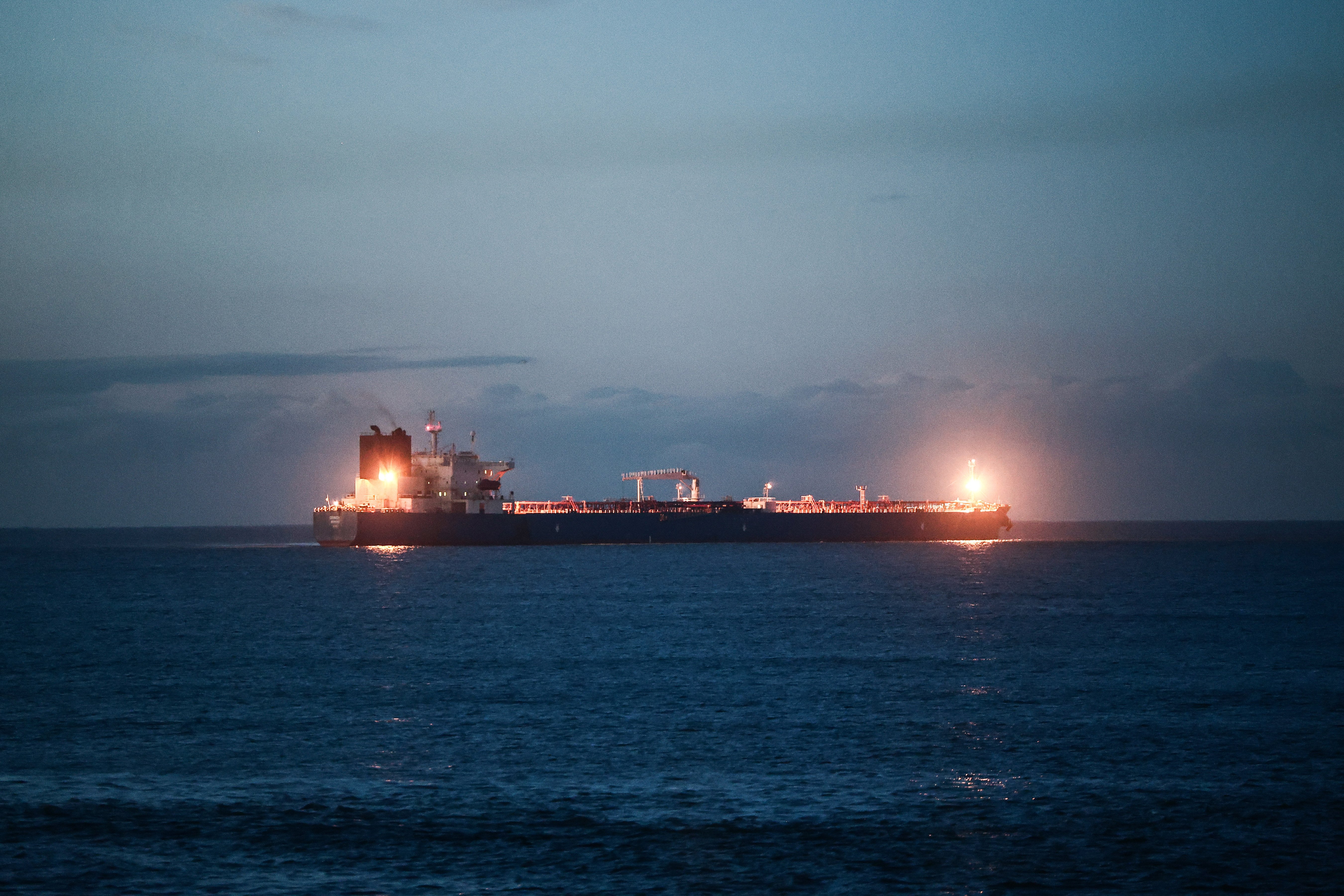
The state budgets of such countries depend heavily on registration fees, making it vital for them to remain on the Paris MoU’s “white list” for port state control—a list of flags with the fewest detentions and violations following port inspections. At this stage, a contradiction emerged: vessels from these registries were being exposed en masse as part of Russia’s “shadow fleet”—ships transporting sanctioned Russian goods and themselves subject to sanctions. Even maneuvering between “flags” did not help preserve registrations: for example, the oil tanker Sagitta was sanctioned as a Panamanian vessel but was intercepted by the United States while already sailing under the Liberian flag.
Pressure eventually spread from sanctioned vessels to the registries themselves. As a result, Panama alone stripped at least 214 vessels of its flag in less than a year and introduced mandatory information-sharing with Liberia and the Marshall Islands regarding rejected ships.
At the next stage, in 2023–2024, Russia shifted its focus toward new registries: Barbados (+177%), San Marino (+663%), and the African states of Gabon and Guinea-Bissau. In 2023, Gabon’s registry grew by 675%, making it Africa’s second-largest after Liberia. Between January and February of that year alone, the fleet flying the Gabonese flag doubled, as roughly 50 tankers linked to Russia’s Sovcomflot abandoned Liberian registration in favor of Gabonese registration.
Sai Baba, NS Nordic, SCF Baltica, Enigma (formerly SCF Yenisey), and Sierra (formerly Suvorovsky Prospect) all transport oil from the port of Murmansk to China, and all ended up under the Gabonese flag. Guinea-Bissau’s registry grew by 340% over the same period.
Nevertheless, these new registries also proved vulnerable to sanctions. Djibouti, one of the fastest-growing registries fueled by Russia’s “shadow fleet,” recorded a 35% decline in registered vessels by early 2025. Moreover, for the first time in history, sanctions were imposed on a legitimate private registry operator—Intershipping Services LLC—which managed Gabon’s registry.
The sanctions of 2025 shattered several records: at the start of the year, the US Treasury Department sanctioned more than 400 legal entities and individuals, while the EU’s 17th, 18th, and 19th sanctions packages brought the total number of sanctioned vessels to 557 by year’s end. Although experts estimate that sanctions cover only half of the “shadow fleet,” they fundamentally changed Russia’s behavior: 36% of vessels sanctioned in 2025 changed flags already in early 2026, while the average time before a first flag change nearly halved—from 85 to 45 days.
A broader range of African states became new “flag countries.”
In 2026, attention shifted to Gambia (+574%), Cameroon (+126%), the Comoros (+180%), and Guinea (+76%). Some registries were effectively created from scratch specifically for the needs of Russia’s “shadow fleet.” In Sierra Leone, over just 18 months, the fleet grew from zero to 10% of all sanctioned vessels—an increase of 105%.
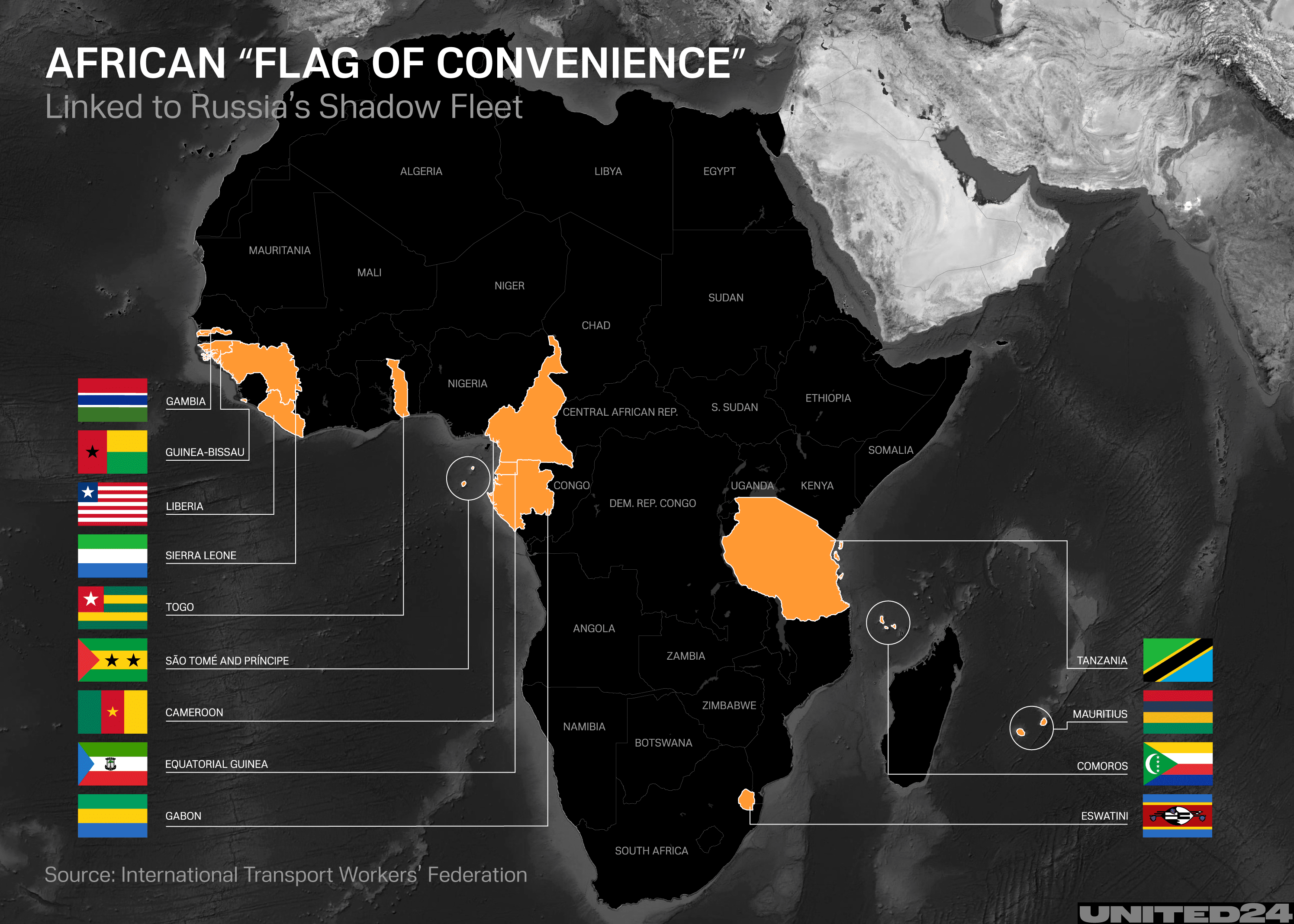
At present, the International Transport Workers’ Federation lists 13 African states as “flags of convenience,” though this is a significantly understated indicator that does not reflect Africa’s true role in sanctions evasion. Russia artificially saturated newly established registries to the point that they displaced traditional players and entered the rankings of the International Chamber of Shipping. These include Togo, Tanzania, Madagascar, and Mozambique.
Although African registries are considered high-risk and are therefore inspected more frequently than others, modern port inspection mechanisms are too slow to keep pace with the scale of the “shadow fleet.” While individual ships are detained, hundreds of others flying the same flag continue to operate. The scheme works, and Russia is simply expanding it within existing registries rather than spending resources searching for new ones.
Russia’s parallel maritime system
Making the “shadow fleet” look legitimate
The combination of two factors—the deliberate interest of African regimes in cooperating with Moscow and their practical inability to enforce oversight—created conditions in which Russia managed to build something qualitatively greater than a sanctions-evasion scheme: a parallel infrastructure to international law itself.
First and foremost, this infrastructure allows operations to proceed legally. There are two types of registries: national registries managed by state authorities and private registries in which administrative functions are delegated to commercial operators. In the Western tradition, national registries are an absolute minority, with private operators controlling most of the world’s tonnage. In Africa, this distinction largely disappears: Gabon, Djibouti, Guinea, and Guinea-Bissau, among others, maintain national registries.
More importantly, official registration with a national authority does not prevent involvement in international crimes. A telling example is the tanker Kiwala, accused of launching drones over the airports of Copenhagen and Oslo in September 2025. The vessel was listed in Djibouti’s national registry, and Djibouti later officially confirmed the registration.
Private registries, in turn, are divided into open and closed registries. In closed registries, the ship operator must be based in the flag state. In open registries, ownership may belong to a company registered anywhere in the world, while the beneficial owner may hold citizenship from any country. It was these open registries that became the foundation of the world’s largest “flags of convenience,” which Russia prioritized during the first two phases.
Africa still maintains nine open registries, most of which work with Russia’s “shadow fleet”: Cameroon, the Comoros, Equatorial Guinea, Liberia, Mauritius, São Tomé and Príncipe, Sierra Leone, Tanzania, and Togo.
The actual management of these registries is concentrated in third countries, primarily the United Arab Emirates. The scale became so extensive that, for the first time in history, sanctions were imposed on a private ship registry operator—UAE-based Intershipping Services LLC—which simultaneously managed the registries of Gabon and the Comoros.
The registries of Gambia and Sierra Leone are managed by the same Cyprus-based company. Notably, tankers from these two countries alone accounted for 40% of all tanker calls at Russia’s Baltic ports in October–November 2025. The fact that the registries of multiple African countries with hundreds of sanctioned vessels are managed from a single office in a third country reveals the nature of this system: African states are providing services to Russia on a massive scale while delegating not only registry administration, but also effective control over it—and with it, international legal responsibility for everything conducted under their flags.
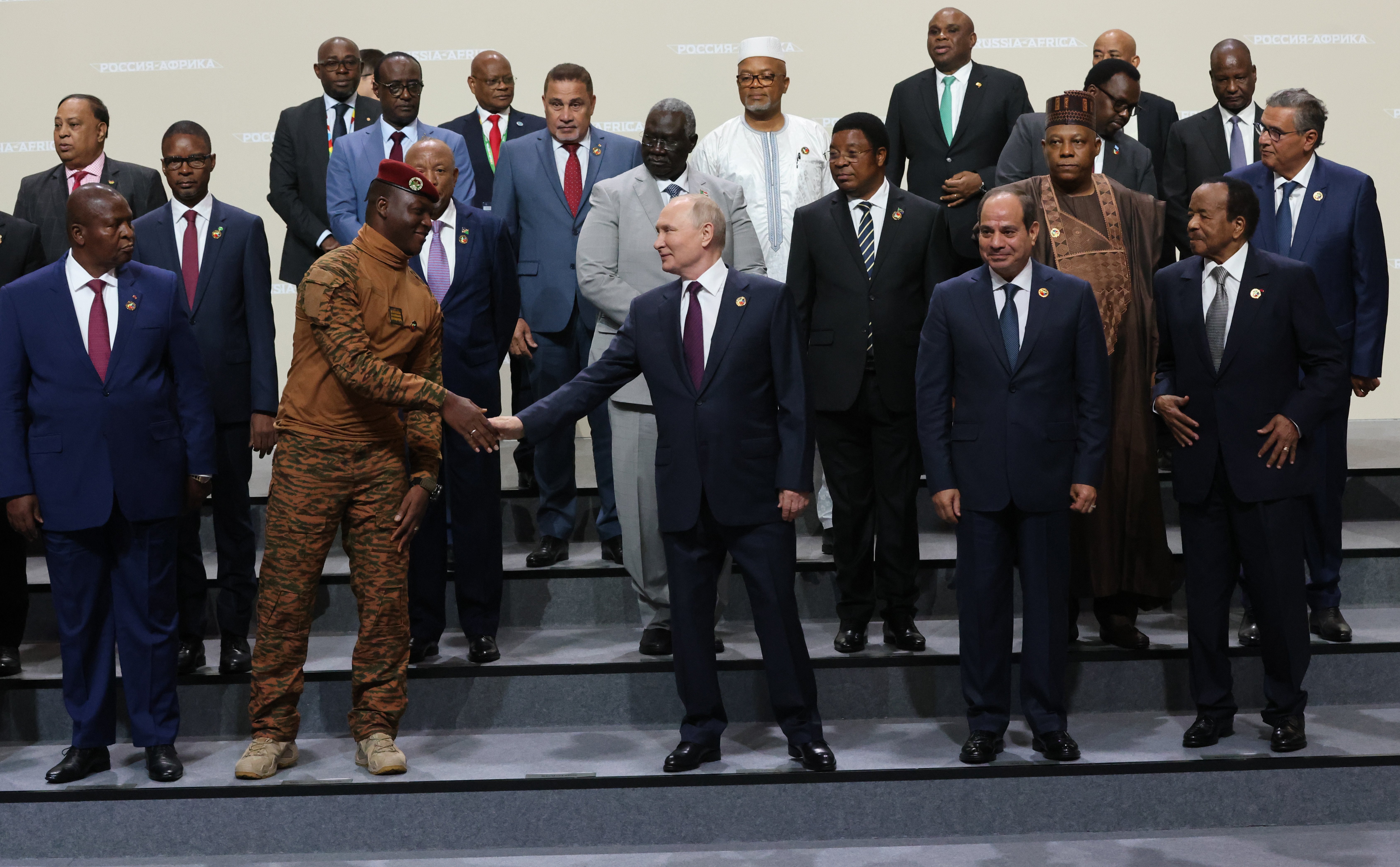
The UAE has also become the jurisdiction for companies managing the vessels themselves. 28 out of 45 tankers forming the key fleet for crude oil transport are managed by UAE-based Stream Ship Management Fzco, an investigation by the Kyiv School of Economics suggests. Vessel ownership is also tied to Emirati entities such as Insania Shipping HK Ltd and Castellario Shipping HK Ltd.
A similar pattern appears across individual African countries. For example, 16 out of 28 tankers under the Gabonese flag transporting Russian crude oil have UAE-based companies serving simultaneously as manager, ISM manager, and owner. The same situation exists in other sectors: 11 out of 16 tankers carrying petroleum products are managed by UAE-based Fornax Ship Management, which effectively took over the fleet from Sovcomflot after sanctions were imposed against it.
It is also notable that different intermediary structures can be identified for different countries. Five tankers under the Guinea-Bissau flag in the key fleet are managed by Turkish companies—Sand Gemi, Cape Gemi, and Tokyo Gemi—and are also owned by Turkish entities. Thus, the role of African countries lies in providing intermediary structures through third countries, such as the UAE, Türkiye, India, and others, to obscure the ultimate beneficiary: Russia.
False flags and fake registries
Legal registration is only part of the picture. More than half of the shadow fleet’s operations are conducted through outright fraudulent schemes that African states are effectively incapable of combating: more than 350 vessels sailing under “false flags” are not classified by any classification society, while sanctioned tankers account for as much as 57% of this segment.
The problem of fraudulent registries has existed since at least 2017. Today, at least 19 fully fraudulent registries have been identified in Africa, including those tied to Angola, Benin, Eswatini, Malawi, and Mozambique. These involve fake websites issuing flag registrations without the knowledge of the respective states. At the same time, 91% of vessels using such registries were already under Western sanctions.
Even after fraud is uncovered, enforcement capabilities remain extremely weak. Gambia provides a telling example: in November, the country removed 71 tankers from its registry and informed the IMO that it did not maintain a maritime registry, yet in January and February of the following year, 19 vessels continued using its MMSI prefix . Cases have also been documented in which private registry operators continued issuing certificates in the name of a country even after their contracts had been terminated.
It is equally revealing that among the states linked to fraudulent registries are landlocked African countries such as Mali, Botswana, and Eswatini. For example, the vessel Macho Queen, which transported sanctioned Iranian oil, used an MMSI associated with Mali. The scale of the fraud went so far that the vessel changed its IMO number—the unique identifier permanently assigned to a ship for life.
Another sanctions evasion tool involves creating “twins” within the AIS system. The scheme consists of assigning a vessel someone else’s MMSI number—either that of an active vessel, as in the case of Guly, registered in the Comoros and impersonated by Macho Queen, or that of a decommissioned ship whose identifier remains in maritime databases.
Eswatini provides another revealing example of systemic vulnerability. The country’s registry was established by a Singapore-based private company through the Indian corporation Aryavart. Until 2023, no vessels sailed under the Eswatini flag; by 2026, there were already 26.
At the same time, Eswatini is not a member of the IMO and has not ratified the MARPOL and SOLAS conventions, meaning it effectively does not recognize international maritime law or international standards for vessel registration and insurance. Among the registered vessels are San Damian, San Severus, and San Cosmas, all previously sanctioned by the United States for supporting the Syrian regime.
Notably, the same individual behind Eswatini’s registry simultaneously launched the registry of another landlocked country—Laos. As a result, sanctioned states are generating enough demand to transform fictitious maritime jurisdictions into a commercial product supported by scalable business models for serial production.
A separate category of violations involves vessels using the flag of a legitimate registry without actually being registered there. Some of these vessels had indeed been registered in African countries for a time, but under sanctions pressure, such registrations were canceled en masse.
The latest high-profile example was Sweden’s interception of two vessels: Sea Owl I, sailing under the Comoros flag, and Caffa, under the Guinean flag. The latter was carrying stolen Ukrainian grain. Guinea had indeed registered Caffa, but canceled its registration several months before the incident; the vessel continued sailing regardless.
Vessels under false flags—both those using legitimate registries without authorization and those operating under fully fraudulent ones—account for more than 31 million deadweight tons of the tanker shadow fleet, exceeding the tonnage of any single legitimate registry.
In light of this, at an IMO session in March 2025, a decision was made to develop new guidelines for vessel registration with the aim of completing the work by 2027—two years after the problem had already reached industrial scale. No standardized mechanism exists to this day.
African states, which formally bear responsibility as flag states, operate with extremely limited resources and, even where political will exists, lack the tools for real control. In cases where such will did emerge, vessels simply continued sailing despite being officially removed from registries. Accordingly, the problem lies in the absence of any mechanism that would make compliance with international maritime norms mandatory rather than merely declarative.
The Russian-African model of interdependence
Why Africa works for Russia
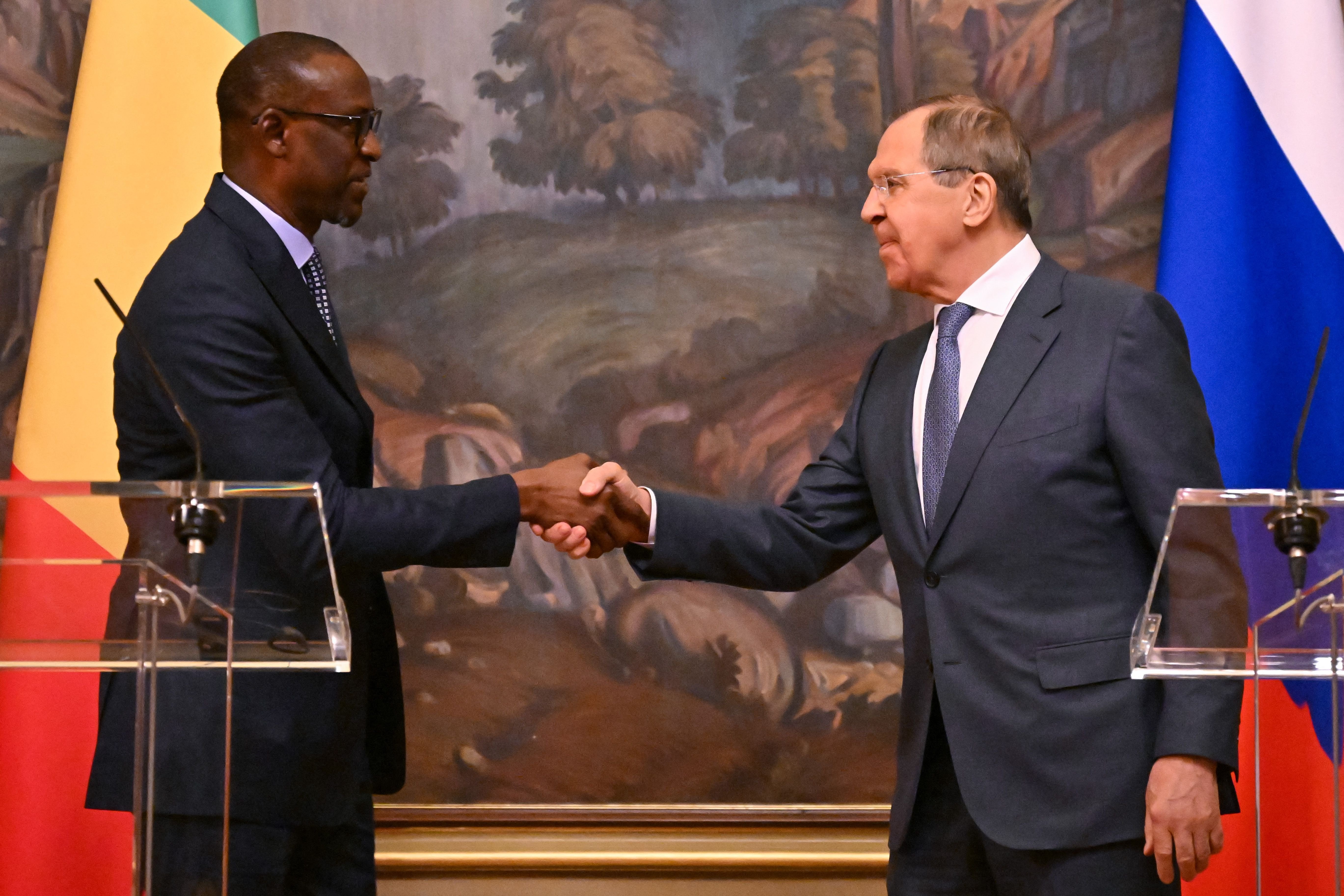
“Africa is one of our key foreign policy priorities,” said Russian Foreign Minister Sergei Lavrov. Russia’s presence in the region is the result of a long-standing and consistent strategic orientation, not a situational response to sanctions. Nevertheless, different phases of the war have also changed the dynamics of Russia’s external relations.
By early 2025, Russia had begun reorienting its African presence: from the landlocked AES triangle in the Sahel—Mali, Burkina Faso, and Niger—westward toward the countries of the Gulf of Guinea. Maritime access transforms Russia’s African presence from a costly military-political operation into a self-financing scheme.
Russia’s broad presence in the region works in both directions: Russia gains operational freedom for its shadow fleet, while African countries receive regime protection and weapons. The unprecedented scale of sanctions in 2025 forced Russia to use its accumulated influence in Africa to address a critical need: keeping the “shadow fleet” operational.
From an operational standpoint, the African space is an ideal environment for flag-hopping. The continent provides enough registries for a vessel to jump between them indefinitely. The sanctioned tanker Aqua Titan changed flags five times between February and November, three of them African: the Comoros, Gambia, and then Cameroon.
The key reason for this is the complete lack of coordination among registries: each subsequent registry accepts the vessel as clean, without access to its history. Only one African country, Liberia, participates in the RISC database—an initiative of 13 countries that allows registries to exchange information about suspicious vessels, refusals, and deregistrations. No other African registry used by the “shadow fleet” belongs to it, and no alternative regional information-sharing initiative exists. The problem, therefore, is not isolated weak registries, but the fact that together they form a space where any vessel can find a new flag.
Moreover, vessels in Russia’s “shadow fleet” systematically fail to meet international safety standards: 96% of crude oil tankers and 92% of petroleum product tankers in Russia’s fleet are more than 15 years old, most lack proper insurance, and many have not passed classification inspections. That is why they need registries that will formally assume responsibility for a vessel without exercising any real oversight.
The tanker Mires provides a critical example. The sanctioned vessel, 20 years old and lacking an ice class certification, traveled the Northern Sea Route without escort despite assessments that it risked severe damage from collisions with sea ice. The vessel sailed under the flag of Sierra Leone—a tropical country with no experience in Arctic shipping, no infrastructure for monitoring vessels in icy waters, and no ice-class standards.
Similarly, the container ships Hong Chang Sheng and Honwell, aged 26 and 24 years respectively, operate between St. Petersburg and China along the same route, usually with their AIS systems turned off and without inclusion in the official NSR registry. No registry claiming internationally recognized technical oversight would accept vessels with such profiles for these routes. The value of African registration lies precisely in the fact that it makes no such claims: it provides legal existence to vessels that, by any generally accepted standard, should not be allowed to sail.
What African regimes get in return
The willingness of African regimes to cooperate with Russia is largely mutually beneficial, as it implies active participation in these schemes. In the main “flags of convenience” countries, ties with Moscow are being steadily deepened across key sectors.
By 2026, the number of Russian embassies on the continent is expected to reach 49, with new embassies opening specifically in states where shadow fleet registries are concentrated—the Comoros, Togo, and Gambia. Moreover, presidential elections are scheduled in Gambia in December 2026, and there are signs that Russia will help incumbent President Adama Barrow remain in power for a third term.
Other countries hosting large portions of Russia’s shadow fleet registrations—Benin, Djibouti, Guinea-Bissau, and São Tomé and Príncipe — are also set to hold elections in late 2026, creating what Moscow sees as a “window of opportunity” to cultivate new loyal regimes.
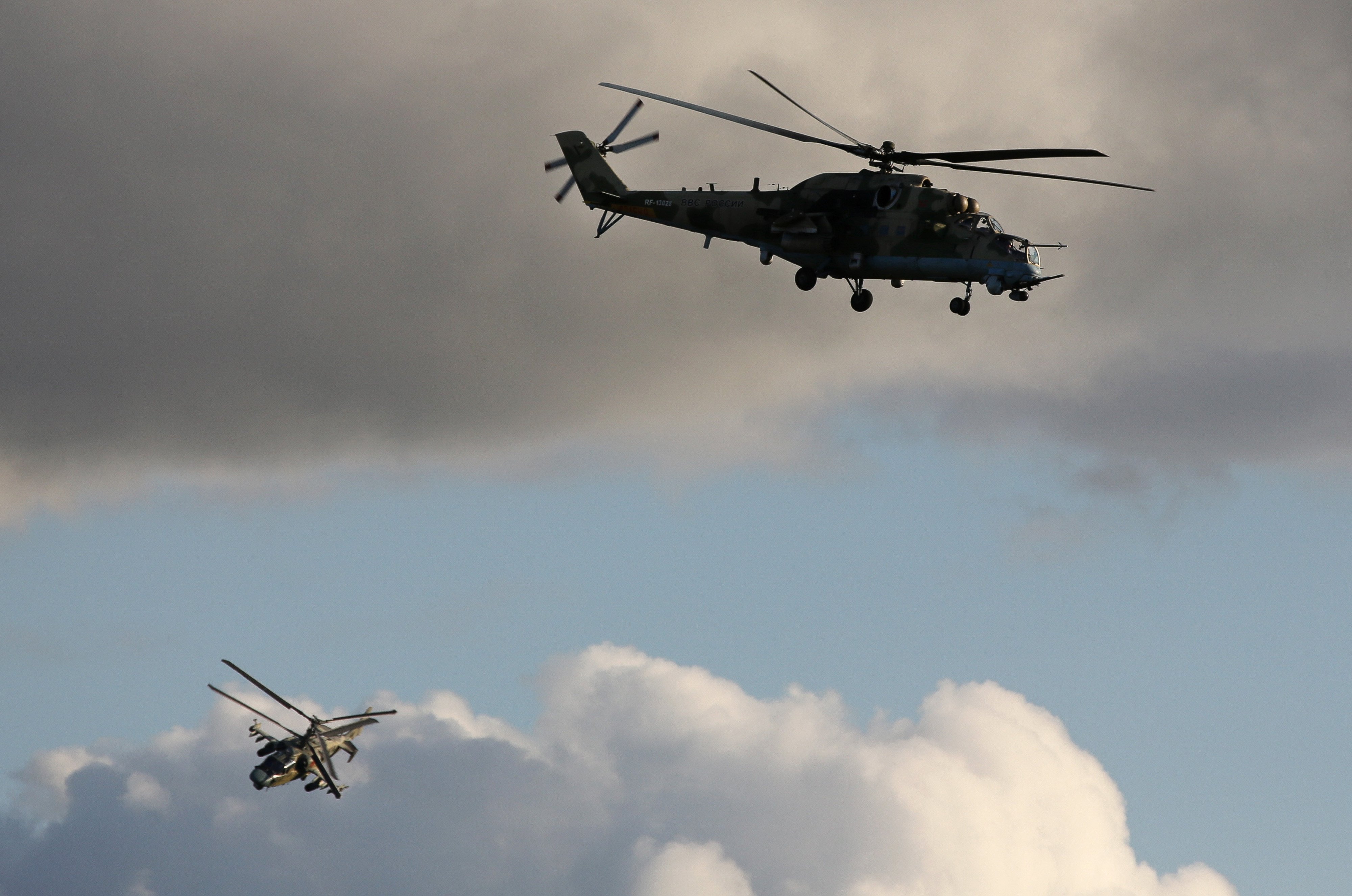
Russia’s military presence includes 43 military-technical cooperation agreements with African states. In Equatorial Guinea, 200 Russian military personnel are stationed to protect President Obiang’s regime and train the army. Cameroon and Togo receive Russian arms deliveries, including Mi-8MT/Mi-17 and Mi-24V/Mi-35 helicopters, Pantsir-S1 air defense systems, armored personnel carriers, and heavy artillery. Nigeria signed agreements for the delivery of Mi-35M and Mi-171E helicopters.
On the other hand, for regimes that came to power through coups—Mali under Assimi Goïta, Burkina Faso under Ibrahim Traoré, Niger under Abdourahamane Tchiani, and the Central African Republic under Faustin-Archange Touadéra — the African Corps, a structure tied to Russia’s GRU military intelligence agency, directly ensures regime survival.
At the same time, at least 22 countries have been targeted by Russian disinformation campaigns, while interference in electoral processes through the “Lakhta Project” network has been documented in 18 countries. Twenty African states have signed nuclear cooperation agreements with Russia.
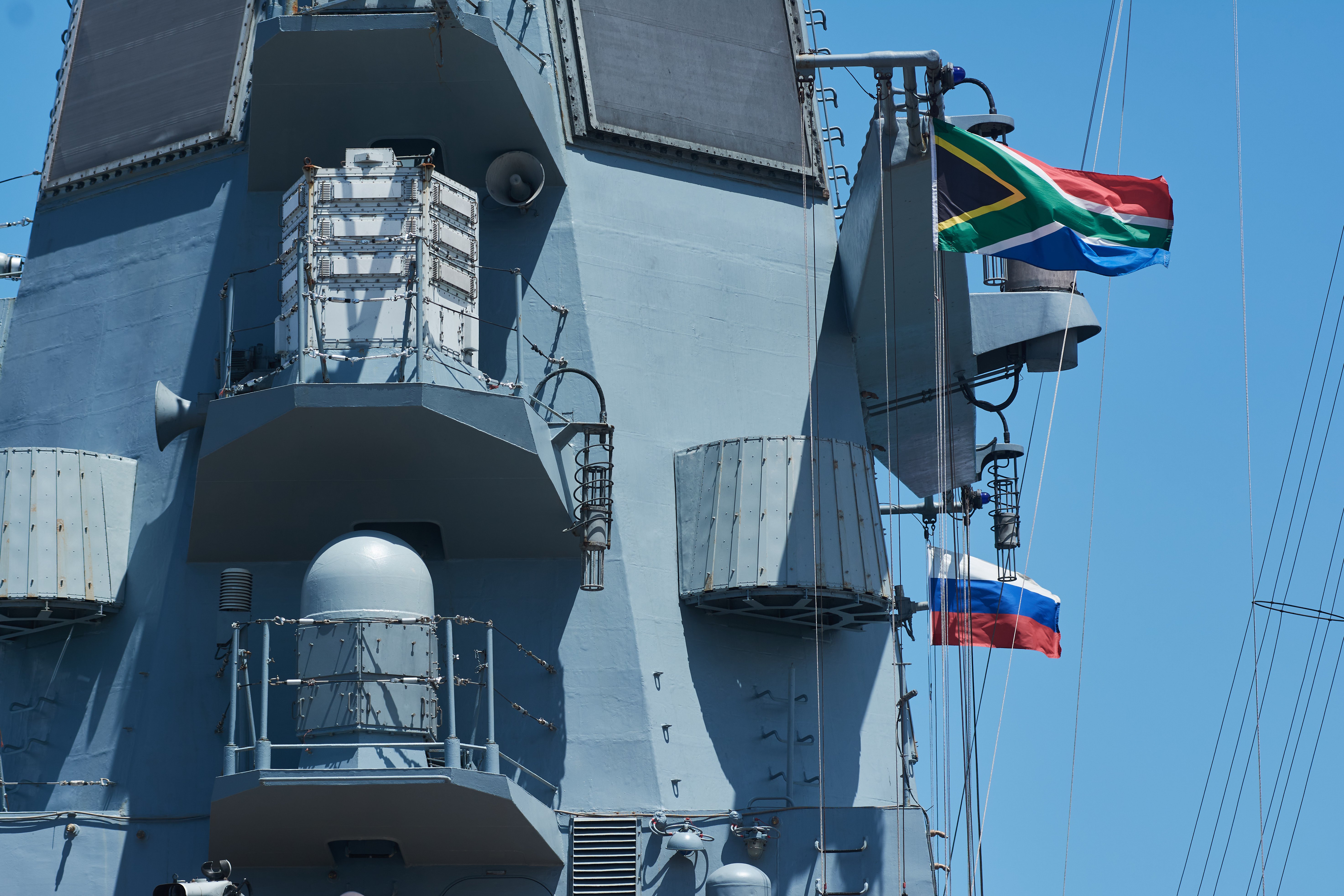
The shadow fleet itself also serves as an instrument of Russia’s presence. In late March 2026, the vessel Sabetta, escorted by the military ship Aleksandr Shabalin, delivered around 100 pieces of equipment to the port of Conakry in Guinea, including BMP-3 infantry fighting vehicles and Spartak MRAP armored vehicles. The latter were first unveiled in 2019 and have been used by Russian special forces against Ukraine.
The logistical infrastructure for these deliveries was provided by subsidiaries of Russia’s UC Rusal, registered in Guinea itself. Similar deliveries also involved the vessels Baltic Leader and Patria, which had already been sanctioned as part of the “Syrian Express”—the group of Russian ships maintaining naval transport links between Syria and Russia.
Under such conditions, the cost of registering sanctioned vessels is consciously viewed by African regimes as acceptable. Registration costs them little in an environment where international law lacks real enforcement mechanisms, while in return the regime receives an electoral guarantee of its own survival.
Sanctions packages targeting vessels and registries do not alter this balance. They raise the operational costs of the fleet but do not affect the political logic that motivates African regimes to cooperate. As long as participation in the scheme remains more beneficial than any alternative, it will continue to reproduce itself—and all conditions for this are ensured by an infrastructure that is actively developing yet remains largely untouched by sanctions.
Was Africa a temporary solution?
The wave of returns to the Russian flag in late 2025 and early 2026 revived debate over whether Russia’s “African strategy” had exhausted itself. The share of vessels sailing under the Russian flag surged from 3% to 21% over the past year. In Baltic Sea ports, the trend was similar—from 1% in 2025 to 14% in 2026.
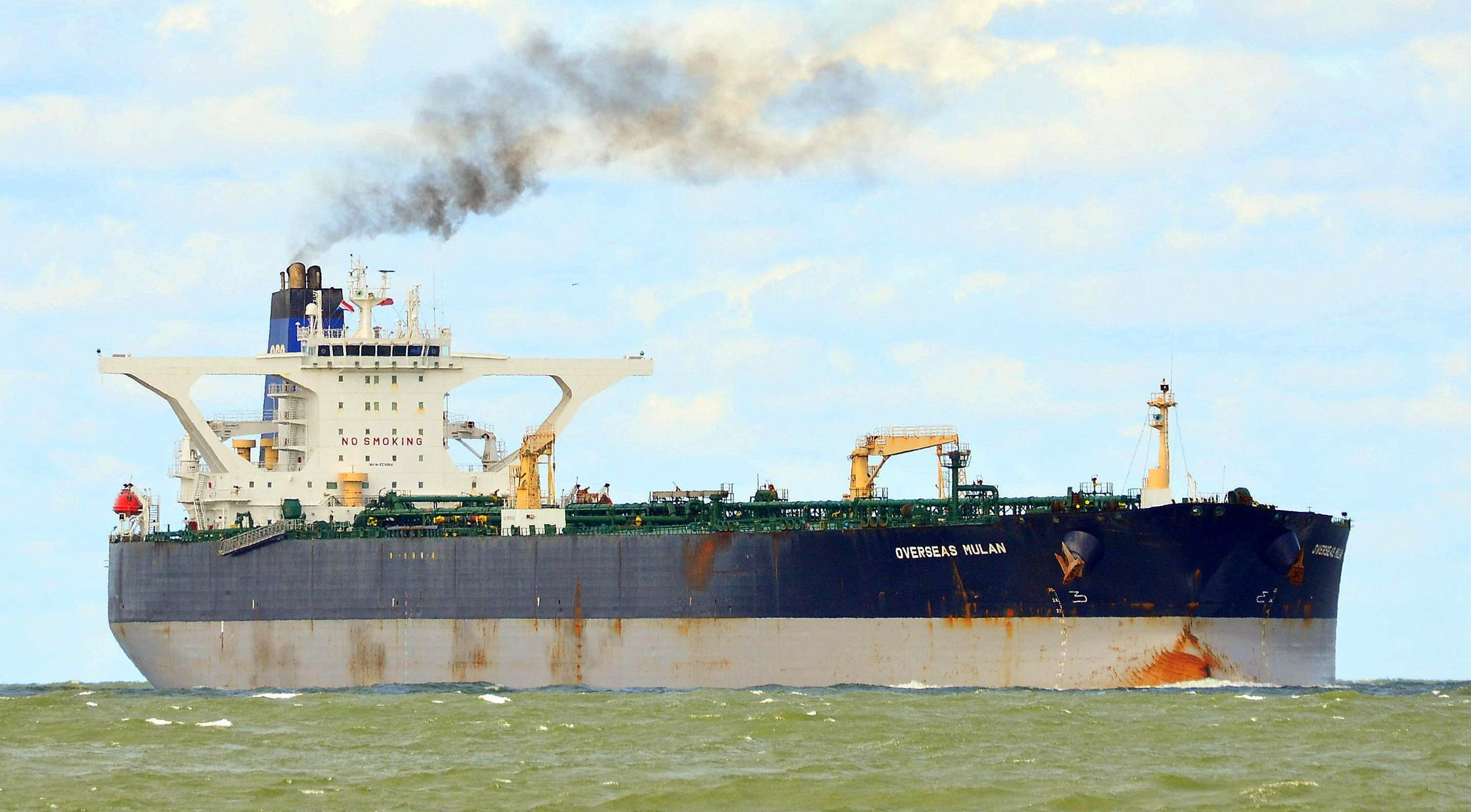
The reason lies in the practical consequences of sanctions: African flags are largely on the Paris MoU’s “black list” and are therefore subjected to inspections and detentions far more frequently than others. A simple mathematical calculation demonstrates the cost of risk. In 2025, the average price of a 15-year-old VLCC supertanker was $59 million. A single Suezmax crude oil shipment carries cargo worth approximately $60–70 million, in addition to insurance and registration costs.
Port delays mean lost freight revenue of $30,000–50,000 per day and potentially frozen cargo. Thus, each vessel faces risks exceeding $100 million in potential losses, while Russia as a whole transports around 3.7 million barrels per day, generating $87–100 billion in annual revenue—an amount which, according to US-based think tank Center for Strategic and International Studies CSIS calculations, exceeds the total economic and military aid provided to Ukraine since the beginning of the war.
The shift back to the Russian flag began after several high-profile detentions. In December and January, the Panamanian tanker Bella1, transporting oil from Venezuela, evaded the US Coast Guard and the United Kingdom for two weeks. During the pursuit, the crew painted a Russian flag on the vessel, and several days later, the ship changed its name to Marinera and re-registered in Russia—though this failed to prevent a US military boarding operation.
In response, the Russian Foreign Ministry stated that, under UNCLOS , no state has the right to use force against vessels registered in a foreign jurisdiction, most likely referring to Article 92 while deliberately ignoring the right of visit under Article 110 and the requirement for a genuine link between a vessel and its flag state under Article 91.
On January 22, a French convoy assisted by the Royal Navy detained the sanctioned vessel Grinch, sailing under the Comoros flag and traveling from Murmansk. Just four days later, on January 26, 2026, 14 coastal governments from EU countries and the UK announced plans for immediate action against “false flags,” after which the shift to the Russian flag accelerated even further.
Within just two months of active detentions—December and January—40 vessels returned to the Russian flag. During the first week of February 2026 alone, at least three sanctioned vessels—Akkord, Saga, and Topaz—completed such transitions. Their previous flags were African, including Liberia, Gabon, and the Comoros.
At present, more than 100 tankers with deadweight tonnage above 50,000 tons sail under the Russian flag, nearly double the number from a year earlier. Russia's largest shipping company Sovcomflot absorbed half of all re-registered tankers. Before 2022, only about 35% of its fleet sailed under the Russian flag, while the overwhelming majority used foreign open registries. That figure has now risen to 56%.
This is a paradoxical development: the traditional registries Russia relied upon throughout its export history can no longer protect its cargoes under wartime conditions.
Nevertheless, the logic behind the shift to the Russian flag differs fundamentally from the logic of using African registries. An African flag is a way to buy time. A vessel can only be declared stateless after authorities prove the registration is fraudulent, verify insurance documentation, and clarify the circumstances with the flag state—a process that takes months.
African countries enable numerous manipulations: open registries conceal the identities of beneficial owners and the nationalities of crews, fraudulent schemes involving IMO and MMSI numbers exist, and communication with the flag state can be intentionally obstructed. Notably, in the case of the tanker Kiwala—from which drones were most likely launched over the airports of Copenhagen and Oslo—Djibouti initially reported that the vessel’s registration had been canceled, only to later assume responsibility for it two weeks afterward.
The main resource of this scheme is time, which prevents detentions from effectively combating the “shadow fleet” because of the sheer scale of operations. Along the Baltic route alone, through which 60% of all Russian crude oil exports pass, two-thirds of tankers sailed under “false flags,” primarily African ones.
For its part, the Russian flag serves a different purpose: protecting the most vulnerable vessels by restoring full flag-state jurisdiction. At minimum, boarding a legitimately registered vessel requires Russia’s permission. This allows Moscow to apply pressure through international maritime law, trigger diplomatic scandals, and, as the Bella1 case demonstrates, even involve warships—making the political cost of detention higher.
A study by maritime intelligence platform Windward notes that another 120 Russian merchant tankers currently broadcasting flags of fraudulent registries have profiles suggesting they may make a similar transition soon.
At the same time, Russia is expanding its own insurance system. The 2025 obligation imposed on leading European port states to inspect vessel insurance documents forced Russia to pivot toward domestic insurers operating with funds from the Russian National Reinsurance Company—effectively from the state budget.
Ingosstrakh remains the longstanding leader, while two other companies, AlfaStrakhovanie and Sogaz, have grown since 2022. Before the full-scale war, Russia used the services of the Western insurance group, the International Group of Protection & Indemnity Clubs, but by 2024, one-quarter to one-fifth of Russian oil tankers in the Baltic Sea were insured by Russian insurers.
It is critically important not to interpret this trend as Russia abandoning its “African strategy.” There is no basis to believe Moscow is giving up African infrastructure. Rather, it is adding a new layer of protection for the most vulnerable vessels. African registries, meanwhile, continue to perform their function: providing the operational mass of a fleet that is too large to be protected entirely by the Russian flag, yet too economically valuable to abandon.
The world Russia built beyond sanctions
Russia operates a fleet of more than 1,500 active vessels, yet despite this unprecedented scale, boarding operations remain loud but isolated exceptions. Europe has issued several statements, including commitments to inspect the registrations of suspicious vessels. The United Kingdom alone inspects an average of 600 vessels every six months, yet has still not carried out a single independent detention.
In early January 2026, Keir Starmer publicly stated that the UK had received legal confirmation of such powers, but during that same month, at least 42 sanctioned tankers passed through the English Channel without obstruction. By March, the number had reached 98 vessels.
Even the most active states have still failed to target the core fleet of 65 tankers, not to mention the broader pool of 340 key Russian vessels. Such inconsistent policies inflict isolated losses on individual ships while simultaneously giving Russia time to build a full-fledged infrastructure operating in parallel to international maritime law.
Under these conditions, international maritime law itself is beginning to lose operational meaning. When detaining a single vessel under a “flag of convenience” requires weeks of verification, while a fleet of thousands of other ships continues moving uninterrupted, the law becomes a procedure without consequences.
Moreover, the constant changes of IMO numbers, vessel names, and registration countries, along with fully fraudulent registries that existed long before Russia’s shadow fleet emerged, undermine the very architecture of international maritime law rather than merely circumventing it.
Since the start of the war, Europe has faced a wave of sabotage: damage to undersea cables and the Balticconnector gas pipeline between Finland and Estonia, surveillance drones over military sites in Germany and the Netherlands, and drone launches above the airports of Copenhagen and Oslo.
Yet these incidents are the logical consequence of the fact that Russian vessels which supported expansionist warfare in Syria and supplied weapons to illegitimate African regimes long before 2022 continue to sail freely through Europe’s international and territorial waters.
Accordingly, each month of inaction against the “shadow fleet” creates new threats to national security and new multimillion-dollar financial losses for Europe.
Still, the deepest problem is that the “shadow fleet” is not about Russia alone. It is a collective term for sanctions evasion by several regimes simultaneously: Russia, Iran, Venezuela, Cuba, North Korea, and others.
These countries coordinate efforts to create shared infrastructure. For example, the New Zealand insurer Maritime Mutual facilitated shipments of already sanctioned Iranian oil worth $18.2 billion, while additionally insuring $16.7 billion worth of Russian oil shipments.
All three vessels belonging to the Vietnamese front company Sao Viet Petrol Transportation—Panda, Ivy, and Leopard—transport both Russian and Iranian oil. The same African and Caribbean flags register tankers for both regimes, while the same operators, primarily from the UAE, manage their registries.
What is described here is the deliberate use of a single commercial structure whose clients are sanctioned states seeking to export by sea. Coordination between the two fleets at the jurisdictional level means that any progress in pressuring one fleet is automatically limited as long as the other remains untouched and can provide backup routes, registries, and intermediaries.
The consequences of international law’s dependence on networks of “shadow fleet” states are already being felt globally, as demonstrated by the so-called “controlled access regime” in the Strait of Hormuz. In practice, the maritime route through which more than 20% of global oil consumption passes has become a zone of selective navigation for those maintaining direct diplomatic channels with Tehran.
On April 29, 20 crossings through the strait were recorded, all involving vessels under the flags of Iran, India, and Tanzania. On other days that month, tankers registered in Gambia, Somalia, Madagascar, and the Comoros also passed through, along with the Russian-linked tanker Arhimeda.
Under the baseline scenario for the war in Iran, Russia’s fossil fuel revenues are expected to rise from $158 billion in 2025 to $229 billion in 2026. It was precisely against this backdrop that the Russian leader Vladimir Putin proposed restoring oil and gas supplies to Europe.
Thus, the “shadow fleet,” against which Europe directed all of its sanctions efforts in 2025, effectively financed a new ultimatum to Ukraine, Europe, and the wider world in 2026.
As long as the West’s response remains fragmented, the “shadow fleet” will continue operating at scale, while Russia’s new “African strategy” demonstrates its intent to create a resilient infrastructure capable of minimizing the effectiveness of sanctions.
In this context, the EU’s 20th sanctions package represents a step in the right direction. It introduced restrictions targeting port infrastructure connected to two key Russian ports—Murmansk and Tuapse—and, for the first time in history, a third-country port, Karimun in Indonesia, was subjected to regulation because of ties to the “shadow fleet.”
The “African scenario” marks a critical stage in the evolution of sanctions evasion schemes: the low cost of registration for both African countries and Russia has enabled the creation of a vast, practically uncontrollable infrastructure of “flags of convenience.”
Accordingly, the logic of European sanctions must evolve as quickly as possible from targeting individual vessels to dismantling the identified ecosystem that enables their existence.
This material was prepared as part of the cooperation between UNITED24 Media and the international analytical and information community Resurgam.
Discuss this article:
-4a56a6b482ec132402c16ef6fcabf9a2.png)


-c439b7bd9030ecf9d5a4287dc361ba31.jpg "Photo of Katherina Popilnichenko")

-72b63a4e0c8c475ad81fe3eed3f63729.jpeg "Photo of Cyril Barabaltchouk")