- Category
- Life in Ukraine
Zoo at War—The Surreal Life of Ukrainian Tigers in a Frontline City
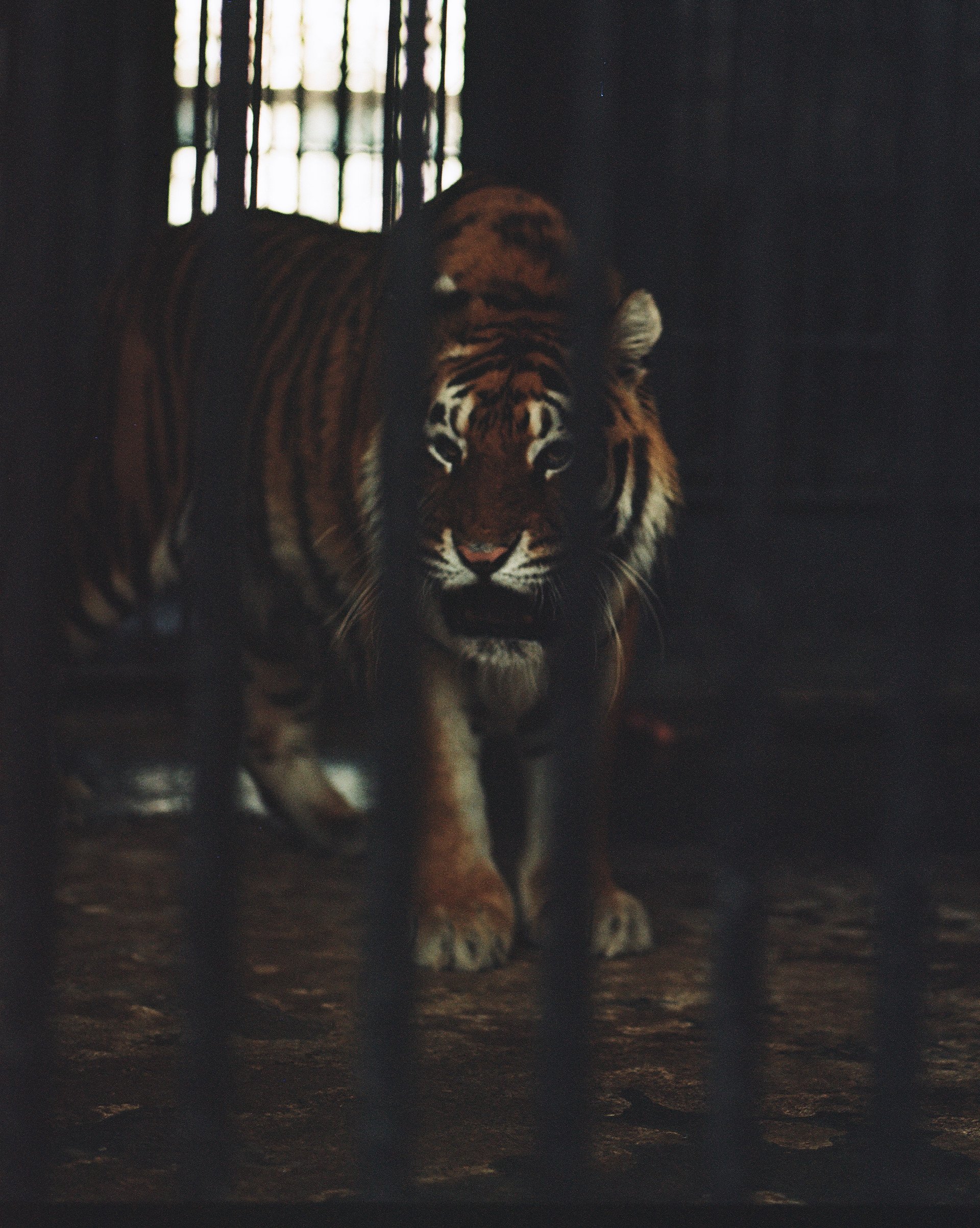
Eight Russian rockets have landed inside Mykolaiv Zoo since the full-scale war in Ukraine began. One—just meters from the enclosure of two tiger sisters.
 Prefer U24 Media on Google
- Authors

-554f0711f15a880af68b2550a739eee4.jpg "Photo of Lucile Brizard")
There is nothing natural about a zoo. I came to this conclusion as I looked at an impaled rocket—its tail sticking out of the ground just meters from the two Amur tigers' enclosure in the city of Mykolaiv, located roughly 60 km away from the frontline.
The tigers—Agrypyna and Penelopa—are sisters born in captivity on September 21, 2005. They have lived through Ukraine’s 2014 Revolution of Dignity, Russia’s attempted illegal annexation of Crimea, its war in eastern Ukraine, and finally its full-scale invasion in 2022.
“They were scared,” says Sasha, the zookeeper looking after Penelopa and Agrypyna, recounting the beginning of the war. “We brought them in from outside so they wouldn’t just lie there exposed.”
She cranks the lever of the mechanical elevator, which deposits slabs of red meat, chicken carcasses, and fish into the enclosure, and continues, “Those noises, the siren—they hear it too.”
When all the food has been dropped into the various enclosures, Sasha, hands on hips, turns and smiles. She makes a clicking sound with her mouth and calls to one of the tigers, “Penelopa!”

Dedicated to the two tigers' care for 18 years, Sasha is young and reserved. She laughs and predicts she will stay at the zoo until retirement as she walks over to Penelopa, who flips onto her back and starts playing like a cat with a plastic sandal repurposed into a toy.
It’s a rare sight, as what I remember the most about the zoo are animals pacing, to and fro, their stride angled and direct.
Can you evacuate a tiger?
Ukraine’s southern city of Mykolaiv is an important port with global grain exports destined for Africa, Asia, and the Middle East. In the early days of the war, Russian forces, trying to reach the city of Odesa, pushed into this strategic hub until the Ukrainian Forces liberated it in March 2022.
Since then, Russian drones and missiles have targeted Mykolaiv’s infrastructure daily. Fragments of eight rockets have fallen within the zoo’s gates, one of them just by the tiger’s outdoor enclosure.
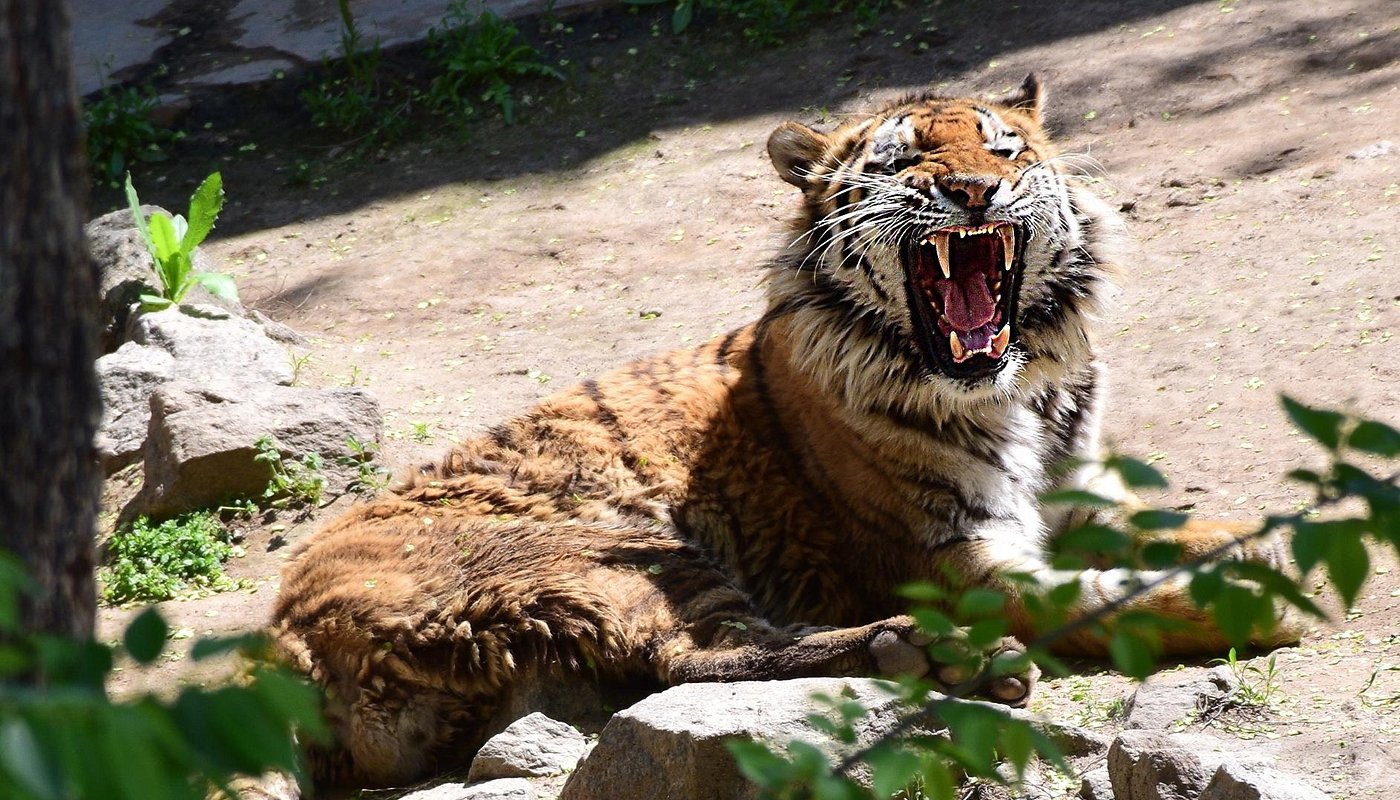
As the explosives fell, the 120-year-old zoo faced a dilemma: Should it evacuate the animals? The task proved to be Herculean and ultimately impossible, as cages, logistical routes, and transport vehicles were not available.
With the animals unable to leave, the zoo then turned to how to sustain them. They were running out of food. Then, Mykolaiv lost access to its main source of clean water after Russian forces destroyed a critical water supply on the Dnipro River, leaving the city parched for about two months.
“At first, we just worked with what was left,” says Sasha, commenting on rationing food in those beginning days. “Shells were falling, things were crumbling,” she adds, looking over at Agrypyna, lazing in the corner.
Small hints of the past struggle are dotted around the enclosures. World Food Program boxes are scattered, filled with canned beans. Up in the main hall, an educational sign teaches children how to identify land mines.
The tigers, on the other hand, seem unbothered by the war and remain true to their nature. This nature reveals itself suddenly, and we are reminded as their growls echo against the walls, that they are wild predators that kill.
Preserving a rare species in captivity
Volodymyr Topchiy, the head of Mykolaiv Zoo, makes us two small coffees in his office, surrounded by pictures of animals, statuettes, and a huge aquarium.
“A tiger will always be a tiger, and a leopard will always be a leopard,” he says. “These are predators. The animal watches you.”
For Topchiy, the need for zoos is clear: “There are fewer and fewer places where animals can live peacefully, where they aren’t destroyed, either by hunting or more often because their habitats are taken. The main role of the zoo—of all good zoos—is preserving a rare species in captivity.”
Today, Mykolaiv is about 60 km from the frontline. As fiber optic drones overwhelm contact lines, Russian forces slowly but surely advance, and in 2025, roughly 19% of Ukraine is occupied.
The consequence of invasion is a tender and unspoken point of understanding that threads Sasha, Volodymyr, Agrypyna, and Penelopa together.
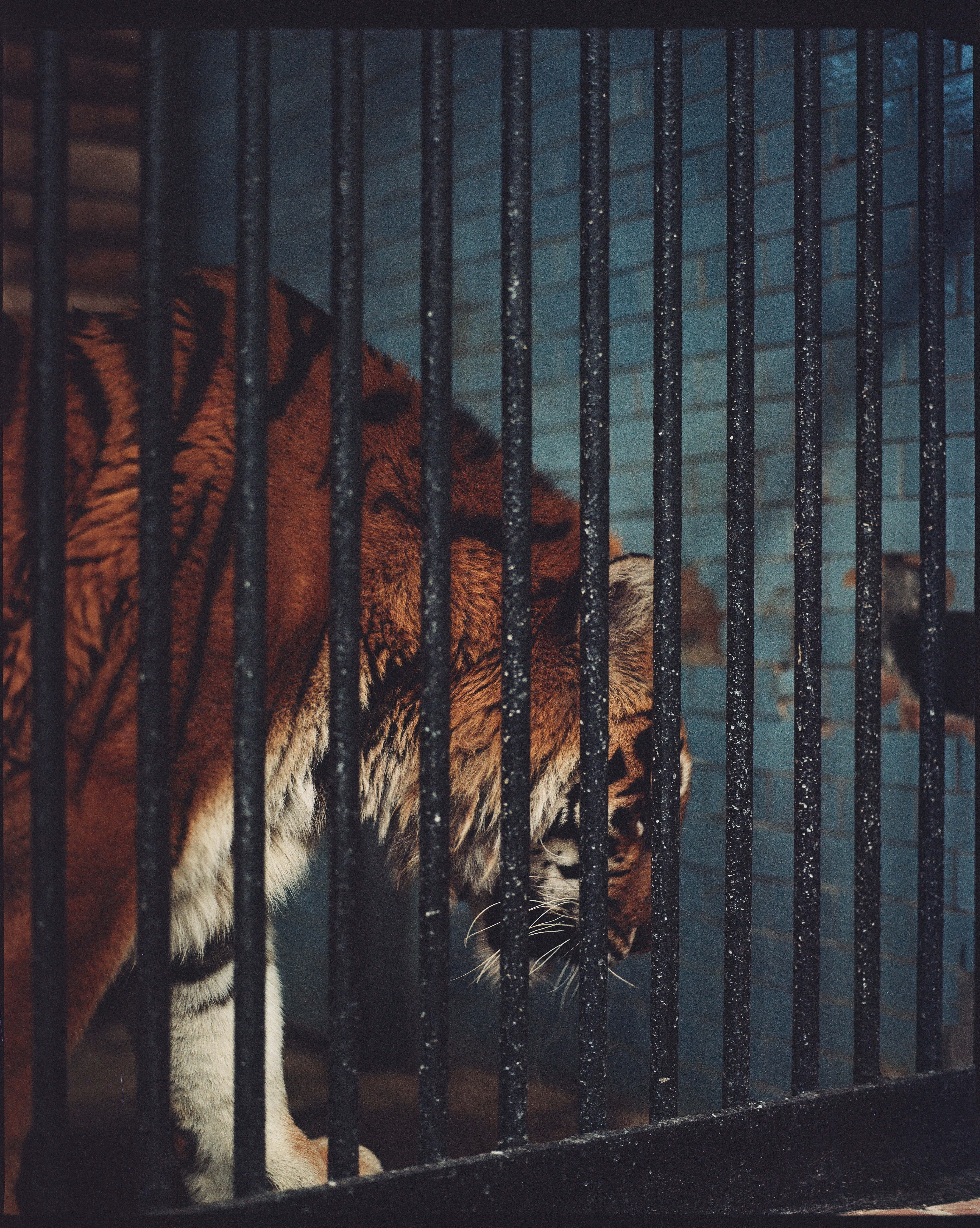
In the 1940s, the Amur tiger population was down to around 40 individuals globally, as they were hunted for pelts while humans decimated and settled their territory. Notoriously solitary, tigers roam large swathes of territory, up to 1,385 km².
Agrypyna and Penelopa have mothered 47 cubs in total, which eventually went to different zoos around the world as part of an EU breeding program.
This practice, known as “Captive breeding,” prevents a species from going totally extinct by freezing it in hopes that the conditions in the wild will become optimal for its eventual reintroduction. However, tigers born in captivity cannot be released into the wild unless this is actively pursued while they are still cubs.
At feeding time, the big cat enclosure erupts with sound. Huge platters of meat are delivered, and Sasha sorts through them wearing long latex gloves. No direct physical contact is made with the animals, and the meat is dropped into the enclosures through various hatches and levers.
The tigers growl, falling silent when they drop to the ground to begin their meal. Sasha’s small frame is heightened as two full-grown lions pace behind her. Inside, we hear the strange hoot of the jaguars.
Penelopa takes the meat away and hides behind thick foliage to eat. Suddenly, intermingled with the green of the leaves, the tiger’s stripes appear and then disappear. Tiger stripes are the same as human fingerprints, and no two stripes have the same pattern.
Beyond this physical distinction, Sasha comments on the tiger sisters' individual personalities, describing them as completely distinct from each other. While she speaks, I imagine glimpsing black and orange fur flashing through a line of trees in a distant forest covered in white snow.
Agrypyna and Penelopa clearly have the instincts of wild animals, but there seems to be nowhere to showcase them. Their presence at the zoo proves to visitors that they exist, that tigers like them are out there somewhere in the wild. The zoo, then, is merely a compromise.
Discuss this article:



-24deccd511006ba79cfc4d798c6c2ef5.jpeg "Photo of Louis Beaudemont")