- Category
- War in Ukraine
Russia Turned Crimea Into a Missile Launchpad; Ukraine Is Now Dismantling It. Here’s How
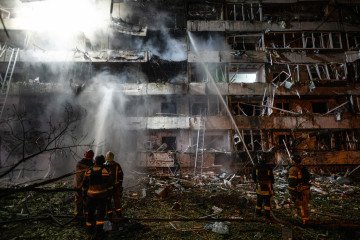
As Ukraine works to isolate Crimea from Russia and disrupt logistics on the southern front, its strikes on the peninsula serve as a form of proactive air defense, eliminating Russian missiles and drone salvos at their source before they can be used against Ukrainian cities.
 Prefer U24 Media on Google
- Authors


-605be766de04ba3d21b67fb76a76786a.jpg "Joseph Place")

Across 40 relentless days and nights between late June and early August, Ukraine launched a sweeping long-range campaign to paralyze Russian oil refining, cripple arms production, and neutralize shadow fleet vessels in the Black Sea and Sea of Azov—all to pressure Moscow toward peace.
Strikes hit key economic targets feeding the Kremlin's war chest, sending dual-use Wildberries logistics centers over 1,700 kilometers away in Yekaterinburg up in smoke. Eleven of Russia's largest oil refineries were also set ablaze, with hits reaching a record 2,500 kilometers into the interior, causing widespread fuel shortages and emergency rationing nationwide.
However, Ukraine’s strikes are also delivering a major blow to Russia’s ability to strike Ukraine from Crimea and hold on to the peninsula.
Why Crimea matters for Russia’s air campaign
Beyond deep strategic economic strikes, Ukraine's campaign relied heavily on "middle strike" drones to dismantle Russian supply chains and air defenses. Nowhere was this more evident than across temporarily occupied Crimea.
Thanks to Ukrainian efforts to hit Russian air defenses, they have been able to exploit gaps better and strike missile and drone launch sites. It is what Tomáš Nagy, an air defense expert and analyst at GLOBSEC, called “passive air defense,” which means that “you harden everything that you can harden, you mobilize whatever you can mobilize, and yes, you strike the capabilities of the other side to create vulnerabilities. And the best that the Ukrainians can do is to try to cripple [Russian] production capacity as much as possible.”
"It all started with Crimea, and it will end with Crimea,” a former Norwegian Defense Attaché to Ukraine, Hans Petter Midttun, told us. He underscored the peninsula's ultimate role in Russia's war against Ukraine.
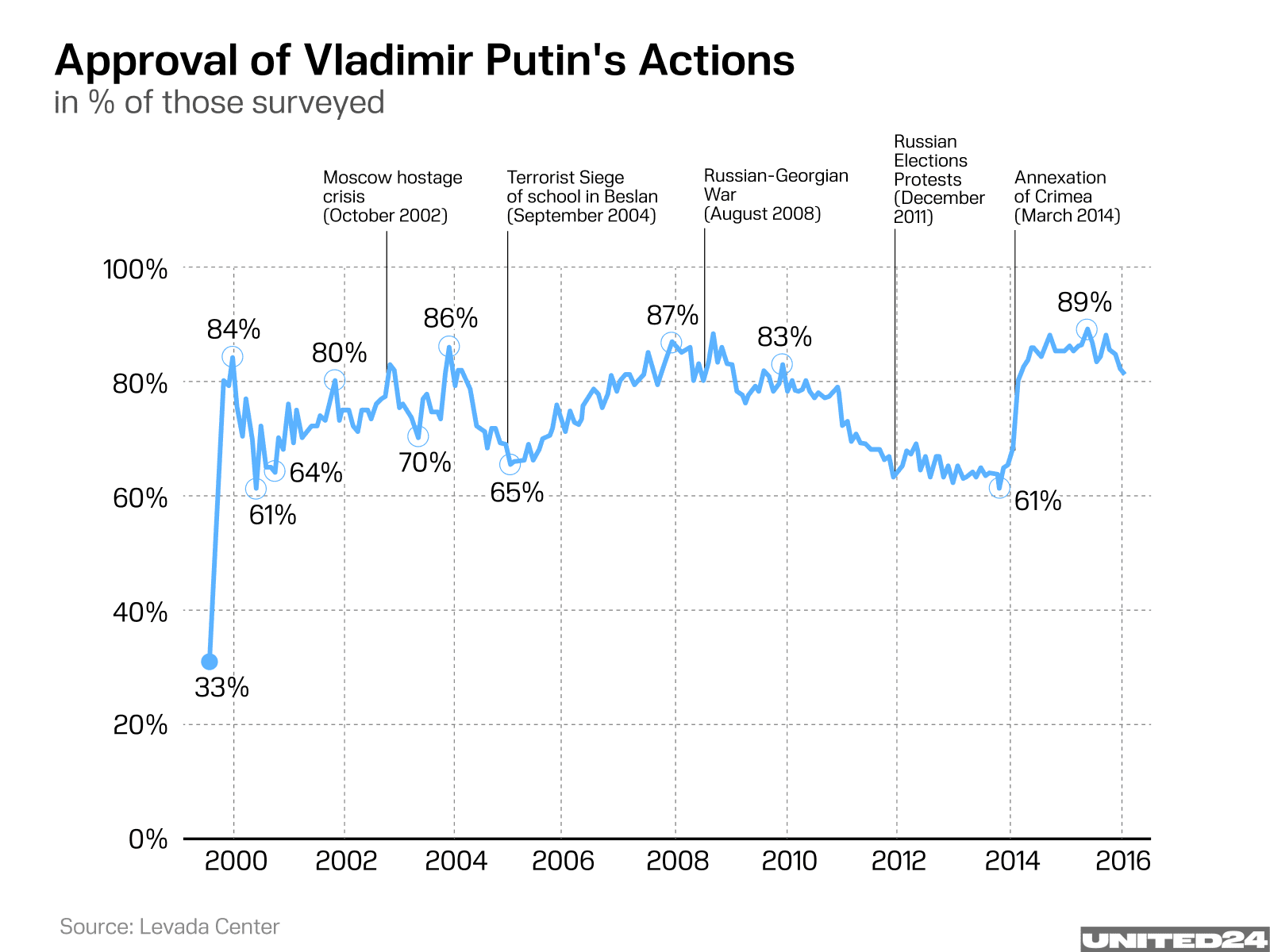
"Russia's illegal annexation of Crimea in 2014 had a dramatic and immediate positive effect on Vladimir Putin's popularity and perceived legitimacy among Russians," he said, adding that it served as "one of the most important turning points in his domestic political standing".
Polling tracked this shift directly, showing Putin’s trust and approval for the general direction of the country jumped notably by August of that year, while overall approval for Putin reached 86% by September.
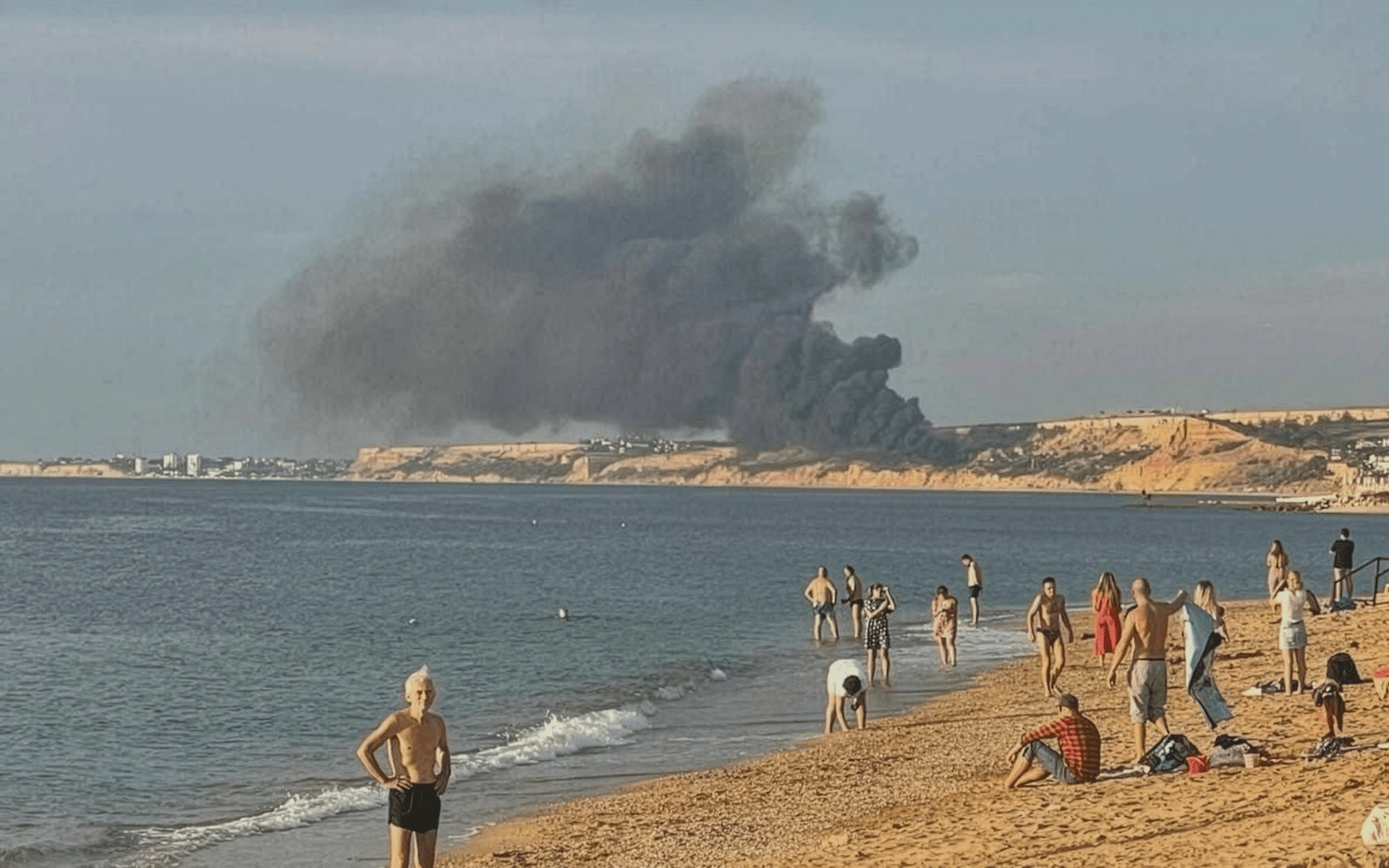
For years, "Crimea was perceived as the 'unsinkable aircraft carrier', essential for Russian power projection in the Black Sea and beyond," while also enabling full Russian control over the Sea of Azov, Midttun said. "Ukraine has turned a strategic trophy into a strategic liability. The campaign aims to make Russian operations from Crimea unsustainable. Every Russian military installation on the peninsula–airfields, naval bases, logistical hubs, sensors and weapons–is today within range of Ukrainian missiles and drones.”
If Crimea is liberated, Putin will likely fall.
Hans Petter Midttun
Former Norwegian Defense Attaché to Ukraine

Ukraine has managed to scale up its drone launches against Russia in both occupied territories and Russia itself, which is redefining the war.
“In the first 16 days of August, the reported rate rose to at least 480 per day,” said Midttun. “With the seven-day average reaching about 540 by 16 August. Russia is presently unable to effectively protect itself against Ukrainian missiles and drones.”
What is Ukraine's active (or proactive) air defense?
While one of the main goals of targeting Crimean infrastructure has been disrupting Russian supply lines, the campaign serves a vital secondary role: proactive air defense.
“Crimea is well within range of southern Ukraine,” said Midttun. “It reduces Ukrainian warning time and ability to counter incoming threats. The maritime domain further increases Ukraine’s defensive challenges, making it hard to locate air defense threats." That geography makes Crimea particularly valuable as a launchpad for Russian missile and drone attacks.
Crimea gives Russia a platform to project its military power from the south, creating what Midttun described as a “near omni-directional” threat and preventing Ukraine from concentrating its forces in the north and east.
To counter this, Ukrainian mid-range strikes degrade threats directly at their launchpads.
How Ukraine targets Russian missile launch infrastructure
Under Operation Crimean Power Switch Off, Ukrainian drone waves methodically degraded Russia's launch capabilities across the peninsula, striking a key forward staging hub and suppressing the daily barrage directed at Ukrainian civilians, cities, and critical infrastructure.
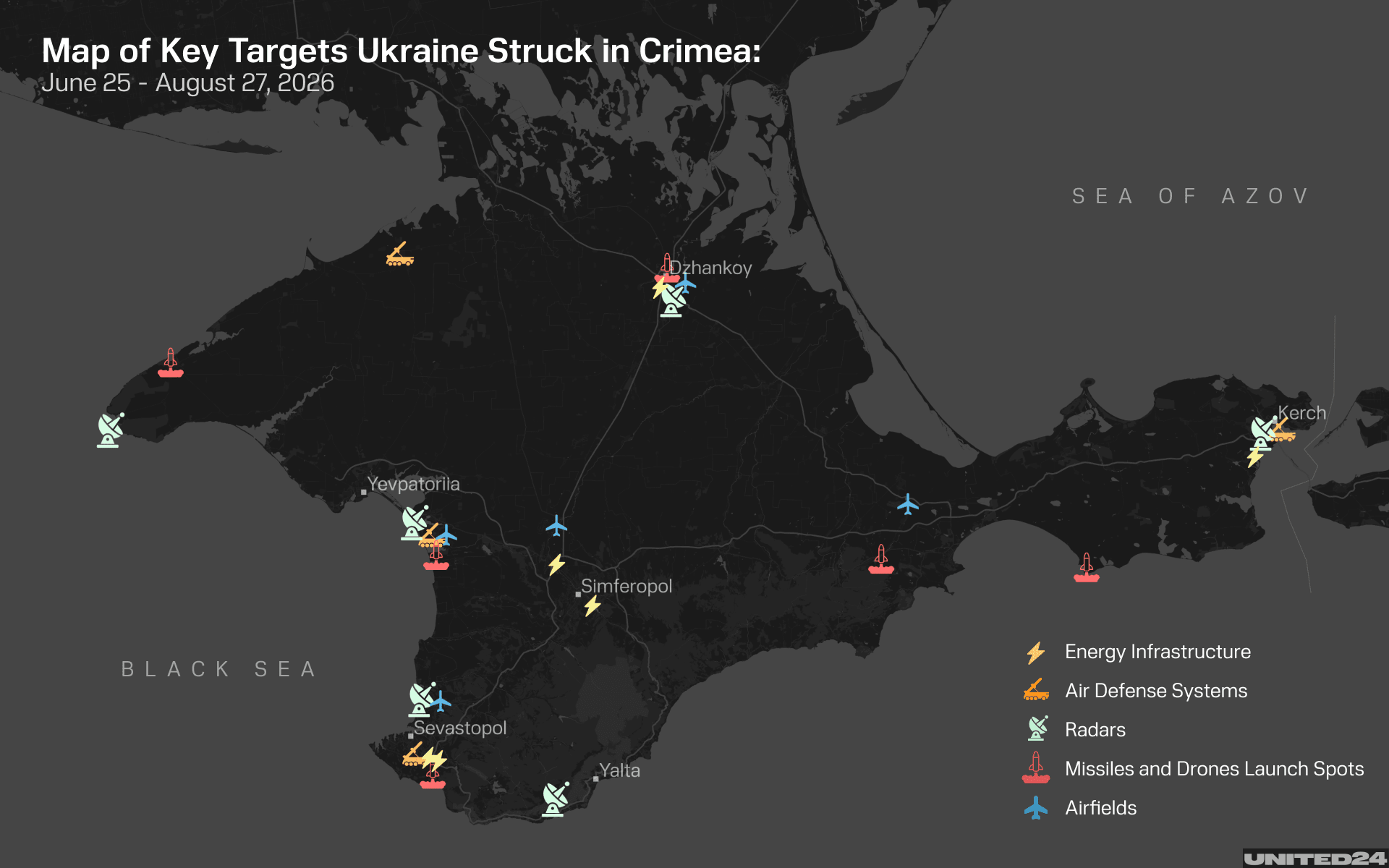
Specifically, Ukrainian strike networks have targeted six distinct pillars of Russia's Crimean military infrastructure:
Air defense—S-300/S-400 launchers, Pantsir-S1 point-defense batteries. This weakens Russia’s defense of military sites.
Missile launch sites—the aforementioned S-300/S-400 launchers, which Russia can use to fire surface-to-air missiles in a secondary ground-attack role, as well as Bastion launch sites used to fire Zircon and Oniks missiles. Striking these systems can reduce missile salvos targeting Odesa, Mykolaiv, and southern frontline positions at the source.
Drone networks and launchpads—Dzhankoi Orion drone relay systems, Cape Chauda Shahed staging grounds, UAV command infrastructure. This targets the infrastructure used to stage, launch, and control Russian drones. In the same coordinated waves that neutralized two S-400 batteries, Ukrainian strikes also destroyed Shahed and Geran drone storage depots.
Radars and tracking arrays—96L6 target acquisition radars, Okhotnyche radar shelters, Nebo complexes. This strips Russian forces of real-time air and maritime tracking, blinding target-coordination networks.
Forward aviation hubs—Belbek, Saky, Dzhankoi, and Hvardiiske airbases: Suppresses tactical jet sorties by striking airfield hangars. This destroys ammo/fuel depots and forces strike aircraft to evacuate further inland.
Military grid infrastructure—Tavriyskaya TPP, 330 kV Simferopol/Sevastopol substations, Kuban-Crimea power bridge. This cuts high-voltage power to bases, forcing air defense batteries and radars onto fragile backup generators.
What Russia uses in Crimea to launch attacks against Ukraine
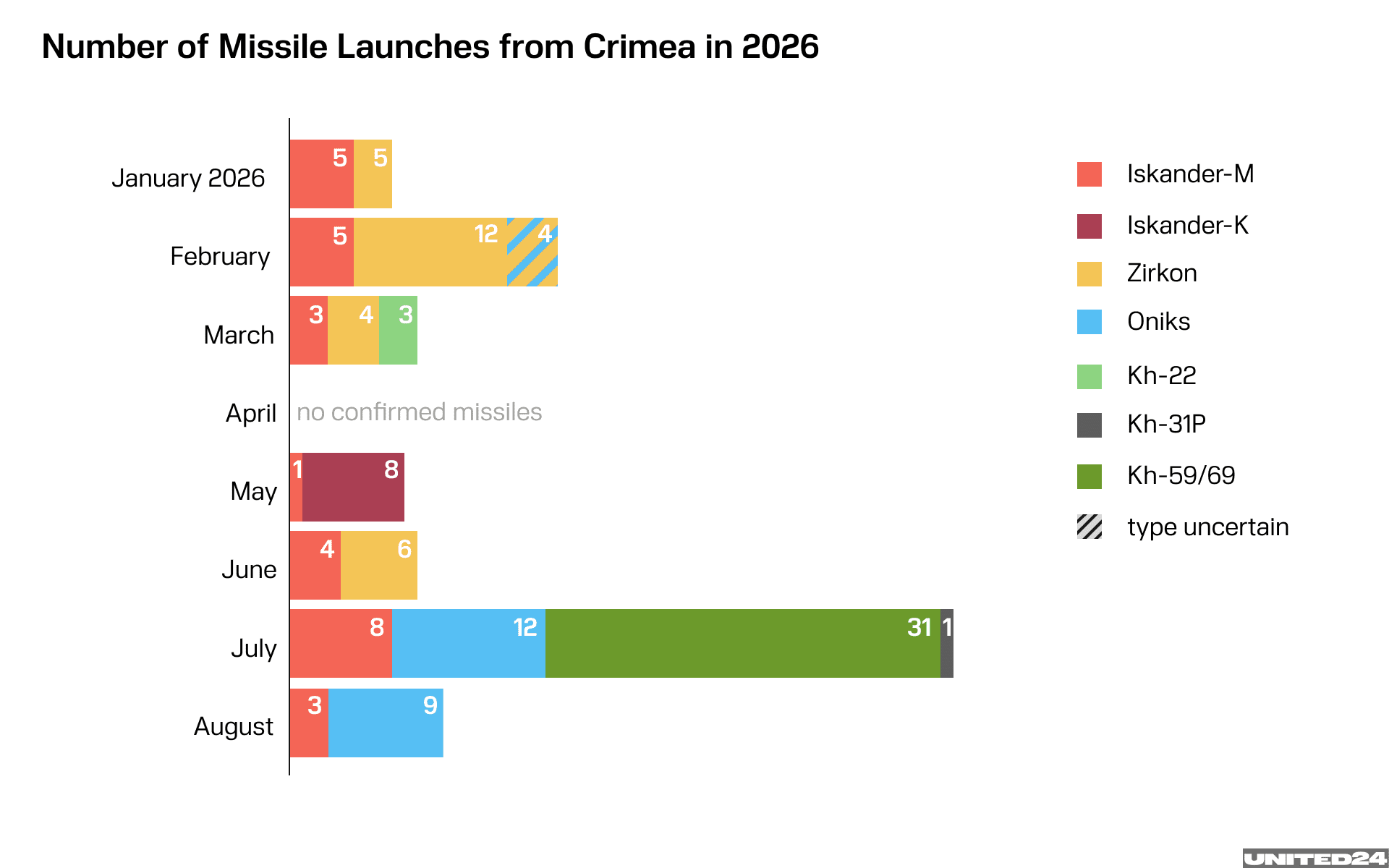
Tracking every launch from Russian-occupied Crimea is difficult. While no single public source provides a complete picture, UNITED24 Media compared reports from Ukrainian threat-monitoring channel Monitor with official Ukrainian Air Force data to identify changes in Russia's use of Crimea as a launchpad.
Between January and August 12, Monitor’s tracking data recorded at least 35 confirmed missile launches across 17 distinct dates and 14 explicit drone launch episodes originating from the peninsula. Ukrainian Air Forces data shows the number of missiles is significantly higher, as Monitor tracks attack launches as they occur, not after; by August, Monitor observes a decrease in ground launches after the 40-day campaign.
Iskander, Zircon, and Oniks missiles were used repeatedly from January through to July. That surge saw a massive spike in attacks from Crimea at the height of the 40-day campaign—mostly from air-launched Kh-56/69 missiles, though ground launches also continued. However, combining the Monitor and Ukrainian official data, it shows that in August, the attacks drop, with four specific instances of Oniks missile launches by August 27, consisting of 8 confirmed missiles. In addition, there is one attack with Iskanders from the Crimea/Black Sea region, though it is unclear if it came from Crimea.
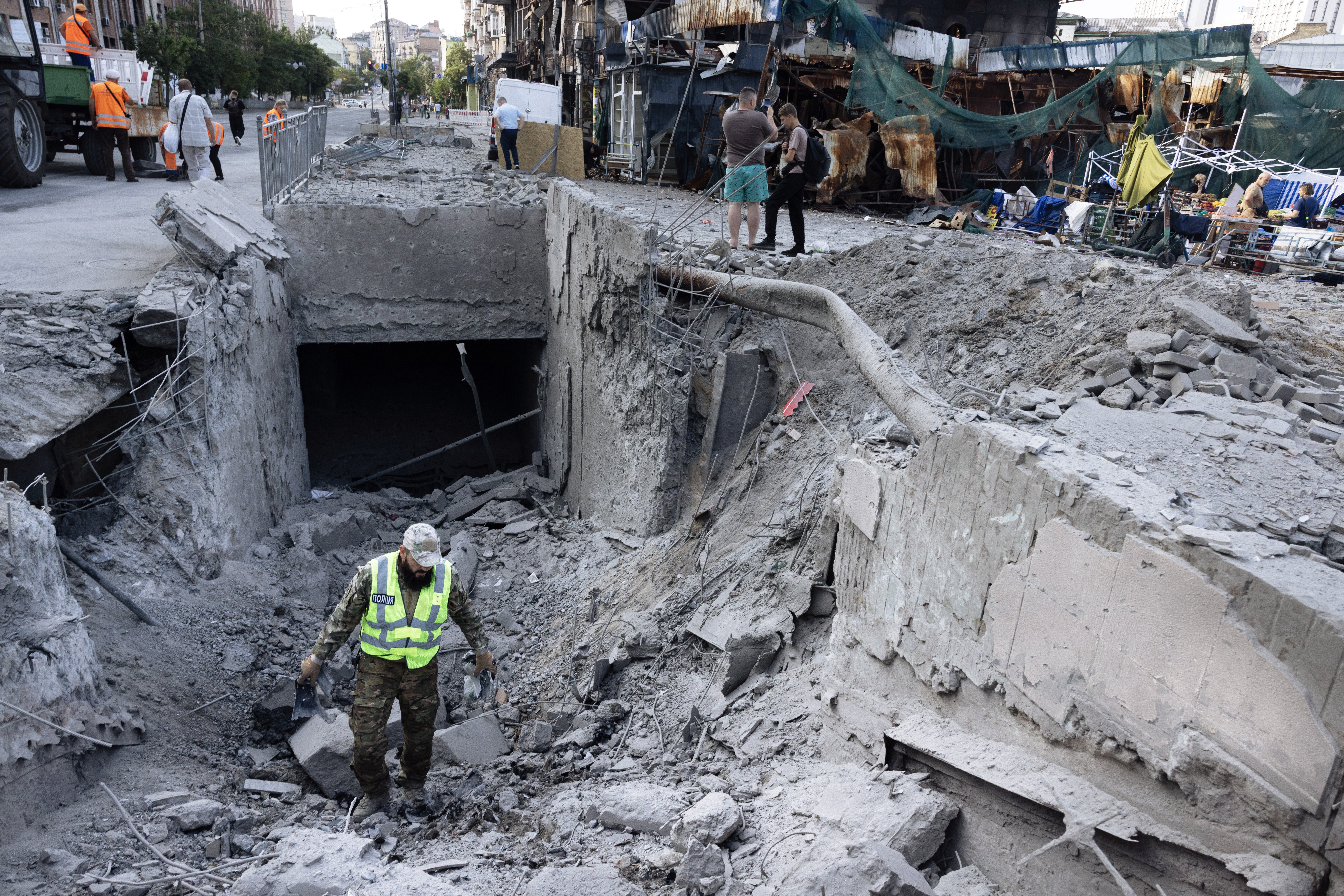
If we compare the types of attacks from Crimea, UAV attacks generally increase in July from the previous two months, but drop by mid-August. At the start of the year, in January, the majority of attacks were from ballistics, yet this number had dropped.
Oniks missiles continue to be launched from Crimea. In August, they were the majority of verified ground-launched missiles recorded from the peninsula in the combined dataset. Originally designed as anti-ship cruise missiles, Oniks can also be used against land targets. The shift in type of missile, and the volume, shows that Ukraine has made an impact on Russia’s ability to use Crimea as a missile launchpad.
Why Crimea is a key part of Ukraine's defense strategy
Further strikes on Russian launch infrastructure could constrain Crimea’s role as a platform for attacks on Ukraine even more. While Crimea remains a crucial launchpad for Russian drones and missiles, further degrading its potential to launch strikes yields multiple strategic benefits.
Midttun listed the key impacts:
Opens the Black Sea for maritime trade and activity
Allows Ukraine to relocate forces and capacities towards Belarus and Russia
Increases the protection of Ukrainian citizens and critical infrastructure
Creates the precondition for the forthcoming liberation of the Crimean Peninsula
The operation “Logistics Lockdown” is not only affecting Russia’s ability to sustain operations from Crimea but also the Russian occupation forces in the Zaporizhzhia and Kherson regions, says Midttun.
“During the last three months, Ukraine has destroyed an average of 13,456 trucks monthly across all sectors,” he said. “A majority of these, however, are destroyed in the south. Road and rail bridges are being destroyed at scale.”
Targeting such a crucial launchpad and eliminating weapons systems before they can fire eases pressure on the southern front. Odesa, Mykolaiv, and other southern cities stand to benefit most directly because of their proximity to the peninsula.
These operations put pressure on Russia’s forces across the occupied south. If Russia cannot transport troops, supplies, and military vehicles without a major risk, then they cannot reinforce and are less able to conduct large-scale offensive operations.
These strikes also divert Russian resources, forcing Moscow to either protect its military equipment on the peninsula by relocating it or transfer air defense systems from elsewhere—weakening Russian defenses on other parts of the frontline.
Further degrading Russia’s ability to launch Oniks missiles could reduce the missile threat to Odesa and southern Ukraine—protecting civilians, supporting frontline forces, and securing Black Sea grain corridors.
What does Ukraine need to increase and repeat these results?
In a recent interview, Unmanned Systems Forces commander Robert “Magyar” Brovdi revealed that his forces are operating at just 14% of full capacity, but could strike seven times as many military targets in Crimea if pledged Western funds arrived faster.
This operational constraint aligns directly with Midttun’s assessment that production readiness is not the issue, but financial backing: "Ukraine lacks the economy to ramp up its missile and drone production. That’s the only thing stopping Ukraine from increasing the scale and scope of the campaign."
Western support must increase to allow Ukraine to expand its impact and replicate these tactics across other fronts, Midttun said. Russia’s invasion is part of a broader hybrid war against Europe—one that will only escalate if Ukraine is forced to operate under persistent material constraints.
Another way to boost Ukraine’s capabilities beyond its own territories would be allowing Starlink use over Russian territory. Ukraine’s ability to use Starlink over Crimea enabled it to strike a wide range of Russian military targets across the peninsula. However, even with the impressive long-range strikes, the satellite system could be more impactful if it eased the transfer of communications to drones.
President Zelenskyy recently said that Ukraine has a “window of opportunity” to end the war, because of its many advantages on the battlefield and in the skies. Operations that degrade Russia’s military infrastructure in Crimea are part of that broader effort.
Right now, we have a window of opportunity. Ukraine has become stronger both on the battlefield and in the skies. Everyone sees these results made possible thanks to our warriors in the first place. I am very grateful to them.
— Volodymyr Zelenskyy / Володимир Зеленський (@ZelenskyyUa) July 10, 2026
Putin – whether he knows this or not – is certainly…
Empowering Kyiv to degrade Crimean launchpads and set the conditions for the peninsula's eventual liberation is not just a battlefield tactic; it directly fortifies wider European security.
Discuss this article:
In a Nutshell

-c439b7bd9030ecf9d5a4287dc361ba31.jpg "Photo of Katherina Popilnichenko")
-190980de852660335650f69af6d832a6.jpg "Ukrainian servicewoman Kateryna “Ptashka” Polishchuk receives Lord Ashcroft Award for Courage in Warsaw, Poland. (Source: Ministry of Foreign Affairs)")