- Category
- War in Ukraine
Ukraine Is Turning Russia’s Air Defense Into “Swiss Cheese.” What’s Next?

Ukraine’s systematic campaign against Russian air defense systems is turning once heavily protected airspace into a network of exploitable gaps. With dozens of confirmed hits on launchers and radars in the first months of 2026 alone, Kyiv is reshaping the geometry of the battlefield and forcing Moscow into impossible choices.
 Prefer U24 Media on Google
- Authors

-24deccd511006ba79cfc4d798c6c2ef5.jpeg "Photo of Louis Beaudemont")
The first months of 2026 have been nothing short of disastrous for Russia’s air defense.
In late March, a Ukrainian strike put out of action the Russian S-400 Triumph—a mobile launcher capable of engaging nearly 100 targets simultaneously—in the Tula region. Days earlier, the Bryansk region’s Buk-M3 system suffered the same fate. In January, a 9S32M1 radar (part of the S-300V system) was pulverized, with video evidence to support it. And that’s without mentioning the Pantsir-S1 air defense system, neutralized by a drone near the temporarily occupied Melitopol (the village of Nove). This remarkable tally represents only part of Ukraine’s new campaign against Russian air defenses.
We bring you stories from the ground. Your support keeps our team in the field.
After an already highly successful 2025 for Ukraine’s military in terms of destroying Russia’s air defense potential, 2026 has started strong, with more than 40 confirmed strikes, some of which have reduced Russia’s most modern systems to burnt-out wrecks.
How many Russia’s systems is Ukraine actually destroying in 2026?
While each individual destruction may seem minor compared with Russia’s vast military arsenal, Tomáš Nagy, an analyst and air defense expert at GLOBSEC, highlights the true significance of this tactic: “If you accumulate a sufficient number of tactical successes, it already becomes highly relevant at the operational level.” While a single strike cannot change the course of the war, this methodical accumulation opens massive windows of opportunity for Ukraine’s strike capabilities.
When the CEO of Rheinmetall, Germany’s largest defense company, compared Ukraine’s innovation capacity to “Lego,” it is worth noting that what is being developed in these so-called “Ukrainian kitchens” can undermine one of the most sophisticated integrated defense systems in the world.
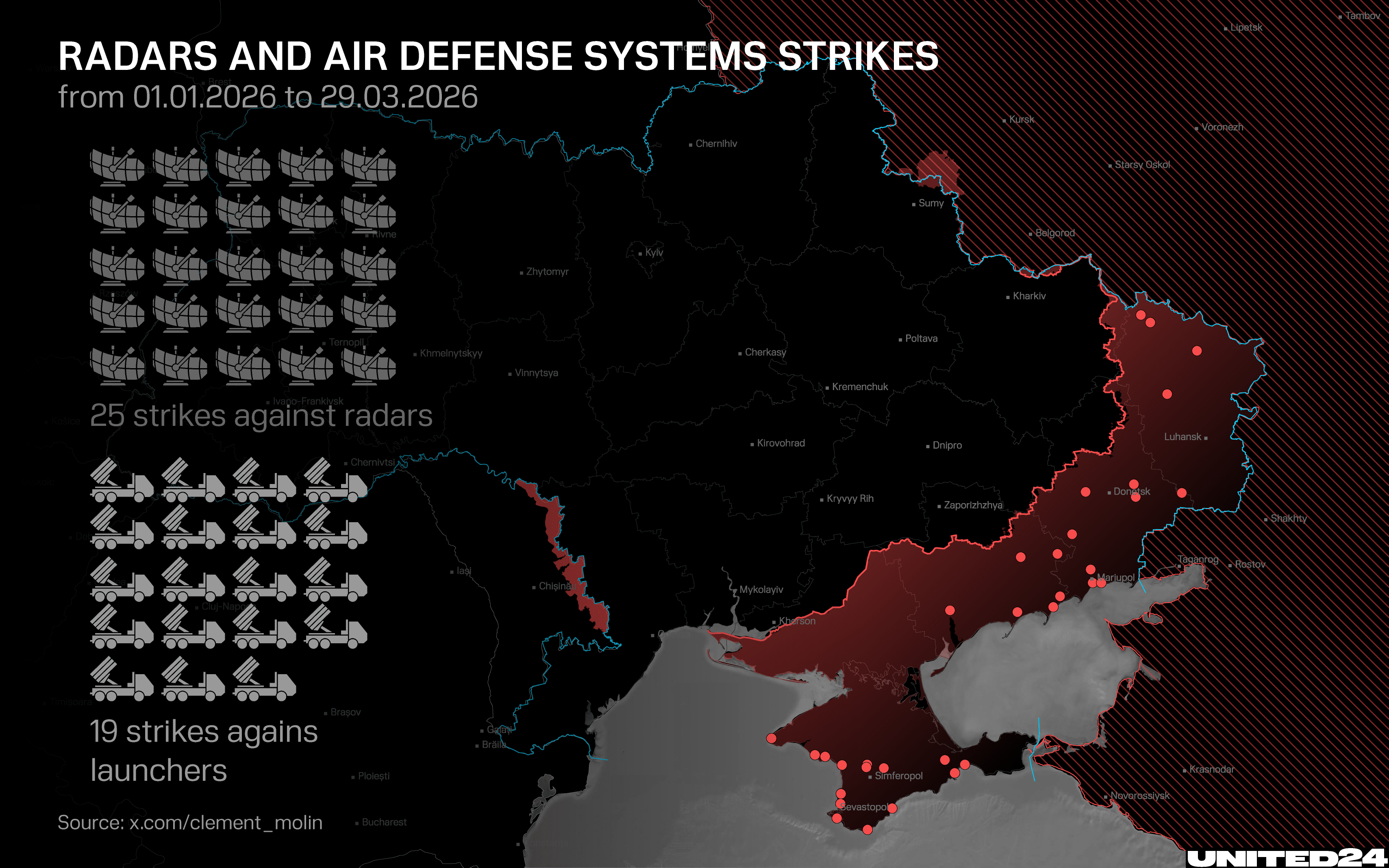
Ukraine carried out 44 successful strikes against various Russian air defense systems during the first months of 2026, according to data compiled by OSINT analyst Clément Molin. This count highlights a strategy aimed at destroying both Russia’s striking force (launchers) and its “eyes” (radars).
“Top-class” launchers
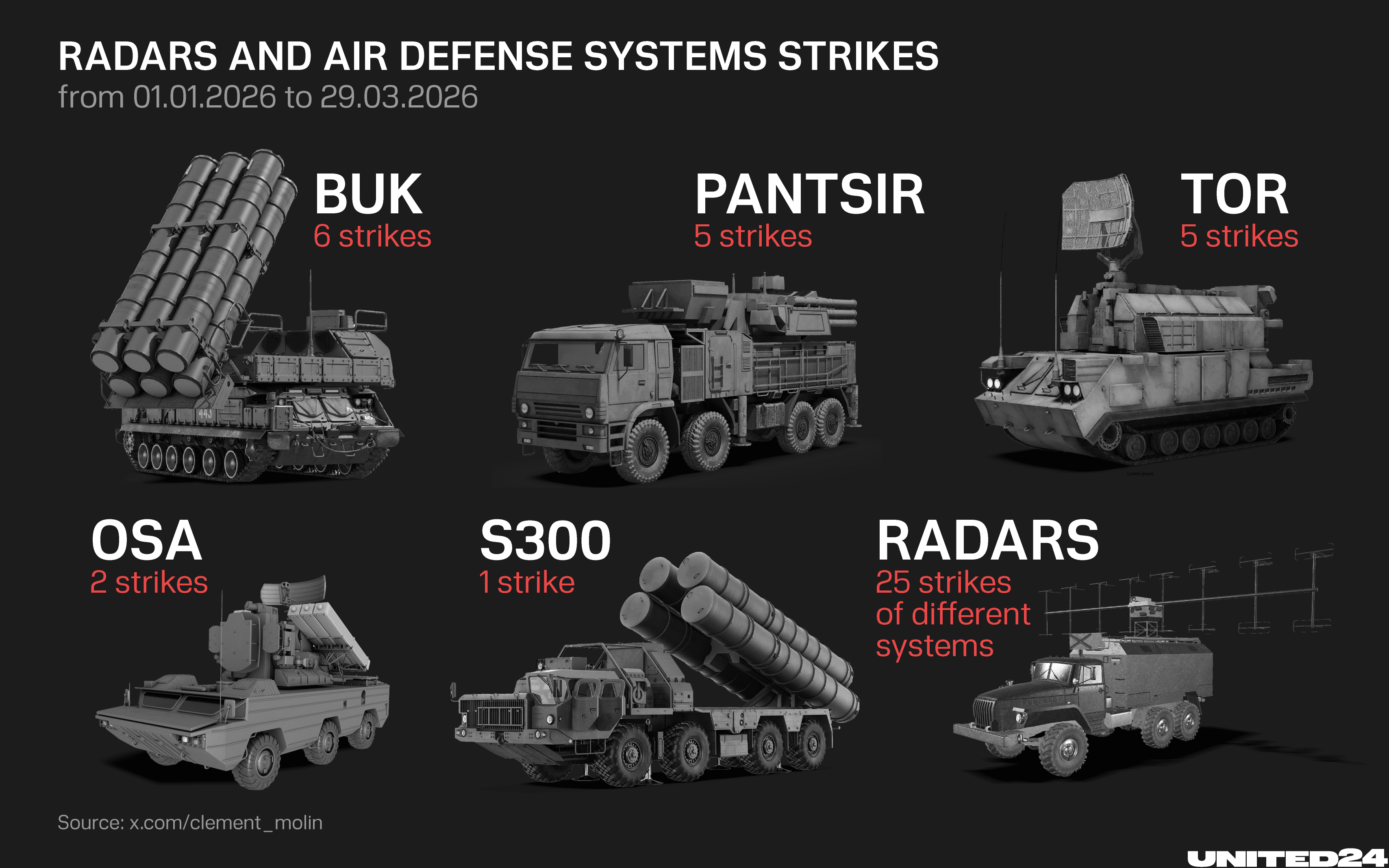
Buk systems (six destroyed): This includes launchers and transporter-loader vehicles from the Buk-M1, Buk-M2, and advanced Buk-M3 variants.
Tor systems (five destroyed): This includes the Tor-M1 and Tor-M2 versions, as well as the extremely rare Arctic Tor-M2DT, designed to withstand temperatures as low as -50°C.
Pantsir systems (five destroyed): These short-range cannon-and-missile defense systems (Pantsir-S1 and S2) have suffered heavy losses. One was obliterated by a heavy Ukrainian FP-2 drone carrying a 100-kilogram warhead. Another destroyed example was a unique version mounted on a heavy Belarusian MZKT-7930 chassis, never seen in combat before.
Osa systems (two destroyed): Valued at more than $10 million per unit, they were eliminated by extremely low-cost FPV drones.
Strategic S-300/S-400 complexes: At least one full S-300 system has been counted, but reports confirm the destruction of several specific heavy launchers, including S-400 Triumph launchers (in Crimea and Belgorod) and S-300VM/V variant launchers (near Mariupol and Luhansk).
Other short-range systems: Tunguska (cannon/missile) and Strela-10 systems were also hit.
Coastal systems (used against ground targets): Bastion coastal missile launchers were also destroyed.
Advanced and costly radar systems
Destroying radars remains the top priority for “blinding” Russia. According to Nagy, while attention often focuses on interceptors and launchers, air defense systems rely heavily on radars and command-and-control units. Molin lists 25 different radar systems destroyed, including some of the most advanced and expensive technologies in Russia’s arsenal:
S-400 / S-300 radar systems: 92N6A and 92N6E tracking radars (the S-400’s “eyes,” capable of tracking 100 targets), as well as the very rare 9S15 Imbir and 9S32M1 radars from the S-300V system.
S-350 Vityaz radars: The 50N6E multifunction radar, one of Russia’s most modern.
Long-range and low-altitude detection radars:
The Nebo family: 55Zh6U Nebo-U and 1L119 Nebo-SVU (valued at $100 million), as well as the RLM-ME component of the Nebo-M.
The 48Ya6-K1 Podlet low-altitude radar.
The 35N6 Kasta-2E2 low-altitude radar.
Early warning and anti-drone radars: The brand-new P-18-2 Prima, the classic P-18 Terek, the 5N84A Oborona-14, the Protivnik-GE long-range radar, the Sopka-2, and the specialized Valdai anti-drone radar.
Air traffic control systems: RSP-6M2 and RSP-10 airfield control stations.
These staggering figures come after an already disastrous 2025 for Russia, during which Ukraine’s Security Service’s special Alpha unit alone destroyed roughly $4 billion worth of air defense equipment.
If the Ukrainians can really strike and severely damage 40 systems every month, that’s huge. The Russians have no way around the problem, because that’s already 500 per year, and that’s massive. No country can cope with that.
Tomáš Nagy
GLOBSEC air defense expert
Creating gaps in Russia’s skies
By methodically destroying these defenses, especially by targeting radars—the military’s “eyes”—and exploiting the slow pace of Russia’s sanctions-hit arms industry, Ukraine has radically changed the equation. At the operational level, this methodical destruction fundamentally alters the battlefield geometry. Nagy describes the current state of Russia’s air defenses as a “Swiss cheese effect.”
You have a very solid cheese, but there are holes inside. That’s what the [Russian] air defense system looks like right now. Obviously, the Ukrainians want those holes to become bigger and bigger.
Tomáš Nagy
GLOBSEC air defense expert
At the tactical level, destroying just a few systems—such as the Tor-M2—instantly creates a physical breach in the air defense network that stretches 50 to 100 kilometers along the front line, as confirmed by the Ukrainian drone unit Raid. A single gaping hole of that size means dozens, or even hundreds, of Ukrainian medium- and long-range strike drones can infiltrate Russian defenses simultaneously.
The pressure is so intense that the Russian command has been forced to strip other strategic borders. Reports indicate that Russia had to withdraw Kasta-2E2 low-altitude radars from its border with Finland—a NATO member—to likely try to patch the holes in Ukraine. Russian State Duma deputy Andrei Gurulyov has publicly admitted that Russia’s military lacks the forces needed to maintain a continuous shield, forcing it to protect only major cities and critical infrastructure while leaving the rest of the territory exposed.
So far, a map where Kasta-2E2 and a Podlet-K1 have been missing along the Finnish border.
— Athene Noctua (@Ath3neN0ctu4) March 30, 2026
7/8 pic.twitter.com/GWHHgzeRph
This attrition is also probably setting the stage for a major shift: the arrival of new Western fighter jets in Ukraine’s Air Force. France is supplying Mirage 2000-5 fighter jets, 4++ generation aircraft equipped with advanced digital avionics.
These aircraft have proven highly effective, reportedly capable of intercepting Russian cruise missiles and Shahed attack drones with a 98% success rate, according to Ukrainian pilots. They also enable the launch of AASM Hammer guided bombs and Storm Shadow/SCALP cruise missiles.
Ukrainian Pilot on the Effectiveness of the Mirage2000
— Ukrainian Air Force (@KpsZSU) November 26, 2025
Ukraine🤝France@FranceenUkraine pic.twitter.com/wGuGmYG4CP
At the same time, the expected integration of Sweden’s JAS 39 Gripen will give Ukraine unprecedented tactical flexibility. Designed around the Cold War-era Bas 90 dispersal doctrine, the Gripen can take off from short stretches of highway, be refueled and rearmed by a team of five technicians in just 15 minutes, and scramble again in under five minutes during an alert.
Armed with Meteor missiles with a range of 150 to 200 kilometers, the Gripen will be able to push Russian aircraft farther from the front lines.
The weakening of Russia’s air defense network is the essential prerequisite for maximizing the impact of these new fleets.
Exploiting the gaps: devastating deep strikes
The operational freedom provided by these breaches is especially visible in the scale, depth, and precision of Ukraine’s recent asymmetric strike campaign against key strategic targets:
The Votkinsk plant: Taking advantage of fully cleared flight corridors, Ukraine’s FP-5 Flamingo missiles were able to travel more than 1,300 kilometers unchallenged to strike the Votkinsk plant—the absolute backbone of Russia’s ballistic missile production, responsible for the RS-24 Yars, the Bulava submarine-launched missile, and the new Oreshnik hypersonic ballistic missile.
The Kremniy EL plant: The absence of a continuous air shield allowed Western Storm Shadow cruise missiles to devastate the Kremniy EL microelectronics plant in the Bryansk region. As Russia’s second-largest supplier of chips for Iskander missiles and even S-400 systems themselves, its destruction literally cripples the electronic “brain” of Russia’s future advanced weapons.
The 100th GRAU Arsenal: Infiltrating through massive holes in the radar network, swarms of Ukrainian drones destroyed the 100th GRAU arsenal in the Kostroma region, a massive depot capable of storing thousands of tons of ammunition, triggering destructive chain reactions and paralyzing logistics.
These strikes on Russia’s production capacity and stockpiles, particularly its long-range missiles, also enable what Nagy calls “passive air defense”—destroying Russian strike capabilities at the source rather than intercepting them after they are launched at Ukrainian cities.
Passive air defense […] means that you harden everything that you can harden, you mobilize whatever you can mobilize, and yes, you strike the capabilities of the other side to create vulnerabilities. And the best that the Ukrainians can do is to try to cripple [Russian] production capacity as much as possible
Tomáš Nagy
GLOBSEC air defense expert
A still powerful Russian defense, but under maximum pressure
It would be misleading to believe the threat has disappeared. Russia still possesses one of the world's most dense and sophisticated integrated air and missile defense networks, a report by the Royal United Services Institute (RUSI) says. Russia’s “monolithic structure,” with its “large number of subordinate entities,” continues to produce systems and missiles in large volumes, and these defenses still intercept a significant share of Ukrainian munitions, forcing Ukraine to use large drone swarms to saturate defenses before a cruise missile can reach its target.
However, the same RUSI report highlights critical vulnerabilities in Russia’s production chain. Russia remains heavily dependent on high-tech Western components, such as printed circuit boards from the US company Rogers Corporation, which are indispensable for the active electronically scanned array radars used in S-500 systems. Russian engineers also rely on Western software such as Altium Designer and Ansys for the design and simulation of microwave components. Sanctions complicate this supply chain, especially by targeting the measuring and calibration equipment needed to certify these complex systems.
«Альфа» СБУ у 2025 році відмінусувала вороже ППО на $4 млрд
— СБ України (@ServiceSsu) January 19, 2026
➡️ https://t.co/PgMQuShnS2 pic.twitter.com/zwHvh8ltNr
If Ukraine maintains this relentless tempo, a strategic tipping point could be reached. As Nagy points out, if Ukrainian forces manage to destroy or severely damage 40 air defense systems every month, that amounts to nearly 500 systems per year. That is a rate of attrition that no country—not even Russia with its war industry running at full speed—can sustain indefinitely. A source in Ukraine’s intelligence community told the authors of the RUSI report that Russia is already consuming more interceptors than it can produce.
If Ukraine continues striking production plants, radars, command centers, and creating 100-kilometer-wide gaps in Russia’s skies, Moscow will soon face an unsolvable dilemma: protect its troops on the Ukrainian front, or protect its weapons factories and cities deep inside its own territory.
Has Russia truly reached the end of its defensive capabilities? Nagy warns against underestimating Moscow’s industry, noting: “I don’t think they have run out of innovation potential.” However, he highlights a critical and highly specific bottleneck.
Yes, sanctions are complicating matters, but where they are really crippled by Western sanctions is machinery parts, some particular machinery parts, and then calibrations. So really the fine-tuning is difficult unless you have that particular expertise.
Tomáš Nagy
GLOBSEC air defense expert
The question is no longer whether Ukraine can punch holes in Russia’s air defense. It is whether it can do so fast enough, exploiting these specific, high-tech calibration vulnerabilities, before Russia adapts.
Discuss this article:
-9a7b3a98ed5c506e0b77a6663f5727c5.png)