- Category
- War in Ukraine
Why Putin Won’t Answer the Alaska Question? The Massive Civilian Death Toll Russia Caused in Ukraine
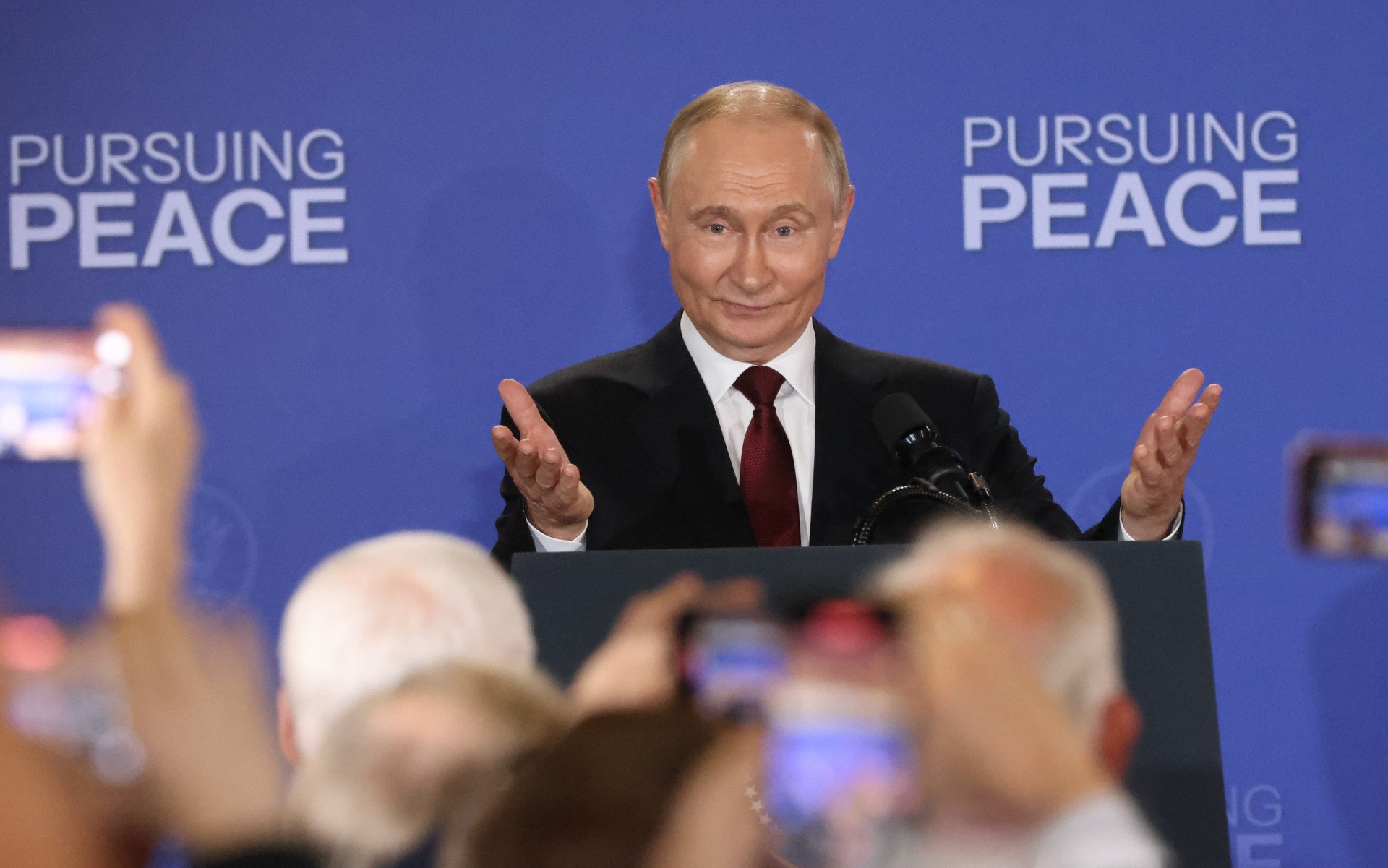
“President Putin, will you stop killing civilians?” a journalist shouted to the Russian leader posing for a photo-op beside US President Donald Trump during a high-stakes summit in Anchorage, Alaska, on August 15. The question was posed because the evidence is overwhelming: Russia is waging war directly against civilians in Ukraine.
 Prefer U24 Media on Google
- Authors


Putin cupped his hand to his ear as if he couldn’t hear, then slipped into his motorcade with a grin. He brushed it off in Alaska, but faced the very same charge on June 19 at the St. Petersburg Forum.
Two days after rescuers pulled 23 bodies from the rubble of a Kyiv apartment hit by a Russian missile, Putin claimed: “The strike did not target residential areas,” alleging it was aimed at defense facilities.
⚡️ Reporters asked Putin when he will stop killing civilians, but he pretended not to hear and gave no answer. pic.twitter.com/16bYXtpkJ0
— UNITED24 Media (@United24media) August 15, 2025
However, as reflected in data from a report by the UN Human Rights Monitoring Mission in Ukraine, Russia is killing civilians. Since the start of the full-scale invasion, Russia has killed at least 13,883 civilians, including 726 children, injuring many more, according to the Mission’s August 13 press release.
Putin’s statement follows a long-discredited Kremlin line that Russia does not deliberately target civilians—even as overwhelming evidence from leading international humanitarian organizations, such as Amnesty International, Human Rights Watch, and others shows systematic strikes on homes, hospitals, schools, evacuation routes, and other civilian sites across Ukraine.
Just three days after the Alaska meeting meant to advance peace, Russia unleashed missiles and drones on Kharkiv’s residential neighborhoods, killing seven—including a toddler and a teenager—and injuring dozens. These are not isolated cases. As documented by Ukraine’s Prosecutor General, they form a pattern of deliberate strikes on civilians—attacks that, as Human Rights Watch notes, “when carried out intentionally or recklessly, constitute war crimes under international law.”
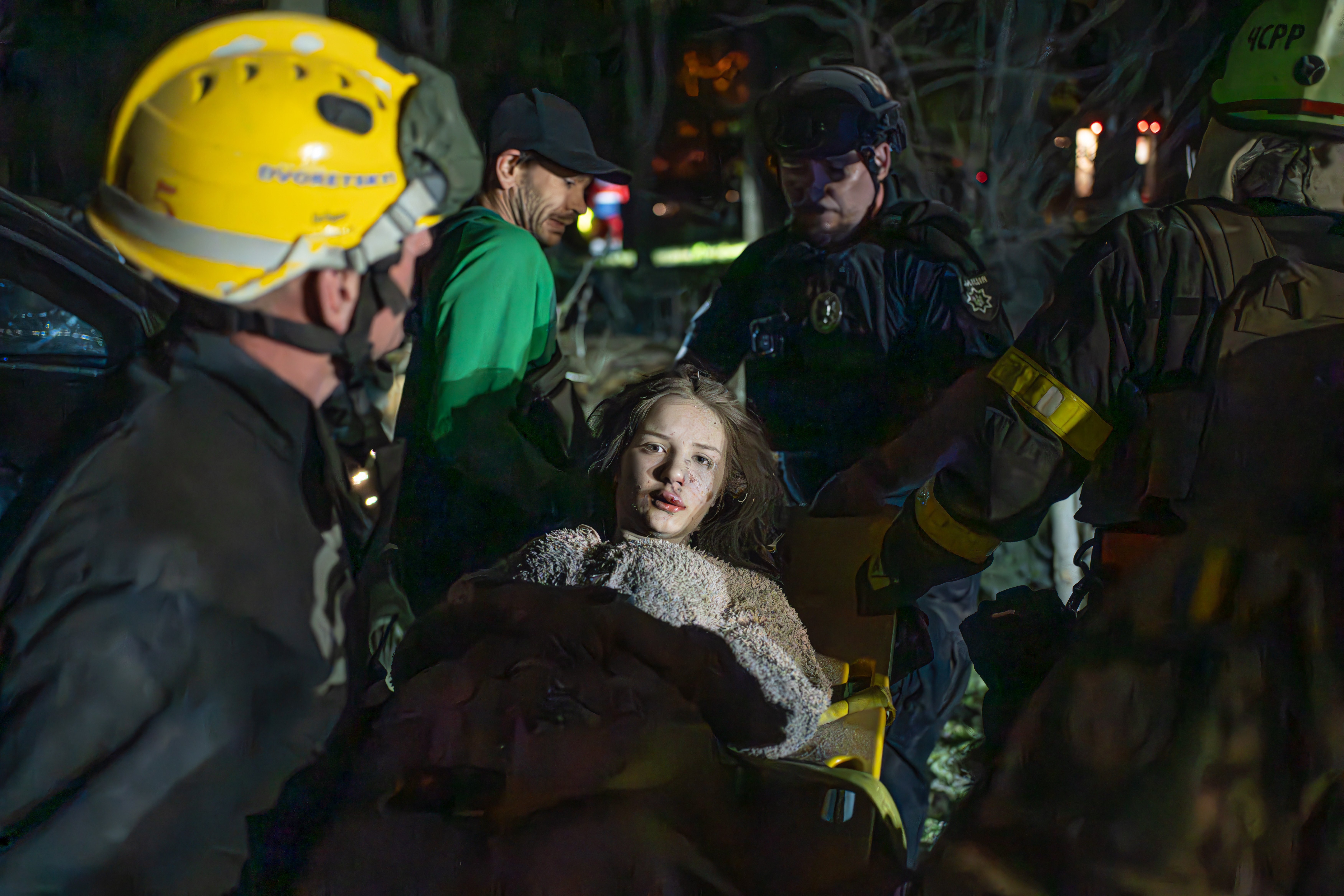
Regional administration building. Kharkiv, March 1, 2022
As people arrived for work, Russian forces struck the Regional State Administration building in central Kharkiv, killing 44 civilians. Two Kalibr cruise missiles were launched twelve minutes apart, in a “double-tap” strike—a tactic intended to hit both the initial victims and the emergency responders who came to assist them.
Security camera footage captured a fireball erupting from the building located on Kharkiv’s central Freedom Square, destroying both parked and passing vehicles. Civilians in the vicinity, including volunteers from an aid collection point on the central square, were among the casualties, Ukraine’s Suspilne media reported.
“Everyone was buried under rubble,” Mykola, a survivor of the attack, said. “We crawled out as best we could, and people helped us."
⚡Ракетний удар по Харківській ОДА. Відео з камери спостереження. pic.twitter.com/mOQ0QCBZP3
— Верховна Рада України (@verkhovna_rada) March 1, 2022
Kremlin’s response: The then Russian Defense Minister Sergei Shoigu claimed that the Russian military “takes all measures to preserve the lives and safety of civilians,” and that “the strikes are carried out only on military targets and use exclusively precision weapons.”
Mariupol. Donetsk region, March 16, 2022
In the single deadliest recorded attack of the war, a Russian aircraft dropped two 500-kilogram bombs on the Mariupol Drama Theatre—while it was sheltering over 1,000 civilians and was clearly marked with the word “CHILDREN” in large Cyrillic letters visible from the air.
“Due to constant air raids and fighting within the city, it was practically impossible to clear the rubble immediately after the [Russian] strike,” the Mariupol City Council reported. Nine days after the attack, they revealed that eyewitnesses reported “around 300 people killed” as a result of the bombing by Russian aircraft.
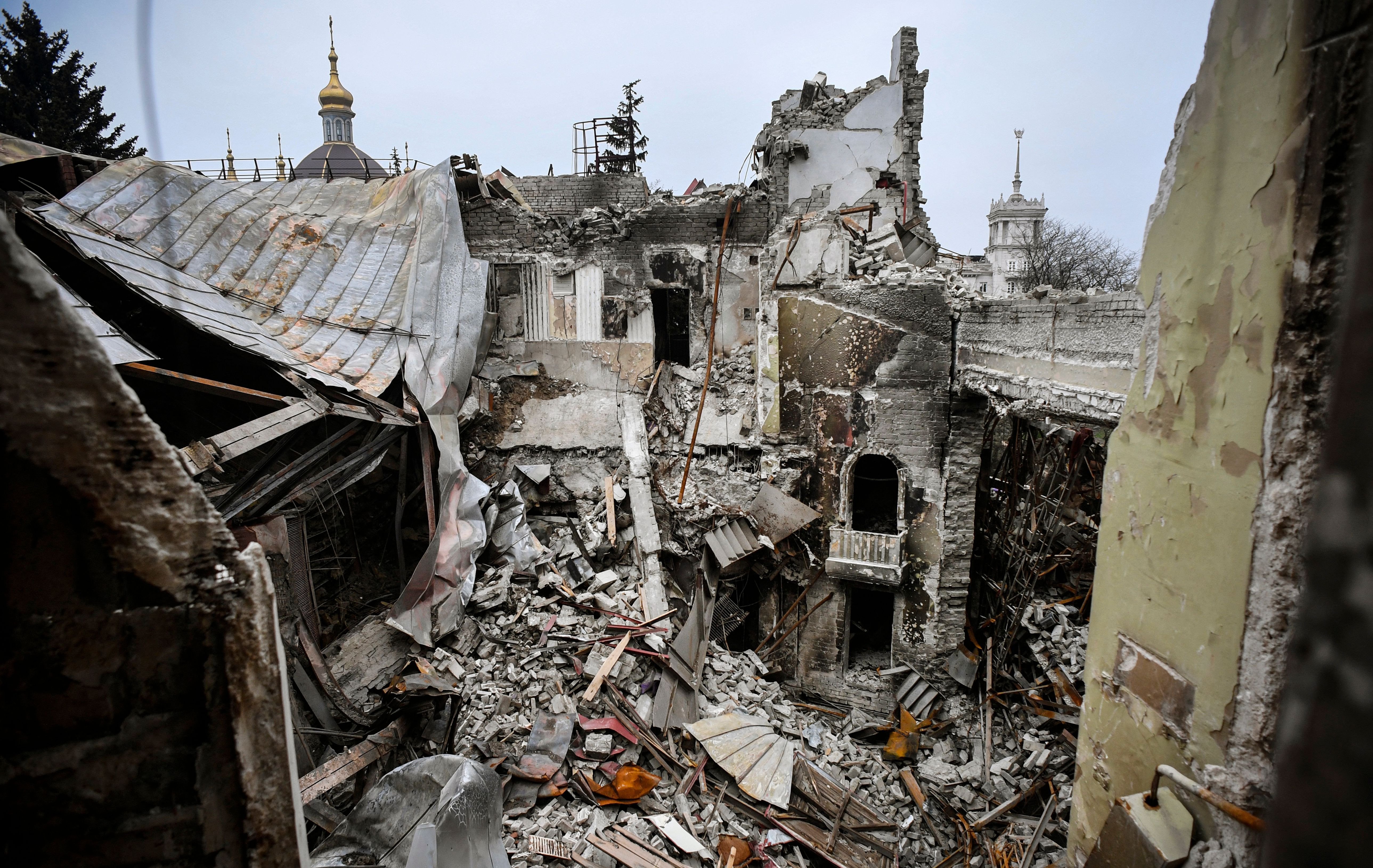
An in-depth investigation by the Associated Press (AP) later suggested the actual number could be as high as 600. The true death toll may never be known, Euronews reported, noting that the theatre and surrounding neighbourhood were later under Russian control, and that in clearing the rubble, any evidence it might have contained was also removed.
Maria, who had managed to escape with her family before the attack, said: "This was the final proof that they are at war with every Ukrainian. They didn't come to capture the city. They came to destroy it," reported Euronews.
Seven days before the theatre attack, Russian forces had bombed Maternity Hospital No. 3 in Mariupol, killing four civilians, including a pregnant woman and her stillborn child. Survivors of that strike were moved to the theater for safety, according to witnesses cited by AP. They were given the most comfortable dressing rooms on the second floor—which would ultimately prove fatal for them.
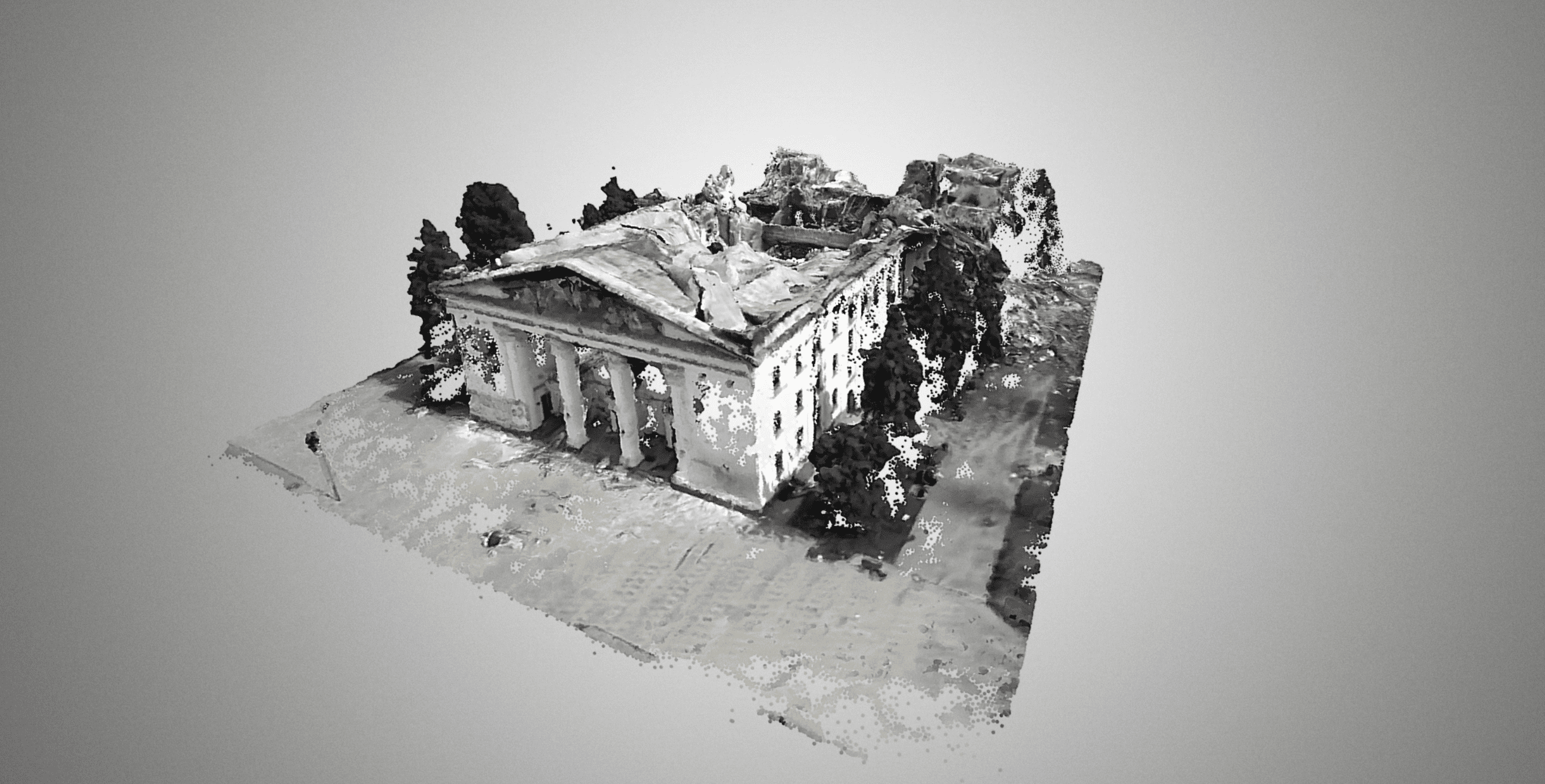
Kremlin’s response: Russia again denied bombing the Ukrainian cities, “no matter how many videos are doctored by NATO,” a spokesperson for Russia's Foreign Ministry said. The Russian Defense Ministry accused Ukraine, claiming that the Azov Battalion was “holding civilians hostages” inside.
What's happening in Mariupol is a massive war crime, destroying everything, bombarding and killing everybody in an indiscriminate manner
Josep Borrell
former EU High Representative
Residential area. Chernihiv, March 3, 2022
Russian forces dropped multiple unguided aerial bombs on a residential square in Chernihiv, causing significant damage to a high-rise apartment building, shops, and a pharmacy. Russia’s bombing killed forty-seven civilians and injured at least 18 more. Many of the victims had been waiting in line for bread outside a nearby building when the attack occurred, said Amnesty International.
“Doors were blown out, and the apartments were completely destroyed,” a 28-year-old resident said. “We could see the sky through them. There are no military or strategic objects in our neighborhood.”
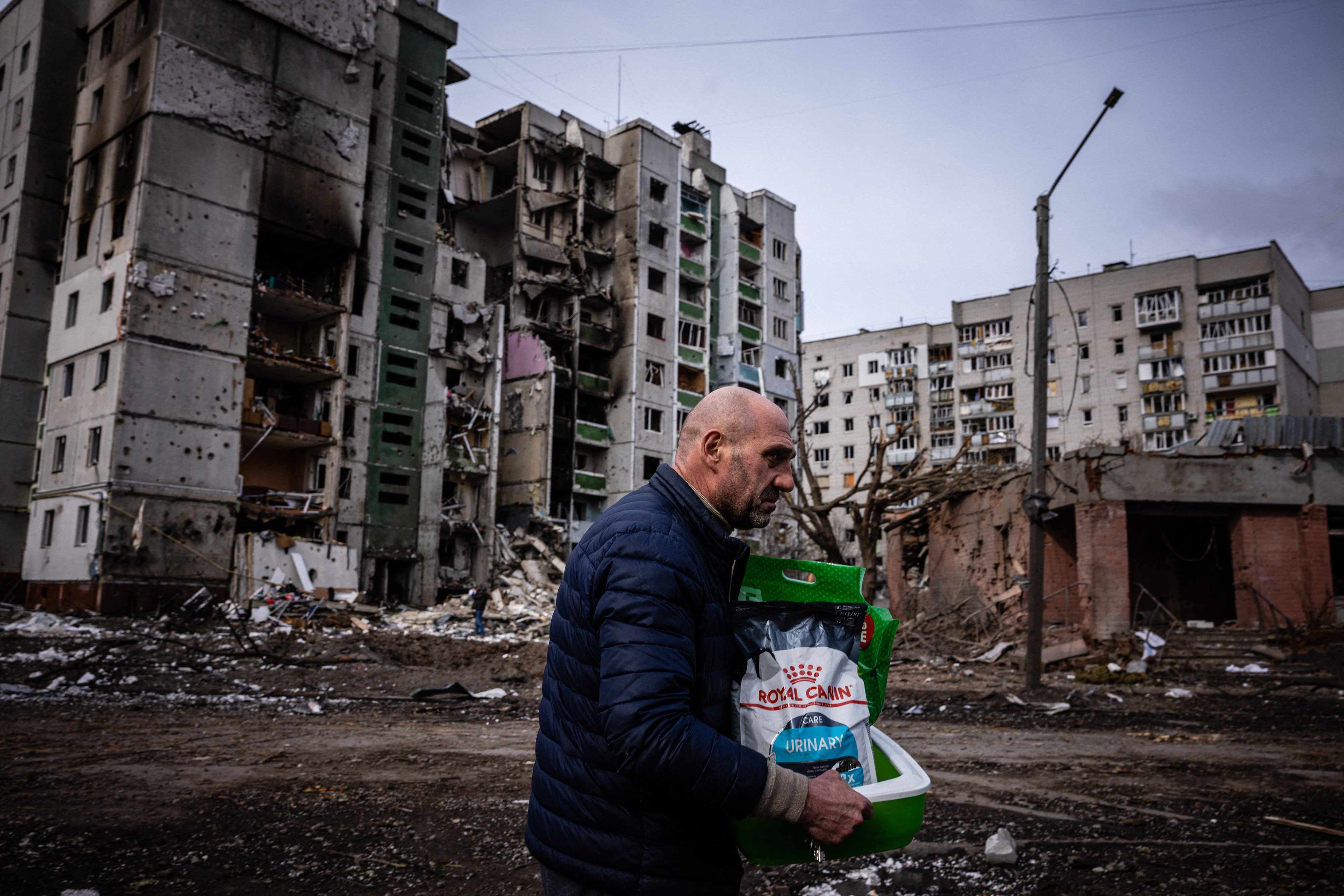
Kremlin’s response: While there were no statements from Russia about their attack on March 3, which killed 47 civilians, Russia’s Defense Ministry’s statement later March attack on civilians claimed that “all the dead people are victims of terror by Ukrainian nationalists.”
Kramatorsk railway station. Donetsk region, April 8, 2022
A Russian Tochka‑U ballistic missile armed with cluster munitions—designed to scatter bomblets and make them deadly in crowded areas—struck the Kramatorsk railway station in the Donetsk region. At the time, more than 4,000 civilians had gathered with their belongings, waiting for trains to take them to relative safety in western Ukraine. The Russian attack killed at least 59 civilians, including five children, and injured over 100 others, many suffering shrapnel wounds while standing on the platform.
A woman waiting with her family described what happened when the first explosions struck: “We fell to the ground. But my mother-in-law didn’t react fast enough. One of her legs was torn away, the other was broken, and then she died,” she said, as cited in a UN report.
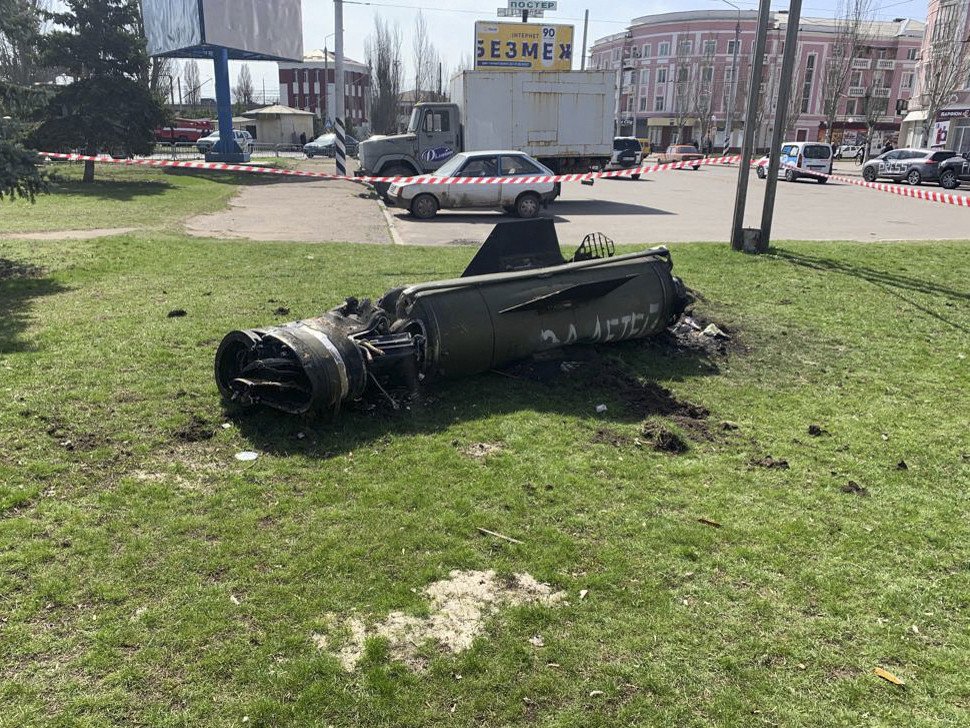
Kremlin’s response: Initial reports appeared on state media proudly reporting a strike at the Kramatorsk railway station. After the appearance of mass civilian casualties, the Kremlin-affiliated media did a U-turn and blamed Ukraine for the strike, denying that Russia uses Tochka‑U missiles.
Kremenchuk shopping mall. Poltava region, June 27, 2022
Russian Tu-22M3 long-range bombers flying over the Kursk region launched a Kh-22 cruise missile that struck a shopping center during working hours in Ukraine’s central Poltava region. The explosion killed 21 civilians and wounded approximately 59 others, as more than 1,000 afternoon shoppers and staff were inside the building.
The head of the Kremenchuk’s intensive care clinic said most bodies were so badly burned, it was impossible to make a visual identification. One survivor, hospitalized with head trauma, recalled losing consciousness and waking beneath a slab of concrete, his wife screaming nearby under the debris.
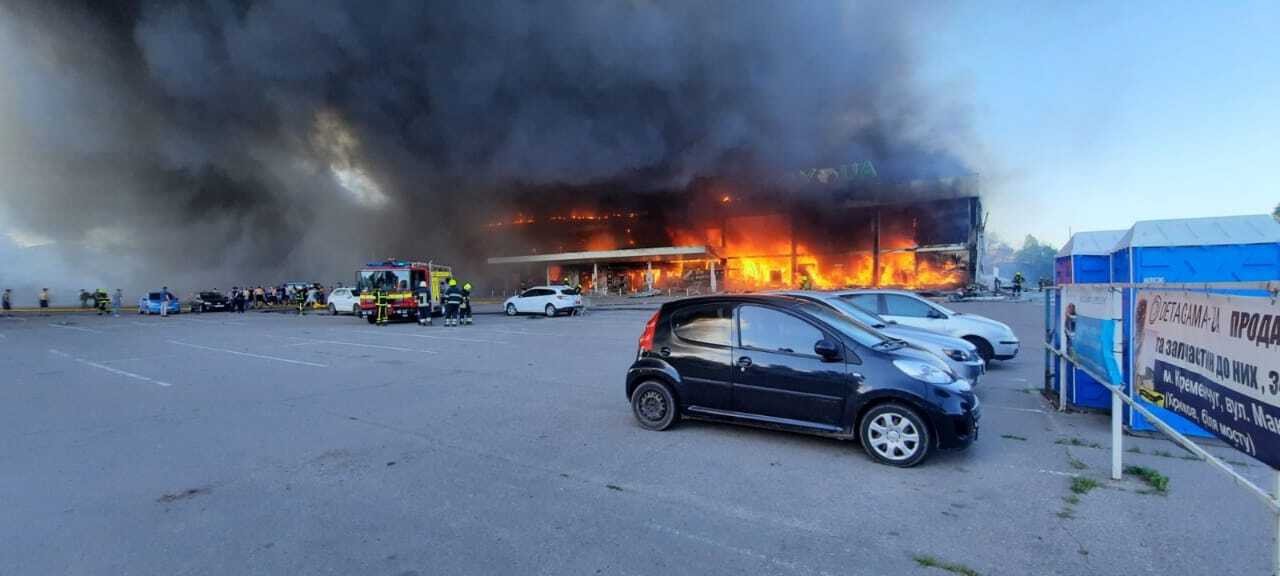
Kremlin’s response: A Russian Defense Ministry official claimed: “The detonation of stored ammunition for Western weapons caused a fire in a defunct shopping center located next to the plant’s territory.”
All these Russian claims are "demonstrably false", reported HRW. Based on site investigations on June 28 and 29, where researchers were allowed "unhindered access" to the facility and could not identify any evidence of military vehicles, weapons, or munitions.
Holiday resort and apartment block. Odesa, July 1, 2022
Russian forces launched three Soviet-era Kh-22 cruise missiles at the coastal town of Serhiivka, near Odesa, striking a holiday resort and a nine-story residential building. The attack killed at least 21 civilians, including two children, and wounded 38 others.
A local resident, Oleksandr, who rushed to the scene after being awoken by the blasts, told reporters that he, the locals, and the emergency workers helped those who survived. “And those who unfortunately died,” he said. “We helped to carry them away.”
Overall, Russia fired 202 missiles on Ukraine in the second half of June alone, 68 of which struck civilian targets. “The enemy is using missiles from the Soviet reserve, which are not sufficiently precise,” said the Ukrainian Armed Forces. “As a result, civilian buildings are being hit.”
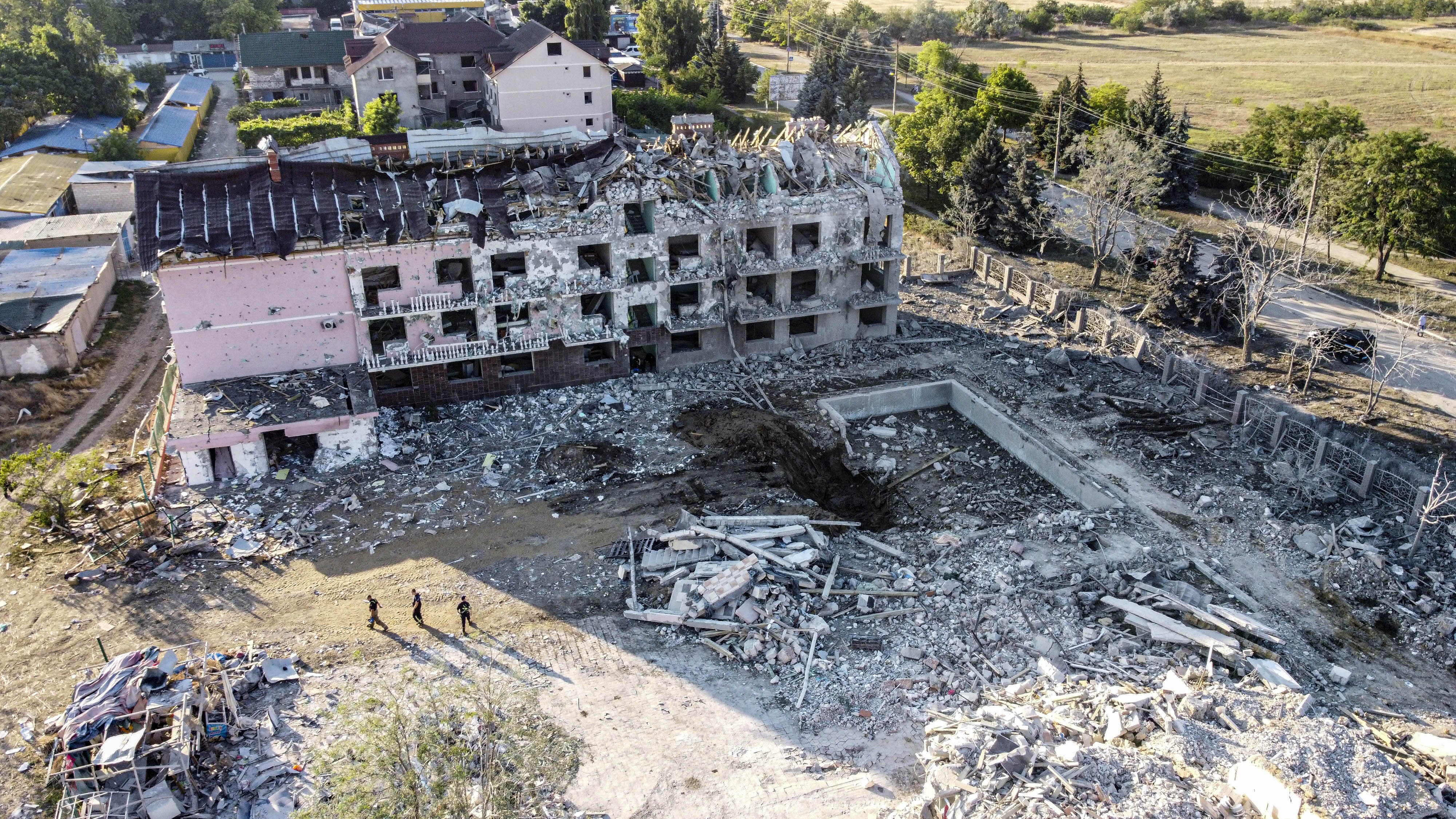
Kremlin’s response: Russian spokesperson Dmitry Peskov reiterated Russia’s false claim that it was not targeting residential areas: “The Russian military is trying to strike munitions depots, weapon repair factories, and troop training facilities.”
Chasiv Yar apartment complex. Donetsk region, July 9, 2022
Russian forces hit a residential area in Chasiv Yar with a BM-27 Uragan multiple rocket launcher, reducing two sections of a five-story apartment block to rubble. The attack killed 48 civilians, including one child, and injured 25 others.
Search and rescue operations lasted five days. 323 State Emergency Service employees removed over 500 tons of debris to search for survivors. Nine people were rescued from the rubble.
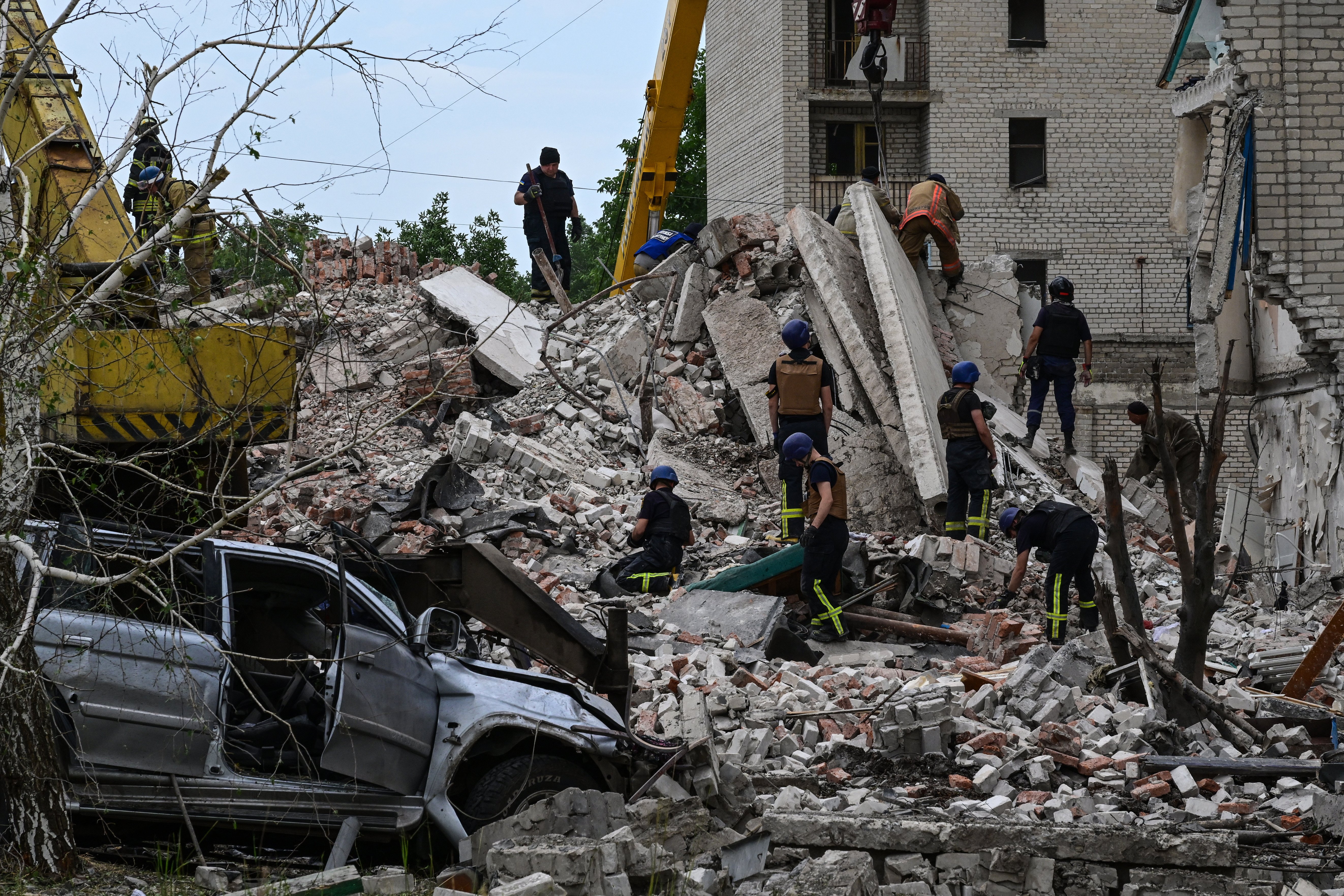
One resident of the town, Oleksandr, 31, speaking to The New York Times, pointed to a pile of rubble and said. “My grandmother was here. That’s her bed. I hope they will find her and I can give her a funeral.”
Kremlin’s response: The Russian Defense Ministry claimed that the strike killed “more than 300 nationalists,” in what, according to them, was an attack on a “deployment point of a Ukrainian Territorial Defense Brigade.”
Downtown area. Vinnytsia, July 14, 2022
Russian forces launched multiple Kalibr cruise missiles from the Black Sea, striking Vinnytsia—a major city in west-central Ukraine, far from the front line. The attack killed 28 civilians and damaged a medical clinic, office buildings, and nearby homes.
Three children were killed in the strike: four-year-old Liza on her way to a speech therapy appointment and two boys, aged 7 and 8—one during a medical examination, the other waiting for his uncle in a parked car which was caught in a fire trap.
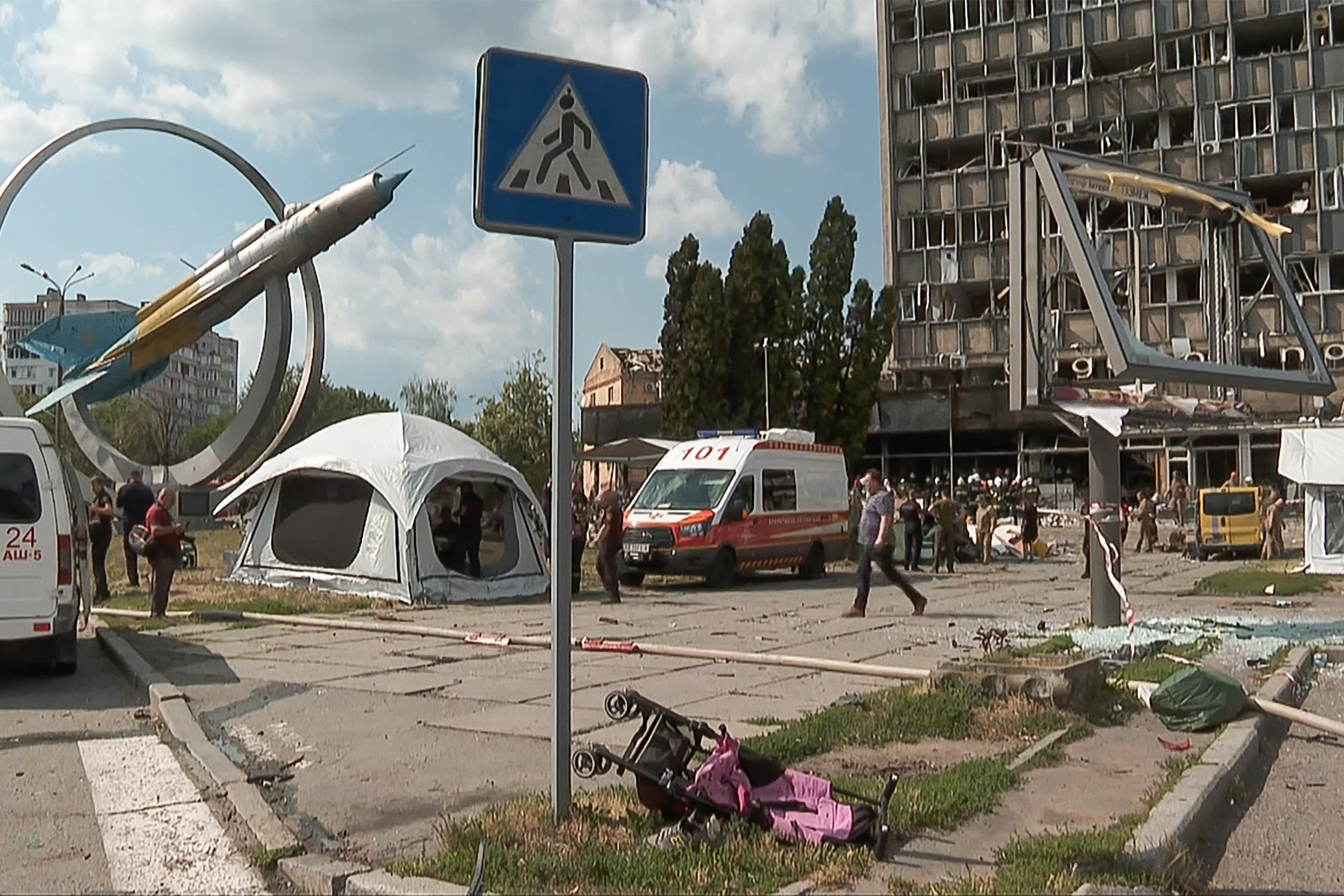
Approximately 200 people sought emergency assistance, and 80 were hospitalized. The State Emergency Service reported that 55 apartment buildings and private homes were damaged or destroyed. “These are quite high-precision missiles,” the regional governor told AP. “They knew where they were hitting.”
Kremlin’s response: In repeated denials of targeting civilian areas, a member of Russia’s permanent U.N. mission, in an address to the chamber, said “Russia only strikes at military targets in Ukraine. The strike on Vinnytsia targeted an officers’ residence, where preparations by Ukrainian armed forces were underway.”
I leaned on the stroller. My face was next to Liza’s. Then an explosion, the earth shook. I sat down near the stroller and started screaming. My phone rang in my bag. My mother called. I told her that Liza was killed by a rocket, and hung up.
Mother of 4-year-old Liza, who was killed in Russia’s attack on Vinnytsia
Civilian convoy, Zaporizhzhia region, September 30, 2022
Russian forces launched 16 missiles on the Zaporizhzhia region from an S‑300 surface-to-air system, four of which struck a convoy of civilian vehicles at a humanitarian aid checkpoint near the city of Zaporizhzhia. The attack killed thirty-two civilians, including two children, and injured around 90 more. The vehicles, packed with suitcases and blankets, had been assembling at a car market on the edge of the city, preparing to deliver supplies and pick up relatives from Russian-occupied territory.
Reuters revealed the aftermath of the strike: in a yellow car, the body of the driver was leaning over the passenger seat, the left hand still clutching the steering wheel. A green car held the bodies of a woman and a young man, covered with plastic sheets, with a dead cat on the rear seat. In a white mini-van, two more bodies lay still, next to a car with blown-out windows and sides pitted with shrapnel. The corpse of an elderly woman lay nearby, her shopping bag beside her.
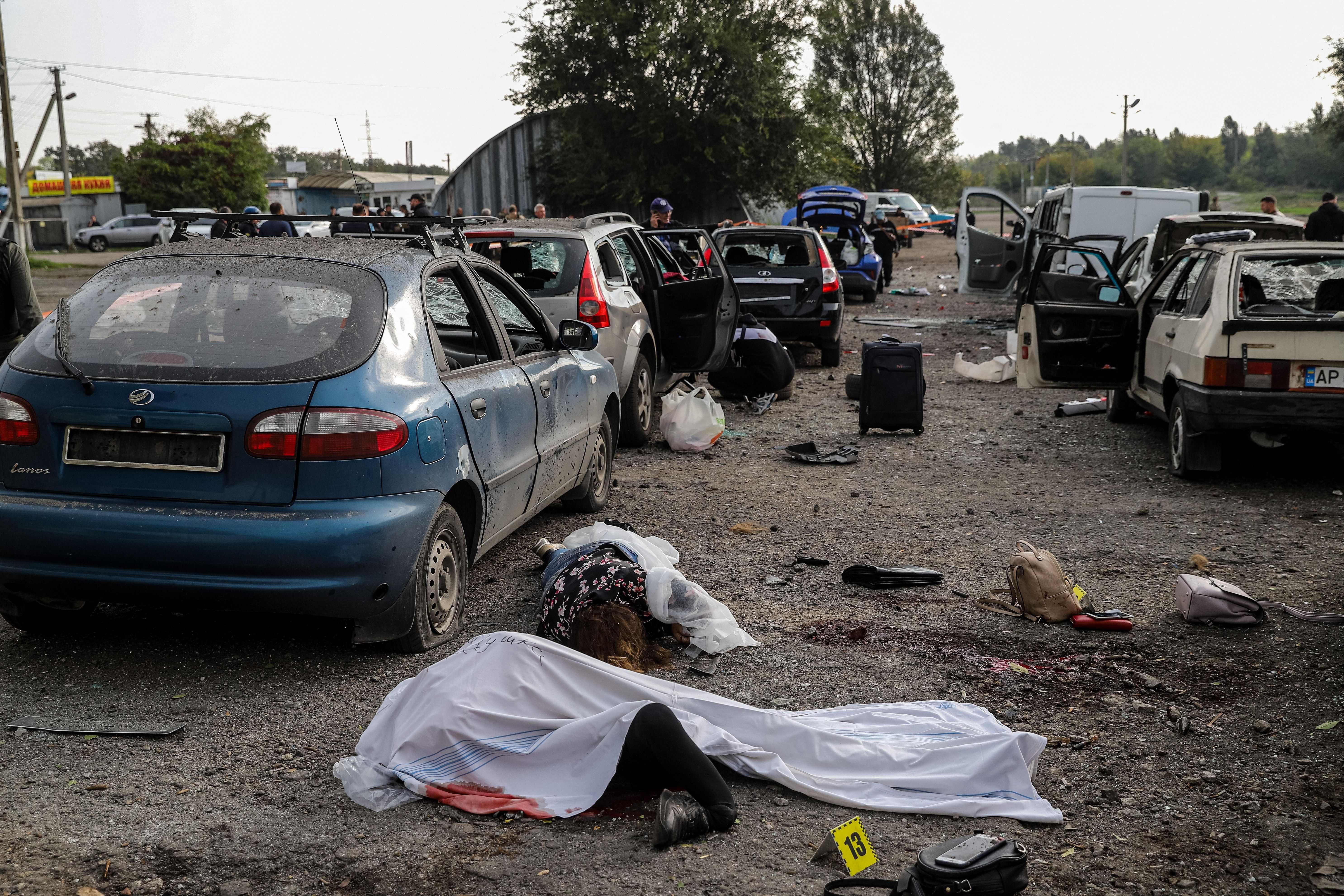
Local Police Colonel Sergey Ujryumov told Reuters that the Russian military "knows that columns are formed here to go to the occupied territories. They had the coordinates. It's not a coincidental strike. It's perfectly deliberate.”
Kremlin’s response: A Russian-installed official in the occupied Zaporizhzhia region blamed the strike on Ukrainian forces. Hours after the attack, Russian authorities held a concert on Moscow's Red Square to mark Putin’s proclamation of Russian rule over Zaporizhzhia and three other Ukrainian regions.
This horrendous attack is further proof of Russia’s utter disregard for civilian lives in Ukraine. People delivering humanitarian aid are not military targets. All those responsible for Russia’s repeated unlawful attacks in Ukraine must be held accountable for their actions.
Amnesty International’s Deputy Director for Eastern Europe and Central Asia
Apartment block. Dnipro, January 14, 2023
A Russian Kh-22 missile with a 950-kilogram warhead struck an apartment building in the southeastern city of Dnipro on a Saturday afternoon. The strike killed 46 people, among them six children—the youngest a boy less than one year old—and injured 80 others.
More than 300 apartments were damaged beyond repair, leaving more than 1000 people homeless. Emergency crews cleared 10 tons of rubble during a search-and-rescue operation that lasted 69 hours, the regional governor said.
For Vladyslav, the screams of those trapped in the aftermath of the strike are something he will never forget. Moments earlier, he had been standing by the door, waiting for his wife to get ready to go shopping. “If we had been outside, most likely we would have been buried under the rubble,” he told The Kyiv Independent.
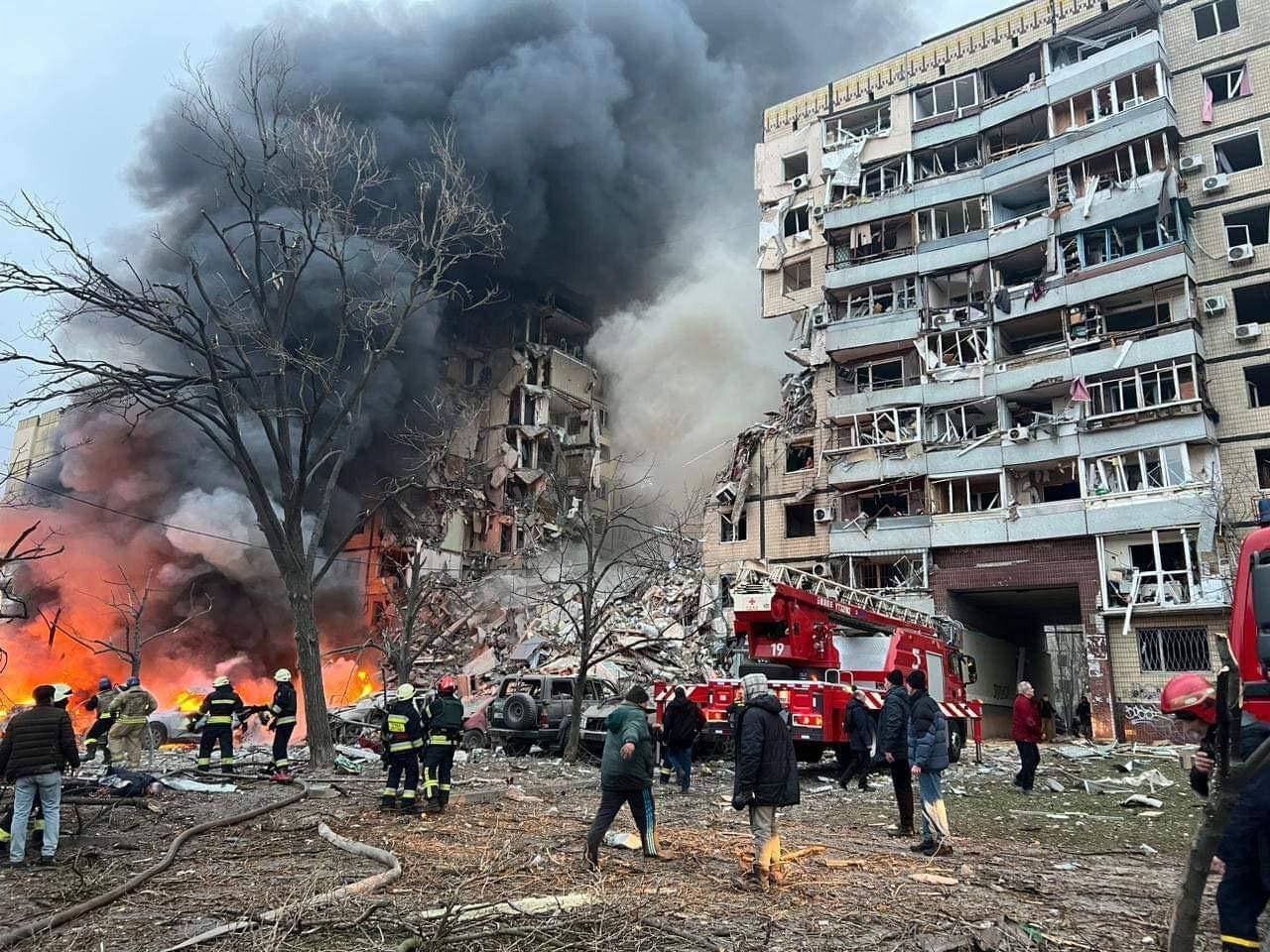
Kremlin response: Peskov blamed the destruction on a Ukrainian air-defense intercept. “Military targets—both evident and obscure—have been attacked," he claimed.
The UK Defense Intelligence flagged these false claims, saying that the missile was “launched from a Tu–22M3 bomber”—part of Russia’s arsenal.
Uman apartments. Cherkasy region, April 28, 2023
While people slept, Russian Tu-95 strategic bombers launched a barrage of long-range Kh-101/Kh-555 cruise missiles at Ukraine from the Caspian Sea region. Ukraine’s air defenses destroyed 21 of 23 of the missiles; however, one struck a high-rise residential building in the city of Uman, Cherkasy region, 200 kilometers south of Kyiv.
Search and rescue operations continued for more than a day in the aftermath of the attack, which killed 23 residents, including six children, and injured 19.
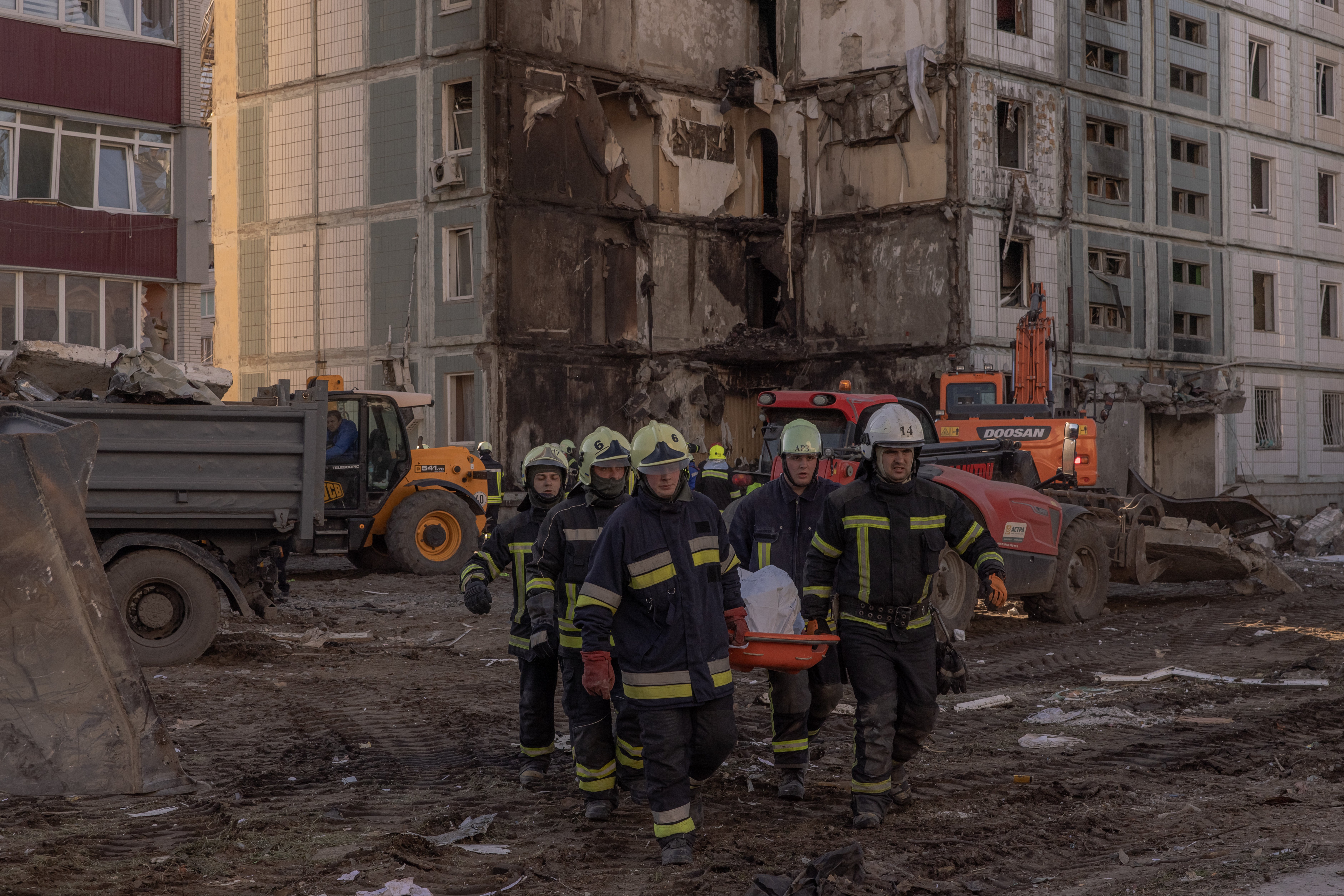
“My neighbours are gone,” said Serhii, 58, who survived in a flat on the seventh floor. Firefighters pulled him and his wife from the balcony after the explosion trapped them inside. “On the ninth floor—an elderly woman, her daughter, and two grandchildren. Gone. On the eighth—a man and his son. Gone. On my floor—a woman and her daughter. Gone. On the sixth—a young family. Their son was lucky… he’s alive.”
Kremlin’s response: Russian Defense Ministry spokesman Igor Konashenkov claimed that Russia carried out “a collective rocket strike using long-range high-precision weapons targeting temporary deployment sites of Ukrainian army reserve units," without providing any evidence. Earlier, the Ministry posted a photo on Telegram showing a missile launch with the caption, “Right on target.”
Hroza wake. Kharkiv region, October 5, 2023
A Russian Iskander ballistic missile struck Hroza in the Kharkiv region, obliterating a café and shop and killing 59 civilians—more than half of the village’s residents. Among the dead were 36 women, 22 men, and a young boy.
Whole families were wiped out while attending a wake for a local soldier, Andrii Kozyr, who had been killed fighting Russian troops earlier in the war. His widow and young son were among those killed in the strike.
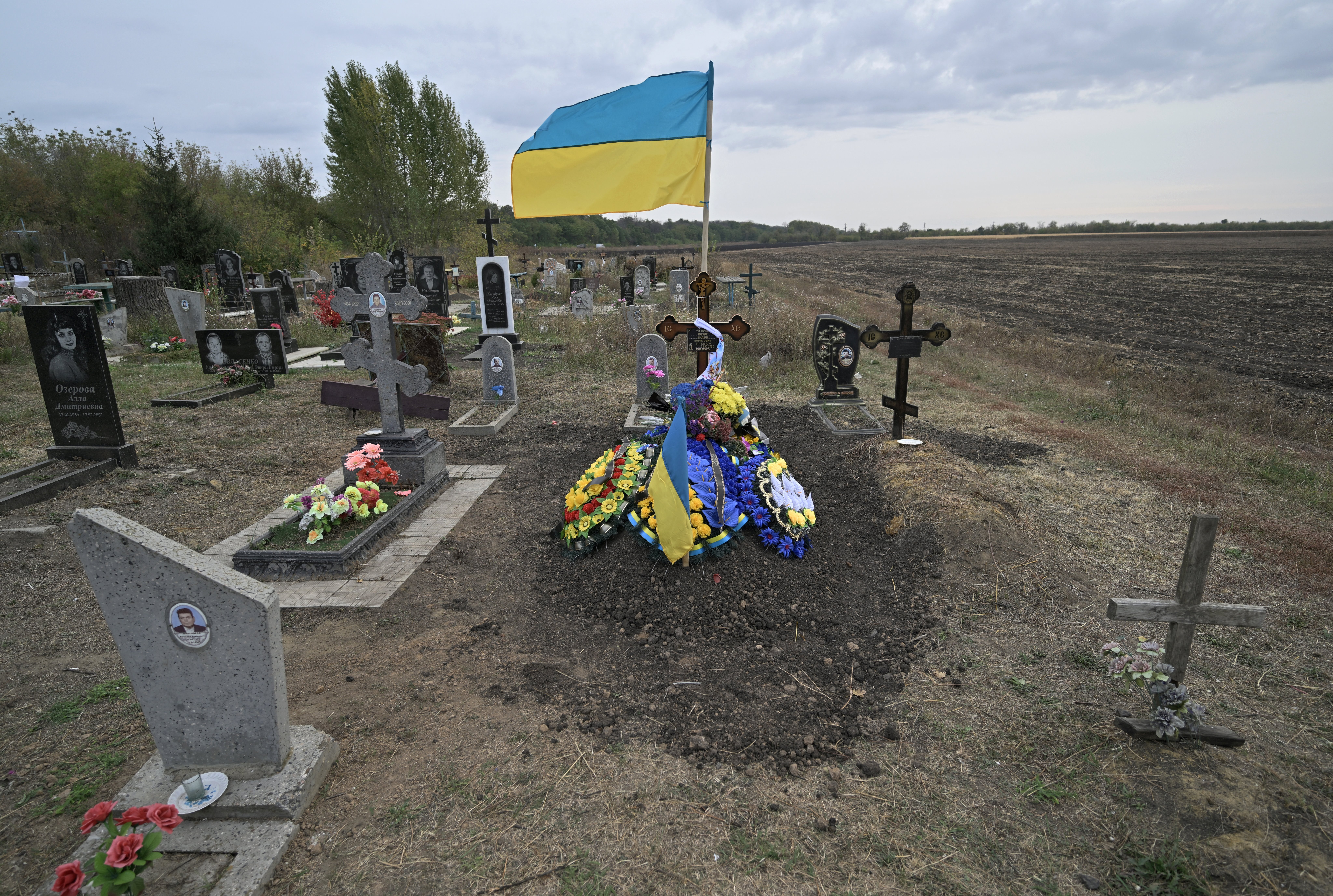
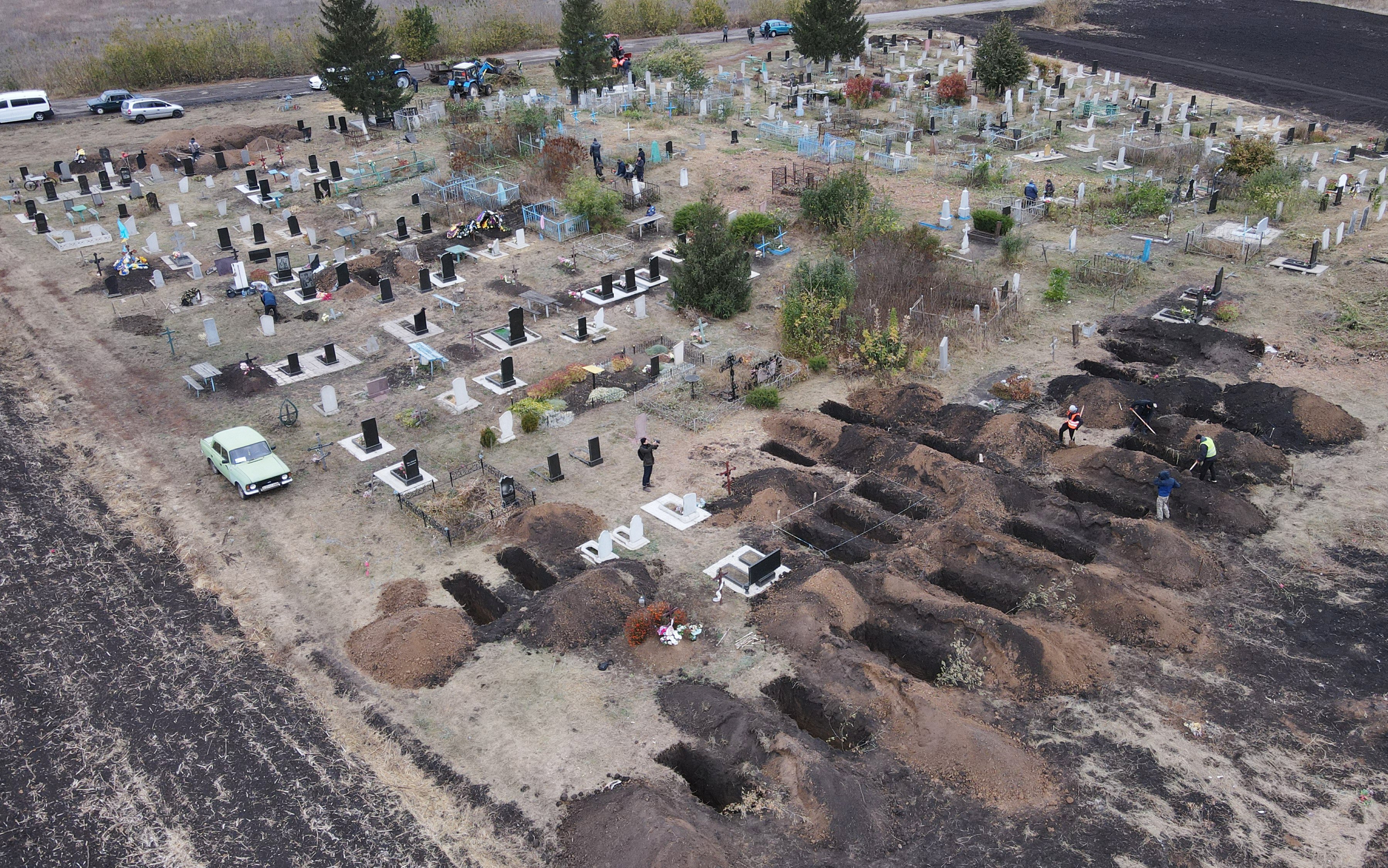
Many victims’ bodies were torn apart by the blast and found scattered across a nearby children’s playground. It took nearly a week to identify all of the dead. Valeriy, 61, from Hroza, said: "Half the village is gone, families are gone." Another local, Yevhen, 41, added: "We lost 18 people on one street, where our parents lived."
Kremlin’s response: Russia’s UN envoy told the Security Council the strike coincided with a funeral for a “high-ranking Ukrainian nationalist,” claiming “many Nazi collaborators” were present."
Double-tap on the residential area. Odesa, March 15, 2024
Russian troops launched Iskander-M ballistic missiles at the port city of Odesa. Emergency services rushed to the scene, but minutes later, Russian forces targeted the site again in a “double-tap” strike, hitting the rescuers. The attack injured at least 75 people, and one emergency worker later succumbed to injuries in the hospital, bringing the total number of people killed to 21.
The victims included a paramedic and a first responder who had arrived after the first blast, stated the regional governor Oleh Kiper. Former deputy mayor, Serhiy Tetyukhin, and police officers were also killed. The strikes destroyed a three-story recreational facility, damaged at least 10 private homes, and hit civilian infrastructure, leaving hundreds without gas and electricity.
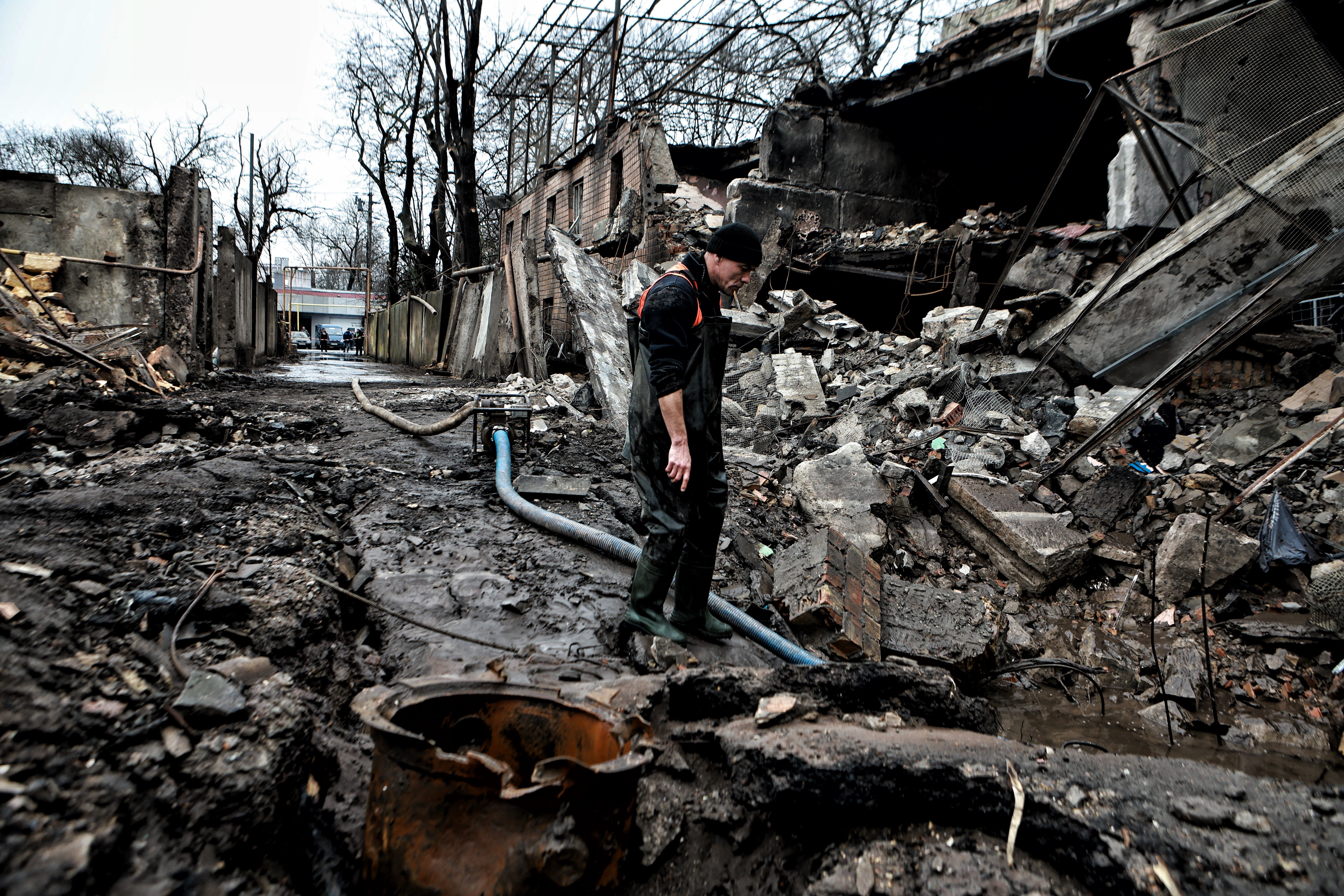
Kiper described the weapon as a “powerful missile that flies from the occupied Crimea in a few minutes.” A local Odesa outlet reported that the air raid siren sounded at 11:01, and the first explosion came at 11:03—giving residents only moments to take cover.
Kremlin’s response: Peskov again claimed that Russia targets energy, defense, command, and communications sites—“not residential or social infrastructure”—omitting Odesa reports of civilian deaths and destroyed homes and rescue vehicles on March 15.
Ohmatdyt hospital. Kyiv, July 8, 2024
Russian forces launched 38 cruise and ballistic missiles across Ukraine, in one of the deadliest attacks of the war. At least 44 civilians were killed, including 5 children, and 147 were injured. The strikes targeted residential buildings, medical facilities, and commercial factories nationwide.
In Kyiv, a cruise missile struck Ohmatdyt National Children’s Hospital, destroying its toxicology unit and damaging the pediatric cardiology center. Two adults, including a young doctor, were killed. Hundreds of children were evacuated. Ten were injured; three heart surgeries underway during the strike were contaminated by debris, and one critically ill child evacuated from intensive care later died at another hospital. “Among the victims were Ukraine’s sickest children,” said UN rights chief Volker Türk.
⚡️ People clear the rubble after a Russian attack on a children's hospital in Kyiv. pic.twitter.com/jxhF0rvYPb
— UNITED24 Media (@United24media) July 8, 2024
Hours later, another air-raid siren forced patients and staff back into shelters. Medics carried patients on gurneys while mothers cradled their bandaged sons and daughters. “My child is terrified,” said Marina, whose 4-year-old son had spinal surgery. “This shouldn’t be happening; it’s a children’s hospital.”
Kremlin’s response: Russia’s Defense Ministry said “strike objectives were achieved,” and dismissed Kyiv’s claims as “completely untrue” and “hysterics” to secure Western funding.
Russia’s UN envoy added that if it had been a Russian strike, the building would be obliterated and “all the children and most of the adults” would be dead, not wounded. Meanwhile, investigators from Ukraine’s Security Service recovered fragments of a Russian Kh-101 missile, including a serial number, from the hospital blast site.
Children’s playground. Kryvyi Rih, April 4, 2025
As children played on swings in the park, a Russian Iskander-M ballistic missile armed with a cluster munition warhead detonated mid-air above a residential neighborhood in Kryvyi Rih, scattering shrapnel across the playground and nearby buildings. The explosion killed 20 people—including nine children—and injured 75 others, the youngest just three months old. The UN Human Rights Monitoring Mission confirmed it as the deadliest single attack on Ukrainian children since the start of the full-scale invasion.
The weapon was designed to maximize casualties, said Oleksandr Vilkul, head of the Kryvyi Rih Military Administration. AP News described bodies strewn across the grass, while Reuters reported emergency workers laboring through the night with flashlights among the wreckage. The blast damaged 44 apartment buildings, 23 houses, 26 business facilities, and eight educational and cultural institutions.
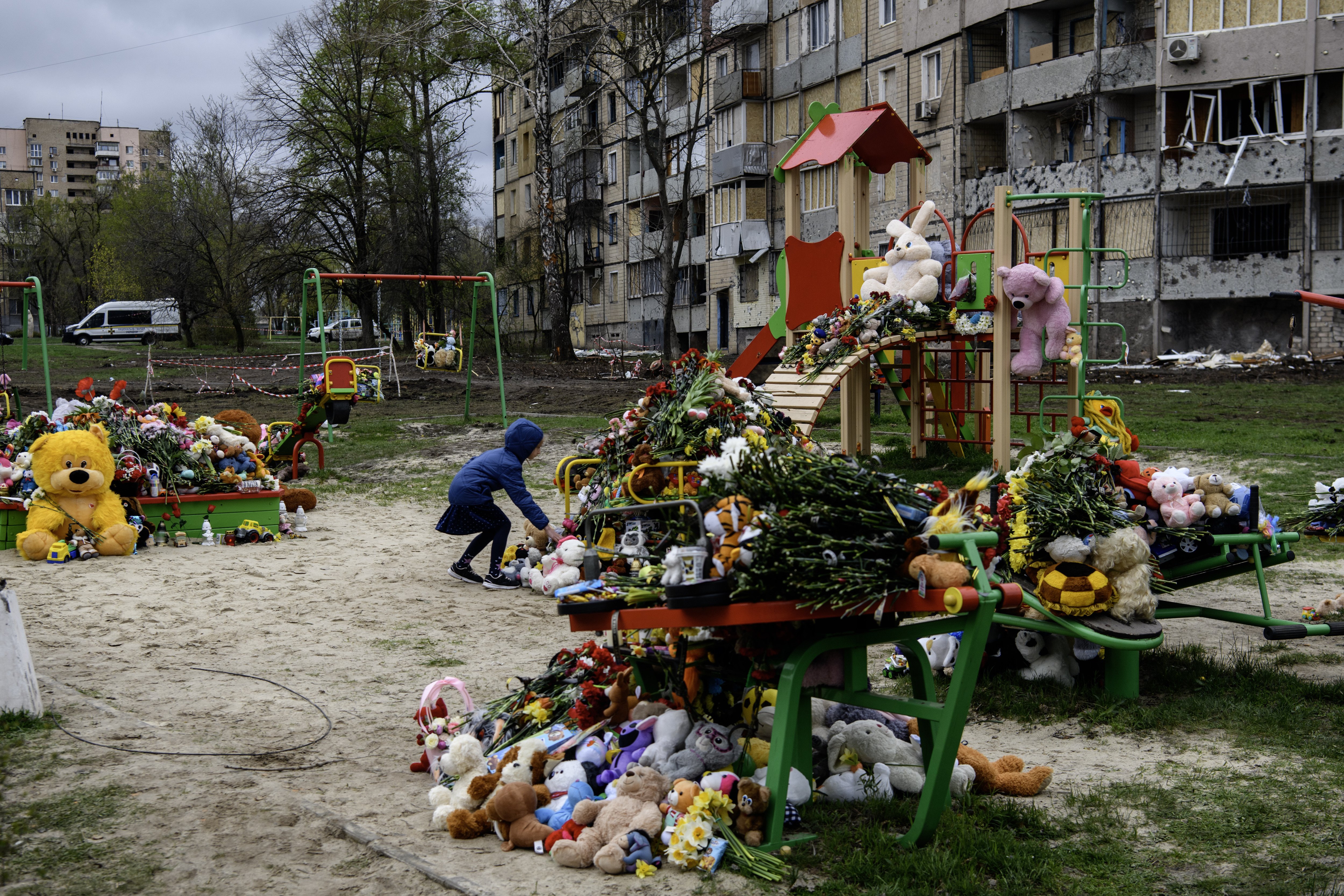
Primary school teacher Iryna mourned her two 7-year-old pupils killed in the strike. Radyslav, she said, was a proud campaigner and “wanted to help” collect food for stray animals. The desks of both children, she added, would now be “empty forever.” Another teacher, Nataliia, remembered 15-year-old Danylo as “a spark” who helped organize school trips. He died alongside his girlfriend, Alina, also 15. “They were holding hands,” said Danylo’s father.
Hours after the missile strike, a Russian drones attacked Kryvyi Rih again, setting a house ablaze, killing a 56-year-old woman inside and injuring five other civilians, said Vilkul.
A spring evening. Some people are coming home from work. Others are cooking dinner. Children are playing outside. At that moment, [Russian forces] strike the center of the neighborhood with a missile, right next to a children's playground. We saw real hell: dead civilians, children.
First Deputy Chief of Ukraine’s Patrol Police Department
Kremlin’s response: Russia's Defense Ministry claimed a "high-precision strike" had targeted "a meeting of unit commanders and Western instructors" in a restaurant.
Palm Sunday. Sumy, April 13, 2025
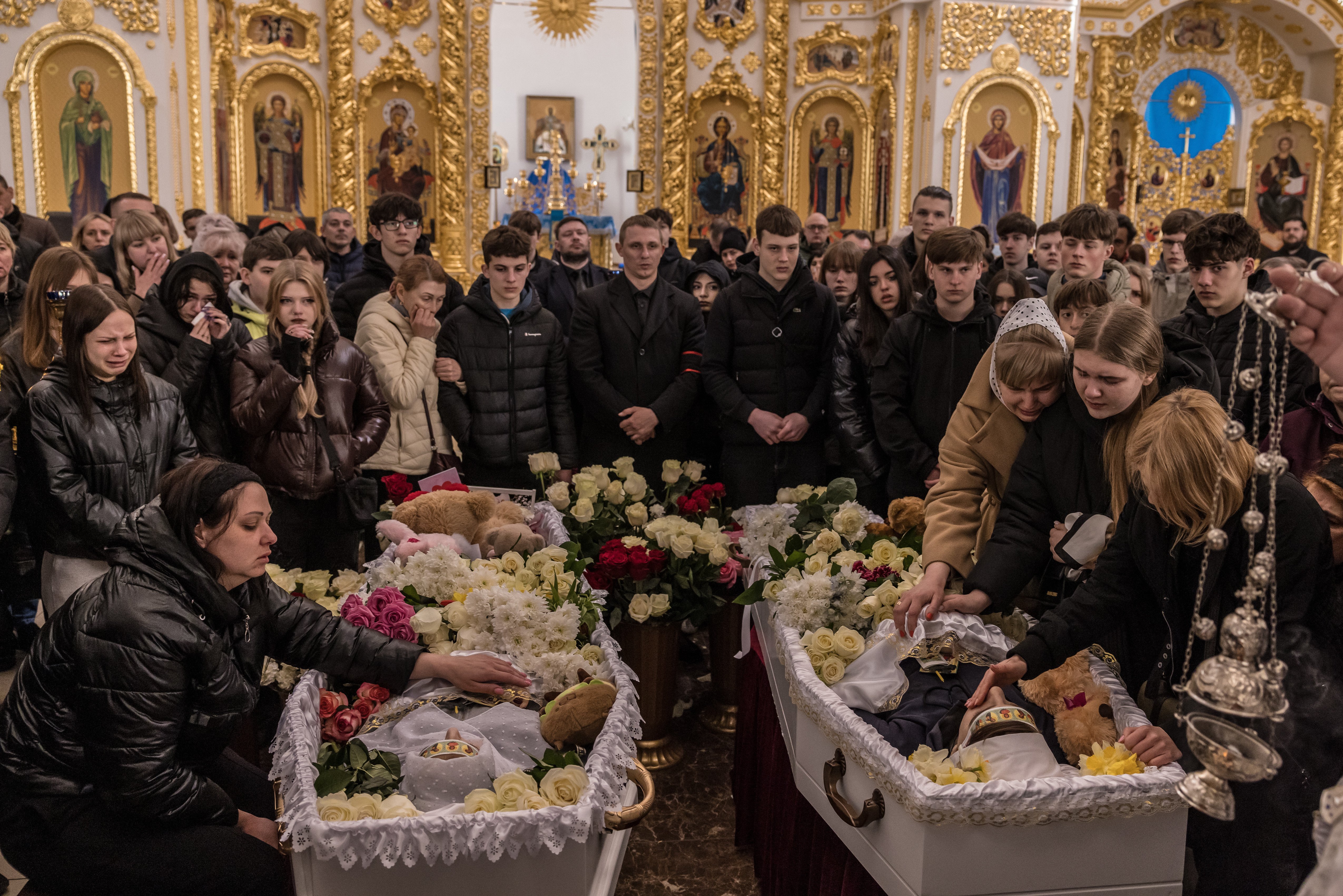
While people were on their way to church on Palm Sunday morning, two Russian Iskander-M ballistic missiles struck the crowded city center of Sumy, a city located only 25 km from the Russian border. The strike killed 35 people, including two children, and injured 129—among them 17 children.
Footage showed burning vehicles, rescuers carrying bloodied survivors, and black body bags lined up by the road, while other victims lay wrapped in foil blankets amid the wreckage. In total, 51 buildings, 34 cars, and a city bus were damaged. Ukraine said Russia used a cluster munition missile to kill as many civilians as possible, calling it a “deliberate shelling of civilians.”
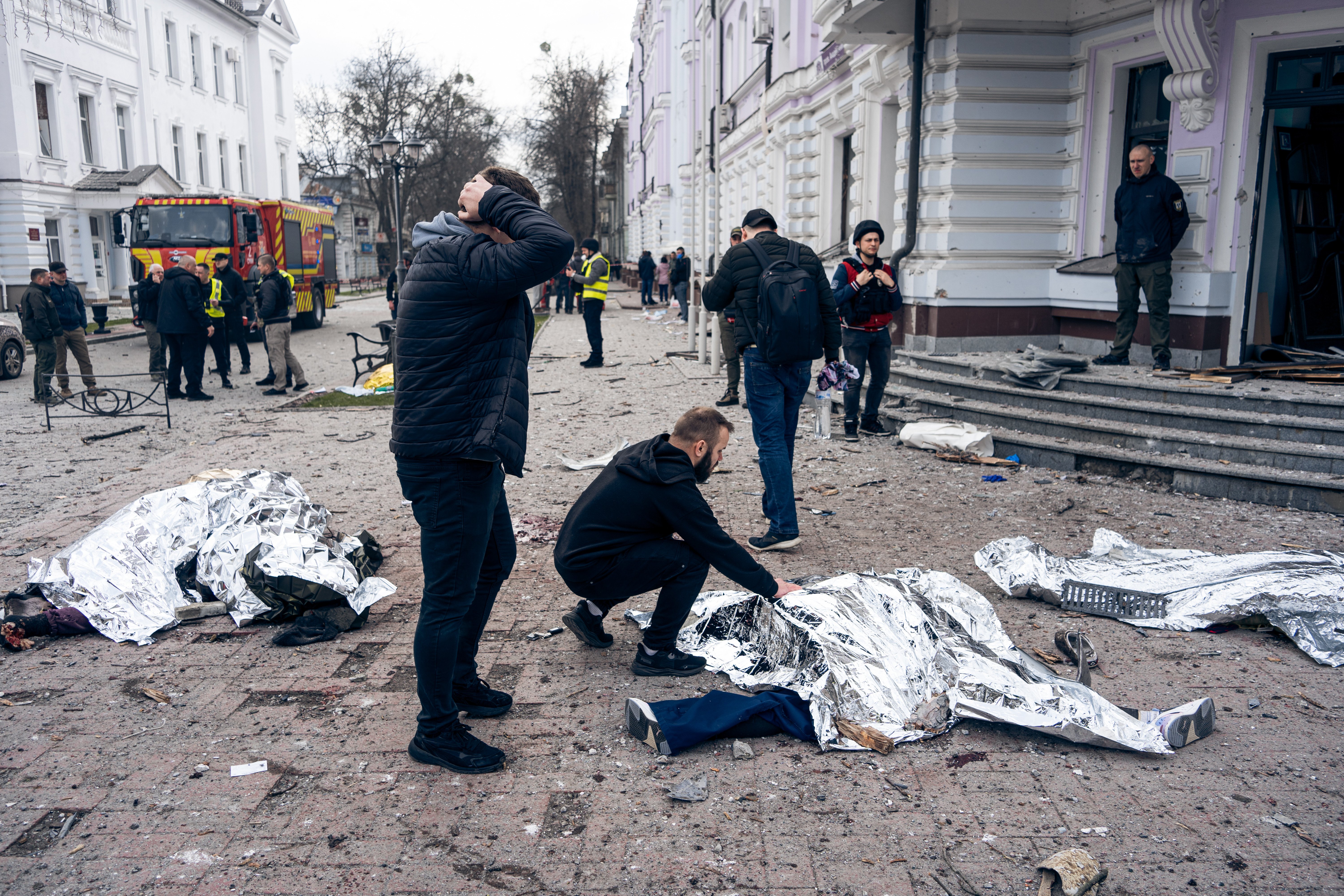
Most of the victims were passengers and the driver of bus No. 62. “This is a bus of death—unfortunately, there were many people, including children,” said the Sumy Regional Military Administration.
Among the survivors was 13-year-old Kyrylo, who crawled out a window, forced the bus door open with his bare hands, and pulled others to safety. He helped rescue his mother, Maryna, whose face and white coat were drenched in blood, The Washington Post reported.
Kremlin’s response: The Russian Defense Ministry claimed they struck a meeting of command staff with two Iskander-M missiles, in which: “more than 60 servicemen of the Ukrainian Armed Forces were destroyed”. The statement accused the Kyiv government of using the Ukrainian population as a human shield, placing military facilities in the center of a densely populated city.
A week after the attack, Putin confirmed that the Russian military intentionally targeted a civilian building and called the strike “retribution” for alleged Ukrainian actions.
Apartment block. Kyiv, June 16-17, 2025
In a nine-hour overnight strike that began at 8 pm on June 16, Russian forces launched 32 missiles and 440 UAVs across Ukraine, primarily targeting Kyiv. The attack killed 30 people and injured 172, many when a Russian missile hit a nine-story residential building, obliterating one section.
More than 400 workers took part in search-and-rescue operations lasting over 39 hours in 27 sites across the capital, Interior Minister Ihor Klymenko said. Twenty-three bodies were recovered, while two people were pulled alive from the rubble, and 50 others were freed after being trapped in their apartments or building entrances.
🔴 UNITED24 Media correspondent @MacalpineAudrey reports from the site of the Russian attack on Kyiv tonight. pic.twitter.com/Bovwo8DbtZ
— UNITED24 Media (@United24media) June 17, 2025
The Ukrainian Air Force intercepted 428 of the 472 aerial threats, some carrying cluster munitions later found in the wreckage, said Kyiv Mayor Vitali Klitschko. He called their use “evidence of the genocide that Russia is committing against Ukrainians” and declared June 18 a day of mourning in the capital.
"I saw the missile because it was low," Olena, who lives in a neighboring building, told the Kyiv Independent. "I grabbed my daughter by the hand and shouted 'run!' It was literally 15 seconds. We ran to the toilet, and then there was a very powerful explosion."
Kremlin’s response: At a June 19 press conference, Putin denied that the strike was aimed at residential areas. He insisted Russia “does not target residential areas” and claimed the missiles were aimed at the “defense‑industrial complex facilities.”
Zaporizhzhia penal colony and Kyiv residential. July 2025
Overnight on July 28–29, Russian forces dropped four guided aerial bombs on a penal colony in the Zaporizhzhia region, killing 16 inmates and injuring around 50 other civilians.
"People were screaming," recalled Yaroslav, 54. "Some dead, some alive, some without legs—half of them burned." That same day, a separate Russian rocket struck a hospital in the Dnipropetrovsk region, damaging the maternity ward and killing three people, including a 23-year-old pregnant woman named Diana.

Two days later, Russia launched eight missiles and 300 drones across Ukraine. In Kyiv, 32 people were killed, including five children, the youngest just two years old. Most of the fatalities occurred when a residential high-rise partially collapsed after being struck by a Russian cruise missile. Medics pulled a man from under the rubble as rescuers painstakingly dismantled structures “centimeter by centimeter,” said the interior minister.
Among the dead were an entire family—a man, a woman, and a child—and, on the sixth floor of one building, a mother with her two children. The attack left at least 179 people injured, including 12 children.
Kremlin’s response: Peskov denied that Russia had targeted civilians in the Zaporizhzhia penal colony, claiming: “Strikes are carried out on military and near-military infrastructure.” At the UN Security Council, Russia’s envoy blamed the civilian deaths in Kyiv on “the criminal placement” of Ukrainian air defenses in populated areas.
A pattern too clear to ignore
Russia’s strikes on civilians are not isolated mistakes but part of a sustained pattern. UN investigations, satellite imagery, recovered weapon fragments, and eyewitness testimony show that homes, hospitals, schools, convoys, and places of refuge have been deliberately struck again and again. Even Russia’s own admissions—such as Putin framing the Sumy attack as “retribution”—leave little doubt that these are not accidents of war.
The toll is staggering, and it keeps climbing. In July 2025 alone, more civilians were killed in Ukraine than in any month for the last three years. As the UN’s Danielle Bell put it: “Whether you are in a hospital or a prison, at home or at work, close to or far away from the frontline—if you are in Ukraine today, you are at risk of getting killed or injured by the war. The risk is higher than last year, and it is rising.”
The evidence of systematic attacks on civilians is overwhelming and grows by the day. Ukraine’s people—killed while waiting in line for bread, playing in the park, or riding the bus—know that such crimes against innocents cannot go unpunished.
On the same day as the Trump-Putin Alaska summit, President Zelenskyy said it was vital that the world open a path towards a just peace. The question shouted to Putin in Anchorage—“Will you stop killing civilians?”—is answered in the evidence laid out here: Russia’s invasion has been waged against civilians, and Ukraine’s fight against its war machine endures.
Discuss this article:





-72b63a4e0c8c475ad81fe3eed3f63729.jpeg "Photo of Cyril Barabaltchouk")